 NIMB EDU
The best course after 12th is the one your Class 12 subjects allow, your family can fund and you can imagine doing for years. Science opens engineering and medicine, commerce opens accounting, finance and management, and arts opens law, media, teaching and the civil services, while several routes are open to every stream.
Most “courses after 12th” pages give a long list and leave the choice to you. This guide is the starting point for a decision. It shows what each stream opens, which entrance exam guards each door, what the official bodies say about eligibility, and where to go next for the stream you studied. Everything below was checked against official sources on 17 October 2026. If you are earlier in school, start with courses after 10th or which stream to take after 10th.
Which course should you take after 12th?
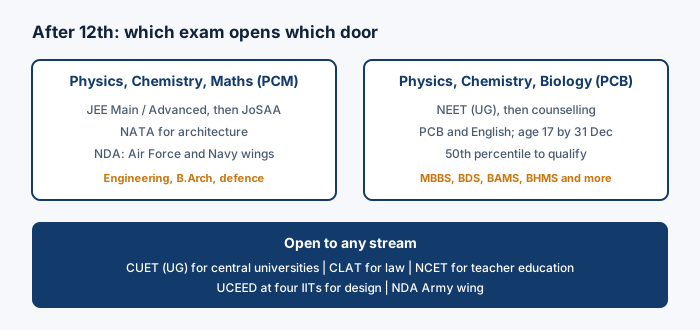
Start with your stream, pick the two or three routes that interest you, and then compare them on entry exam, years of study and first job. The map below shows how the main exams relate to the main streams.
| Your stream | Main routes | Go deeper |
|---|---|---|
| Science (PCM) | Engineering, architecture, B.Sc, NDA (Air Force and Navy), pilot training, plus every any-stream route | Courses after 12th science |
| Science (PCB) | MBBS, BDS, AYUSH degrees, nursing, pharmacy, B.Sc | Courses after 12th science |
| Commerce | B.Com, BBA, CA, CS, CMA, diplomas, finance and accounting careers | Courses after 12th commerce |
| Arts / humanities | BA, law, media, teaching, design, government exams | Courses after 12th arts |
What does each stream open?
Each stream opens a core set of routes, and a shared set stays open to everyone. Knowing the shared set matters most for students who think their stream has closed their options.
Routes tied to your subjects
- Engineering and architecture need Mathematics. NATA’s 2026 brochure requires Physics and Mathematics as compulsory subjects with at least 45% aggregate (NATA 2026 brochure).
- Medicine and AYUSH degrees need Physics, Chemistry and Biology or Biotechnology with English, and NEET (UG) sets the 50th percentile for the general category (NTA, NEET (UG) 2026 bulletin).
- Pharmacy asks for Physics and Chemistry plus Mathematics or Biology, so both PCM and PCB students can apply (Pharmacy Council of India B.Pharm syllabus).
- Commercial pilot training requires Physics and Mathematics at 10+2, per the DGCA examination portal.
Routes open to every stream
- Law: CLAT asks for 10+2 with 45% marks (40% for SC, ST and PwD), whatever the stream (Consortium of NLUs).
- Central and other participating universities: CUET (UG) 2026 offered 37 tests: 13 languages, 23 domain subjects and a General Aptitude Test. A science, commerce or arts student can build a test combination for a BA, B.Com or B.Sc (NTA CUET (UG) syllabus).
- Teaching: the four-year Integrated Teacher Education Programme gives B.A. B.Ed., B.Sc. B.Ed. and B.Com. B.Ed. degrees, and admission is through NCET (PIB).
- Defence: the NDA Army wing asks only for a 12th pass, while the Air Force and Navy wings need Physics, Chemistry and Mathematics (UPSC notice).
- Design: for UCEED 2027, students from any stream can apply to IIT Bombay, IIT Delhi, IIT Hyderabad and IIT Indore, while three other institutes ask for PCM (UCEED).
The takeaway is that “I took the wrong stream” is rarely true. A few routes are closed, a larger number are open, and the sub-hubs list both.
Which entrance exams should you know about?
Four exam systems account for most of the routes above. Learn the one that matches your target first.
| Exam | Opens | Verified fact for the current cycle |
|---|---|---|
| JEE Main / Advanced, then JoSAA | IITs, NITs, IIITs and other centrally funded technical institutes | JoSAA 2026-27 covers 138 institutes (JoSAA); IITs need 75% (65% SC, ST, PwD) or the top 20 percentile of the board (JEE Advanced) |
| NEET (UG) | MBBS, BDS, BAMS, BUMS, BSMS, BHMS | Age 17 by 31 December, no upper age limit; applications ran 8 Feb to 8 Mar 2026 (NTA NEET portal) |
| CUET (UG) | Undergraduate programmes at central and other participating universities | 37 tests in 2026; each university sets its subject combinations |
| CLAT | Five-year integrated law at National Law Universities | 45% (40% SC, ST, PwD) in 10+2; no upper age limit for CLAT 2027 |
Follow the exact dates on the official NTA sites for NEET and CUET. Applications for the next cycle usually open early in the calendar year, so start preparing in Class 12, not after the results.
What types of course can you join after 12th?
Every option falls into one of five types, and the type decides the length, the entry route and the kind of job it leads to. Pick the type first, then the subject.
| Type | What it is | Where to read more |
|---|---|---|
| Degree (general or honours) | BA, B.Com, B.Sc, BBA and similar; three or four years under UGC’s undergraduate framework | Courses after graduation shows what comes next |
| Professional degree | Engineering, medicine, nursing, pharmacy, law, architecture, with a regulator and usually an entrance exam | Engineering, medical and paramedical courses after 12th |
| Professional qualification | CA, CS, CMA and ACCA, which run alongside or instead of a degree | CA course guide |
| Diploma or certificate | Shorter, skill-focused programmes, awarded by universities, boards or training bodies | Diploma courses after 12th commerce, linked above |
| Government and defence entry | Recruitment exams that accept a 12th pass, such as NDA and SSC CHSL | Government jobs after 12th |
How long is a degree after 12th, and can you leave early?
Under UGC’s Curriculum and Credit Framework for Undergraduate Programmes, a bachelor’s degree runs three years (120 credits) or four years with honours (160 credits). The framework lets a student exit with a UG certificate after one year (40 credits) or a UG diploma after two years (80 credits). Each needs an added 4-credit vocational course. A student can re-enter within three years. The whole degree must be finished within seven years (UGC framework).
The honours-with-research route asks for 75% or more in the first six semesters. A university decides whether and when it adopts the framework, so ask the specific college which structure it follows and whether the exit awards are offered before you enrol.
What should you do between your results and the first day of college?
Work through the steps in order, because the early ones decide whether the later ones are possible.
- Shortlist two or three routes from the stream table above and note the exam each needs.
- Check eligibility in the current bulletin: subjects, minimum marks and age limits.
- Register for the exam portal of NTA (NEET, CUET) or the exam body (CLAT, UCEED) and note the dates for the cycle.
- Apply to colleges in parallel. University and state portals have their own forms and last dates, which differ from the national exams.
- Verify the college on UGC or AICTE using the checklist below.
- Apply for scholarships before you pay the first instalment, not after.
- Keep a fallback. Hold one broad degree option open until your first-choice seat is confirmed.
Is an online degree after 12th valid?
It can be, but only for a programme the regulator has approved. UGC’s Distance Education Bureau publishes separate lists of recognised and entitled institutions for open and distance learning and for online programmes. It also links a UGC document on the equivalence of degrees from distance and conventional modes (UGC-DEB). Check the institution and the specific programme on that list, and confirm the year, since entitlement is reviewed. Fields with their own councils, such as medicine, nursing and engineering, need that council’s approval, so check it before you enrol in any online route.
How can you pay for it?
Start with government scholarships. The National Scholarship Portal issues a one-time registration (OTR) number, generated using Aadhaar, so a student does not have to register again each academic year. A student may apply for one merit-based scheme and one or more welfare-based schemes. At the time of checking, its home page listed the Central Sector Scheme of Scholarship for College and University Students open for renewal for 2026-27. Eligibility, income limits and dates differ by scheme and year, so read the scheme notice. Never pay an agent for a promised seat or scholarship.
What mistakes do students make after 12th?
- Choosing by a friend’s choice or a salary headline. Salary pages rarely say who the figure applies to or in which year.
- Reading last year’s bulletin. Percentage limits, age rules and tests change between cycles.
- Paying a deposit before checking recognition. A refund is hard to get if the course turns out not to be approved.
- Confusing a diploma with a degree. A diploma may be shorter, but it may not meet the eligibility rule for a later exam or postgraduate course.
- Having no fallback. One missed cut-off should not cost a year.
How do you choose between two good options?
Compare them on five points, in this order: entry route, years of study, total cost, what the first job looks like and how reversible the choice is. The five-step guide to choosing the best course after 12th walks through the method with a worked example, and the commerce version does the same for commerce students.
If pay is the deciding factor, read high salary courses after 12th science and high salary courses after 12th commerce, which show what can and cannot be verified. A quick rule helps with reversibility. A broad degree, such as a B.Sc, B.Com or BA, keeps options open, while a long professional degree commits you early. Neither is better; the point is to choose knowingly.
What if you want a job-ready skill alongside a degree?
Add a skill that employers can check, and add it in the first or second year. For accounting and finance, diploma courses after 12th commerce explains the three kinds of diploma and who awards each. Students from science or arts backgrounds should read courses after 12th without commerce, since accounting needs no commerce background. NIMB offers practical online courses in TallyPrime, GST and basic computing, which fit alongside a degree rather than replace one.
How do you check a college before you pay?
Look the college and university up on the official regulators before you pay a deposit.
- The university: check it on the UGC website.
- Technical programmes: check the institution on the AICTE website.
- Medical and nursing seats: use the official counselling process. The NEET bulletin lists the counselling bodies for each course.
- Fees: ask for the full fee schedule in writing, including hostel and exam fees.
- Placement claims: ask for the year, the median and the share of students placed.
Guides by stream and topic
Use the guides below to move from the overview to a decision. Each one is written to stand alone and links back here.
All guides in Courses After 12th

Accounting Courses Without a Commerce Background: What Works
You can move into accounting from a science or arts background. Which courses accept non-commerce students, what is genu…

Courses After 12th Without Commerce: Your Routes Into Accounting
No commerce background needed. Accounting diplomas accept you; here's what to learn from scratch, the real extra time, a…

Diploma Courses After 12th Commerce: Options, Duration and Who Awards Them
Diploma courses after 12th commerce, sorted by who awards them and the job each leads to, plus what a diploma cannot rep…

After 12th, Which Course Is Best? A Five-Step Way to Choose
Choose a course after 12th in five steps: stream, interests, limits, entry route and a shortlist test, plus entrance rou…

Courses After 12th Arts: Routes, Exams and Government Jobs
Courses after 12th arts: BA, law, media, design, teaching and government jobs, with the entrance exam and eligibility fo…

Courses After 12th Science: Routes, Exams and Eligibility
Courses after 12th science for PCM, PCB and PCMB: engineering, MBBS, agriculture, B.Arch, B.Sc, law and more, with exam,…

High Salary Courses After 12th Science: What Can Be Verified
High salary courses after 12th science, without made-up figures: what is verified, years to first pay, and five question…

After 12th Commerce, Which Course Is Best? A Decision Guide
No course is best for everyone. Match your goals, maths comfort, money and scores to the right route after 12th commerce…

Courses After 12th Commerce With High Salary: What the Evidence Shows
Only CA has a counted, dated placement result among commerce routes. See what is measured, what is only an estimate, and…

Engineering Courses After 12th: Eligibility, Exams and Branches
Engineering courses after 12th: AICTE subject and 45% rule, JEE and JoSAA 2026 marks rules, lateral entry and how to pic…

Medical Courses After 12th: Which Need NEET and Which Don’t
Medical courses after 12th: MBBS, BDS, AYUSH, nursing and pharmacy, with the NEET rule, subjects, length and regulator f…

Courses After 12th Commerce: Every Option Compared
Compare 20 courses after 12th commerce on entry rules and length, plus CUET subjects, scholarships and loans, all checke…
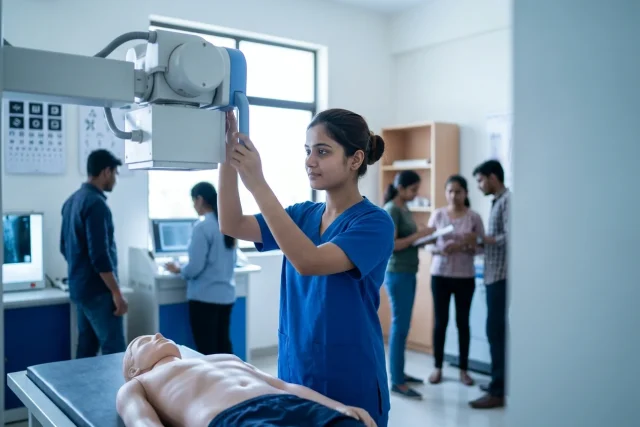
Paramedical Courses After 12th: Eligibility, PCB and NCAHP Rules
Paramedical courses after 12th: which need PCB, which do not, NEET status after the 2026 NCAHP changes, diploma rules an…

B.Tech AI vs B.Sc AI vs BCA AI: Which AI Degree After 12th?
B.Tech in AI, B.Sc AI or BCA with AI after 12th? Eligibility, entrance routes, approvals, the IIT Madras online option a…
Frequently asked questions
Which is the best course after 12th?
There is no single best course. The best choice is the one your subjects allow, your budget supports and you will stay with. Use the decision guide to compare options.
Which course can I do after 12th in any stream?
Law through CLAT, undergraduate degrees through CUET (UG) at participating universities, the integrated teacher education programme, the NDA Army wing and design at four IITs are open to every stream. Check each exam’s current bulletin.
Can I change my stream after 12th?
For many degrees, yes. A BA, B.Com or B.Sc may ask only for a Class 12 pass or specific CUET tests, so your Class 12 stream may not matter. For engineering and medicine, the subject requirement is firm.
Which courses after 12th do not need an entrance exam?
Some universities admit on Class 12 marks, and skill courses and diplomas often do not use an exam. Read the college’s admission notice, and check the college’s recognition before applying.
Which courses give jobs quickly after 12th?
Short skill courses, such as accounting software or computing, can lead to entry-level work in months, but they do not replace a degree where one is required. Government clerical jobs through the SSC CHSL ask for a 12th pass, though some posts require Science with Mathematics.
What is the minimum percentage needed after 12th?
It depends on the course. IITs need 75% (65% for SC, ST and PwD) or a top-20-percentile place; CLAT needs 45% (40% for SC, ST and PwD); NATA needs 45% aggregate. Always read the current bulletin.
How many years is a degree after 12th?
Three years for a general bachelor’s degree and four years for honours under UGC’s undergraduate framework. Professional degrees such as engineering and medicine follow their own regulators, so check their pages.
Is an online degree after 12th valid?
Only if the institution and the programme are on the UGC-DEB lists for the year you enrol. Fields with their own councils, such as medicine, nursing and engineering, need that council’s approval, so check it first.
When do admissions open after 12th?
National exams such as NEET (UG) opened applications from 8 February to 8 March in 2026, well before the board results. College and university forms follow their own schedule, so watch each official portal.
Can I get a scholarship after 12th?
Yes. Apply through the National Scholarship Portal, which hosts central and other schemes, and read each scheme’s eligibility and last date.
Can I leave a degree after one or two years?
Where the university has adopted UGC’s framework, you can exit with a UG certificate after one year or a UG diploma after two, and re-enter within three years. Ask the college first.
Which stream is best after 10th?
See which stream to take after 10th, which covers the decision before Class 11.
Still deciding?
If your shortlist has more than three options, or your family and you disagree, a structured conversation helps. Book career counselling to go through your marks, interests and budget, or call 9212008787.