Most taxation courses teach either direct tax or indirect tax. The Diploma in Taxation Law at NIMB covers both, over three months, because that is how the work actually arrives: a client with an income tax return also has GST returns, and TDS obligations, and no interest in whether those sit in different chapters of a textbook.
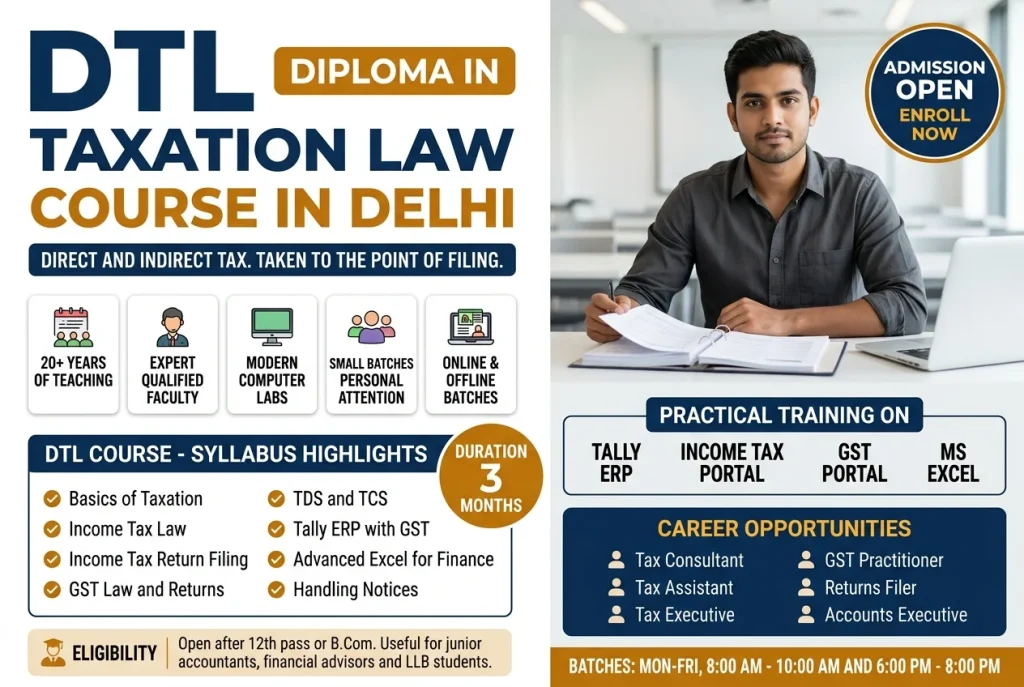
In short: the Diploma in Taxation Law (DTL) is a three-month program priced at Rs 20,000, covering income tax, GST and TDS/TCS together with hands-on Tally ERP and Excel work. It runs in classroom and online formats and is open after 12th pass or B.Com.
What is the Diploma in Taxation Law (DTL)?
DTL is a practical taxation diploma built around filing rather than theory. It starts with the structure of the Indian tax system, then works through income tax law — how tax applies to income from salary, from business, and from property — and into online income tax return filing, calculation and planning.
The indirect side covers GST registration, return filing and audit procedures. TDS and TCS are treated separately, including online TDS return filing, because deduction and collection are where a lot of practical errors are made. Throughout, work is done hands-on in Tally ERP and Excel rather than on paper.
Who should do this course?
The diploma is open after 12th pass or B.Com, and is particularly useful for:
- Junior accountants who want to move from bookkeeping into the taxation side of an accounts department, where the work is less easily automated.
- Financial advisors who need to speak accurately about tax when advising clients.
- LLB students adding a practical, revenue-generating skill to a legal qualification.
It also suits anyone intending to set up as an independent tax consultant, which is the most common reason students give for choosing it over a single-subject GST course.
Certification and examination
Assessment is an online multiple-choice examination of one hour, conducted through the institute’s portal. Passing students receive a recognised diploma certificate.
Fee and what it covers
The Diploma in Taxation Course fee is ₹20,000, inclusive of study material, tuition, the examination and the diploma certificate.
Why study taxation at NIMB
Tax law changes every year, and a course that is not taught by people currently filing returns dates quickly. Teaching is by practising chartered accountants, the software work is hands-on, and the diploma can be taken in classroom or online mode over three months.
How the course is taught
The diploma starts with the structure of the Indian tax system, then works through income tax law, how tax applies to income from salary, business and property, before moving into online return filing, calculation and planning. GST registration, return filing and audit procedures follow, with TDS and TCS treated separately because deduction and collection are where most practical errors are made. Work throughout is hands-on in Tally ERP and Excel rather than on paper.
Classes run in both classroom and online mode, so the course can be taken alongside a job. Assessment is an online examination through the institute’s own portal: multiple choice questions, one hour. Students who pass receive the certificate or diploma for the course.
Career opportunities after this course
A taxation diploma opens both employment and independent practice, and students split fairly evenly between the two. The breadth is what makes the difference: someone who handles income tax and GST and TDS can take whatever walks through the door.
Tax Consultant
Advises individuals and businesses on income tax and GST, and files their returns. The most common destination for this course, and the reason many students take it: a consultancy built on ITR and GST filing has an annual rhythm and a client base that returns each year.
Taxation Executive
Owns the tax function inside a company’s accounts department — computing liability, filing returns, handling notices and keeping the company compliant across direct and indirect tax. Less easily automated than bookkeeping, which is part of why it holds its value.
TDS Executive
Specialises in deduction and collection at source: working out what should be deducted, depositing it correctly and filing TDS returns. Deceptively technical, and a common source of penalties when handled by someone who has only half-learned it.
GST Practitioner
The indirect tax half of the diploma on its own. Some students work as GST practitioners while building toward broader consultancy, because GST returns recur monthly and provide steadier early income than annual ITR work.
Accounts role with tax responsibility
A general accounting position where taxation is a defined part of the job. Common in small and medium businesses that cannot justify a separate tax function but still need returns filed properly.
Income here tracks the city, the client base or employer, and how much practical filing work a candidate can show, not a fixed number this page could quote. We don’t invent salary data, so that question is best put directly to the institute.
How this compares with our other courses
If you only need GST — because that is what your employer needs, or what your clients ask for — the GST Practitioner Course covers it in two months at a lower fee. DTL is the right choice when you want income tax as well.
If your goal is an in-house accounts role rather than consultancy, look at the BAT Course or the Diploma in Financial Accounting: both spend more time on accounting itself, which is what an accounts department hires for. Practical work here is done in Tally, so software familiarity helps.
How to enrol in the Diploma in Taxation Law
Admission runs through a short conversation rather than an entrance test. Call the institute on 9212008787, or visit the centre at E-56, Laxmi Nagar, Delhi 110092, and an advisor will confirm the three-month schedule, take you through the current batch timings, and explain what the course covers in practice.
Comparing options? GST Course vs Diploma in Taxation goes through the trade-off in detail.
What you can do after each module
Three months covers six blocks that move from tax structure through to filing practice.
| Module | What it covers | What you can do afterward |
|---|---|---|
| 1. Structure of the Indian tax system | How direct and indirect tax fit together | Explain where GST, income tax and TDS each apply, and why a client rarely needs only one |
| 2. Income tax law: salary, business, property income | How tax applies to each of the three income heads | Compute taxable income for salary, business and property income |
| 3. Online income tax return filing and planning | Preparing and filing an ITR, basic tax planning | Prepare and file an income tax return and suggest basic planning options |
| 4. GST registration, return filing and audit | Registering a business for GST and handling its returns | Register a business for GST and file its returns |
| 5. TDS and TCS | Deduction and collection at source, and the returns that follow | Calculate TDS and TCS correctly and file the returns without the common errors that trigger penalties |
| 6. Hands-on practice in Tally ERP and Excel | Case-based work throughout, not saved for the end | Move comfortably between Tally ERP and Excel for real tax computations rather than working on paper |
Who this course is not for
This course is not for someone who only needs GST and nothing else; the shorter and cheaper GST Practitioner Course covers that alone in two months. It is also not the right fit for someone chasing a company accounts role rather than consultancy or advisory work, since DTL is weighted toward tax law and filing rather than the bookkeeping and financial statements a company accounts job actually tests for; the BAT Course or Diploma in Financial Accounting fit that better. And if you have no comfort at all with Tally or Excel, expect the practical sessions to feel harder than the tax content itself; a short run at the Tally Course first removes that friction.
A realistic three months
The diploma splits into a direct-tax half and an indirect-tax half, with TDS and TCS treated as their own block in between. Early months are heavier on explanation; income tax law across three separate income heads takes real time to get straight. The GST section tends to move faster because most students have some exposure to indirect tax already, and the TDS and TCS block, though shorter, usually needs the most repetition, since small errors there compound into penalties in the real job. Hands-on Tally ERP and Excel work runs throughout rather than being saved for the end, so most weeks mix explanation with return-filing practice.
DTL or the standalone GST course
The choice between this diploma and the standalone GST course usually comes down to how narrow the work will be. If every client or employer need is going to be GST, the two-month course is cheaper and faster. If income tax, TDS and GST will all come up, which is common for anyone planning independent consultancy, the three months here covers all three instead of forcing three separate enrolments later. GST Course vs Diploma in Taxation walks through the decision in more detail.
The terms you will be working with
Taxation has a precise vocabulary, and the precision is the point. Several of these terms are routinely used as though they meant the same thing.
Direct tax is tax borne by the person it is levied on, such as income tax.
Indirect tax is tax collected through an intermediary from the person who ultimately bears it, such as GST, which a seller collects and a buyer pays.
TDS is tax deducted at source: the payer withholds tax when making a payment, and deposits it with the government on the payee’s behalf.
The assessment year is the year in which the income of the preceding financial year is assessed. Income earned in one year is assessed in the next, which is why the two dates on a return are never the same.
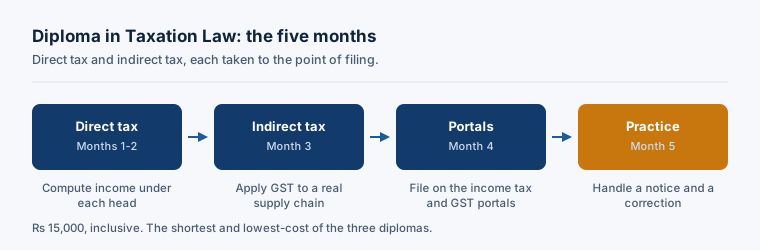
A notice is a formal communication from the tax department requiring a response within a stated period. Handling one is a distinct skill from filing, and it is where the fifth month of this diploma goes.
More questions about the Diploma in Taxation Law
Can I do this while working a job?
Yes. The diploma runs in classroom and online formats over three months, and working students tend to use the online option to fit sessions around office hours.
What if I miss classes?
Because the diploma moves through direct tax, GST and TDS/TCS as connected blocks rather than standalone topics, missing sessions in one block makes the case-study work in the next block harder to follow. Flag any planned absence to your advisor before the batch starts.
What software do I need at home?
None that you need to buy. Practical work happens in Tally ERP and Excel during scheduled sessions; at home a computer with internet access is enough to review filings and prepare for the exam.
Is the certificate recognised?
It is a diploma certificate awarded and recognised by the institute on passing its exam. It is not a substitute for the separate professional qualifications that govern practice as a chartered accountant or tax lawyer; students taking this diploma are typically building a practical filing and consultancy skill, not a statutory professional licence.