 NIMB EDU
The best course after graduation is the one that fits your degree, your marks and the work you want to be doing in three years. The main routes are a master’s degree, a professional title (CA, CS, CMA, ACCA, CFA), a government job, teaching or research, or a job with a skill course alongside. No single course is best for everyone, and each route has an entry rule that an official body sets.
Most lists on this topic print ten course names and stop. This guide starts from the decision instead. It shows the five routes and the real entry rule for each, with the source, then points you to the guide for your degree. Facts below were last checked on 26 October 2026. Exam dates change every year, so the linked official page always wins over this one.
What are the main options after graduation?
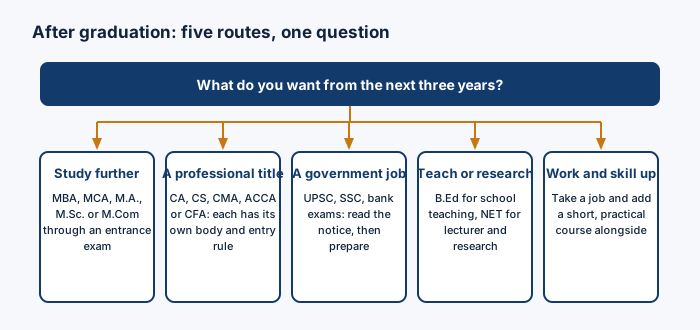
There are five honest routes, and most graduates end up combining two of them, for example a job plus a bank exam, or a skill course plus CA. The diagram shows them side by side.
| Route | How you get in (official rule) | Who should think twice |
|---|---|---|
| MBA or PGDM | CAT needs a bachelor’s degree with at least 50% (45% for SC, ST and PwBD); final-year students can apply (CAT 2026) | Anyone applying only because they have not decided |
| MCA | NIMCET needs 60% (55% for SC, ST, PwD) in a UG programme of at least three years with Mathematics or Statistics as a subject, or a B.E./B.Tech. (NIMCET 2026) | Graduates whose degree had no maths or statistics |
| M.A., M.Sc., M.Com | CUET (PG) for many universities, where each university sets its own eligibility (CUET PG); JAM for M.Sc. at IITs | Anyone who wants a job-ready skill rather than another degree |
| CA | Direct entry to Intermediate with 55% in a commerce degree or 60% in any other degree (ICAI) | Anyone who cannot study for years alongside training |
| CS | Graduates and postgraduates in any discipline are exempt from the entrance test (CSEET) and register for the Executive stage (ICSI) | Anyone who dislikes law and drafting |
| UPSC, SSC, banks | UPSC civil services needs a graduate degree of a recognised university (UPSC notice 05/2026); SSC and bank exams publish their own notice each cycle | Anyone who cannot sustain a long, uncertain preparation |
Which course is best after your degree?
Your degree decides which doors are open without extra conditions, so read the guide for yours. We have written a separate, deeper page for each major degree:
- B.Com: best courses after B.Com covers CA, CS, CMA, ACCA, CFA, M.Com, MBA, bank jobs and skill courses.
- BBA: courses after BBA explains why a BBA needs a practical skill and when an MBA makes sense.
- BCA: which course is best after BCA compares MCA, MBA and going straight into IT.
- B.Sc.: which course is best after B.Sc. covers M.Sc. through JAM and CUET PG, teaching, research and business routes.
- B.A. and other degrees: the routes in this guide (MBA, CS, CA, government exams, teaching) are open to arts graduates too, subject to the rules shown. Our guide to accounting courses without a commerce background shows how to enter finance from any stream.
Should you do a master’s degree after graduation?
Do a master’s degree if you need it for the job you want (teaching, research, a specialist role) or if you have a clear reason to enter management or computing. Do not do one only to delay a decision, because the fee and the two years are real. Entry is by exam in most cases, and each test below has its own rule.
| Test | What it opens | Entry rule as published |
|---|---|---|
| CAT 2026 | MBA at the IIMs and many other schools; check that a PGDM is AICTE approved | Bachelor’s degree with at least 50% (45% for SC, ST, PwBD); final-year students and CA, CS or CMA holders could apply in the 2026 cycle; the minimum does not guarantee a shortlist |
| NIMCET 2026 | MCA at 11 NITs and 2 IIITs, on NIMCET rank alone | 60% (55% for SC, ST, PwD) in a three-year UG programme with Mathematics or Statistics, or a B.E./B.Tech. |
| IIT JAM 2027 | M.Sc. and related programmes at 23 IITs (around 3,000 seats) | Completed degree or final year; each admitting IIT sets its own minimum qualification |
| CUET (PG) | Postgraduate programmes at participating universities | Set by each university; the NTA FAQ tells candidates to check the university’s eligibility and choose matching test paper codes |
| UGC NET and CSIR-UGC NET | Assistant Professor and research-fellowship eligibility | Read the current NTA bulletin for subjects and marks |
How do the two main postgraduate entrance tests compare?
Knowing the pattern before you pay for coaching tells you whether the test suits you. NIMCET (for MCA) and IIT JAM (for M.Sc.) have the most fixed, published structure, and the table is taken from their own brochures. The full papers, timelines and seat details are in the BCA and B.Sc. guides.
| NIMCET 2026 (MCA) | JAM 2027 (M.Sc. at IITs) | |
|---|---|---|
| Size | 120 multiple-choice questions, 1,000 marks, 2 hours, in three timed parts; Mathematics carries 600 marks | 60 questions, 100 marks, 3 hours, in seven test papers; you may take one or two |
| Negative marking | 25% of the marks for each wrong answer; none for unanswered | Only in the 30 multiple-choice questions (one-third or two-thirds of a mark) |
| Fee | Rs 2,500 (Rs 1,250 for SC, ST and PwD) | Rs 2,000 for one paper and Rs 2,700 for two (Rs 1,000 and Rs 1,350 for female, SC, ST and PwD candidates) |
Both are computer-based. JAM admission follows All India Rank in the paper with no extra interview or written test. The sources are the NIMCET 2026 information brochure (PDF) and the JAM brochure linked above. New registration for JAM 2027 has closed; its dates are in the calendar further down, and the JAM site carries any change and the next cycle. Your own degree subject decides which test you can sit, so the degree guides go into the eligibility detail.
Which institutions do the official rankings list?
The Ministry of Education’s National Institutional Ranking Framework (NIRF) publishes ranks by category, and its 2025 lists are a neutral place to start a shortlist. A rank is a starting point, not a verdict: NIRF ranks the institution as a whole, and a good overall rank does not tell you about one programme. Confirm the programme, the fee and the placement record on the institution’s own pages.
| NIRF 2025 category | Ranks 1 to 3 | Longer list |
|---|---|---|
| Management | IIM Ahmedabad, IIM Bangalore, IIM Kozhikode | Top 10 in the BBA guide |
| Universities | Indian Institute of Science, Jawaharlal Nehru University, Manipal Academy of Higher Education | Top 5 in the B.Sc. guide |
| Colleges (undergraduate colleges) | Hindu College, Miranda House, Hans Raj College | Top 5 in the B.Sc. guide |
Read the full lists on the NIRF site, which also shows the score parameters behind each rank. NIRF 2025 was the newest edition on the site on 26 October 2026. The list does not include every good institution, and many private and state institutes do not take part.
What does the four-year degree change for your next step?
It changes how long a postgraduate programme can be and what you need for a doctorate. NEP 2020 says an undergraduate degree will be of three or four years with multiple exit options, with the four-year multidisciplinary Bachelor’s programme the preferred option. Master’s programmes may be two years (the second devoted to research), one year after a four-year Bachelor’s with Research, or an integrated five-year programme. A Ph.D. then needs either a Master’s degree or a four-year Bachelor’s with Research (NEP 2020, sections 11.9 and 11.10).
The University Grants Commission turned this into admission marks in its Ph.D. regulations, notified on 7 November 2022. They list a Master’s with at least 55% marks as an eligibility route. That means a one-year Master’s after a four-year Bachelor’s, or a two-year Master’s after a three-year Bachelor’s. They add that a candidate seeking admission after a four-year Bachelor’s should have at least 75%. A relaxation of 5% may be allowed for SC, ST, OBC (non-creamy layer), differently-abled, EWS and other categories (UGC Ph.D. Regulations, 2022). Each university decides when and how it adopts the four-year structure and runs its own Ph.D. selection, so ask the admission office which structure applies to your batch and whether a three-year degree like yours is accepted for the programme you want.
Which professional courses can any graduate take?
Any graduate can start a professional qualification, but the entry rules and the length differ, so compare them before choosing. The longer comparison is in CA vs CS vs CMA vs ACCA.
- CA (ICAI): graduates and postgraduates in commerce with at least 55%, or in other subjects with at least 60%, register directly for Intermediate (ICAI). Start with the CA course guide.
- CS (ICSI): graduates in any discipline skip the entrance test (ICSI); see the company secretary course guide.
- CMA (ICMAI): a degree of a recognised university is an entry route to Intermediate (ICMAI eligibility); see the CMA course guide.
- ACCA: a relevant degree can earn exemptions from some papers, and the count depends on your degree, so use ACCA’s own exemptions calculator; see the ACCA course guide.
- CFA: a completed bachelor’s degree qualifies for enrolment. Undergraduates can enrol when the exam window is 23 months or less before graduation, and work experience is an alternative (CFA Institute policies).
Can you prepare for a government job after graduation?
Yes, and a degree in any subject is the starting condition for most central recruitment exams. For the UPSC civil services examination, a graduate degree is required and final-year students may apply. The 2026 notice allows six attempts for General candidates, nine for OBC and unlimited attempts for SC and ST candidates while they remain age-eligible. The age window for General candidates was 21 to 32 years on 1 August 2026 (UPSC notice 05/2026). The SSC CGL 2026 notice asks for a bachelor’s degree for most posts and names a subject for a few, such as statistics posts (SSC CGL 2026 notice). The notice describes two stages. The preliminary examination has two objective papers and only screens candidates. The Main examination has nine written papers, two of them qualifying only, followed by an interview of 275 marks. Bank recruitment is announced each cycle by IBPS. Read the current notice for age, attempts and syllabus. Keep a skill or a job going during preparation, because exam cycles are long.
What about teaching or research?
School teaching normally needs a B.Ed. Confirm that the programme is recognised by the National Council for Teacher Education, and check your state’s rules before you apply. For college lecturer posts and research fellowships, the national tests are UGC NET and, for the sciences, CSIR-UGC NET. Both are run by NTA, and both pages describe qualifying as eligibility for Assistant Professor and research-fellowship purposes, subject to UGC criteria.
Are short skill courses worth it after graduation?
Yes, when the course matches a job advert you can actually apply for, and no when it is bought to replace a qualification. Short courses build one testable skill (an accounting package, GST, payroll, Excel, data analysis) that gets you interviews. They do not give you a degree or a professional title, and they do not count towards CA, CS or CMA.
Check who awards the certificate. NPTEL offers IIT and IISc courses, and most of its certificates need a proctored in-person exam (NPTEL FAQ). NIELIT accredits computer-training institutes for specified levels of its O, A, B and C level courses, so ask any centre to show its accreditation (NIELIT accreditation scheme). If a provider claims recognition under the national skills framework, look the qualification up on the National Qualifications Register.
For finance and accounts, NIMB teaches the practical software and tax skills these jobs ask for. The accounting course picker gives a straight recommendation in three questions.
Is an online degree after graduation valid?
An online or distance degree is valid for jobs and further study only if the university and the programme are recognised. Check the institution and programme on the UGC Distance Education Bureau site (UGC-DEB) before paying, not on the provider’s own page.
Which exam dates are coming up?
Most graduates miss an option because the window had closed before they looked. Each row names its cycle and its source, and was checked on 26 October 2026. Dates that have already passed are left out, because a closed window helps no one. Dates marked tentative or calendar-listed can change, so the linked official page always wins.
| Exam and cycle | Dates | Source |
|---|---|---|
| CAT 2026 (MBA) | Registration closed 22 September 2026; admit cards from 4 November; test on 29 November 2026 | CAT 2026 home page |
| JAM 2027 (M.Sc.) | New registration closed (the brochure said 19 October, extended twice to 24 October 2026); fee payment for registered candidates until 26 October; test on 14 February 2027 | JAM 2027 important dates |
| SSC CGL 2026 | Tier-II tentatively December 2026 | SSC CGL 2026 notice, tentative schedule |
| UPSC civil services 2027 | Notification 13 January 2027; last date to apply 2 February 2027; preliminary examination 23 May 2027; Main examination from 20 August 2027 | UPSC Annual Calendar 2027, as on 20 May 2026 |
| NIMCET (MCA) | The 2027 brochure is not out yet. For planning, the 2026 cycle took applications until 1 May and held the test on 6 June 2026 | NIMCET 2026 brochure |
| CUET (PG), UGC NET, bank exams | Next-cycle dates are not announced; read the NTA and IBPS sites linked above | Official sites |
The practical lesson is to start in the final year of your degree. CAT and JAM accept final-year students, and NIMCET accepts candidates appearing for the qualifying examination. If your results come late, proof of eligibility is usually asked for at admission, not at application (see each brochure).
What does a graduate earn?
No official dataset gives one salary for “graduates”, because pay depends on the role, city and employer far more than on the degree. Portal pages that print a single range usually give no source, year or sample, so this guide prints none. To estimate for yourself, read three live job adverts for the exact role in your city and compare the pay they state.
Which mistakes do graduates make at this stage?
- Starting a long course to postpone the decision. It defers the question by years and the fees are real.
- Trusting a ranked list. “Top 10” pages are often written by an institute promoting its own course. Check each claim against the awarding body.
- Ignoring the entry rule. Minimum marks, a maths subject or an exam cycle can close a door you assumed was open. Read the rule before you pay for coaching.
- Treating a short course as a qualification. It is a skill. It does not replace a degree or a professional title.
All our guides for graduates
Each page below goes deeper on one degree or one route.
All guides in Courses After Graduation

Best Courses After B.Com: What to Do Next, and Why
Courses after B.Com compared: CA, CS, CMA, ACCA, CFA, MBA, M.Com, bank and SSC jobs, skill courses. Official entry rules…

Courses After BBA: Which Is Best, and What Leads to a Job
Courses after BBA compared: MBA, CA, CS, CMA, ACCA, CFA, short courses and government jobs. Official entry rules, and wh…

After BCA, Which Course Is Best? MCA, MBA or a Job
After BCA, which course is best? MCA, MBA, an IT job, CA or a government exam compared, with the official entry rules an…

After B.Sc., Which Course Is Best? M.Sc., MBA, B.Ed or a Job
After BSc, which course is best? M.Sc. through JAM or CUET PG, B.Ed, NET, MBA, MCA, CA and government exams compared, wi…
Frequently asked questions
Which course is best after graduation?
There is no single best course, so pick by goal. Choose a master’s degree for specialist or management roles. Choose a professional title (CA, CS, CMA, ACCA, CFA) for finance careers, a government exam for a public-sector job, or a skill course for a quicker start in work.
What is the best course after graduation for a job?
For a quick start, a practical skill course tied to the job advert you are targeting works best, for example Tally and GST for accounts roles. For a stronger long-term title, a professional qualification takes years but carries more weight with employers who ask for it.
Can I do an MBA after any graduation?
Yes. CAT accepts a bachelor’s degree in any discipline with at least 50% marks (45% for SC, ST and PwBD). Meeting the minimum does not guarantee a call from an IIM, because each institute adds its own selection process.
Can I do CA after graduation in arts or science?
Yes. ICAI allows direct entry to Intermediate for graduates in subjects other than commerce with at least 60% marks (55% for commerce graduates), so you skip the Foundation exam.
Which short-term courses can I do after graduation?
Accounting software (Tally), GST, payroll, advanced Excel, data analysis and computer-application courses are the common ones. Choose the one that matches the jobs you are applying for and check who awards the certificate.
Can I prepare for UPSC after graduation?
Yes. A graduate degree from a recognised university is the only educational condition, and the degree subject does not matter. Read the current notice for age limits and attempts.
Is a distance or online degree accepted?
Only if the university and programme are recognised by UGC. Verify on the UGC-DEB site before you enrol.
Can I do two courses together after graduation?
Yes, if the combination is workable. A skill course alongside government-exam preparation, or a part-time course alongside a job, is common. Two long, exam-based routes at once, such as CA and a full-time MBA, are rarely workable because each needs steady study time. Count the hours before you commit.
Which PG course is best after a B.A.?
An M.A. in your subject, an MBA through CAT, or a professional route such as CS, which is open to graduates in any discipline. CA is open to arts graduates with 60%. NIMCET for MCA needs Mathematics or Statistics in the degree, so many B.A. graduates cannot use it.
When should I start preparing for a postgraduate entrance test?
In the final year of your degree. CAT and JAM accept final-year students, and NIMCET accepts candidates appearing for the qualifying examination. Registration windows are short, so check the dates for the next cycle on the official site as soon as you decide.
Still deciding?
If you would like to talk it through, book a career counselling call or message us on WhatsApp at 9212008787. Bring your degree, your marks and a rough idea of the work you want to be doing in three years. That is enough to get a straight answer, including “this course is not for you”.