NIMB EDU

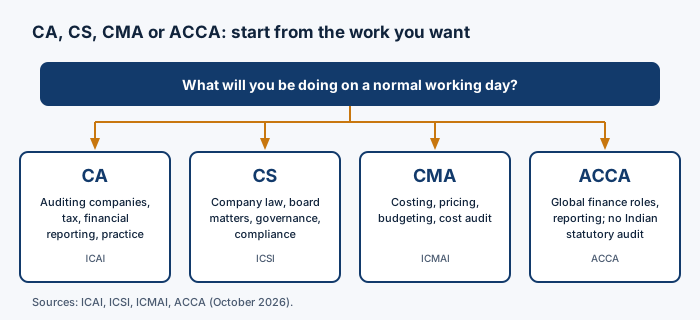
Choose CA if you want to audit companies or work in tax and financial reporting in India. Choose CS for company law and governance, and CMA for costing and management accounting. Choose ACCA for a global finance qualification, if you do not need to sign Indian statutory audits. No one of the four is better in general. Each leads to different work, and the law gives two of them exclusive duties.
This comparison uses only official sources: ICAI for CA, ICSI for CS, ICMAI for CMA and ACCA’s own pages, all read in October 2026. Where a number is our own arithmetic, we say so, and where an institute publishes nothing, we leave it blank rather than guess. Salary is deliberately not the deciding column, because the four bodies do not publish pay on a common basis. Each course has its own full guide: CA, CS, CMA and ACCA. If you have not yet chosen between professional courses and a degree, begin with which course is best after 12th commerce.
What is the difference between CA, CS, CMA and ACCA?
They are four professional accountancy and corporate qualifications from four different bodies, and they differ most in what they are about and what they legally allow. CA centres on audit, tax and financial reporting. CS centres on company law, compliance and governance. CMA centres on cost and management accounting. ACCA is an international finance qualification.
| CA | CS | CMA | ACCA | |
|---|---|---|---|---|
| Body | ICAI | ICSI, statutory body under the Company Secretaries Act, 1980 | ICMAI, statutory body under the Cost and Works Accountants Act, 1959 | ACCA, a UK-based global body |
| Focus | Audit, tax, financial reporting | Company law, governance, compliance | Cost and management accounting | Financial reporting, management accounting, audit, tax, finance |
| Start after Class 12 | Foundation | CSEET entrance test | Foundation | Applied Knowledge, if you meet the marks; otherwise Foundations in Accountancy |
| Start after graduation | Intermediate, with 55% (commerce) or 60% (other) | Executive Programme, any discipline | Intermediate, any discipline | Applied Knowledge or higher, with exemptions if ACCA accepts your degree |
| Exam stages and papers | Foundation 4, Intermediate 6, Final 6, plus 4 online modules | CSEET 4, Executive 7, Professional 7 | Foundation 4, Intermediate 8, Final 8 | Applied Knowledge 3, Applied Skills 6, Strategic Professional 4, plus an ethics module |
| Practical training | 2 years of articleship | 21 months | 15 months | 36 months of experience with 9 objectives |
| Exam months | Foundation and Intermediate in January, May, September; Final announced per cycle | CSEET in February, June, October; Executive and Professional in June and December | June and December | March, June, September, December |
Sources: ICAI figures from ICAI’s FAQ on the new scheme and the ICAI Prospectus 2026; CS from the ICSI CSEET FAQ, the ICSI training guidelines and the ICSI student-services FAQ; CMA from the ICMAI Prospectus; ACCA from its qualification structure page. ACCA is also being redesigned, with new Knowledge exams from July 2027 and Expertise and Strategic Professional exams from September 2027 (ACCA: the future ACCA Qualification).
Which one gives legal rights that the others do not?
Two of them: CA and CMA each hold a duty reserved by the Companies Act, 2013, and the others hold none that we could verify. A statutory audit of a company can be done only by a chartered accountant with a valid certificate of practice under Section 141 (ICAI study material: audit and auditors). ICMAI states that cost accountants are exclusively authorised to be appointed cost auditors under Section 148 (ICMAI Prospectus).
ICSI names CS qualifiers for roles such as adviser to the board, key managerial personnel and compliance officer. We did not find a reserved duty in the sources we read (ICSI course brochure). ACCA does not give the right to sign Indian statutory audits. That is the sharpest practical test: if you want your signature on a company’s audit report in India, only CA does it.
How long does each take?
Only ICAI and ACCA give enough official detail to state a minimum. For CA, ICAI’s prescribed periods add up to about 43 months from Foundation. Direct entry takes about 39 months. Both figures leave out exam sittings and results (the full timeline is in CA course duration). ACCA says students who work and study together could qualify in as little as three or four years.
| Course | What is published | What we can add |
|---|---|---|
| CA | Study periods of 4, 8 months, ICITSS, 2 years of articleship and 6 months before Final | About 43 months from Foundation, about 39 for direct entry (our sum of ICAI’s minimums) |
| CS | 21 months of practical training after the Executive Programme; exams about six to seven months after the registration cut-off | About three years minimum from Executive registration to membership (our arithmetic; ICSI publishes no total) |
| CMA | 15 months of practical training; oral coaching of 4 months; skills training of 120 hours (Intermediate) and 80 hours (Final) | ICMAI publishes no total; our estimate is about 3 to 4 years from Class 12 and 2 to 3 after graduation, with exams in June and December |
| ACCA | As little as three or four years while working; 36 months of experience; no limit on the first two levels; seven years to finish Strategic Professional | The 2027 redesign may change your route |
The practical lesson is that the minimums are close, from about three to about four years of work after the entry point, and that retakes, not syllabus length, decide how long you take. The next section shows the pass rates behind that.
How hard are the exams?
All four are hard, and the bodies count pass rates differently, so the numbers below show how many candidates clear a stage, not which course is harder. ICAI reports each group and both groups together; ICMAI separates candidates who sat one group only from those who sat both. ACCA reports each exam for each sitting. ICSI’s rates reached us only through a secondary report.
| Course and sitting | Level | By group | Both groups together |
|---|---|---|---|
| CA, May 2026 (ICAI press releases) | Foundation | Not applicable | 20.09% |
| Intermediate | Group I 10.25%; Group II 16.11% (all who sat that group) | 8.47% | |
| Final | Group I 12%; Group II 20.49% (all who sat that group) | 14.07% | |
| CS, June 2026 (TaxGuru’s report, not an ICSI document) | Executive | Group 1 17.41%; Group 2 22.19% | Not reported to us |
| Professional | Group 1 32.69%; Group 2 29.49% | Not reported to us | |
| CMA, June 2026 (ICMAI press release) | Intermediate | Sat Group I only 23.93%; sat Group II only 30.64% | 19.68% |
| Final | Sat Group III only 30.22%; sat Group IV only 44.21% | 32.97% | |
| ACCA, September 2026 (ACCA; Applied Knowledge: June 2026) | Per exam, not per group | Applied Skills 42% to 54%; Strategic Professional 41% to 53%; Applied Knowledge 65% to 89% | |
The sources are the ICAI press releases for Final, Intermediate and Foundation, the ICMAI June 2026 press release, TaxGuru’s report of ICSI’s results and ACCA’s pass-rates page. Read them as a pattern, not a ranking. Passing every paper of an Indian level in one go is hard, whereas an ACCA candidate who fails one exam keeps the others. A clean first-time run is the exception on the Indian routes, so budget for a retake.
Which is cheapest?
On published body fees, ACCA is the most expensive by a wide margin. Among the three Indian bodies the order depends on which CS figure you use, so each is labelled below. All totals are our addition of the body’s published fees, assuming every exam is passed first time.
- CMA: about Rs 64,100 from Foundation or Rs 56,600 for graduates entering at Intermediate, before GST, with ICMAI’s compulsory coaching inside the course fee (CMA course fees).
- CA: about Rs 84,500 from Foundation or Rs 74,000 for direct entry, including ICAI’s two soft-skills courses, before coaching (CA course fees).
- CS, registration, exams and orientation: about Rs 54,000 via CSEET or Rs 50,000 for graduates. CS full journey, adding the Executive Development Programme (Rs 10,000) and Corporate Leadership Development Programme (Rs 30,000): about Rs 94,000 via CSEET or Rs 90,000 for graduates, before coaching and membership (CS course fees).
- ACCA: about 2,280 pounds, about Rs 2.89 lakh at the rate on 16 October 2026, before three exams priced by Indian centres (ACCA course cost in India).
| Course | Approximate body fees | What is excluded |
|---|---|---|
| CMA | Rs 64,100 from Foundation; Rs 56,600 for graduates | GST, retakes; ICMAI coaching is already in the course fee |
| CA | Rs 84,500 from Foundation; Rs 74,000 direct entry | Coaching, study costs, retakes |
| CS, registration, exams and orientation | Rs 54,000 via CSEET; Rs 50,000 for graduates | EDP and CLDP, coaching, retakes |
| CS, full journey with EDP and CLDP | Rs 94,000 via CSEET; Rs 90,000 for graduates | Coaching, membership, retakes |
| ACCA | 2,280 pounds, about Rs 2.89 lakh | Three Applied Knowledge exams, tuition, retakes; moves with the exchange rate |
Coaching costs and your living costs during the training years usually matter more than the body fee. Training is paid, but at a floor. ICAI’s minimum articleship stipend ranges from Rs 2,000 to Rs 6,000 a month, and ICSI’s minimum is Rs 5,000 a month. ICMAI’s prospectus sets Rs 2,000, 3,000 and 4,000 in years one to three with a practising cost accountant, and corporate placements range from Rs 15,000 to Rs 30,000 for students and Rs 37,000 to Rs 50,000 for Final-qualified trainees, as the CMA fees guide explains.
What do you actually study in each?
The four overlap in accounting, tax and law, and differ in where they go deep. The table lists the main papers by subject area, taken from each body’s paper list in the four guides linked at the top.
| Subject | CA | CS | CMA | ACCA |
|---|---|---|---|---|
| Financial accounting and reporting | Advanced Accounting; Financial Reporting (Ind AS) | Corporate Accounting and Financial Management | Financial Accounting; Corporate Accounting and Auditing; Corporate Financial Reporting | FA, FR, SBR |
| Audit | Auditing and Ethics; Advanced Auditing, Assurance and Professional Ethics | Compliance Management, Audit and Due Diligence | Cost and Management Audit | AA, AAA |
| Tax | Taxation (income tax and GST); Direct Tax Laws and International Taxation; Indirect Tax Laws | Tax Laws and Practice | Direct and Indirect Taxation; Direct Tax Laws and International Taxation; Indirect Tax Laws and Practice | TX, ATX (an option) |
| Cost and management accounting | Cost and Management Accounting | No dedicated paper in the lists we read | Cost Accounting; Management Accounting; Strategic Cost Management | MA, PM, APM (an option) |
| Company and business law | Business Laws; Corporate and Other Laws | Company Law and Practice; Capital Market and Securities Laws; Drafting, Pleadings and Appearances | Business Laws and Ethics; Corporate and Economic Laws | LW |
| Finance and strategy | Financial Management and Strategic Management; Advanced Financial Management | Strategic Management and Corporate Finance | Financial Management and Business Data Analytics; Strategic Financial Management | FM, AFM (an option), SBL |
Two points follow. CS carries by far the most law, and CMA the most cost and management accounting. CA and ACCA are the broadest on audit and reporting. ACCA’s papers are named by subject and not by country, so check ACCA’s current syllabus for how much Indian tax and company law an ACCA student actually studies before you rely on it for Indian practice.
What do you get at the end?
You get a title, and the titles carry different rights, which is the last piece of the decision.
| Course | Title and rights |
|---|---|
| CA | Member of ICAI, a chartered accountant; a Certificate of Practice for those who intend to practise; the only route to Indian statutory audit |
| CS | Associate member of ICSI (ACS) after 21 months of training; roles ICSI names include adviser to the board, key managerial personnel and compliance officer |
| CMA | Associate (ACMA) after Final and three years of qualifying experience; Fellow (FCMA) after five years as an Associate; exclusive appointment as cost auditor |
| ACCA | Affiliate after the exams, member after 36 months of experience and the ethics module; Fellow (FCCA) after five continuous years of membership |
Two recognitions matter if you are weighing a professional course against a degree. A UGC public notice of 15 April 2021 says the CA, CS and ICWA (the cost accountants’ earlier name) qualifications are to be considered equivalent to a postgraduate degree, as the ICAI Prospectus describes it (UGC notice). We found no similar notice for ACCA. Outside India, ACCA reports members and students in 180 countries (ACCA: June 2026 results), but for any country you target, check that country’s own rules for the Indian bodies and for ACCA.
Is the CMA here the same as the US CMA?
No. The CMA in this guide is the Indian Cost and Management Accountant qualification from ICMAI. The American CMA, from the Institute of Management Accountants, is a separate credential with its own exams, and search results often mix the two. If a page compares “CMA vs ACCA” by pay or exam length, check which CMA it means.
Which pays the most?
No official source compares the four on a common basis, so we do not name a winner. The one primary figure we can give is ICAI’s. Its 64th campus placement drive for newly qualified CAs, in April to May 2026, reported an average package of Rs 13.30 lakh and a highest offer of Rs 27.50 lakh (ICAI Placement Directorate). That covers those who joined the campus drive and got offers, not every CA, as our CA salary guide explains.
ICSI’s brochure publishes no salary figures, only a general statement about remuneration. For the others, we have separate pages: company secretary salary, CMA salary and accountant salary. Compare numbers only when they come from the same kind of source.
Which should you choose?
Choose by the work you want, then check the route fits your money and time. The table maps common goals to the course that fits best.
| If you want | Choose | Why |
|---|---|---|
| To audit companies, run a practice, or work in tax | CA | Statutory audit is reserved for chartered accountants with a certificate of practice |
| To work on company law, board matters and compliance | CS | The syllabus is company law, securities law and governance |
| To work on costs, pricing, budgeting and cost audit | CMA | The syllabus is cost and management accounting, and cost audit is reserved for cost accountants |
| To work in global finance or move abroad | ACCA | An international qualification; check the recognition rules of the country you target |
| A lower-cost professional route in rupees | CMA first, then CA or CS | CMA has the lowest published body fees; CA and CS are close once ICSI’s Rs 40,000 EDP and CLDP are counted; all three cost far less than ACCA |
| A professional title but a heavy law interest | CS | CS leans on law more than the other three |
| A quick job in under a year | None of the four | Look at shorter accounting courses |
The most common mistake is choosing on prestige and discovering at articleship or training that you dislike the work. Ask a practitioner what a normal week looks like before you commit three or four years. If you are in B.Com, the best courses after B.Com sets these four beside degrees and jobs.
Can you do more than one?
Yes, and the institutes recognise each other in some places. These links are documented by the bodies themselves; the table lists the ones we could verify.
| If you have passed | Then you can | Source |
|---|---|---|
| CS or CMA Intermediate | Enter CA Intermediate directly | CA course guide, from ICAI’s prospectus |
| CA Intermediate or ICSI Foundation | Be exempt from CMA Foundation | ICMAI course eligibility |
| CA Intermediate or CMA Final | Enter CS Executive directly (ICSI’s documents differ on which CA level is needed) | ICSI CSEET FAQ |
| ICMAI or ACCA membership | Get advanced entry to the other qualification, with exemption from the majority of papers | ICMAI: MOU with ACCA |
For ACCA and other qualifications, exemptions come only through ACCA’s own exemptions calculator, which looks at your institution, programme and year. ICAI’s page on mutual recognition lists CPA Ireland and does not mention ACCA (ICAI mutual recognition). So check with ACCA before you trust a claim that CA earns a fixed number of ACCA exemptions.
Frequently asked questions
Which is better, CA, CS, CMA or ACCA?
None is better in general. CA fits Indian audit, tax and reporting, CS fits company law and compliance, CMA fits costing and management accounting, and ACCA fits a global finance career. The right one depends on the work you want and on your money and time.
Which is the toughest among CA, CS, CMA and ACCA?
We cannot rank them, because the bodies count pass rates differently. In May 2026 ICAI reported 8.47% for Intermediate and 14.07% for Final among candidates who sat both groups (Final Group I 12%, Group II 20.49%). In June 2026 ICMAI reported 19.68% and 32.97% for candidates who sat both groups. ACCA’s September 2026 rates for single exams ran from 41% to 54% at Applied Skills and Strategic Professional.
Which has the highest salary, CA, CS, CMA or ACCA?
No official source compares them on a common basis. The only primary figure is ICAI’s campus placement average of Rs 13.30 lakh for newly qualified CAs in April to May 2026, which covers only those who took part and received offers.
Can I do CA and ACCA together?
Nothing in the sources we read forbids it, but both are heavy commitments, and CA articleship is full time. Whether CA study earns ACCA exemptions is decided by ACCA’s exemptions calculator.
Which is easiest to start after 12th?
Entry is open to any stream for CA Foundation, CSEET and CMA Foundation. ACCA’s direct entry needs 65% in two subjects including English and Maths or Accounts, though ACCA points you to Foundations in Accountancy if you fall short of that.
Is CA higher than CMA?
Neither is higher in law. CA holds the Indian statutory audit right and CMA holds cost audit, and each leads to different work. A UGC notice treats CA, CS and ICWA as equivalent to a postgraduate degree for UGC NET purposes, per the ICAI Prospectus.
Is ACCA valid in India?
It is a recognised international qualification, but it does not let you sign statutory company audits in India. That is reserved for chartered accountants with a certificate of practice under the Companies Act, 2013.
Which has the lowest fees?
On published body fees, CMA: about Rs 64,100 from Foundation or Rs 56,600 for graduates. CS is Rs 54,000 via CSEET or Rs 50,000 for graduates for registration, exams and orientation only, and Rs 94,000 or Rs 90,000 for the full journey with the EDP and CLDP. CA is about Rs 84,500 from Foundation, and ACCA about Rs 2.89 lakh at the 16 October 2026 rate. Coaching and retakes are extra in every case.
Which is best after B.Com?
Graduates can enter CA Intermediate with 55% in commerce, and CS Executive and CMA Intermediate with a degree in any discipline. Which is best depends on your goal, as the choosing table shows.
Still deciding?
If you are torn between two of these, a conversation helps more than another comparison. Talk to a career counsellor, or call 9212008787 or message us on WhatsApp. NIMB EDU sells online accounting and tax courses, and none of CA, CS, CMA or ACCA is among them, so we have no stake in your pick.