NIMB EDU

The Company Secretary (CS) course is a professional qualification run by the Institute of Company Secretaries of India (ICSI). After an entrance test (CSEET) come the Executive Programme and the Professional Programme, then 21 months of practical training before you become an Associate member (ACS).
This guide uses ICSI’s own documents, read in October 2026. It matters because ICSI replaced its entrance test from the June 2026 session, and many search results still describe the old online test. Costs are on CS course fees, stage by stage, pay is on company secretary salary in India, and the side-by-side with other qualifications is CA vs CS vs CMA vs ACCA.
What is the CS course?
It is the route to becoming a Company Secretary, a professional who advises a company’s board on corporate law and governance and keeps it compliant. ICSI is a statutory body set up under the Company Secretaries Act, 1980, and it works under the Ministry of Corporate Affairs (ICSI course brochure). The brochure lists roles such as adviser to the board, compliance officer, secretarial auditor, insolvency professional and registered valuer. It publishes no salary figures, so any pay claim you read needs its own source.
What are the stages of the CS course?
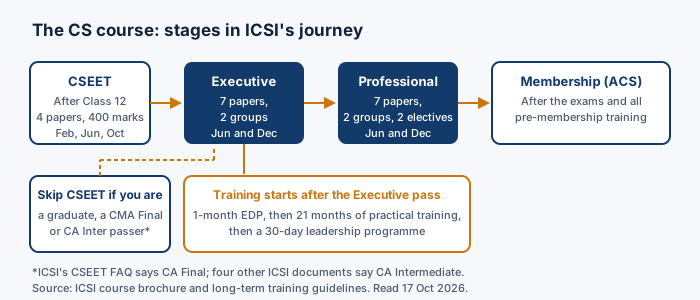
There are five steps: CSEET, the Executive Programme, the Professional Programme, pre-membership training, and membership. Graduates and some other candidates skip the first step.
| Stage | What it is | Papers | Exam months |
|---|---|---|---|
| CSEET | Entrance test; skipped by graduates and others listed below | 4 papers, 400 marks | February, June, October |
| Executive Programme | Core corporate law, accounting and tax | 7 papers in 2 groups | June and December |
| Professional Programme | Advanced governance, compliance, drafting and electives | 7 papers in 2 groups, including 2 electives | June and December |
| Training | 30-day EDP, 21 months of practical training, 30-day leadership programme | Not exams | Not applicable |
| Membership | Associate Member (ACS) | Not applicable | Not applicable |
Who is eligible for the CS course?
You can start after Class 12 through CSEET, or directly at the Executive Programme if you are a graduate. Only Indian nationals can apply for CSEET. The stream you studied in Class 12 does not matter, and ICSI states no minimum percentage in the documents we read.
| Your position | Where you enter | Condition |
|---|---|---|
| Passed Class 10 | CSEET, provisional registration | You must later submit a Class 12 admit card or marksheet |
| Passed or appearing in Class 12 | CSEET | Indian national |
| Passed CSEET | Executive Programme | Register within one year of the CSEET result |
| Graduate or postgraduate, any discipline | Executive Programme directly | Pays a CSEET exemption fee |
| In the final year or final semester of a three-year degree | Executive Programme, provisional | Upload the final-year admit card |
| Passed (or appearing in) the 6th semester of a five-year integrated programme | Executive Programme, regular or provisional | Admit card for the provisional route |
| CA Intermediate passed, or CMA Final passed | Executive Programme directly | Pass certificate |
| Passed ICSI Foundation | Executive Programme directly | Old-scheme route |
The table follows ICSI’s restructuring announcement of 10 April 2026 and the student-services FAQ. One caution for CA qualifiers: ICSI’s documents disagree. The CSEET FAQ (question 9) lists “the Final Stage of CA (ICAI)” as exempt, while the announcement, the fee structure, the student-services FAQ and the course brochure all say ICAI Intermediate pass. We follow the four that agree, but ICSI has not reconciled them, so confirm on the registration portal. For CMA, all of them say CMA Final.
How do you register for the CS course, step by step?
All registration is online. ICSI says a downloaded form is not accepted, and hard copies are not needed unless ICSI asks for them (ICSI student-services FAQ).
CSEET route (after Class 12)
- Open icsi.edu, click “Become a Company Secretary”, tick the boxes that apply to you and proceed to registration.
- Pay the CSEET registration fee. Registration is valid for three years from the month you register.
- Complete the one-day Student Induction Programme before you enrol for the exam. Free online classes run for each session.
- Enrol in the enrolment window, then download the e-admit card about ten days before the exam.
- After you pass, register for the Executive Programme within one year of the result.
Executive Programme (CSEET passers, graduates and other direct-entry candidates)
- Register on ICSI’s SMASH student portal, using the CSEET-passed link or the direct-admission link.
- Upload your documents (qualification proof, and the CSEET result or exemption proof) and pay by card, net banking or Canara Bank challan.
- Your user ID is issued instantly after payment and is your registration number. If registration shows as pending, documents or fees are short.
- Download the registration letter and identity card from icsi.edu, since ICSI no longer posts them. Study material arrives within 21 working days.
Professional Programme
- Pass both Executive groups under the same syllabus. Groups passed under different syllabuses do not qualify.
- Log in to SMASH, go to Student Services and choose “Professional Registration Request”.
- Select your elective in each group (mandatory), tick the journal box if you want it, and pay.
- Download your registration letter and identity card. You can change an elective later through “Change optional subject”.
What changed in CSEET from June 2026?
CSEET is now a centre-based exam with four papers, replacing the remote-proctored online test. The last sitting in the old format was in January 2026, and the first restructured sitting was in June 2026. Anyone who passed in January 2026 may still register for the Executive Programme within a year of their result without paying the exemption fee (ICSI announcement).
| Day | Paper | Format and duration | What the syllabus covers (level: basic) |
|---|---|---|---|
| 1 | Business Communication (100) | Subjective, 3 hours | Grammar, vocabulary, comprehension; business letters, reports, email, notices, agenda and minutes |
| 2 | Fundamentals of Accounting (100) | Subjective, 3 hours | Journals and ledgers, bank reconciliation, depreciation, final accounts, partnership and LLP accounts, company accounts basics |
| 3 | Economic and Business Environment (100) | Subjective, 3 hours | Part A Economics 50 (demand and supply, national income, Budget); Part B Business Environment 50 (regulators, governance) |
| 4 | Business Laws (60) and Business Management (40) | OMR-based, 2 hours, no negative marking | Contracts, company law elements, partnership, sale of goods, negotiable instruments; management functions and theories |
The test is held in the first week of February, June and October, in the afternoon, with 15 minutes of reading time. To pass you need 40% in every paper and 50% overall in one sitting, with no carry-forward of marks. Registration is valid for three years, so you can retake without registering again, but the result is valid for one year only. The restructured CSEET syllabus replaces the older 200-mark MCQ test still shown in the 2022 syllabus booklet.
The next sitting is in the first week of February 2027. Registration for that sitting closed on 31 October 2026; exam enrolment runs from 16 November to 15 December 2026, with a late-fee window to 20 December (ICSI important dates for 2026). ICSI’s own documents do not agree on every cut-off, since the CSEET FAQ gives different registration windows from the announcement and the dates sheet. Use the notice on the restructured CSEET page for the session you are targeting.
What do you study in the Executive Programme?
The Executive Programme has seven papers in two groups, mostly law and accounting, tested at “working knowledge” level. You can take one group at a time or both together. Each paper is 100 marks. The table follows the ICSI Syllabus 2022, with topic headings condensed.
| Paper | Parts and marks | Main topics |
|---|---|---|
| Group 1, Paper 1: Jurisprudence, Interpretation and General Laws | 100 | Constitution, interpretation of statutes, torts, civil and criminal procedure, evidence, arbitration basics, RTI, IT law, contract, sale of goods, negotiable instruments |
| Group 1, Paper 2: Company Law and Practice | Concepts 60; Administration and Meetings 40 | Company types, memorandum and articles, share capital, debt instruments, charges, accounts and auditors, meetings, directors, key managerial personnel |
| Group 1, Paper 3: Setting Up of Business, Industrial and Labour Laws | Setting Up 60; Industrial and Labour Laws 40 | Business forms, LLPs, start-ups, MSMEs, conversions, licences; the new labour codes, wages, social security |
| Group 1, Paper 4: Corporate Accounting and Financial Management | Corporate Accounting 60; Financial Management 40 | Accounting standards, consolidation, cash flows; capital budgeting, cost of capital, capital structure, working capital |
| Group 2, Paper 5: Capital Market and Securities Laws | Capital Market 40; Securities Laws 60 | Primary and secondary markets, IFSC; issue of securities, public issues, QIP, IDRs |
| Group 2, Paper 6: Economic, Commercial and Intellectual Property Laws | Economic and Commercial Laws 60; IP Laws 40 | FEMA, FDI, SEZ, FCRA, money laundering, competition, consumer protection, RERA; patents, trade marks, copyright |
| Group 2, Paper 7: Tax Laws and Practice | Direct Tax 60; Indirect Tax (GST and Customs) 40 | Heads of income, capital gains, deductions, procedure; GST levy, supply, input tax credit, Customs overview |
What do you study in the Professional Programme?
The Professional Programme also has seven papers in two groups, tested at “expert knowledge” level, and you pick an elective in each group. Group 1 holds Papers 1 to 4 and Group 2 holds Papers 5 to 7.
| Paper | Parts and marks | Main topics |
|---|---|---|
| 1. Environmental, Social and Governance (ESG): Principles and Practice | Governance and Sustainability 65; Risk Management 20; Environment and Sustainability Reporting 15 | Board committees, CSR, risk management, sustainability reporting |
| 2. Drafting, Pleadings and Appearances | Drafting and Conveyancing 70; Pleadings and Appearances 30 | Agreements and deeds, documents under the Companies Act, opinion writing, pleadings |
| 3. Compliance Management, Audit and Due Diligence | Compliance Management 40; Audit and Due Diligence 60 | Records, certification; audit process, opinion and reporting, due diligence |
| 5. Strategic Management and Corporate Finance | Strategic Management 40; Corporate Finance 60 | Competitive strategy; sources of corporate funding |
| 6. Corporate Restructuring, Valuation and Insolvency | Restructuring 40; Valuation 20; Insolvency, Liquidation and Winding Up 40 | Mergers and acquisitions; valuation; creditors’ committee, debt recovery, striking off |
| Slot | Elective | Marks split |
|---|---|---|
| Paper 4 (Group 1) | 4.1 CSR and Social Governance | CSR 50, Social Governance 50 |
| Paper 4 (Group 1) | 4.2 Internal and Forensic Audit | Internal Audit 60, Forensic Audit 40 |
| Paper 4 (Group 1) | 4.3 Intellectual Property Rights: Law and Practice | 100 |
| Paper 4 (Group 1) | 4.4 Artificial Intelligence, Data Analytics and Cyber Security: Laws and Practice | Legal and compliance perspective, technological perspective |
| Paper 4 (Group 1) | 4.5 Advanced Direct Tax Laws and Practice | 100 |
| Paper 4 (Group 1) | 4.6 IFSCA: Regulations, Listing and Compliances (new from June 2026) | 100 |
| Paper 7 (Group 2) | 7.1 Arbitration, Mediation and Conciliation | Arbitration and Conciliation 70, Mediation 30 |
| Paper 7 (Group 2) | 7.2 GST and Corporate Tax Planning | GST 70, Corporate Tax Planning 30 |
| Paper 7 (Group 2) | 7.3 Labour Laws and Practice | 100 |
| Paper 7 (Group 2) | 7.4 Banking and Insurance: Laws and Practice | Banking Laws 50, Insurance Laws 50 |
| Paper 7 (Group 2) | 7.5 Insolvency and Bankruptcy: Law and Practice | 100 |
The IFSCA elective applies from the June 2026 session (listed on ICSI’s New Syllabus 2022 page). Our reading, not ICSI advice: 4.2 and 7.1 suit practice and dispute work, 4.5 and 7.2 suit tax, and 7.4 suits banking and insurance roles.
How are CS exams passed, and what exemptions exist?
At Executive and Professional you need 40% in every paper and 50% in the aggregate of the group you sit. If you fail a group but score 60% or more in a paper and at least 25% in each remaining paper, you are exempted from that paper in later sittings (ICSI qualifying marks). You can cancel such an exemption before the enrolment deadline if you want to resit for a better mark. The fee structure lists no charge for it.
Before you can enrol for any exam you must also clear an online Pre-Examination Test, whose Rs 1,000 fee is part of the registration package. Students who attend ICSI classroom coaching take tests set there instead. A Dubai centre is offered with a surcharge. The syllabus expects you to know law changes up to 31 May for the December session and 30 November for the June session. ICSI’s indicative model paper for the Professional Programme shows 3 hours and case-based questions (ICSI indicative model papers), and we found no Executive model paper, so we state no Executive duration.
Separately, a higher qualification can earn paper-wise exemption for Rs 1,000 a paper (ICSI exemption notice), and only for these two qualifications:
| Qualification | Executive papers exempted | Professional papers exempted |
|---|---|---|
| LL.B. (three-year or five-year integrated) with 50% or more in aggregate | Paper 1: Jurisprudence, Interpretation and General Laws | None |
| ICMAI Final passed | Paper 4: Corporate Accounting and Financial Management; Paper 7: Tax Laws and Practice | Paper 5: Strategic Management and Corporate Finance; elective 4.2; and one of elective 7.2 or 7.4 |
You apply on the SMASH portal with attested mark sheets, by 9 April for the June session or 10 October for the December session. An exemption at Executive does not carry over to Professional, so you apply again for those papers.
Registration for Executive and Professional is valid for five years and can be renewed through “de novo” registration. It closes five to seven months before the exam: for December, by 31 May (both groups) or 31 July (one group), and for June, by 30 November (both) or 31 January (one) (ICSI student-services FAQ).
What study material and classes does ICSI provide?
ICSI supplies the study material, and it is free to read online: the Executive Programme and Professional Programme pages carry a PDF for every paper, including each elective. Printed books come with registration, though students who register de novo must buy them. ICSI listed new editions of Executive Paper 7, elective 4.5 and elective 7.2 “for June 2027 exam onwards”, so check which edition applies to your sitting.
ICSI also runs free online classes for CSEET every session, online master and doubt-clearing classes for Executive and Professional, and classroom teaching at regional offices and chapters for a “very nominal” fee it does not quantify. Private coaching is optional, and ICSI neither prices nor endorses it.
What training does the CS course need?
After passing the Executive Programme you complete a 30-day Executive Development Programme (EDP), then 21 months of practical training under a practising CS or in a company. The ICSI training guidelines require the EDP before training starts. Training is open once you have passed the Executive Programme, so you need not wait for the Professional Programme.
| Programme | Length | When | Format |
|---|---|---|---|
| Student Induction Programme (SIP) | 1 day | Before enrolling for CSEET | Online or classroom |
| Three Days Orientation Programme (TDOP) | 3 days | During the Executive stage | Classroom or online |
| Executive Development Programme (EDP) | 30 days | After the Executive pass, before training | 15 days online, then 15 days classroom |
| Practical training | 21 months | After the EDP | With a practising CS or company |
| Corporate Leadership Development Programme (CLDP) | 30 days | After the Professional pass and 21 months of training | Phase I 15 days non-residential, Phase II 15 days residential |
Sources: the ICSI guidelines for SIP, TDOP, EDP and CLDP.
The rules of the 21-month training
- Register the training. You and a practising CS sign a training contract on stamp paper (minimum Rs 20), or you get a letter of training from a company. Register it with ICSI before you start or within 30 days of starting. Later registration is not valid and the period is not counted.
- Probation. The first two months are probation. You may transfer then with 14 days’ notice, and the time counts. After that, transfer is allowed only in listed exceptional cases (for example a trainer’s death, a spouse’s or parent’s transfer, or stipend unpaid for three months) or by mutual no-objection, with 60 days’ notice.
- Hours and leave. A minimum of 8 hours a day. Executive-pass trainees get 52 days of leave for Professional preparation, including 31 days of exam leave. Extra leave extends the training.
- Stipend. A minimum of Rs 5,000 a month, paid from probation onwards, or as the Council decides. It is a floor, not typical pay.
- Reports. Your trainer files a quarterly progress report within 30 days of each quarter. You also write a project report, with a viva during the CLDP.
- Who can train you. A practising CS with a Certificate of Practice and at least one year of experience, a listed or large company with a whole-time CS (unlisted companies need paid-up capital of Rs 50 lakh or net worth of Rs 5 crore), specified LLPs, or bodies such as MCA offices, SEBI, NSE, BSE and RBI. A CS with 1 to 2 years of experience may take one trainee, and a NIFTY 50 company up to 15.
Can you be exempted from training?
Yes, but only after the Professional Programme, and only with qualifying experience. ICSI’s guidelines recognise, for example, three years as an executive in a company’s secretarial department (four years as an assistant), five years’ practice as a CA or cost accountant auditing at least two client companies, five years’ practice as an advocate, or five years as a university faculty member in law, management or finance. Combinations can count if they add up to six years. The processing fee is Rs 20,000, of which 80% is refunded if you are found ineligible (ICSI exemption guidelines).
How do you become a member (ACS)?
You pass the Professional Programme, complete or get exemption from training, collect a Training Clearance Certificate (TCC) and apply for Associate membership. Since 1 November 2020 ICSI asks for one TCC listing your entire training history. You upload each completion certificate on ICSI’s Stimulate portal, and the TCC is generated once the Directorate of Training approves it (ICSI TCC announcement).
Membership carries a yearly fee. For FY 2026-27 ICSI lists Rs 2,950 for an Associate and Rs 3,540 for a Fellow with the physical journal, and Rs 2,360 and Rs 2,950 without it, all including 18% GST, plus Rs 2,360 a year for a Certificate of Practice (ICSI notice for FY 2026-27). We could not open a current ICSI page for the one-time entrance fee or the conditions for moving from ACS to Fellow (FCS), so check those before you reach that stage.
How long does the CS course take?
ICSI publishes no total duration, so any single number you read is an estimate. ICSI’s own pieces are: Executive and Professional exams about five to seven months after the registration cut-off, a 30-day EDP, 21 months of training and a 30-day leadership programme.
Our arithmetic, which ICSI does not publish: if you clear every exam first time and study for the Professional Programme during training, the minimum from Executive registration to membership is roughly three years. Result waits and retakes add to that, and CSEET comes first if you start after Class 12.
| Date | What happens |
|---|---|
| 31 October 2026 | Last date to register for the February 2027 CSEET |
| 16 November to 15 December 2026 | CSEET exam enrolment for February 2027 (late-fee window to 20 December) |
| 30 November 2026 | Last date to register for both groups in June 2027 |
| 21 to 28 December 2026 | Executive and Professional exams |
| 31 January 2027 | Last date to register for one group in June 2027 |
| First week of February 2027 | CSEET; the result follows in the last week of March, per the CSEET FAQ |
What does the CS course cost?
On ICSI’s published fees, registration, exams and orientation come to about Rs 54,000 via CSEET and Rs 50,000 for graduates at first attempt. ICSI charges separately for the EDP (Rs 10,000) and the leadership programme (Rs 30,000), which brings our total to about Rs 94,000 via CSEET and Rs 90,000 for graduates. These totals are our addition of ICSI’s figures, not an ICSI-published total, and they exclude coaching and membership. The working and the concessions are in the fee guide.
How hard is the CS course?
Most candidates do not clear a group at a given sitting. In the June 2026 results, declared on 25 August 2026, the reported pass rates were 17.41% for Executive Group 1 and 22.19% for Group 2, and 32.69% for Professional Group 1 and 29.49% for Group 2 (TaxGuru, which reproduces a press release signed by ICSI’s Secretary). The press-release file on icsi.edu lists only rank holders and gives no percentages, so we could not match these figures to an ICSI document. Pass rates change from sitting to sitting. They are a reason to plan for a retake, not a prediction for you.
How does CS compare with CA and CMA?
CS leans towards company law and governance, CA towards audit, tax and financial reporting, and CMA towards cost and management accounting. ICSI and ICMAI give each other’s qualifiers exemptions, for example a CMA Final pass skips CSEET. Training is the sharpest difference: 21 months for CS, against 15 months for CMA and two years for CA. The sister guides are the CA course and the CMA course, and the comparison guide linked at the top sets all four qualifications side by side.
Is the CS course right for you?
CS suits you if you are comfortable reading statutes and writing precisely, and you want a career in compliance, governance or corporate law inside a company or in practice. It suits you less if you want mainly accounting and audit, in which case compare CA and CMA. If you want a job within a year, look at shorter accounting courses first, and if you are unsure between routes, read which course is best after 12th commerce. NIMB EDU sells online courses in accounting and tax, and the CS course is not one of them, so we have no stake in whether you choose it.
Frequently asked questions
Can I do CS after 12th?
Yes. You register for CSEET after passing or while appearing in Class 12, in any stream. A Class 10 pass can register provisionally and submit Class 12 documents later.
What is the eligibility for the CS course after graduation?
Graduates and postgraduates in any discipline can register for the Executive Programme directly, without taking CSEET, by paying the CSEET exemption fee. Final-year students can register provisionally.
Is CSEET compulsory for CS?
It is compulsory for those entering after Class 12. It is not required for graduates, CA Intermediate passers or CMA Final passers, among the other exempt categories ICSI lists.
What is the CSEET syllabus and pattern now?
Four papers of 100 marks: Business Communication, Fundamentals of Accounting, Economic and Business Environment, and Business Laws and Management. The first three are subjective and the fourth is OMR-based, with no negative marking.
How many papers are there in CS Executive and Professional?
Seven each, in two groups. The Professional Programme includes two electives, one per group, chosen from six options in Group 1 and five in Group 2.
What is the passing percentage for CS exams?
The pass rule is 40% in each paper and 50% in aggregate. In June 2026 the reported pass rates by group were 17.41% and 22.19% for Executive, and 32.69% and 29.49% for Professional.
How much is the CS course fee?
About Rs 54,000 on the CSEET route and Rs 50,000 for direct entry for registration and exams, or about Rs 94,000 and Rs 90,000 with the EDP and leadership programme added (our addition of ICSI figures). Coaching is extra.
Is the CS course available online?
Partly. Registration, study material, the CSEET induction, online classes and the first half of the EDP are online. Exams are held at centres, and the second half of the EDP, the 21 months of training and the leadership programme are in person.
Is there a stipend during CS training?
Yes. ICSI sets a minimum of Rs 5,000 a month for the 21 months, paid from the probation period onwards. Employers can pay more.
How many attempts do I get in CS?
ICSI sets no cap on attempts in the documents we read, but your registration is valid for five years for Executive and Professional and three years for CSEET. After that you need de novo registration, which costs Rs 2,000 or Rs 3,000.
Still deciding?
CS is a long commitment and worth a second opinion before you register. If you would like help comparing CS, CA, CMA or a degree route, talk to our counselling team. See career counselling, or call 9212008787 or message us on WhatsApp. You can also browse all courses after 12th.