If you are reading this soon after a result, the first thing worth saying is that the decision does not have to be made this week. People make bad choices in the fortnight after a result, in both directions — some quit something they were close to finishing, others sign up for another attempt without thinking about it because stopping feels like an admission.
This page is written for the second and third attempt, not the first. It assumes you have given this years.
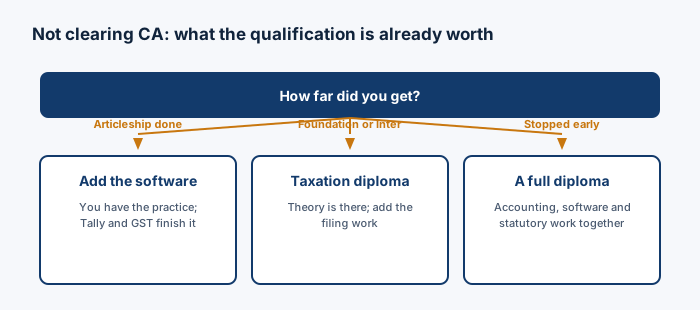
The attempt was not wasted, and this is not consolation
People who have studied for CA and not cleared consistently undervalue what they know, because they are measuring it against the qualification rather than against the job market.
Against the job market it looks different. You have covered accounting standards, direct and indirect taxation, audit, and corporate law to a depth that no vocational diploma reaches. If you cleared the Foundation and one or more Intermediate groups, you have a documented record of that. Articleship, if you did any, is real experience that employers understand.
Set against a commerce graduate with none of that, you are ahead on theory by a wide margin. What you are usually behind on is narrower than you think, and it is practical: the software, the portals, the speed. Those are months of work, not years.
The honest assessment of whether to continue
Nobody outside your situation can make this call. But there are questions that make it clearer, and they are worth answering on paper rather than in your head.
- Are your marks moving? Attempts that trend upward are a different situation from attempts that sit flat. Flat across three tries usually means the method is the problem, and repeating it produces the same result.
- Is the obstacle the material or the circumstances? Studying while working full-time, or through a family situation, is a different failure from not understanding the subject. The first can change. The second needs a different approach, not another attempt.
- What is the real cost of another attempt? Not the fee — the year, the income foregone, and the compounding difficulty of explaining a long gap later.
- Would you advise a friend in your position to continue? People are consistently more honest about someone else’s situation than their own.
Continuing is a legitimate answer. People clear on the fourth and fifth attempt. The failure mode is not continuing — it is continuing without deciding to, drifting attempt to attempt because stopping feels like defeat.
What actually stays open
More than people assume in the weeks after a result.
Employment in accounts and finance
This is the most common route and the most underrated. Companies hire CA dropouts specifically, because the theoretical depth is real and the training cost is lower. What usually blocks it is the practical gap described above, and closing it takes a matter of months.
Taxation practice
Direct and indirect tax is an area where CA-level study genuinely transfers. Practitioners working on GST and income tax compliance do not all hold the qualification, and the subject knowledge you already have is most of the distance.
CS, CMA, or a related qualification
Different examinations, different structures, and for some people a better fit. Worth investigating properly rather than dismissing as a consolation prize — they are not.
M.Com, or an MBA
If the academic route suits you and the CA format does not, these remain available and are a genuine change of approach rather than the same attempt again.
Articleship experience, used directly
If you completed articleship, that is practical exposure most candidates lack entirely. It counts, and it should be on your CV prominently rather than as an explanation.
What we would actually suggest
Whatever you decide about the examination, the practical gap is worth closing either way — it takes months, it is inexpensive relative to a CA attempt, and it makes you employable while you decide. It does not foreclose going back.
That is the only thing on this page that points at a course, and we would rather it read as a footnote than as the purpose. If it is useful: the Diploma in Taxation Law is three months and builds directly on tax study you have already done, and the Diploma in Financial Accounting is the broader twelve-month option. The guide to options after B.Com covers the alternatives, including several we do not sell.
If what you need right now is not a course, that is a completely reasonable place to be.
Frequently asked questions
Will employers hold the incomplete CA against me?
Generally no, and many treat it as a positive signal about the depth you studied to. Be straightforward about it rather than leaving a gap unexplained.
Should I remove CA from my CV?
No. Cleared groups are a documented achievement and articleship is real experience. Present them as what you have rather than as what you did not finish.
How long does it take to become employable?
If the theory is already there, the practical gap is usually a matter of months rather than years. The software and the portals are the bulk of it.
Can I work and continue attempting?
Many do. It is harder, and it is worth being realistic about which of the two you are actually prioritising, because attempting both at half effort is the most common way people lose several more years.