GST return filing is not one task. It is a calendar of them, running every month or every quarter, each with its own form, its own deadline and its own penalty for missing it. This guide sets out the whole cycle in the order it actually happens.
It is written for people who have to do the filing: junior accountants who have inherited the job, business owners who have decided to stop outsourcing it, and students learning compliance properly for the first time.
The returns you actually file
Most registered businesses deal with two forms every period, plus an annual return. Everything else is situational.
| Return | What it reports | Frequency | Due |
|---|---|---|---|
| GSTR-1 | Outward supplies — your sales invoices | Monthly | 11th of the following month |
| GSTR-1 (QRMP) | Same, quarterly filers | Quarterly | 13th of the month after quarter end |
| IFF | B2B invoices, months 1 and 2 of a quarter | Monthly | 13th |
| GSTR-3B | Summary return and tax payment | Monthly | 20th of the following month |
| PMT-06 | Tax deposit, QRMP filers | Monthly | 25th |
| GSTR-2B | Auto-drafted statement of available credit — you read it, you do not file it | Monthly | Generated by the portal |
The order the work happens in
The sequence matters more than most guides admit, because since 2025 the forms feed each other and errors no longer stay local to the form you made them in.
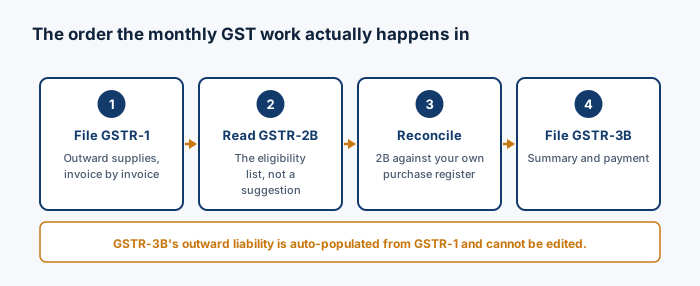
- Reconcile your sales register against the invoices you are about to report. Corrections are cheapest here, before anything is filed.
- File GSTR-1. This reports your outward supplies and, importantly, it now determines part of your GSTR-3B.
- Read GSTR-2B. The portal drafts it from what your suppliers filed. It tells you what input tax credit is actually available, which is not necessarily what your purchase register says.
- Reconcile purchases against GSTR-2B. Any gap is a supplier who has not filed, and it is your credit that is stuck.
- File GSTR-3B and pay.
What changed in 2025, and why it matters
This is the part worth reading carefully, because a lot of older guidance describes the previous behaviour.
Since the July 2025 tax period, the outward liability in Tables 3.1 and 3.2 of GSTR-3B is auto-populated from your GSTR-1 and is non-editable on the portal. You cannot quietly fix a GSTR-1 mistake by typing a different figure into GSTR-3B, which was common practice before. Corrections have to be made through GSTR-1A before GSTR-3B is filed.
Input tax credit in Table 4 is likewise auto-populated from GSTR-2B.
The practical consequence: reconciliation stopped being tidy-up and became the only safeguard. Once GSTR-1 is filed, the error is downstream in a form you cannot edit. Anyone still treating GSTR-1 as a rough draft to be corrected later is working to rules that no longer exist.
What being late costs
Three separate consequences, and people usually only budget for the first.
- Late fee: ₹50 per day, capped at ₹10,000.
- Interest: 18% per annum on tax outstanding. Section 50(1) sets a ceiling of “not exceeding eighteen per cent” and the rate is fixed by notification; 18% is the notified rate.
- The three-year block: a GSTR-3B cannot be filed more than three years after its original due date. After that the tax period is permanently blocked.
The third is the one that ends businesses rather than merely costing them. A period you cannot file is a period you cannot regularise, and it sits on the record permanently.
Filing guides, step by step
- How to file GSTR-1 — outward supplies, table by table, including what to do when e-invoice data is auto-populated.
- How to file GSTR-3B — the summary return, the locked tables, and reconciling ITC against GSTR-2B.
- Input tax credit rules — the four conditions for claiming, the 180-day reversal rule, and apportionment under Rules 42 and 43.
- E-way bill rules — the ₹50,000 threshold, who generates the bill, and how validity runs by distance.
- GST late fee calculation — what a late return actually costs, why the daily figure is a waiver rather than the statutory amount, and the three-year bar under Section 39(11).
- TDS return filing — the quarterly forms, the two separate deadlines, and the three charges for lateness.
- PF and ESI returns — contribution rates, the monthly ECR deadline, and the coverage rules employers get wrong.
A month walked end to end: a worked example
The steps above make more sense with actual dates attached. Consider a hypothetical trading business, single state, monthly filer, working through August 2026.
Through August, the business raises invoices as it sells and keeps its sales register current rather than reconstructing it at month end. By 31 August the register shows outward taxable supply of Rs 18,50,000 for the month, with CGST and SGST at 9% each: Rs 1,66,500 CGST plus Rs 1,66,500 SGST, Rs 3,33,000 in total.
Between 1 and 10 September, before touching the GST portal, the accountant reconciles the sales register against the invoices actually raised. Two invoices worth Rs 40,000 taxable value between them were recorded in the accounting system but never pulled into the export used for filing; they get added now. The corrected outward figure is Rs 18,90,000, tax Rs 3,40,200.
On 11 September, GSTR-1 for August is filed with the corrected figures. Because the error was caught before filing, there is no need to touch GSTR-1A for this period; that route exists for mistakes found after the return has already gone in.
On 14 September, GSTR-2B for August generates on the portal, showing Rs 2,10,000 of available input tax credit. The purchase register for August shows Rs 2,25,000 claimed, a gap of Rs 15,000 traced to a single supplier who has not yet filed its own GSTR-1. A call on 15 September gets a promise to file within the week, but the credit does not appear in August’s GSTR-2B regardless of when the supplier eventually files, because that statement is generated for the period and does not retroactively refill itself.
On 20 September, GSTR-3B for August is due. The outward liability of Rs 3,40,200 arrives auto-populated from GSTR-1 and cannot be edited. Table 4 is completed with Rs 2,10,000 of ITC, the figure GSTR-2B actually supports, not the Rs 2,25,000 the purchase register would suggest. The missing Rs 15,000 is not lost; once the supplier files, it will show up in a later period’s GSTR-2B and can be claimed then, subject to the Section 16(4) time limit described on the input tax credit page. The balance tax is paid and the return is filed on time.
Nothing in this month was unusual. A missed invoice, a supplier running late, a deadline met through three separate filings. That is the ordinary shape of a compliance month, and the dates above show where each step actually falls against the calendar rather than in the abstract.
Every return at a glance, including the ones this guide has not covered yet
The table earlier in this guide covers the two returns and supporting forms that apply every period. The table below adds the returns that apply annually, or only to composition taxpayers, because a filing calendar that shows only monthly obligations misses the ones that arrive once a year and catch people out precisely because they are unfamiliar.
| Return | Who files it | Frequency | Due date | What it does |
|---|---|---|---|---|
| GSTR-1 | Regular taxpayers | Monthly or quarterly (QRMP) | 11th monthly; 13th after quarter-end (QRMP) | Reports outward supplies, invoice by invoice |
| GSTR-3B | Regular taxpayers | Monthly or quarterly (QRMP) | 20th monthly; QRMP filers file quarterly on a date staggered by state grouping | Summarises liability and ITC, and is where tax is actually paid |
| GSTR-9 | Regular taxpayers above the notified turnover exemption | Annual | 31 December following the financial year | Consolidates the year’s GSTR-1 and GSTR-3B filings into one annual return |
| GSTR-9C | Taxpayers above the notified turnover threshold for reconciliation | Annual | Filed alongside GSTR-9 | Reconciles annual turnover in the audited financial statements against the GST returns |
| CMP-08 | Composition scheme taxpayers | Quarterly | 18th of the month after quarter-end | Statement-cum-challan for the composition taxpayer’s quarterly tax payment |
| GSTR-4 | Composition scheme taxpayers | Annual | 30 April following the financial year | The composition scheme’s annual return |
The turnover thresholds that decide who must file GSTR-9 and GSTR-9C, and the exact QRMP GSTR-3B due dates by state group, have moved before and can move again. Confirm the figure that applies to a specific taxpayer on the GST portal or in the current CBIC notification rather than treating any number above as fixed.
Frequently asked questions
Do I have to file if I had no sales?
Yes. A nil return is still a return, and the late fee applies to a missed nil filing just as it does to any other.
What is the difference between GSTR-1 and GSTR-3B?
GSTR-1 reports your outward supplies invoice by invoice. GSTR-3B is the summary return where tax is actually paid. Since July 2025 the outward figures in GSTR-3B come from GSTR-1 automatically.
What is QRMP and should I use it?
Quarterly Return, Monthly Payment. Smaller taxpayers file GSTR-1 and GSTR-3B quarterly but still deposit tax monthly through PMT-06 by the 25th, and still furnish B2B invoices monthly through the IFF by the 13th. It reduces filing frequency, not payment frequency.
My supplier has not filed, so credit is missing from GSTR-2B. What now?
You cannot claim what is not there. The practical route is to chase the supplier before your own deadline, because once you have filed, recovering that credit becomes considerably harder.
Can I learn this properly rather than piecing it together?
The GST Practitioner Course covers the full compliance cycle over two months, including real-time filing exercises. If you want income tax and TDS alongside GST, the Diploma in Taxation Law runs three months.