Input tax credit is where most GST money is won and lost. Claim too little and you pay tax you did not owe. Claim what you were not entitled to and you face reversal with interest, at a rate set under a section that permits up to 24%.
This page covers the conditions for claiming, the situations that force a reversal, and the two apportionment rules that catch businesses with mixed use.
The four conditions for claiming
Section 16 sets them, and all four must hold. Failing any one makes the credit unavailable, not merely delayed.
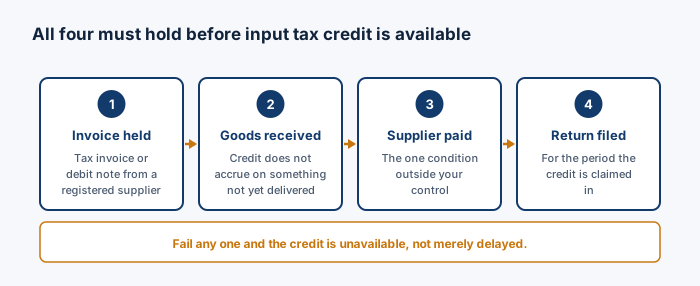
- You hold a tax invoice or debit note from a registered supplier.
- You have received the goods or services. Credit does not accrue on an invoice for something not yet delivered.
- The supplier has actually paid the tax to the government.
- You have filed the return for the period.
Condition three is the one outside your control, and it is the reason GSTR-2B matters so much. Credit only appears there once your supplier has reported the invoice in their GSTR-1. A supplier who has not filed is a supplier whose tax you cannot reclaim, however correct your own paperwork is.
The deadline nobody mentions until it has passed
The four conditions above decide whether a credit is valid. Section 16(4) decides whether you are still allowed to take it at all, and it is the provision that costs businesses the most money, because it expires quietly.
A registered person cannot take input tax credit on an invoice or debit note after the thirtieth of November following the end of the financial year the document pertains to, or the furnishing of the relevant annual return, whichever is earlier.
Two things follow, and both catch people out:
- It is the earlier of the two dates, not the later. If you file the annual return for a year in September, the window for that year closed in September — not on 30 November.
- A valid credit still expires. All four conditions can be met, the supplier can have filed, the invoice can be genuine, and the credit is still gone if the date has passed. Nothing about the underlying transaction rescues it.
The practical control is a single annual review: before the November deadline, reconcile the whole financial year rather than the month, and look specifically for invoices that never made it into a return. A credit found in December for the previous year is not a correction, it is a loss.
GSTR-2B is the eligibility list, not a suggestion
Your purchase register records what you bought. GSTR-2B records what your suppliers told the department they sold you. The gap between the two is the working list for every reconciliation.
Claiming credit that does not appear in GSTR-2B is the single most scrutinised entry on a return. In practice the recoverable route is almost always to chase the supplier into filing, not to claim anyway and argue later.
The 180-day rule
This one catches businesses that are otherwise careful, because it has nothing to do with paperwork and everything to do with cash.
If you claim credit on an inward supply and then fail to pay the supplier within 180 days of the invoice date, the credit must be reversed. Pay part of the invoice and the reversal is proportionate to the unpaid portion.
The credit can be reclaimed once payment is made. But in the interval you have reversed it, and the reversal carries interest.
The practical control is a payables ageing report read against your ITC claims, not just against your cash position. A supplier invoice sitting at 170 days is a reversal about to happen.
Reversal under Rules 42 and 43
These apply where inputs are used for more than one purpose, and they are mechanical rather than discretionary.
- Rule 42 covers inputs and input services used partly for business and partly for non-business purposes, or partly for taxable and partly for exempt supplies.
- Rule 43 covers the same split for capital goods, apportioned across a longer period.
Where a business makes both taxable and exempt supplies — common in education, healthcare and parts of financial services — the credit is apportioned rather than claimed in full. This is not optional, and it is a frequent source of demand at audit.
Blocked credits
Section 17(5) lists supplies on which credit is not available even where the supply is used in the course of business. Motor vehicles below a seating threshold, food and beverages, club memberships, and works contract services for immovable property are the ones that come up most often.
These are worth checking before claiming rather than after. A blocked credit claimed in good faith is still a wrongly availed credit.
A working sequence
- Download GSTR-2B for the period.
- Match it line by line against the purchase register.
- Investigate every difference. Missing from 2B means the supplier has not filed; missing from your register means you have not booked it.
- Remove blocked credits under Section 17(5).
- Apply Rule 42 or 43 apportionment where use is mixed.
- Check payables ageing for anything approaching 180 days.
- Claim the balance in Table 4 of GSTR-3B.
Steps 2 and 6 are where the money is. Everything else is bookkeeping.
Rule 37: the 180-day reversal, in numbers
The 180-day condition itself comes from the second proviso to Section 16(2) of the CGST Act. Rule 37 of the CGST Rules is the machinery. It prescribes how the reversal is worked out. Since the amendment effective 1 October 2022, the amount is paid or reversed in the GSTR-3B for the period immediately following the 180 days, with interest under Section 50. It is no longer added to output tax liability as it was before.
Credit does come back. Rule 37(2) entitles you to re-avail it once the supplier is paid, and Rule 37(4) disapplies the Section 16(4) time limit to that re-availment — so unlike an ordinary late claim, there is no deadline on it. Naming both provisions matters because a notice will cite them, and looking up the 180-day rule without the numbers is slower than it needs to be.
Take an invoice dated 1 March for Rs 2,00,000 taxable value, GST at 18% of Rs 36,000, with the full Rs 36,000 claimed as ITC in the March GSTR-3B. The 180-day window from the invoice date runs out around 27 August. If, by that date, only Rs 1,20,000 of the Rs 2,00,000 has actually been paid to the supplier, 40% of the invoice value remains unpaid. The reversal is proportionate to that unpaid share: 40% of the Rs 36,000 credit, Rs 14,400, has to be added back to output tax liability in the return for the period in which the 180 days lapse. Interest runs on that amount for the period it was wrongly held.
Once the remaining Rs 80,000 is paid to the supplier, say on 15 October, the Rs 14,400 can be reclaimed as credit in the return for that period. Nothing about the underlying invoice changes; only the cash position does.
Rule 42 and Rule 43: apportionment with figures
Rule 42 and Rule 43 exist because a business making both taxable and exempt supplies cannot claim full credit on inputs that serve both. The mechanics differ slightly between the two, and a worked figure makes the difference clearer than the description alone.
Rule 42, for inputs and input services
Take a business with Rs 5,00,000 of common input tax credit for a tax period, meaning credit on inputs and input services that cannot be attributed solely to taxable or solely to exempt supplies. Total turnover for the period is Rs 1,00,00,000, of which Rs 20,00,000, 20%, is exempt turnover. Under Rule 42, the ineligible portion of the common credit is calculated as the exempt share of turnover applied to the common credit: 20% of Rs 5,00,000, which is Rs 1,00,000. That Rs 1,00,000 is reversed and added to output tax liability. The remaining Rs 4,00,000 stays available as eligible credit.
Rule 43, for capital goods
Capital goods used for both taxable and exempt supplies are apportioned differently: the common credit is spread over a longer period rather than apportioned once. Take a capital asset with GST of Rs 6,00,000 at purchase, spread over five years, Rs 10,000 of common credit attributed to each month. If the exempt turnover ratio for a given month is 15%, the ineligible credit for that month is 15% of Rs 10,000, Rs 1,500, reversed with interest for that month. The following month’s ratio might differ, so the reversal is recalculated each month rather than fixed at purchase.
The figures above are illustrative, built to show the mechanics rather than drawn from a real filing. The ratio, the period used, and the treatment of the exempt turnover figure itself are all defined precisely in the rules; check the current rule text before applying either calculation to an actual return.
Section 17(5): the exceptions inside the blocked list
The blocked credit categories listed above are easy to state as an absolute rule, and doing so is not quite accurate for at least one of them. Motor vehicles are blocked from credit as a general position, but Section 17(5) itself carves out specific exceptions. Credit remains available where the vehicle is used for further supply of such vehicles, for transportation of passengers, or for imparting driver training on that class of vehicle. A business that trades in vehicles, runs a passenger transport service, or operates a driving school is not automatically shut out of credit that the categorical list, read on its own, suggests it should be.
The same pattern, a general block with a narrower carve-out for businesses whose actual trade is the blocked category, runs through other items in the section. The practical rule is to read the exception attached to the specific category before assuming the block applies, rather than relying on the summary list alone.
Frequently asked questions
Can I claim ITC that is not in GSTR-2B?
GSTR-2B reflects what suppliers have filed and is what the department reconciles against. Claiming beyond it invites scrutiny, and the practical remedy is usually to get the supplier to file.
What happens if I do not pay a supplier within 180 days?
The credit claimed on that invoice must be reversed, proportionately if part payment has been made. It can be reclaimed once payment is made.
What is the difference between Rule 42 and Rule 43?
Rule 42 apportions credit on inputs and input services; Rule 43 does the same for capital goods over a longer period.
Is ITC available on everything I buy for the business?
No. Section 17(5) blocks credit on specified supplies even where they are used in the course of business — certain motor vehicles, food and beverages, and club memberships among them. Several of those blocks carry express exceptions that turn on how the supply is used. Credit on motor vehicles is restored where they are used for further supply of such vehicles, for transport of passengers, or for driving training. Works contract services stay creditable where they are an input service for a further supply of works contract service. Only clause (g), personal consumption, keys off non-business use.
Where can I learn to do this properly?
The GST Practitioner Course covers input tax credit and reconciliation over two months with real-time filing exercises. See also how to file GSTR-3B, where the credit is actually claimed, and the full filing cycle.