An e-way bill is the document that makes a consignment legal in transit. Move goods above the threshold without one and the consignment can be detained, which costs considerably more than the ten minutes generating it would have taken.
The rules are short. The details that catch people are the threshold, who is responsible, and how validity is calculated.
When one is required
Rule 138 requires an e-way bill for movement of goods where the consignment value exceeds ₹50,000. That applies to interstate and intrastate movement alike.
Two cases need one whatever the value: inter-state movement of goods to a job worker, and inter-state movement of handicraft goods by a person exempt from registration. Individual states can also set a higher threshold for movement inside the state, so check the state before relying on the ₹50,000 figure for a purely local delivery.
Two points people get wrong:
- It is consignment value, not invoice value. A single movement carrying several invoices is assessed on the total.
- Individual states set their own intrastate thresholds, and several differ from ₹50,000. Check the position for the state you are moving goods within, not just the central rule.
Who generates it
Primary responsibility sits with the registered person causing the movement — usually the supplier. Where the supplier has not generated one, the transporter is required to, before the movement begins.
In practice this means a consignment can be detained for the failure of a party who is not the one standing with the vehicle. Confirming the bill exists before a vehicle leaves is cheaper than resolving it at a check post.
How long it is valid
Validity runs by distance rather than by a flat period.
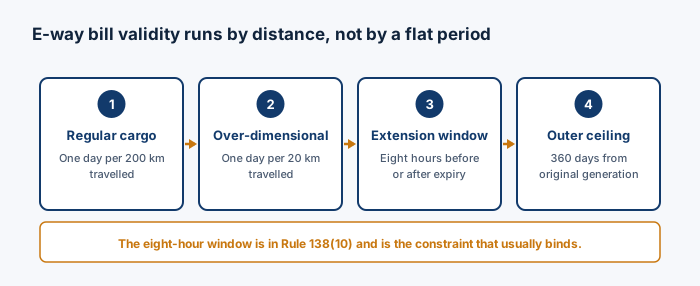
| Cargo type | Validity |
|---|---|
| Regular cargo | One day per 200 km |
| Over-dimensional cargo | One day per 20 km |
An extension has to be made within eight hours before or after expiry. That window is in Rule 138(10) itself and is the constraint that usually binds.
There is also a 360-day ceiling on extension, measured from the original generation date. That one is worth separating out: it is not in Rule 138. It is a restriction the e-way bill portal applies, announced by GSTN in December 2024 and in force from 1 January 2025, alongside the rule that a bill cannot be generated against a document more than 180 days old. A portal restriction can change without a notification, so check the portal rather than the rules if a long movement is close to the limit.
The failure mode worth planning around is a vehicle breaking down mid-route with a bill about to expire. Validity can be extended, but it has to be done before it lapses — afterwards the position is considerably worse.
What goes on the bill
Part A carries the consignment details: GSTIN of supplier and recipient, place of delivery, invoice or challan number and date, value, HSN code and reason for transport. Part B carries the transport details, principally the vehicle number.
Part A can be filled in advance. Part B has to be completed before movement, and a bill without Part B is not valid for transit.
When it is not required
Exemptions exist and are worth knowing rather than generating bills unnecessarily. Broadly: consignments below the threshold, goods exempt from e-way bill requirements under the rules, transport by non-motorised conveyance, and movement from a port or airport to an inland container depot for customs clearance.
The exempt list is specific. Check it against the current rules rather than assuming a category is covered.
What happens if goods move without a valid e-way bill
Section 129 of the CGST Act is the provision that makes the threshold in Rule 138 more than a paperwork requirement. It gives the proper officer power to detain and seize goods, and the vehicle carrying them, where they are moved without a valid e-way bill, or with one that does not match the consignment actually in transit. Detention happens at the check post or wherever the vehicle is stopped; release follows only after the matter is resolved, which usually means payment.
The Act sets the penalty as a proportion of either the tax payable or the value of the goods. It sets a materially higher amount where the person in charge of the goods does not come forward to claim them within the time allowed, and different treatment again for exempt goods. These figures have been revised by amendment before, so the exact percentage currently in force needs to be checked against the current text of Section 129 or a recent CBIC circular before it is relied on for a specific shipment. This page will not repeat a percentage on the assumption it has not changed since the last time it was checked.
What a worked example can still show, without needing that exact percentage, is the order of magnitude. Take a consignment worth Rs 3,00,000 taxable value, GST at 18%, Rs 54,000 tax, moved with a Part B that was never completed because the vehicle number changed at the last minute and nobody updated the bill. That is a bill without a valid Part B, which is not valid for transit. If the vehicle is stopped and the goods detained, even a penalty pitched at the lower end of what Section 129 allows adds tens of thousands of rupees to a shipment that would otherwise have cost nothing extra. Add to that the cost that arrives before any penalty is even calculated. A truck sitting at a check post is a day or more of demurrage, a driver and vehicle earning nothing, and, for anything perishable, stock that may not survive the delay. Completing Part B before the vehicle leaves the yard is a five-minute task set against that exposure.
Who generates the bill, scenario by scenario
Rule 138 assigns responsibility to whoever causes the movement, but that person is not always the same party, and getting it wrong leaves nobody having generated the bill at all.
| Scenario | Who generates it |
|---|---|
| Registered supplier sells and arranges its own transport | The supplier, before the goods leave |
| Registered supplier hands goods to a transporter to arrange carriage | The supplier generates it before handing over the goods; if the supplier has not, the transporter must generate it before movement begins |
| Unregistered supplier sells to a registered recipient | The registered recipient is treated as the party causing the movement and is responsible for ensuring a valid bill exists |
| Goods sent for job work | The principal sending the goods, or the registered job worker if it is the job worker initiating the movement; check the specific fact pattern against the rule rather than assuming |
The scenario that causes the most disputes is the second one. A supplier who assumes the transporter will handle it, and a transporter who assumes the supplier already did, can both be wrong at once, and the vehicle that gets stopped does not care whose assumption failed.
Validity by distance, worked
Validity is calculated from distance, not from a flat number of days, and the rule rounds in the mover’s favour for a part-day rather than against them.
Take a consignment of regular cargo travelling 850 km. At one day per 200 km, 850 divided by 200 is 4.25. The rule treats any distance remaining after full 200 km blocks as adding a further full day, so the bill is valid for 5 days from the time of generation, not 4. A 1,400 km movement, by the same logic, divides evenly into 7 days of validity. Over-dimensional cargo runs the same way at one day per 20 km, so the same 850 km movement is valid for 43 days, not 4 or 5. The 20 km rate is not for over-dimensional cargo alone: Rule 138(10) applies it equally to a multimodal shipment where at least one leg is by ship.
The distance entered when the bill is generated is the basis for this calculation, which is why an under-stated distance at generation is a validity problem waiting to surface mid-route, not just a data entry error.
Cancelling and extending an e-way bill
An e-way bill can be cancelled by the person who generated it, but only within a short window after generation. It can be cancelled only if the goods have not actually commenced movement or the bill has not already been verified in transit by an officer. Once an officer has verified it on the road, cancellation is no longer available; the bill is treated as having been used. The exact number of hours allowed for cancellation is set in the rules and is worth confirming on the portal before relying on it, since this is a detail that has been adjusted before.
Extension works the other way around the clock: it has to be applied for before the current validity lapses. The rules allow a narrow exception for extending shortly after expiry in defined circumstances, such as a vehicle breakdown or a natural calamity. But this is not a general grace period, and the safer practice is always to extend before the clock runs out rather than to rely on the exception being available. A validity period that quietly expires mid-route, with no extension filed, leaves the consignment in the same position as one that never had a bill at all: liable to detention under Section 129 if it is stopped.
What happens when the bill and the consignment do not match
A check post officer verifying an e-way bill is checking whether Part A matches what is actually on the vehicle: the goods description, the HSN code, the value, and the vehicle number in Part B. A mismatch, whether from a genuine error or from goods substituted after the bill was generated, is treated the same way as missing documentation for the purpose of Section 129. The officer can detain the consignment until the discrepancy is explained and resolved. Minor, explainable differences, such as a rounding difference in value, are treated differently in practice from a wholesale mismatch in goods description. But the safer assumption going into a check post is that any material difference invites the same detention risk as no bill at all.
Frequently asked questions
Is an e-way bill needed for intrastate movement?
Yes, above the threshold. Several states set their own intrastate limits, so check the position for the state concerned.
What is the threshold?
₹50,000 consignment value under Rule 138, subject to state-specific intrastate variations.
How is validity calculated?
One day per 200 km for regular cargo, one day per 20 km for over-dimensional cargo. Extensions are capped at 360 days from generation.
Who is responsible if the supplier has not generated one?
The transporter is required to generate it before movement begins.
Can Part B be left blank?
No. A bill without Part B is not valid for transit.
Where can I learn the wider compliance picture?
E-way bills sit inside the GST filing cycle, and the GST Practitioner Course covers them alongside registration, computation and return filing over two months.