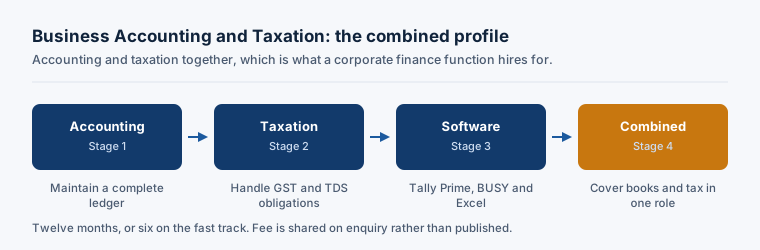
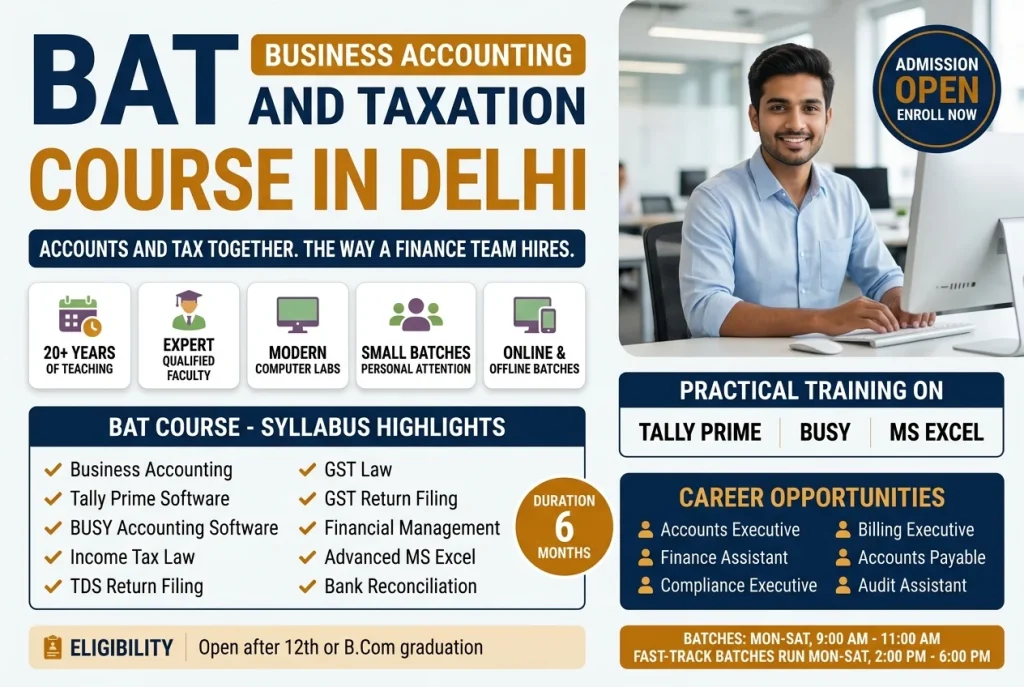
The Business Accounting and Taxation course sits between a pure accounting qualification and a pure taxation one. It runs for six months and is built for students aiming at accounts roles in the corporate sector, where both halves of the job arrive together.
In brief: the Business Accounting and Taxation (BAT) course runs six months at a fee of Rs 40,000, combining business accounting in Tally Prime and BUSY with taxation and financial management. The fee is shared on enquiry rather than published here, and classes run in classroom and online formats.
What is the BAT course?
BAT combines business accounting, taxation and financial management into one programme. The accounting half covers tracking income, expenses and profit and managing company assets, worked through Tally Prime and BUSY. The taxation half covers income tax law, TDS return filing, GST law and GST return filing — the compliance work that a company’s accounts department owns.
Financial management is the third component: budgeting, financial planning and cash flow management. This is the part that distinguishes BAT from a bookkeeping course, and the part that tends to matter when someone is considered for a more senior role.
Who should do this course?
The course is open after 12th or B.Com graduation. It suits students who know they want to work in a company’s accounts function rather than in independent practice, because it is organised the way a corporate accounts department is organised — accounting, compliance and planning as one job rather than three specialisms.
Six months suits students who need to be employable sooner and do not want to spend a full year studying before they start.
Fee and instalments
The fee for the BAT course is shared on enquiry, and monthly instalments are available. Call the institute on 9212008787 for current details, including batch timings and instalment terms.
Why study BAT at NIMB
The combination is the point. Studying accounting and taxation separately leaves a gap where the two meet, and that gap is most of the actual work in a corporate accounts department. Teaching is by practising chartered accountants, software work is hands-on, and the course runs in classroom or online mode with a fast-track option.
How the course is taught
The course runs six months, which suits students who do not want to give another full year to study. The accounting half is worked through Tally Prime and BUSY — tracking income, expenses and profit, and managing company assets. The taxation half covers income tax law, TDS return filing, GST law and GST return filing. Financial management runs alongside both: budgeting, financial planning and cash flow management, which is the component that distinguishes BAT from a bookkeeping course.
Classes run in both classroom and online mode, so the course can be taken alongside a job. Assessment is an online examination through the institute’s own portal: multiple choice questions, one hour. Students who pass receive the certificate or diploma for the course.
Career opportunities after this course
BAT is aimed at corporate accounts departments, where accounting, compliance and planning are treated as one job rather than three specialisms. The roles below reflect how those teams are actually organised.
Accounts Executive
The core corporate accounting role — maintaining books, supporting close, and working within a defined finance function rather than running one single-handed. BAT suits this because it covers the taxation and planning sides that a corporate role touches.
Taxation Executive
Handles the company’s direct and indirect tax compliance: income tax, TDS returns, GST law and GST return filing. A defined position in most companies large enough to have an accounts department.
GST Practitioner
Owns GST compliance specifically, registration, return filing and reconciliation. Within a corporate setting this is usually part of a larger tax function rather than independent practice.
TDS Executive
Deduction and collection at source, and the returns that follow. Technical, unforgiving of small errors, and consequently a role companies prefer to fill with someone trained rather than someone learning on the job.
Finance or MIS Executive
The financial management side of the course, budgeting, financial planning and cash flow management, points here. This is the part that separates recording what happened from being asked what should happen next, and it is what tends to matter for progression.
Earnings in these roles are shaped by the city, the employer and the accounting and tax work a candidate can demonstrate, none of which this page can quantify responsibly. Ask the institute what recent BAT students have actually been offered, since we won’t publish figures we can’t verify.
How this compares with our other courses
BAT and the Diploma in Financial Accounting are the two diploma-level options and the choice between them comes down to length and emphasis: DFA runs twelve months and goes further into accounting itself, including payroll and PF/ESI returns, while BAT runs six and gives more weight to taxation and financial management.
If you want taxation alone, the Diploma in Taxation Law is three months and the GST Practitioner Course is two. If you want to start earning quickly and study further later, begin with the Tally Course.
How to enrol in the BAT Course
Admission runs through a short conversation rather than an entrance test. Call the institute on 9212008787, or visit the centre at E-56, Laxmi Nagar, Delhi 110092, and an advisor will confirm the six-month schedule, take you through the current batch timings, and explain what the course covers in practice.
Deciding between BAT and DFA? DFA vs BAT Course compares them properly.
What you can do after each module
The programme covers four blocks that move from bookkeeping through to planning.
| Module | What it covers | What you can do afterward |
|---|---|---|
| 1. Business accounting in Tally Prime and BUSY | Tracking income, expenses and profit, managing company assets | Maintain a company’s books across two major accounting platforms |
| 2. Taxation: income tax law and TDS return filing | Computing a company’s income tax position and filing TDS returns | Work out a company’s income tax position and file its TDS returns correctly |
| 3. Taxation: GST law and GST return filing | Registering, computing and filing GST returns for a business | Register a business for GST and file its returns |
| 4. Financial management | Budgeting, financial planning and cash flow management | Build a basic budget, forecast cash flow, and speak to where a business’s money is going rather than only where it has been |
Who this course is not for
This is not the right course for someone who wants a fast, narrow qualification; GST and TDS are covered here as part of a bigger programme rather than as standalone modules you can finish quickly, and the GST Practitioner Course or Diploma in Taxation Law do that more directly. It is also not ideal for someone set on independent tax consultancy specifically, since BAT is built around corporate accounts department roles, where accounting and compliance sit inside one job rather than a client-facing practice; DTL leans further that way. And because the fee is not published on this page, if a fixed, known-upfront cost matters to your decision more than anything else, ask about that before comparing courses on content alone.
A realistic year, or six months over six months
On the twelve-month route, the first stretch is accounting fundamentals in Tally Prime and BUSY, running two software packages side by side rather than one after another. Taxation, income tax, TDS and GST, follows once the accounting groundwork is solid, and financial management, budgeting and cash flow, runs through the later months as the applied layer on top of both. The six-month fast track compresses the same three components for students who have already completed a degree and want a shorter run to employability. Expect a heavier weekly load than the twelve-month version covering the same ground in half the time.
BAT or the DFA course
BAT and DFA are the two twelve-month options here, and BAT is the one weighted toward taxation and financial management rather than a third accounting software package and payroll. If the deciding factor is whether a job needs budgeting and cash-flow skills or PF and ESI payroll skills, that is the actual difference, not the accounting fundamentals, which both courses share. DFA vs BAT Course sets out the comparison against specific role types.
The terms you will be working with
This course pairs two subjects that are usually taught apart, so it carries the vocabulary of both.
Business accounting is the day-to-day recording and reporting of what a company earns, spends, owns and owes.
TDS is tax deducted at source: the payer withholds tax when making a payment, and deposits it with the government on the payee’s behalf.
Input tax credit is the GST already paid on purchases, set off against the GST owed on sales.
A reconciliation is the comparison of two independent records of the same transactions: a bank statement against the cash book, or a purchase register against the credit the portal says you are entitled to.
A statutory due date is the date by which a return or a remittance must reach the government. Missing one costs money whether or not the underlying figures were right, which is why this course teaches the calendar alongside the work.
More questions about the BAT Course
Can I do this while working a job?
Yes, on the twelve-month route, which runs in classroom and online formats built to sit alongside a job. The six-month fast track is more demanding week to week and suits students who can commit more study time, typically recent graduates rather than those working full time.
What if I miss classes?
The course sequences accounting, then taxation, then financial management, so missing early sessions on Tally Prime or BUSY makes the taxation modules harder later. Talk to your advisor about how the batch handles catch-up before committing to the fast track in particular, since it has less slack built in.
What software do I need at home?
Nothing you need to purchase. Tally Prime and BUSY work happens during scheduled sessions on the institute’s systems; at home you mainly need a computer to revise and to join online classes.
Is the certificate recognised, and how is the course assessed?
Assessment for BAT is a one-hour, multiple-choice online exam set by the institute, and passing it earns the recognised certificate or diploma for the route you took. The fee is ₹40,000 for the six months; ask about the current instalment terms when you enquire.