NIMB EDU

No stream is best. The right one is the stream whose subjects you can work at for two years and whose doors lead where you want to go. Science keeps the most doors open, Commerce and Arts keep fewer, and the cost of that difference only matters if you want engineering or medicine.
That sentence is the whole decision in miniature. This guide shows how to apply it: which streams keep which careers open, which choices cannot be reversed, how to test a stream before you commit, and how to have this conversation at home. Stream is one of four routes after Class 10; the others, diploma, ITI and early skills, are laid out in all courses after 10th, by route.
Do you have to choose a stream at all?
In policy, no. In most schools, still yes. India’s National Education Policy 2020 says secondary school will have “no hard separation” among arts, humanities and sciences, or between vocational and academic streams, and promises more choice of subjects (NEP 2020, paragraph 4.9). That is the direction, not the timetable your school runs this year.
What you will meet in practice is a list of subject combinations offered by your school and board: a Science combination with Mathematics, one with Biology, a Commerce combination, and an Arts combination. Which combinations exist, and whether you can mix them, depends on the school. So the first practical step is simple: get the list of combinations your target schools offer, before you decide anything.
Which doors does each stream keep open?
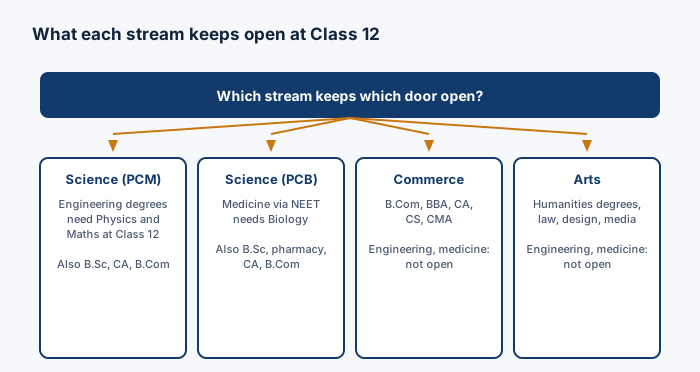
Science with Physics and Maths opens engineering, Science with Biology opens medicine, and every stream leads to many degrees and to CA. (PCM means Physics, Chemistry, Mathematics; PCB means Physics, Chemistry, Biology.) The two closed doors are the ones that matter most to understand, because they are the only ones you cannot reopen after Class 12.
| Career or route | What it asks of Class 12 | Source |
|---|---|---|
| Engineering degree (B.Tech, B.E.) | AICTE’s entry table lists Physics and Mathematics as mandatory for the main branches (Civil, Mechanical, Electrical, Electronics, Computer Science); a few, such as Biotechnology, Agriculture and Food Engineering, list other combinations | AICTE handbook, table 8.4 |
| Medicine (MBBS) via NEET-UG | Physics, Chemistry, Biology or Biotechnology, and English under NMC’s 2023 regulations | NMC Graduate Medical Education Regulations 2023, clause 11 (NEET-UG is run by the NTA) |
| B.Arch via JEE (Main) | Mathematics, Physics and Chemistry at Class 12; B.E./B.Tech asks for Physics and Mathematics plus one of Chemistry, Biotechnology, Biology or a technical vocational subject | NTA, JEE (Main) eligibility |
| NDA, Army wing | Class 12 pass; no subject is named | UPSC NDA (II) 2026 notice |
| NDA, Air Force and Naval wings; Naval Academy 10+2 cadet entry | Class 12 with Physics, Chemistry and Mathematics | Same UPSC notice |
| Commercial pilot licence | 10+2 with Physics and Mathematics, for every flight-crew applicant except the private pilot category | DGCA Pariksha FAQ |
| Law (CLAT UG) | 10+2 or equivalent with at least 45% marks (40% for SC, ST and PwD candidates); the Consortium’s page names no stream | Consortium of NLUs, CLAT 2027 UG eligibility |
| Chartered Accountancy | Class 12 from a recognised board; ICAI does not name a stream | ICAI FAQ |
| Most graduate government exams | A bachelor’s degree in any subject; a few posts need Maths at Class 12 level | SSC CGL notice |
| B.Com, BBA, B.A., B.Sc. | Set by each university; confirm for the course you want | University prospectus |
The new rows add two surprises. Defence and flying are not “Science only”: the Army wing of the NDA takes any Class 12 subject, while the Air Force and Naval wings, and a pilot licence, need Physics and Mathematics. And law is open to every stream, since the CLAT page asks for a Class 12 pass and a percentage, not a subject. Exam rules change, so read the notice for your year; the NDA row is from the 2026 (II) notice, and the CLAT row is from the page for the 2027 test.
Two more details in the table are worth stopping on. First, ICAI’s provisional-registration FAQ asks for a Class 12 pass from a recognised body and names no stream, so a Science or Arts student can become a CA. Second, the Staff Selection Commission’s CGL notice treats most posts as open to any graduate, but its Junior Statistical Officer post asks for at least 60% in Mathematics at Class 12 level, or Statistics as a degree subject. Stream rarely decides a government career, but it occasionally decides one post.
Which choice cannot be undone?
Leaving Physics and Maths, or Biology, is the one-way door. If you take Commerce or Arts in Class 11, engineering degrees and MBBS are out of reach, because the entry rules above require subjects you will not have studied. Going the other way is easy: a Science student can usually move to a commerce or arts degree after Class 12.
That asymmetry is the strongest practical argument for Science if you are undecided and can cope with the subjects. It is not an argument for Science if you will struggle with the subjects for two years. Marks in Class 12 still decide the college you get, and a student who spends two years failing Physics has not kept anything open.
What about Mathematics in Class 10?
If your board lets you choose between a basic and a standard Mathematics paper in Class 10 (CBSE does), the choice can affect Mathematics in Class 11. CBSE’s rules on this have been changed by circular in recent years rather than set once, so read the circular for your admission year on CBSE’s website, and ask your school what it will accept. Do not assume last year’s rule still applies.
How do you choose between Science, Commerce and Arts?
Match the stream to what you do when nobody is making you, then check it against the career you have in mind. These pairings are a starting point, not a verdict.
| If you tend to… | Lean towards | Watch out for |
|---|---|---|
| Enjoy solving problems step by step, and like Maths or Physics | Science (PCM) | Two years of heavy coaching alongside school |
| Like how bodies, plants and medicines work, and can memorise carefully | Science (PCB) | Medical seats are few and the entrance is competitive; have a second plan |
| Follow money, business or how companies work, and are comfortable with numbers | Commerce | Weak accounts or Maths can make this harder than it looks |
| Read, write, argue or draw, and want law, media, design or public service | Arts (Humanities) | Fewer purely professional entry routes; choose the career early |
| Prefer working with your hands and want to earn sooner | Not a stream: see diploma courses after 10th | A diploma or ITI is a real route, not a fallback |
Is Science the “toughest” stream and Arts the “easiest”?
No stream is easy once you aim high in it. Science has the heaviest daily workload for many students. Arts has fewer fixed professional doors, so success depends on choosing a destination such as law, civil services, design or teaching and working towards it. Commerce is not an easier Science: Accountancy, Business Studies and Economics reward steady practice, and Mathematics adds to the load where taken.
Which stream myths fail when you check them?
Most stream advice is repeated, not checked. These five claims are common, and each is settled by a regulator’s own document.
| The claim | What the document says |
|---|---|
| “Only Science students can become CA.” | ICAI’s provisional-registration FAQ asks for a Class 12 pass from a recognised board and names no stream (ICAI FAQ, above). |
| “You cannot join the NDA without Science.” | Half true. The Army wing takes any Class 12 subject; the Air Force and Naval wings need Physics, Chemistry and Mathematics (UPSC NDA notice, above). |
| “Arts students cannot study law.” | CLAT UG asks for a Class 12 pass with 45% and names no stream (CLAT 2027 page, above). |
| “Any stream can lead to a pilot licence.” | No. DGCA asks for Class 12 with Physics and Mathematics for every flight-crew applicant except the private pilot category (DGCA FAQ, above). |
| “Your stream decides your government job.” | Mostly not. SSC CGL treats most posts as open to any graduate; the Junior Statistical Officer post asks for Mathematics at Class 12 level (SSC CGL notice, above). |
What if your school does not offer the stream you want?
Ask the school for its list of subject combinations, in writing, before you accept a seat. If none fits, there are two other routes. A different school may offer the combination, and the National Institute of Open Schooling lets you build your own subject list: its Senior Secondary course follows a Class 10 pass from a recognised board and asks for a minimum of five subjects (NIOS admission procedure). Some institutions expect specific subjects for specific courses, so check your target course’s rule before you pick, as the table above shows for engineering, medicine and flying.
Does the second CBSE board exam change the stream decision?
Only the timing. CBSE’s notification of 14 February 2026 lets a passed student improve in up to three subjects of Science, Mathematics, Social Science and languages in a second Class 10 exam, and says the first exam is mandatory (CBSE notification). If a subject you need for a stream, say Mathematics or Science, is your weak spot, the second exam is a second chance at it. Ask your target schools whether their stream cut-offs use the first result or the better one, since a school sets that for itself. Other boards have their own rules.
How can you test a stream before you commit?
Spend two weeks on it, using the free textbooks. NCERT publishes its textbooks at ncert.nic.in. Download the Class 11 book for the one or two subjects that scare you most, and do the first chapter’s exercises without help. This gives you something the Class 10 marksheet cannot: how you feel after two hours with the subject.
- Pick the hardest subject in the stream. Physics for PCM, Biology for PCB, Accountancy for Commerce, Political Science or History for Arts.
- Do one chapter’s exercises across a week. Note what you finish, what you skip, and whether you wanted to keep going.
- Ask a Class 12 student in that stream for a typical week of homework and tuition.
- Compare how you felt with how you did. Liking it and finding it hard is fine; disliking it and finding it easy is a warning.
How do you put it together in one page?
Write three lines for each stream you are considering, then compare. The aim is to replace opinion with evidence you can point to.
| Line | What to write | Where the answer comes from |
|---|---|---|
| Evidence of interest | One thing you did in this subject area without being asked | Your two-week test, above |
| Door check | The Class 12 subjects your target career asks for | The table above, then the regulator’s own page |
| Cost of being wrong | What you would do if the stream goes badly: a school change, NIOS, a different degree after Class 12 | Your family conversation, below |
If every line points to one stream, choose it. If two streams tie, choose the one with the more open door check: Science with Physics and Mathematics (PCM) keeps engineering, B.Arch, the NDA’s Air Force and Naval wings and a pilot licence available, but only if you can do well in it, as the section on one-way doors explains.
What should parents and students ask each other?
Put the career question first and the marks question second. A student who can say what they want in one sentence can usually be matched to a stream in minutes. A student who cannot is better served by an honest conversation about interests than by a stream chosen because a cousin did well in it.
- For the student: What did I do this year without being told? Which subject did I stay up with?
- For the parent: Am I choosing for the child’s strengths or for a job I recognise? Can I afford the coaching this stream assumes?
- For both: If this stream goes badly, what is our plan for Class 12? What would we do differently?
If the answers do not come easily, that is a reason to talk to someone neutral, not a reason to guess. NIMB offers career counselling for exactly this stage.
What if your Class 10 marks are lower than you hoped?
Lower marks narrow the choice of school, not the choice of future. Schools set their own cut-offs for Science and sometimes for Commerce, so a low aggregate may mean you cannot get PCM at your first-choice school. It does not mean you cannot get it anywhere, and it does not mean the other routes are poor. Apply in the stream you want to several schools, keep a diploma or ITI application open in parallel, and read the improvement-exam rules for your board if your marks fell short in a single subject.
What comes after the stream?
Each stream leads to its own set of choices after Class 12. When you get there, courses after 12th science, courses after 12th commerce and courses after 12th arts cover them in detail, and all courses after 12th shows the whole map. For the commerce-to-CA route specifically, see how to become a chartered accountant.
Frequently asked questions
Which stream is best after 10th?
There is no best stream. Science keeps the most doors open, especially engineering and medicine, but only if you can handle the subjects. Commerce suits business, finance and CA, and Arts suits law, media, design and public service. Choose by what you can sustain for two years and by the career you want.
Which stream is best for a high salary?
None, on its own. Income depends on the career, the institution and the years you put in, not on the stream label. Guides that rank streams by salary rarely cite a source, and we do not quote figures we cannot verify. Look at the career you want and its published pay data instead.
Can I become a CA after taking Science or Arts?
Yes. ICAI’s provisional-registration FAQ asks for a Class 12 pass from a recognised board and does not name a stream, and it lets a Class 10 pass register provisionally; the Foundation exam can be taken once you have appeared in Class 12. See the CA course explained for the full route.
Can I take Science without Mathematics?
Often yes, through the Biology combination (PCB) where your school offers it. That keeps medicine open but closes engineering, which asks for Physics and Mathematics. Check what your board and school offer.
Can I change my stream after Class 11?
It depends on the school and the board, and the rules are strict in many places. Do not count on switching. Treat the Class 11 choice as the one you will finish with, and test it first as described above.
Which stream is best for a government job?
For most graduate-level posts, stream does not matter, because the notice asks for a degree in any subject. Some posts name a subject: SSC’s CHSL notice asks for Science with Mathematics for certain Data Entry Operator posts, and CGL’s Junior Statistical Officer asks for Mathematics at Class 12 level. Read the notice for the post you want.
Is a diploma better than Science if I am unsure?
Not better, but a legitimate alternative if you already know you want a technical career. A three-year diploma can lead to the second year of a B.Tech through lateral entry, with conditions on marks and seats; see diploma courses after 10th.
Which stream is best for the army, navy or air force?
It depends on the entry. The Army wing of the NDA asks for a Class 12 pass with no subject named, while the Air Force and Naval wings ask for Physics, Chemistry and Mathematics (UPSC NDA (II) 2026 notice). Other defence entries have their own rules, so read the notice for the one you want.
Can I become a pilot with Commerce or Arts?
Not for a commercial licence, as DGCA’s examination FAQ asks for Class 12 with Physics and Mathematics from every flight-crew applicant except the private pilot category. A Commerce student who takes Mathematics but not Physics, or an Arts student without either, would not meet it.
What marks do I need in Class 10 to get Science?
The school decides. We found no regulator document that sets a Class 10 mark for a stream, and NEP 2020 says secondary school will have “no hard separation” among streams. Ask each target school for its cut-off in writing, and apply to several.
Still deciding?
Take the two-week test, ask your target schools for their subject combinations, and write the career you want in one sentence before you choose. If you would like a second opinion, book career counselling or call 9212008787 or message us on WhatsApp with your Class 10 marks and the subjects you like.