NIMB EDU
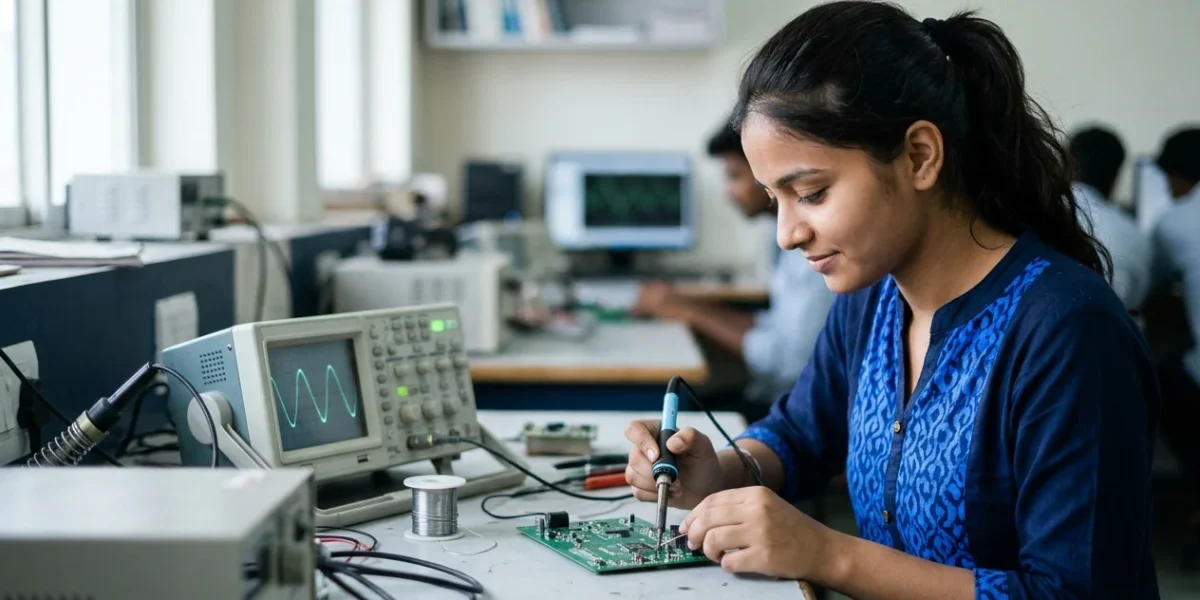
Polytechnic courses after 10th mean, in most cases, a three-year diploma in engineering and technology, approved by AICTE and run through your state’s technical education board. The national entry rule is only “passed Class 10”; the rest, including whether you sit an entrance test, is decided by your state.
The diploma courses after 10th guide covers the whole family of diplomas and which ones are not really open after Class 10. This page goes deeper on one thing: the polytechnic itself. It shows the three doors into a diploma (Class 10 is only the first), the exit points AICTE allows along the way, how Uttar Pradesh, Maharashtra and Bihar set theirs from official documents, and what the diploma leads to, with the pay the railway notices state.
What is a polytechnic course after 10th?
It is the three-year diploma that AICTE lists under “Engineering and Technology”, with Class 10 pass as the entry qualification (AICTE Approval Process Handbook 2024-27, Annexure 8). It is taught in AICTE-approved institutes, government or private, under a state board of technical education. Students who finish get a diploma; those who want a degree can seek lateral entry into the second year of a B.Tech.
It is a different thing from an ITI trade, which is a National Trade Certificate in a single trade under DGT (ITI courses after 10th compares them). A polytechnic teaches an engineering branch more broadly and for longer, and its main promise is the route to technician jobs and to a degree.
What are the ways into a polytechnic?
Class 10 is the usual door, but not the only one. There are three. AICTE’s table lets students enter the second year of a diploma from two other starting points, which matters if your plans change.
| Door | Enters at | Condition in AICTE’s table |
|---|---|---|
| Class 10 pass | Year 1 of the 3-year diploma | “Passed 10th Std./SSC examination” |
| Class 10 plus a two-year ITI | Year 2 | Eligible for the second year of a diploma in any branch of engineering and technology; bridge courses offered |
| Class 12 in the listed subjects | Year 2 (lateral entry) | 10+2 with subjects such as Physics, Mathematics, Chemistry, Computer Science, Electronics, Information Technology or a technical vocational subject, as per the handbook’s table 8.4 |
The practical meaning: a student who misses a seat after Class 10 can still reach the same diploma through a two-year ITI or after Class 12 Science, though seats at year 2 are limited. Pharmacy is the exception to remember: the Pharmacy Council of India describes D.Pharm as a course after 10+2 (PCI FAQs), so it is not a polytechnic door after Class 10.
Can you leave a diploma early and still have something to show?
Yes. AICTE’s handbook describes exit points so that a student who leaves is not left with nothing. It states that students who exit after the first year may be awarded a Certificate of Vocation, and after the second year an Industrial Training Certificate or Diploma of Vocation, with the full diploma at the end of year three (Annexure 8).
Treat this as a safety net, not a plan. Whether a given board actually awards these certificates, and whether employers recognise them, depends on the state. Ask the institute whether it awards them and what the certificate is called.
Which branches does a polytechnic offer?
Branches differ by institute, and a single polytechnic seldom offers all of them. The commonly offered engineering branches are civil, mechanical, electrical, electronics and communication, computer science and automobile. Choose the branch by the work you picture yourself doing, and then check that your institute is approved for that branch.
| Branch | The kind of work it trains for | Check before you choose |
|---|---|---|
| Civil | Construction sites, surveying, estimating, drawings | Survey instruments and a materials lab in the institute |
| Mechanical | Machines, production, maintenance, workshop | A working workshop, not only classrooms |
| Electrical | Wiring, power distribution, motors, maintenance | Electrical machines lab and safety training |
| Electronics and communication | Circuits, telecom equipment, repair and testing | Lab access per student |
| Computer science | Programming basics, networks, support roles | Whether hardware and software labs are current |
| Automobile | Vehicle systems, servicing, workshop supervision | Tie-ups with service centres or workshops |
The work descriptions are general, not job offers; we have not found an official placement table by branch to quote. Use them to narrow the choice, then ask each institute for last year’s recruiter list.
How does admission work in different states?
It varies, so never rely on a rule you read for another state. Uttar Pradesh uses an entrance test; other states publish their own counselling schedules on portals. The table records only what we could confirm from an official page.
| State and portal | What the official source shows |
|---|---|
| Uttar Pradesh (JEECUP / UPJEE(P)) | The 2026 brochure lists the 3-year Diploma in Engineering and Technology (Group A) with Class 10 pass and a minimum of 35% marks; admission is through an online entrance test (15 to 22 May 2026), with half the paper on mathematics and half on physics and chemistry, and then counselling. A separate group (K) admits ITI-passed students directly to the second year. Minimum age is 14 on 1 July 2026 (UPJEE(P) 2026 information brochure, in Hindi). |
| Haryana (technical admissions portal) | The portal runs separate admission streams for Diploma (Engineering), Diploma (Engineering) lateral entry and Diploma (Pharmacy); it also runs a separate counselling for each. Read the current prospectus for subject and mark conditions. |
| Maharashtra (Directorate of Technical Education) | DTE’s site lists “Post SSC Diploma 2026” on its own portal and says first-year engineering and architecture diploma admission for 2026-27 began on 20 May 2026. The latest brochure we could read is the Government of Maharashtra’s 2025-26 one (hosted by a government polytechnic, because the DTE copy was offline): an Indian national who passed Class 10 or SSC with at least 35% aggregate marks, admitted through the Centralised Admission Process on a merit list, not an entrance test (DTE information brochure 2025-26). Confirm the 2026-27 text before you rely on it. |
| Bihar (BCECE Board) | The DCECE 2026 prospectus covers the three-year engineering diploma group (PE): a pass in the matriculation or an equivalent Class 10 examination, with no minimum or maximum age for that group, and seats allotted by rank in the DCECE entrance test, which was held on 23 May 2026. Applicants must fall in a listed residence category, such as parents who are permanent residents of Bihar (DCECE 2026 prospectus, bilingual). |
| Telangana (TG POLYCET 2026 notification) | Admission is by TG POLYCET rank. A candidate must have passed SSC (or a recognised equivalent such as CBSE, ICSE or NIOS) with Mathematics as one of the subjects and at least 35% marks; NIOS, open-school and other-board candidates must pass all subjects including Mathematics, Physics and Chemistry with at least 35% in each. There is no age restriction for admission, though the scholarship has age caps of 20 years (OC) and 24 years (others) as on 1 July 2026. The notification schedules first-phase slot booking from 27 to 31 May 2026, certificate verification from 29 May to 1 June, physical reporting at the allotted college from 8 June 2026 and spot admissions to 8 July 2026. |
| Tamil Nadu (DOTE admission portal) | Runs polytechnic admissions through its own portal; we could not read the eligibility text from the page, so confirm there. |
| Delhi (Directorate of Training and Technical Education) | The portal’s 2026-27 notice says admission to approved institutes affiliated with the Board of Technical Education, Delhi, began on 25 May 2026. We could not read the eligibility text from an official document, so read the current notice. |
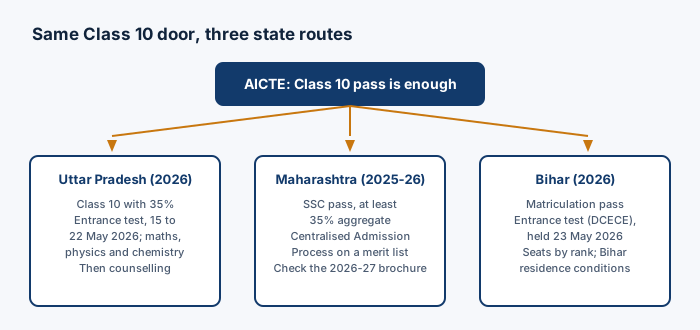
Two lessons from the table. First, states that test (Uttar Pradesh and Bihar) mean preparation for Mathematics, Physics and Chemistry starts well before Class 10 results, while Maharashtra’s route rewards your Class 10 marks. Second, lateral-entry streams exist as separate processes in the same portal, so a student coming from ITI or Class 12 should register for the right stream and not for year-one admissions.
What do the state rules have in common, and where do they differ?
Read side by side, the 2026 documents above agree on the floor and differ on the gate. All of them start from a Class 10 pass, and Uttar Pradesh and Telangana both set 35% (Maharashtra’s brochure also says 35% aggregate). They differ on three things worth checking before Class 10 results arrive.
| Question | What the official documents show |
|---|---|
| Is Mathematics required? | Telangana asks for Mathematics among the Class 10 subjects. Uttar Pradesh tests mathematics, physics and chemistry in its entrance paper. We did not find a subject condition in the Maharashtra or Bihar documents we read. |
| Is there an age limit? | Uttar Pradesh sets a minimum of 14 on 1 July 2026. Bihar’s engineering group has no minimum or maximum. Telangana has no age limit for admission, only age caps for its scholarship. |
| How is the seat decided? | Entrance rank in Uttar Pradesh, Bihar and Telangana; a centralised merit list in Maharashtra. |
| When did the 2026 cycle run? | Uttar Pradesh test 15 to 22 May; Maharashtra first-year admission began 20 May; Bihar test 23 May; Delhi admissions began 25 May; Telangana first-phase certificate verification from 29 May and spot admissions to 8 July. |
The dates are 2026 dates. Cycles move each year, but the pattern holds: tests and registration fall in April and May, before or around the time Class 10 results come out, and counselling runs through June and July. Start collecting documents before results are declared.
How do you apply, step by step?
- Read your state’s current prospectus for eligibility, the test (if any) and seat categories. Each document cited above is that state’s own.
- Register online and pay the processing fee. Telangana’s notification, for example, requires the SSC hall ticket number and date of birth, a processing fee and a slot booking before you can attend certificate verification.
- Sit the entrance test if your state holds one, or wait for the merit list if it does not.
- Verify documents at the help-line or counselling centre. Telangana’s list includes the rank card, Aadhaar card, SSC marks memo, study certificates, transfer certificate and, where applicable, income, EWS, caste and residence certificates. Expect a similar list elsewhere, with local terms.
- Fill your branch and institute options in order of preference and accept the allotment through the portal.
- Report to the college by the date given. Telangana’s notification warns that a seat not reported for stands cancelled, and that a rank alone does not guarantee admission.
Is there a scholarship for polytechnic students?
Some students qualify. The PM YASASVI guidelines on the National Scholarship Portal define “Group 4” as non-degree courses entered after Class 10 and name three-year polytechnic diplomas and ITI courses among them (PM YASASVI guidelines). The copy we read covers 2021-22 to 2025-26, so confirm on the portal that the scheme continues, and read the eligibility for your own category and state; the Telangana notification shows that states add their own age caps.
What does a polytechnic diploma lead to?
Three things: technician jobs, a degree by lateral entry, and an apprenticeship. Each has documented conditions.
Jobs that name a diploma
Railway recruitment shows one concrete example. CEN 02/2026 listed Technician Grade I (Signal) at Level 5, with an initial pay of Rs 29,200, for 323 of its 6,557 vacancies, at ages 18 to 33 as on 1 July 2026. It accepted a three-year engineering diploma in the relevant streams, a degree in engineering, or a B.Sc. in listed subjects such as Physics, Electronics, Computer Science, Information Technology or Instrumentation. The same notice listed 6,234 Technician Grade III vacancies at Level 2 (Rs 19,900) that asked for Matriculation plus ITI, and said a diploma or degree would not be accepted in place of ITI for those Level 2 posts unless specified (RRB CEN 02/2026). The higher-paid diploma post therefore had about 5% of the cycle’s vacancies. A diploma is useful for such posts, but it is not a mass-recruitment ticket. High salary courses after 10th sets this against other routes.
Junior Engineer posts are the better-known diploma target, and two 2025 notices show them. Railway CEN 05/2025 invited applications for Junior Engineer, Depot Material Superintendent and Chemical and Metallurgical Assistant posts at Level 6, with an initial pay of Rs 35,400, ages 18 to 33 as on 1 January 2026 and 2,569 vacancies across all Railway Recruitment Boards. It accepted a three-year diploma in engineering, with B.E. or B.Tech accepted in the same discipline (RRB CEN 05/2025). The Staff Selection Commission’s Junior Engineer (Civil, Mechanical and Electrical) examination, 2025 was for Group B posts at Level 6, Rs 35,400 to 1,12,400, and listed a three-year diploma in the matching branch as the qualification for most organisations (some also accept a degree), with an age limit of up to 30 or 32 years as on 1 January 2026 depending on the post. It announced 1,340 tentative vacancies, and the final vacancy list (its file is dated 24 June 2026) totalled 1,731 (SSC notice and final vacancy list).
Read these two against the technician notice above and a pattern appears: the diploma opens the Level 5 and Level 6 posts, not the mass Level 1 and 2 posts, and those posts come in cycles with age limits and competitive tests. Branch matters too, because each post names the branch it accepts, so a diploma in the wrong discipline does not qualify. Both are single recruitment cycles, not standing offers.
A degree by lateral entry
A three-year diploma holder can seek the second year of a B.Tech. AICTE’s handbook caps lateral-entry seats at 10% of an institute’s approved intake, over and above regular seats, plus unfilled first-year vacancies (clause 6.13). The same handbook sets a 45% marks minimum (40% for reserved categories), as the diploma guide explains. The door exists but is narrow, so treat diploma marks as seriously as Class 12 marks.
An apprenticeship
Under the minimum rates notified in September 2019, the first-year stipend for a technician apprentice or diploma holder is Rs 8,000 a month, against Rs 7,000 for a National or State certificate holder (PIB, Lok Sabha reply of 14 September 2020). The reply said no increase was then being considered, so confirm current rates with the employer or the apprenticeship portal.
Polytechnic, ITI or Classes 11 and 12?
Choose polytechnic if you already lean toward engineering and want a qualification you can build on. Choose Classes 11 and 12 if you want medicine, CA or a wide choice of degrees. Choose ITI for a single trade and an earlier start. Which stream after 10th gives a two-week test to settle it, and courses after 12th science shows what the school route opens.
What mistakes do students make?
- Waiting for results before preparing documents. The 2026 tests and registrations fell in April and May.
- Assuming a test-free route. Uttar Pradesh, Bihar and Telangana admit by entrance rank; only Maharashtra’s brochure we read admits on a merit list.
- Applying to year one when you qualify for year two. ITI and Class 12 candidates have separate lateral-entry streams.
- Choosing a branch by name alone. Posts name the branch they accept, and approval is per branch.
- Trusting “approved” without checking. See below.
How do you judge a polytechnic before paying?
- Is the institute approved by AICTE for your branch and year? Approval is per programme, so check the branch. AICTE’s public dashboard has separate tabs for approved institutes, closed institutes and unapproved institutes; look the name up there (AICTE dashboard).
- Is the diploma awarded by the state board? “Our own diploma” is a skill course, not a polytechnic diploma.
- Is admission through the state process? Ask what your seat is under, and keep the allotment letter.
- Are the labs and workshop real? Visit, or ask for a recent video walk-through, and look for the equipment your branch needs.
- Is the full fee in writing? Include hostel, exam and material charges. No national fee figure exists to compare against, because fees are set by states and institutes.
- Who promises placement? No institute controls hiring. Ask for last year’s recruiter list and speak to a former student.
Frequently asked questions
What is the eligibility for a polytechnic after 10th?
AICTE requires only a Class 10 pass. States add conditions: Uttar Pradesh’s 2026 brochure asks for a minimum of 35% marks in Class 10 and an entrance test, Maharashtra’s 2025-26 brochure asks for 35% aggregate and admits on merit, and Bihar’s 2026 prospectus admits by rank in an entrance test. Other states publish their own rules. Read your state’s current prospectus.
Is a polytechnic the same as a diploma?
Yes, in the common usage. “Polytechnic” is the institute and “diploma” is the qualification it awards after three years.
Can I do a polytechnic after 12th?
Yes. AICTE’s table lets students with Class 12 in subjects such as Physics, Mathematics, Chemistry or Computer Science enter the second year through lateral entry, subject to available seats.
Is a polytechnic better than Classes 11 and 12?
Neither is better. A polytechnic suits a student who already knows the technical field; Classes 11 and 12 keep more degrees open, including medicine and CA. The diploma route to a degree exists but is narrower.
Which polytechnic branch has the best scope?
We do not rank branches, because no official source gives pay by branch at this level. Choose the branch you can enjoy for three years, and check what local employers hire for.
Can I do B.Tech after a polytechnic?
Yes, through lateral entry into the second year, with minimum marks (45% in AICTE’s rule; 40% for reserved categories) and a limited number of seats.
Are polytechnic fees quoted anywhere official?
Fees vary by state, by government or private status, and by branch, and we found no single official table. Ask the institute or your state portal for the fee schedule in writing.
How many years is a polytechnic course?
Three years after Class 10, with a full diploma at the end of year three. AICTE also allows exit certificates after years one and two, as described above.
Is polytechnic better than ITI?
Neither is better. A polytechnic diploma is longer, broader and has a documented route to a B.Tech; an ITI is shorter and trade-specific. A two-year ITI can also lead into year two of a diploma, as the ITI guide explains.
Can I get a government job after a polytechnic diploma?
Yes, in notices that name the diploma. Railway CEN 05/2025 and the SSC Junior Engineer examination 2025 both listed a three-year engineering diploma as a qualification at Level 6. These are competitive, cycle-based recruitments with age limits, not guaranteed postings.
Is Mathematics compulsory for a polytechnic?
Not in the national entry rule, which only requires a Class 10 pass. States add their own conditions: Telangana asks for Mathematics among the Class 10 subjects, and Uttar Pradesh tests mathematics, physics and chemistry. Read your state’s prospectus.
What is the age limit for a polytechnic?
It is set by the state. Uttar Pradesh’s 2026 brochure sets a minimum of 14 on 1 July 2026; Bihar’s engineering group has no minimum or maximum; Telangana has no age limit for admission but caps its scholarship at 20 years (OC) or 24 years (others).
Still deciding?
If you are weighing a diploma against school or a trade, talk it through: book career counselling, or call 9212008787 or message us on WhatsApp with your Class 10 marks and the subjects you enjoy. We will compare routes with you, including ones we do not teach.