The Diploma in Financial Accounting is the longest course NIMB runs, twelve months, and the most complete. It is aimed at students who want the whole job rather than one skill: the accounting, the software, the payroll, and the statutory returns that come with employing people.
Quick summary: the Diploma in Financial Accounting (DFA) is a twelve-month program priced at Rs 60,000 with instalment options, covering Tally Prime, BUSY and SAP FICO alongside payroll, PF and ESI filing. Classes run in classroom and online formats and are open after 12th or B.Com.
What is the Diploma in Financial Accounting (DFA)?
DFA is a job-oriented diploma that takes someone from accounting fundamentals to being genuinely employable in an accounts department. Over twelve months it covers financial accounting itself, then the three software packages an Indian accounts department is most likely to run, Tally Prime, BUSY and SAP FICO, followed by payroll and taxation.
The payroll component is worth calling out, because it is often skipped elsewhere: payroll accounting, provident fund, ESI matters, and the actual filing of PF and ESI returns. Banking and financial services are covered alongside, and taxation is treated as it applies inside an accounts department rather than as a separate discipline.
Who should do this course?
The diploma is open after 12th or after B.Com graduation, and students from commerce and non-commerce backgrounds are both accepted — the course starts from fundamentals, so a non-commerce background is not a barrier.
It suits two groups: freshers who want a complete qualification before their first accounting job, and working accountants who learned on the job, are competent at what they do, and are held back by gaps — usually payroll, statutory returns, or a second software package.
Certification and examination
The institute conducts an online multiple-choice examination of one hour through its portal, and awards a diploma certificate on completion.
Fee and what it covers
The Diploma in Financial Accounting fee is ₹60,000. It is the institute’s most substantial course at twelve months, and instalment options are available — ask about these when you enrol rather than assuming the fee must be paid in full up front.
Why study financial accounting at NIMB
Twelve months is long enough to actually become competent rather than merely certified, which is the difference the course is built around. Teaching is by practising chartered accountants, software work is hands-on across Tally Prime, BUSY and SAP FICO, and the payroll and statutory return content reflects what accounts departments genuinely need done.
How the course is taught
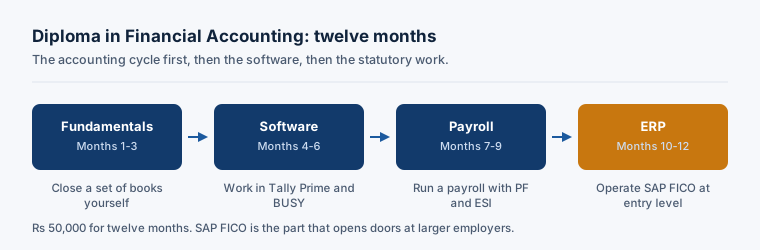
Twelve months is long enough to become competent rather than merely certified, and the course is structured around that. It begins with accounting fundamentals — which is what makes it workable for students from non-commerce backgrounds — then moves through the three software packages an Indian accounts department is most likely to run: Tally Prime, BUSY and SAP FICO. Payroll follows, including provident fund and ESI matters and the actual filing of PF and ESI returns, with taxation treated as it applies inside an accounts department rather than as a separate discipline.
Classes run in both classroom and online mode, so the course can be taken alongside a job. Assessment is an online examination through the institute’s own portal: multiple choice questions, one hour. Students who pass receive the certificate or diploma for the course.
Career opportunities after this course
DFA is the broadest course here, and the roles reflect that. Because it covers three software packages plus payroll and statutory returns, it opens positions that a single-software certificate does not reach.
Accounts Executive
The core destination. Maintains the books, handles receivables and payables, reconciles accounts and supports month-end close. The role most directly served by a twelve-month diploma, because it expects competence across the whole accounting cycle rather than one part of it.
Junior Accountant
The entry position in most accounts departments, usually reporting to a senior accountant or the finance head. What distinguishes candidates here is practical software fluency — being able to work in Tally or BUSY on day one rather than after three months of training.
Payroll Executive
Runs salary processing, provident fund and ESI, and files those returns. Worth singling out: payroll is routinely skipped in accounting courses and routinely required in accounting jobs, and being able to do it is a common reason someone moves past assistant level.
Accounts Assistant
Supports a larger accounts function with data entry, invoice processing and reconciliation. Often a first step, and the diploma tends to move students past it faster than a short certificate does.
Accounting roles in banking and financial services
Banks, NBFCs and financial services firms hire accounting staff for internal finance functions. The banking and financial services component of the diploma is aimed at this route.
What a DFA graduate earns depends heavily on the city, the size of the accounts department and the breadth of software skills shown at interview. Rather than quote unverified salary figures, we’d rather you ask the institute what recent diploma students have gone on to earn.
How this compares with our other courses
DFA is the broadest course we run. If twelve months is more than you want to commit, the BAT Course covers similar ground with a six-month fast track, and the Tally Course gets you employable in one month with the option to continue later.
If you specifically want taxation rather than the whole accounting job, the Diploma in Taxation Law goes deeper into income tax and GST than DFA does. Students unsure about computers often take the Basic Computer Course first — the Excel work in particular pays off across everything that follows.
How to enrol in the Diploma in Financial Accounting
Admission runs through a short conversation rather than an entrance test. Call the institute on 9212008787, or visit the centre at E-56, Laxmi Nagar, Delhi 110092, and an advisor will confirm the twelve-month schedule and instalment options, take you through the current batch timings, and explain what the course covers in practice.
Deciding between DFA and the BAT Course? DFA vs BAT Course compares them properly. From a non-commerce background? Read this first.
What you can do after each module
Twelve months covers six blocks. Each one adds a distinct, checkable skill rather than repeating the last.
| Module | What it covers | What you can do afterward |
|---|---|---|
| 1. Accounting fundamentals | Financial accounting from first principles, built to work for non-commerce backgrounds too | Read and prepare basic financial statements and explain double-entry accounting |
| 2. Tally Prime | Hands-on bookkeeping in the software most Indian businesses use | Maintain a full set of company books in Tally Prime |
| 3. BUSY | A second major accounting software package | Operate a second widely used accounting platform, useful since employers vary in which one they run |
| 4. SAP FICO | Enterprise-level financial software | Navigate SAP’s financial module, relevant when applying to larger organisations |
| 5. Payroll, PF and ESI | Payroll accounting, provident fund and ESI matters, and filing PF and ESI returns | Run a payroll cycle and file the statutory returns that go with it |
| 6. Banking, financial services and taxation | Accounting entries relevant to banks and financial services, plus taxation as it applies inside an accounts department | Handle the taxation and banking-related entries a company accountant meets day to day |
Who this course is not for
This course is not for someone who wants to be earning within a month or two; twelve months is a genuine commitment, and the Tally Course or GST Practitioner Course get you into work far sooner if income is the immediate priority. It is also not the most efficient route for someone who only wants to specialise in taxation or independent consultancy rather than a company accounts role. A large share of the twelve months goes into a second and third software package and payroll, which mainly pays off inside an accounts department. And if the fee genuinely will not stretch to Rs 60,000 even with instalments, the Tally Course followed later by the GST Practitioner Course or Diploma in Taxation Law builds toward similar employability in smaller, cheaper steps.
A realistic year on this diploma
Twelve months divides roughly into thirds. The opening stretch is fundamentals; students who struggled with accounting at school often find this the hardest part, precisely because it moves slowly and deliberately. The middle stretch is where the software work concentrates, Tally Prime first, then BUSY, then SAP FICO, and this is where most hands-on lab time sits. Payroll, PF and ESI filing come later, once the accounting groundwork is solid enough to make sense of statutory deductions. Because the course runs a full year, most working students treat it as a standing weekly commitment rather than something to finish in a burst.
DFA or the BAT course
DFA runs twelve months and the BAT course six, and both combine accounting with taxation, so the overlap is real. The practical difference is depth versus breadth. DFA spends its extra six months on a third software package, SAP FICO, and on payroll, PF and ESI filing specifically, while BAT gives more of its six months to financial management and tax compliance. DFA vs BAT Course goes through which matters more for a specific career goal.
The terms you will be working with
Twelve months is long enough that the vocabulary changes as you go. These are the terms the diploma is built around.
Financial accounting is the recording, classifying and summarising of a business’s transactions into the statements that show what it owns, what it owes, and how it performed.
The accounting cycle is the sequence from recording a transaction to closing the books at period end. Making that sequence automatic is what the first three months of this diploma exist for.
A trial balance is the list of every ledger balance at a point in time. It checks that debits equal credits, which catches arithmetic errors and says nothing at all about whether an entry was classified correctly.
SAP FICO is the finance and controlling module of SAP, the ERP system larger companies run their accounts on. It is the part of this diploma that opens doors at bigger employers.
Payroll is the computation of what each employee is owed and what must be withheld from it, together with the statutory remittances that follow.
More questions about the Diploma in Financial Accounting
Can I do this while working a job?
Yes, though twelve months alongside a full-time job is a longer commitment than most of the shorter courses here. Classes run in classroom and online formats, and most working students treat the online sessions as the practical option for a year-long course.
What if I miss classes?
A year-long diploma has more room to recover from a missed session than a two-month course does. But the software modules build on each other, Tally Prime before BUSY, BUSY before SAP FICO, so falling behind on one makes the next harder. Talk to your advisor early if you know you will miss a stretch.
What software do I need at home?
You don’t need to buy Tally Prime, BUSY or SAP FICO licences yourself. The hands-on software work happens during scheduled lab sessions on the institute’s systems; at home you mainly need a computer for revision, practice exercises and the online class sessions.
Is the certificate recognised?
The diploma certificate is issued and recognised by the institute on completion of its exam. What tends to matter more to employers than the certificate itself is the software fluency and payroll experience behind it, which is why the course is built around hands-on work rather than classroom instruction alone.