Tally Prime is the software most Indian businesses actually keep their books in, which makes it the most directly employable single skill on this list. The Tally course at NIMB runs one month for the basic level and two months for advanced, and is built around using the software rather than describing it.
Quick summary: the Tally Course runs two months for Rs 10,000, covering financial records, inventory, payroll and GST entries inside Tally Prime. It’s taught in classroom and online formats and open to freshers, accountants and business owners alike.
What is the Tally course?
The course teaches Tally Prime as it is used in a working accounts department: managing financial records, handling inventory, running payroll, and dealing with GST and other taxation matters inside the software. Tally is used across Asia and in many European countries, by organisations from small businesses to multinationals, which is why the skill travels well between employers.
The basic course covers the fundamentals over one month. The advanced course runs for two and goes further into the areas where Tally does real work, complex inventory, payroll, and taxation handling.
Who should do this course?
The Tally course suits people who need an employable skill quickly. Freshers take it as a first qualification; working accountants take the advanced course to fill gaps; and business owners take it to manage their own books rather than outsourcing routine entries.
It is also the most common starting point for students who are not yet sure how far they want to go. One month is a small commitment, and it credits naturally towards the longer accounting diplomas if you decide to continue.
Certification and examination
The institute conducts an online multiple-choice examination through its portal and awards a certificate on completion.
Fee
The fee for the Tally course is ₹10,000. For the advanced course fee, call the institute, the two are priced separately.
Why study Tally at NIMB
The course is taught by practising chartered accountants who use the software daily, and the sessions are hands-on. Both classroom and online modes are available, and two months is short enough that you can be usefully qualified quickly.
How the course is taught
The course teaches Tally Prime as it is used in a working accounts department rather than as a feature tour: managing financial records, handling inventory, running payroll, and dealing with GST and other taxation matters inside the software. The basic course covers the fundamentals in one month. The advanced course runs two and goes further into the areas where Tally does real work, complex inventory, payroll and taxation handling.
Classes run in both classroom and online mode, so the course can be taken alongside a job. Assessment is an online examination through the institute’s own portal: multiple choice questions, one hour. Students who pass receive the certificate or diploma for the course.
Career opportunities after this course
Tally competence is expected in junior accounting roles in India rather than treated as a bonus, which cuts both ways: it rarely wins a job alone, but its absence loses one. These are the positions it opens.
Accounts Assistant
The most common first destination. Handles data entry, invoice processing, basic reconciliation and day-to-day book maintenance in Tally. A one-month certificate plus a commerce background is frequently enough to be interviewed for this.
Junior Accountant
A step up, with responsibility for maintaining a set of books rather than only entering into them. Reachable with the advanced course, particularly if you can also handle GST entries.
Billing or Data Entry Executive
Invoice generation, billing and record-keeping inside Tally. Common in retail, distribution and small manufacturing, where volume matters more than complexity.
Inventory or Store Accountant
Tally handles inventory alongside accounts, and businesses carrying stock need someone who can manage both. The advanced course covers the inventory side properly.
Freelance bookkeeper
Maintaining books for several small businesses at once. Realistic once you are genuinely fluent, and a common way to earn while studying something longer.
How much these roles pay comes down to the city, the size of the business and the Tally skills a candidate can prove at interview, not anything fixed. We’d rather point you to the institute for real, current answers than publish salary guesses.
Where to go after Tally
Tally is deliberately a starting point. Once you are comfortable in the software, the natural next steps are the GST Practitioner Course, which teaches the compliance work you will be doing inside it, or the Diploma in Financial Accounting if you want the complete accounts role including payroll and statutory returns.
For a corporate accounts department, the BAT Course combines accounting and taxation. If you are not yet confident with computers generally, the Basic Computer Course is the better place to start.
How to enrol in the Tally Course
Admission runs through a short conversation rather than an entrance test. Call the institute on 9212008787, or visit the centre at E-56, Laxmi Nagar, Delhi 110092, and an advisor will confirm whether the basic or advanced course suits you, take you through the current batch timings, and explain what the course covers in practice.
Wondering whether this is enough on its own? Is a Tally course enough to get a job?
What you can do after each module
The basic course covers three blocks; the advanced course adds two more on top.
| Module | What it covers | What you can do afterward |
|---|---|---|
| 1. Financial records in Tally Prime (basic) | Setting up a company and recording day-to-day transactions | Set up a company in Tally and record transactions independently |
| 2. Basic inventory (basic) | Tracking stock alongside accounts | Manage stock records for a small business inside Tally |
| 3. GST and taxation entries (basic) | Entering GST-relevant transactions inside the software | Enter GST-relevant transactions inside Tally without switching to another tool |
| 4. Complex inventory (advanced) | Multi-location and batch-tracked stock | Manage stock that goes beyond simple item counts |
| 5. Payroll and deeper taxation handling (advanced) | Running payroll and more complete GST and taxation workflows inside Tally | Run a payroll cycle inside Tally and handle taxation workflows beyond the basic-course level |
Who this course is not for
This is not the course for someone who wants to understand tax law itself, income tax, TDS and GST rules, rather than just operating the software; the GST Practitioner Course or Diploma in Taxation Law teach the rules, this teaches the tool. It is also not enough on its own for someone who wants a complete accounts department skill set, payroll statutory filing, multiple software packages, financial planning; the DFA or BAT courses cover that ground properly. And if you have never used a computer at all, the basic course moves through Tally screens quickly; the Basic Computer Course first will save you from learning two new things at once.
A realistic two months
The two-month course is short enough that most weeks map to a topic: setting up a company and recording transactions first, then basic inventory, then GST and taxation entries toward the end. The second month slows that pace down and adds complex inventory and payroll on top, which is why it takes as long as it does for material that sounds, from a syllabus list, like only a modest addition. Tally rewards repetition more than most software; students who practise on sample data between sessions tend to move faster than those who only watch demonstrations.
Is Tally enough on its own?
Tally competence gets you an interview more often than it gets you hired outright, since employers increasingly expect it as a baseline rather than treat it as a differentiator. Is a Tally course enough to get a job? answers that question directly, and it is worth reading before assuming one month of software training is the whole plan.
The terms you will be working with
Tally has its own vocabulary, and most of the mistakes beginners make come from a handful of words that sound interchangeable and are not.
TallyPrime is accounting software used across Indian small and medium businesses to keep books, track inventory, run payroll and prepare the data behind GST returns.
A ledger is an account that records transactions of one kind: one customer, one bank account, one expense head.
A group is the classification a ledger sits under, and it decides where that ledger appears in the balance sheet or the profit and loss account. A ledger filed under the wrong group produces correct entries and a wrong statement.
A voucher is the record of a single transaction. The voucher type, whether payment, receipt, sales, purchase, contra or journal, determines how the entry is treated.
A contra entry is a movement of money between a business’s own cash and bank accounts. It is not a payment, because nothing has left the business, and recording it as one is the most common early error.
More questions about the Tally Course
Can I do this while working a job?
Yes, particularly the two-month course. Classes run in classroom and online formats, and the short duration is built to fit around a job rather than require time off.
What if I miss a class?
Because Tally is learned by doing, missing a session on a topic like inventory or payroll means that block does not get reinforced before the next one. Ask your advisor how the batch handles make-up sessions if you know you will be away.
What computer or software do I need at home?
A computer with internet access is enough for the online sessions. You do not need your own Tally Prime licence to attend, since the hands-on software work happens on the institute’s systems during class.
Is the certificate recognised?
The certificate is awarded and recognised by the institute on passing its exam. Tally fluency itself is what employers actually test at interview, often by asking you to work through a scenario live, so treat the certificate as evidence of completion rather than the whole proof of skill.
What you can actually do after each stage
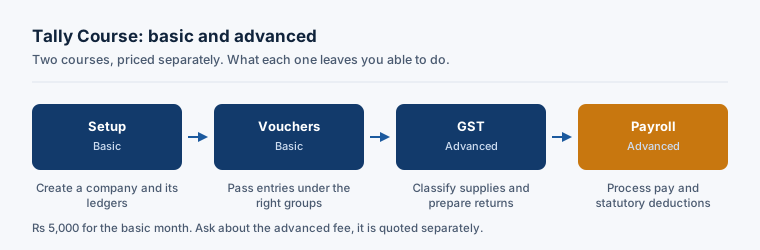
The basic and advanced courses are sold separately, and the honest way to choose between them is by what each one leaves you able to do rather than by duration.
| After | You can | You still cannot |
|---|---|---|
| The two-month course | Create a company, set up ledgers under the right groups, pass day-to-day vouchers, and produce a trial balance and a profit and loss account | Handle GST classification confidently, run a payroll, or find the cause when a report looks wrong |
| The full two months | Classify supplies for GST, prepare the data behind a return, run payroll with statutory deductions, and reconcile against a bank statement or a purchase register | File the returns themselves, which happens on the government portals and is covered in the GST Practitioner Course |
Most people who come for the basic course and intend to work in accounts end up doing the advanced one. If that is already your intention, ask about taking them together rather than as two separate enrolments.
Where this course stops
Tally is software. Accounting is the subject the software records. A person who knows every screen in TallyPrime and cannot say why an entry belongs where it does is a fast data entry operator, and will be paid like one.
That is not an argument against learning Tally — it is the most asked-for package in Indian job adverts and the fastest route to a first accounts job. It is an argument against stopping here. We have written honestly about whether a Tally course is enough on its own, and the short version is: often yes for a first job, rarely for the second.
If you want to see what the software is actually doing, the TallyPrime guide covers the reasoning, and GST entries in TallyPrime covers the part that decides your return.