 NIMB EDU
The best way to choose a course is to run your options through five filters in order. Ask what interests you, what you are good at, what you can afford in money and years, how you get in, and what the job market actually offers. Each filter removes options, and what is left is a short list you can compare side by side.
Most career guidance pages stop at “follow your passion” or list courses by stream with unsourced salary ranges. This guide gives you a method you can apply tonight. It uses official data for the parts that can be checked: labour-market numbers from the Ministry of Statistics, enrolment numbers from the Ministry of Education, and the education policy that now governs course design. Facts were checked on 26 October 2026. If you already know your stage, jump to the stage table under filter 4.
What is career guidance, and how is it different from counselling?
Career guidance is the process of matching what you want and can do to a course and a job. Counselling is one way to get it: a conversation with a trained person who looks at your marks, interests, constraints and goals. Guidance can also come from a school teacher or a family member who works in the field. An official service is the National Career Service (NCS) portal, which lists job seekers, counsellors and career centres and runs a toll-free helpline on 1514 (National Career Service).
The national education policy treats this as a public responsibility. NEP 2020 calls for career counselling in schools to identify student interests and talents. It also calls for counselling systems in every education institution, which it describes as handling stress and emotional adjustment (Ministry of Education, NEP 2020). In practice, many schools have little time for it, which is why students end up choosing by default.
How do you choose the right course? A five-filter method
Work through the filters in the order below, and write your answer to each one. The order matters: interest and aptitude narrow the field cheaply, while money and the job market test whether the survivors are realistic.
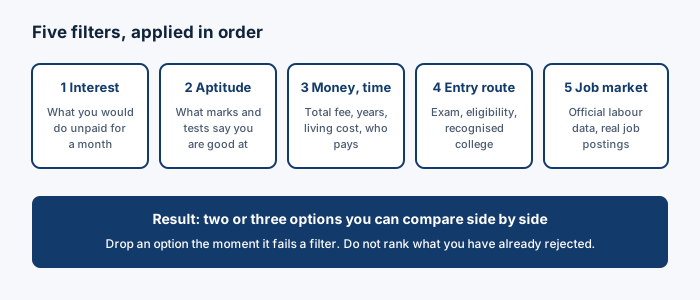
| Filter | The question to answer | Evidence to use | Warning sign |
|---|---|---|---|
| 1. Interest | Which three subjects or tasks would you choose for a free afternoon? | Your own list, written before you talk to anyone | Your list is exactly what your friends chose |
| 2. Aptitude | Where do your marks and practice results beat the class average without heavy effort? | Class 9 to 12 marks by subject; sample papers from the exam you are considering | You like a subject you consistently score poorly in |
| 3. Money and time | What is the total cost, in years and rupees, including living costs? | The regulator’s or university’s fee page, written down in full | Only the first-year fee is quoted |
| 4. Entry route | Which exam or eligibility rule decides your admission? | The official bulletin of the current cycle | Admission is “guaranteed” without an exam or merit rule |
| 5. Job market | What work does this lead to, and who hires for it? | Official data, live job listings, a person who works in the field | Salary claims with no source or year |
Filter 1 and 2: interest and aptitude
Interest is what you will keep doing when it gets hard; aptitude is what you can do well without grinding. You need both, but they are tested differently. Test interest by trying the work: read a first-year textbook chapter, watch a lecture, or do a short project in the field for a week. Test aptitude with evidence you already have. Compare your marks by subject over three years, then take a sample paper of the entrance exam you are considering under timed conditions. A single online “aptitude test” can be a useful prompt, but treat the result as one input, not a verdict.
Filter 3: money and time
Count the whole cost, not the first year. Write down the years to qualify, the total fees, living costs if you move, and what you will earn, if anything, during training. Professional courses show why. A chartered accountant spends years on exams and training before the full qualification, and the fee is spread across stages. Read CA course fees and how to become a chartered accountant before deciding. For any degree, check recognition on the UGC website, and for technical programmes, on the AICTE website.
Filter 4: the entry route
Every serious route has a gate. Know which exam or eligibility rule guards it, and read the current year’s bulletin, because rules change between cycles. The stage hubs below lay out the gates, with official sources, for each point where you choose.
| Where you are | Start here | Then compare |
|---|---|---|
| Finishing Class 10 | Courses after 10th | Which stream after 10th and diploma courses after 10th |
| Finishing Class 12 | Courses after 12th | Science, commerce, arts, and which course is best |
| Graduated or about to | Courses after graduation | Best courses after B.Com |
| Want a government job | Government jobs after 12th | The recruiter’s own notice, every cycle |
Filter 5: the job market
The labour market is where good plans get tested, so use official numbers, not the salary range on a course brochure. The Ministry of Statistics’ Periodic Labour Force Survey (PLFS) reported that youth (15-29) unemployment fell to 9.9% in 2025 from 10.3% in 2024, with urban youth at 13.6%. It also reported that unemployment among educated persons (secondary and above) fell to 6.5% from 7.0% (MoSPI, PLFS Annual Report 2025 press note). The same note puts average monthly earnings of regular wage or salaried workers at Rs 24,217 for men and Rs 18,353 for women in 2025. These are all-education averages, so they are a floor to compare against, not a promise for any course.
Competition on the supply side matters too. The Ministry of Education’s All India Survey on Higher Education (AISHE) counted 4.50 crore students in higher education in 2023-24, up from 4.46 crore in 2022-23 (PIB, AISHE 2022-23 and 2023-24 release, July 2026). The discipline split we could verify from a primary source is the earlier 2021-22 survey. In it, 78.9% of students were in undergraduate courses. The largest undergraduate enrolments were in Arts (34.2%), Science (14.8%), Commerce (13.3%) and Engineering and Technology (11.8%) (PIB, AISHE 2021-22). Treat the shares as indicative of the pattern, not as current figures. A big pool of graduates with the same degree means employers look for something extra: a professional qualification, a tested skill, or a portfolio. That is why this site stresses a second layer on top of the degree, such as accounting or Tally for commerce students. It is also why not clearing CA is a recoverable situation, not an ending.
To test a path against real demand, search live listings on the NCS portal, then ask two people who work in the field what the first two years look like. Both take about an hour.
What do the main entrance gates look like?
Filter 4 is easier when you can see the gates side by side. The table lists seven national gates, with one rule from each exam’s own latest notice. Each rule is only one line of a longer notice, so treat the table as a map and read the linked source before you plan.
| Route | Gate | What the latest official source says |
|---|---|---|
| Medicine (guide) | NEET (UG) 2026 | 180 compulsory questions in 180 minutes, 720 marks, plus 4 for a correct answer and minus 1 for a wrong one; candidates must be 17 by 31 December of the exam year; no upper age limit |
| Law | CLAT 2027 (UG) | At least 45% in Class 12 (40% for SC, ST and PwD); no upper age limit; students appearing in March or April 2027 may apply but must show proof of passing at admission |
| Design | UCEED 2027 | Class 12 passed in 2026 or 2027; candidates who first appeared in 2025 or earlier are not eligible; general candidates born on or after 1 October 2002 |
| MBA (after BBA) | CAT 2026 | Bachelor’s degree with at least 50% marks (45% for SC, ST, PwBD); final-year students could apply in the 2026 cycle, whose registration closed on 22 September 2026 |
| MCA (after BCA) | NIMCET 2026 | 60% in a three-year UG programme with Mathematics or Statistics, or a B.E./B.Tech. |
| M.Sc. (after B.Sc.) | IIT JAM 2027 | Seven papers, 60 questions, 100 marks; test on 14 February 2027; around 3,000 seats at 23 IITs |
| Civil services | UPSC CSE 2026 | Graduate degree of a recognised university in any subject; age 21 to 32 on 1 August 2026 for General candidates; about 933 vacancies expected in the 2026 cycle |
The pattern across the rows is the point. Most gates ask for a minimum percentage, many ask for a specific subject, and most have a short application window. Reading the notice in the final school or college year, not after it, is the most useful single habit this guide can give you.
Can you change your mind after you start a degree?
Often, and the policy now allows for it in the structure of the degree itself. NEP 2020 says an undergraduate degree will be of three or four years with multiple exit options. These are a certificate after one year in a discipline including vocational and professional areas, a diploma after two years, or a Bachelor’s degree after three years. It also describes an Academic Bank of Credit that digitally stores credits earned at recognised institutions (NEP 2020, section 11.9). In practice, each university decides how fast it adopts this. Before you start, ask the admission office three questions in writing. Can I exit with a certificate or diploma? Are credits transferable? What happens to my fee if I leave?
Moving across fields after a degree is also possible and is covered, with the entry rules, in the graduation hub linked above. The gates that close early are the ones that need specific Class 12 subjects, which is why filter 4 comes before you choose a stream.
How do you check a college or course before you pay?
Check the awarding or approving body, not the brochure. A short checklist:
- University degrees: confirm the university is recognised on the UGC website. For distance or online degrees, check the programme on the UGC Distance Education Bureau site at deb.ugc.ac.in, not on the provider’s own page.
- Engineering, management and other technical programmes: check approval on the AICTE website.
- Teaching (B.Ed): check recognition with the National Council for Teacher Education.
- Skill certificates: if a provider claims national recognition, look the qualification up on the National Qualifications Register.
- Rankings: the Ministry of Education’s NIRF publishes ranks by category for institutions that take part; a missing name is not a warning, but a claimed rank you cannot find there is.
- Money: get the total fee for the whole programme in writing, and never pay the full amount before you have the admission letter.
Does your stream decide your career?
Less than it used to. NEP 2020 sets as a principle that there should be no hard separations between arts and sciences, between curricular and extra-curricular activities, or between vocational and academic streams. It also criticises rigid separation of disciplines with early specialisation. Entrance exams still apply subject rules (for example, engineering routes need Mathematics, and medicine needs Biology), but many routes, such as CUET-based degrees, law and design, are open to every stream. The stage hubs list both the closed and the open doors.
What mistakes do students make when choosing a course?
- Choosing by salary headline. A top-package figure describes the best case at one college, not the typical outcome.
- Choosing by peers or pressure. Your friends’ interests are not yours. Your parents’ experience may be out of date, but their constraints on money are real. Discuss both openly.
- Skipping the entry route. A course is not an option if you cannot meet its eligibility rule or entrance exam.
- Paying before checking recognition. Confirm UGC or AICTE status first, and ask for the fee in writing.
- Treating the choice as permanent. Many routes let you add a second layer later, and graduates can move across fields, as courses after graduation shows.
Which course suits which kind of student?
There is no universal ranking, but patterns help. Use this table to find a guide to read next, then run the five filters on what it lists.
| If you are… | Likely routes to examine | Read next |
|---|---|---|
| Strong in Mathematics and Physics | Engineering, architecture, defence, pure sciences | Courses after 12th science |
| Drawn to numbers, business and money | B.Com, BBA, CA, CS, CMA, accounting skills | Best course after 12th commerce |
| Drawn to writing, law, society, media | BA, law, journalism, teaching, civil services | Courses after 12th arts |
| Wanting to earn sooner | Diplomas, skill courses, government recruitment | Diploma courses after 10th, government jobs after 12th |
| Already working or graduated | Professional courses, upskilling, specialisation | Courses after graduation |
How do you pick a career counsellor?
A good counsellor asks for your marks, interests, family constraints and goals before suggesting anything, and shows you the sources behind each option. Be cautious when someone recommends one institution before understanding you, guarantees a seat or a job, or asks for the full fee up front. Ask what the counselling covers, how long it takes, who will do it, and what it costs, and get those answers in writing before you commit. Our own career counselling page sets out how our sessions work.
Guides in this section
All guides in Choosing a Course

GST Course vs Diploma in Taxation: Which Should You Do?
A straight comparison of the two-month GST Practitioner Course and the three-month Diploma in Taxation Law — what each c…

DFA vs BAT Course: Which Twelve-Month Diploma Is Right?
The Diploma in Financial Accounting runs twelve months and the BAT course six, and they overlap heavily. Here is the act…

B.Com vs Accounting Course: Which Is Worth More?
A degree and a diploma do different jobs. What a B.Com gives you, what it leaves out, and when a practical accounting co…

Accounting Course Fees in Delhi: Who Publishes
We surveyed eight institutes for a published fee. Of the local ones we could reach, none stated a price. The method, the…

Which Accounting Course Should You Take?
Answer three questions and get a straight recommendation from the six courses at NIMB EDU — including when the honest an…
Frequently asked questions
How do I choose a career when I have no idea what I want?
Start with elimination, not discovery. List what you definitely do not want and check your strongest subjects by marks. Then try one low-cost experiment, such as a week of a short course or a conversation with someone in a field. Then run the five filters on the two options that survive.
Is career guidance worth it?
It is worth it when it gives you a decision method and sources you can verify, and not just a recommendation. Judge any guidance by whether you can check its claims on official sites.
What are the best career options after 12th?
It depends on your stream and goal. Science opens engineering and medicine, commerce opens accounting and finance, arts opens law, media and teaching, and several routes are open to every stream. See courses after 12th for the full map.
Can I change my stream or field later?
Often, yes. NEP 2020 favours flexibility between disciplines, and many postgraduate courses and professional exams accept graduates from other fields. Some routes, such as medicine and engineering at the undergraduate level, need the right Class 12 subjects, so check the eligibility rule early.
How do I know if a college is genuine?
Check whether the university is on the UGC website and whether a technical programme is approved on the AICTE website. Be wary of any institution that promises admission without an entrance or merit process.
Which career has the best salary in India?
No official source ranks courses by starting salary. The PLFS gives average earnings across all workers, and individual regulators sometimes publish placement data. Treat any single “best salary” claim as a prompt to ask for the source and the year.
Should I choose a government job or a private career?
Choose by what you can do and accept. Government recruitment has fixed exam stages, age limits and pay levels, which our government jobs guide sets out. Private careers vary more in pay and risk. You can prepare for both in a degree.
Where can I get free government career guidance?
The National Career Service portal lists job seekers, counsellors and career centres, and runs a toll-free helpline on 1514. NEP 2020 also says every education institution should have counselling systems for stress and emotional adjustment, so ask your school or college what it offers.
Is there an age limit for NEET?
Not an upper one. The NEET (UG) 2026 bulletin says candidates must have completed 17 years by 31 December of the exam year and states that there is no upper age limit. Read the next bulletin for the 2027 rule.
Can I leave a degree midway without losing everything?
NEP 2020 describes certificate, diploma and degree exit points after one, two and three years, with credits stored in an Academic Bank of Credit. Whether your university offers them depends on how far it has adopted the policy, so ask before you enrol.
Still deciding?
If you have run the five filters and still have two or three options, or you cannot get past the first filter, a conversation can help. Book a session through our career counselling page, or call or WhatsApp us on 9212008787. Bring your latest marks, any entrance scores and the options you are considering.