NIMB EDU
Most paramedical diplomas are not open after Class 10. The national regulator’s curricula for the lab, radiology and ophthalmic diplomas all ask for Class 12 with Physics, Chemistry and Biology. What is open after Class 10 is narrower: a few ITI health trades listed by DGT, a short skill certificate at the entry level, in Bihar a state-run Dresser course, and Classes 11 and 12 in Science as the route to everything else.
That is not what most “paramedical courses after 10th” lists say. They name DMLT, X-ray and OT technician courses with the words “after 10th” and leave the entry rule vague, which is how families pay a deposit and find out later. This guide checks each popular course against the regulator’s own document, then shows the routes that really start at Class 10 and what each qualifies you for. For the bigger map see all courses after 10th; if you already have Class 12, paramedical courses after 12th is the guide you need.
Are paramedical courses open after Class 10?
For the regulated diplomas, no. In 2025 and 2026 the National Commission for Allied and Healthcare Professions (NCAHP), set up under the NCAHP Act, 2021, has been publishing competency-based curricula for allied health courses. Where we could read the entry rule, it starts at Class 12.
| Course | Entry in the regulator’s document | Length | Open after 10th? |
|---|---|---|---|
| Diploma in Medical Laboratory Technology (DMLT) | 10+2 with Physics, Chemistry, Biology; minimum age 17 (NCAHP curriculum) | 2 years | No |
| Diploma in Medical Radiology and Imaging Technology | Higher Secondary (10+2) with Physics, Chemistry, Biology; age 17 (NCAHP curriculum) | 2.5 years including internship | No |
| Diploma in Ophthalmic Assistant | 10+2 with Physics, Chemistry, Biology or Mathematics, minimum 50% (NCAHP curriculum) | 2 years including a 6-month internship | No |
| ANM (Auxiliary Nurse Midwife) | Raised from Class 10 to 10+2 by the Indian Nursing Council (CBSE circular 20, March 2012); state prospectuses now ask for 10+2 | 2 years (INC) | No |
| D.Pharm | Two-year course after 10+2 (Pharmacy Council of India) | 2 years | No |
Two details are worth knowing. NCAHP’s DMLT notice dated 1 July 2026 asks institutions to adopt the curriculum from 2026-27 and makes it mandatory from 2027-28 (NCAHP notice). And the radiology curriculum records a committee recommendation to phase the diploma out by 2030 in favour of bachelor’s and master’s programmes, which means the diploma route itself may not last. The full list of published curricula is on the NCAHP curriculum page.
We also checked the older ANM rule, which many lists still get wrong. CBSE circular 20 of 15 March 2012 says that, following a Health Ministry letter of 14 October 2011, the Indian Nursing Council “has revised the eligibility criteria for admission in ANM course to 10+2 instead of 10th”, and tells CBSE schools to take no new admissions to their ANM course from 2012-13. That is a government circular reporting INC’s rule, not INC’s own regulation, which we could not locate online; but current state prospectuses agree. Goa’s 2026-27 ANM prospectus asks for 10+2 with 45% aggregate (40% for SC and ST) and an age of 17 to 35 (Government of Goa), and Bihar’s 2026 prospectus puts ANM among its intermediate-level courses with 10+2 at 40% (DCECE 2026 prospectus). A college advertising ANM after Class 10 should be asked for the state nursing council’s written rule.
What health courses can you do after Class 10?
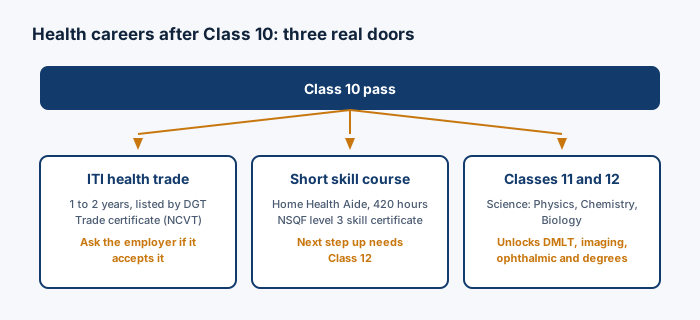
Three national routes exist, and Bihar adds a state one. They differ in how far they go. The first two start working life earlier; the third keeps the regulated diplomas and degrees open.
ITI health trades under DGT
DGT’s Craftsmen Training Scheme lists several healthcare trades with a Class 10 pass as the entry (DGT, CTS course details, read 17 October 2026).
| Trade on DGT’s list | Length | Entry | NSQF level |
|---|---|---|---|
| Radiology Technician | 2 years | Class 10 pass | 5 |
| Dental Laboratory Equipment Technician | 2 years | Class 10 pass | 4 |
| Physiotherapy Technician | 1 year | Class 10 pass | 3.5 |
| Health Sanitary Inspector | 1 year | Class 10 pass | 3.5 |
| Geriatric (Old Age) Care | 1 year | Class 10 pass or equivalent | 3.5 |
| Hospital Housekeeping | 1 year | Class 10 pass | 3.5 |
Here is the honest limit. These are National Trade Certificates under NCVT, and DGT’s table does not say whether a hospital, or a state paramedical or nursing council, treats them as equal to the NCAHP diplomas. A “Radiology Technician” ITI certificate and a Diploma in Medical Radiology and Imaging Technology are different qualifications with different entry rules. Before you choose one for a career in imaging, ask the hospital or council you hope to work with whether it accepts the ITI certificate. Our ITI guide covers admission, the pass rules and the onward routes.
Short skill certificates
The Healthcare Sector Skill Council’s Home Health Aide Trainee qualification is on the National Qualifications Register at NSQF level 3 with a Class 10 pass as the entry, 420 hours of training (240 classroom and 180 practical) and a Skill Certificate, approved on 18 February 2025 (NQR qualification file). It prepares you to help patients at home or in a care setting with daily living, not to work as a technician.
The ladder above it is steeper than the marketing suggests. The next step, General Duty Assistant Trainee (NSQF 4), is listed with a different entry (NQR listing). Emergency Care Assistant (NSQF 4, 1,500 hours) takes a Class 12 pass, or a Class 10 pass with two years of relevant experience, among other combinations, and sets the minimum age at 18 (NQR qualification file). So a Class 10 student can move up from Home Health Aide only if the next qualification accepts it. The qualification file for General Duty Assistant Trainee (version 2.0, approved by the National Skills Qualifications Committee on 18 February 2025) clears up the pairing: entry is either a Class 12 pass, or the NSQF level 3 Home Health Aide Trainee qualification plus 1.5 years of experience in the health sector (NQR qualification file). So a Class 10 student reaches it through Home Health Aide plus work experience, or through Class 12; a Class 10 pass alone does not meet it.
A second Class 10 skill route: Frontline Health Caregiving Assistant
The same council lists a Frontline Health Caregiving Assistant qualification at NSQF level 3: entry is a Class 10 pass (or a Class 8 pass with two years of relevant experience, or a previous NSQF level 2.5 qualification with 1.5 years of experience), the minimum age is 18, and the training is 570 hours (190 classroom, 140 practical and 240 on-the-job). The file shows next steps at NSQF level 4 such as Geriatric Care Assistant, Frontline Health Associate and Hospital Front Desk Coordinator. It was approved on 31 January 2024 with a review due on 31 January 2027 (NQR qualification file). Note the age: a student who passes Class 10 at 15 or 16 cannot start this one until 18, so those years are better spent on Class 11 and 12 or an ITI trade.
A state route: Bihar’s Dresser course
Some states run their own health courses at Class 10 level. Bihar’s DCECE 2026 prospectus has a “Para Medical (Matric Level)” group whose only course is Dresser. It asks for a pass in the Class 10 examination (CBSE, ICSE or a board’s equivalent) with science and English, and an age of 15 to 30 on 31 December 2026. Admission is by rank in a state entrance test, held on 24 May 2026. The seat matrix lists the course at government medical colleges, with 30 seats at PMCH Patna and at several others (Bihar’s prospectus, section 5, and the 2026-27 seat matrix). It is limited to Bihar’s residence categories, and a dresser’s work is wound care, not diagnostic technology. We did not find a matric-level paramedical diploma in the other states we checked, so ask your state’s medical education department what exists.
Classes 11 and 12 in Science
This is the route to the regulated diplomas and degrees. Physics, Chemistry and Biology in Class 12 satisfy the entry rule in the three curricula above. For degree-level allied health courses, NCAHP wrote on 19 November 2025 that in most of its notified curricula appearing in NEET is one of the eligibility criteria from 2026-27 (NCAHP letter). On 2 March 2026 it deferred that requirement for B.PT and B.OT to 2027-28 (NCAHP letter), so check the curriculum and the latest letters for the course you want. Which stream after 10th helps if you are unsure about Science, and medical courses after 12th shows what follows.
What age and marks do these courses actually ask for?
Entry rules are not only about the Class 10 pass. Pulling the documents above into one table shows why a 15-year-old Class 10 graduate has fewer immediate options than lists suggest.
| Course or route | Minimum age in the source | Marks or subjects in the source |
|---|---|---|
| DMLT (NCAHP curriculum) | 17 | 10+2 with Physics, Chemistry, Biology |
| Medical Radiology and Imaging Technology (NCAHP) | 17 | 10+2 with Physics, Chemistry, Biology |
| Ophthalmic Assistant (NCAHP) | Not stated in the extract we read | 10+2 with Physics, Chemistry, Biology or Mathematics, minimum 50% |
| ANM, Goa 2026-27 | 17 to 35 | 10+2 with 45% aggregate (40% for SC and ST) |
| Bihar Dresser (Matric level), 2026 | 15 to 30 on 31 December 2026 | Class 10 with science and English |
| Home Health Aide Trainee (NQR) | Not stated in the file | Class 10 pass |
| Frontline Health Caregiving Assistant (NQR) | 18 | Class 10 pass |
| Emergency Care Assistant (NQR) | 18 | Class 12, or Class 10 with two years of relevant experience, among other combinations |
The pattern is plain. The regulated diplomas start at 17 after Class 12; the care-assistant certificates start at 18; and the only Class 10-level courses with an age floor below 17 are Bihar’s Dresser course and the DGT trades. A student who finishes Class 10 at 15 therefore has two honest choices: a DGT trade or Bihar’s course now, or Class 11 and 12 and the regulated route.
What does registration with NCAHP involve?
The Allied Healthcare Professionals Registry states that NCAHP’s mandate is to regulate 56 allied and healthcare professions listed in the Schedule of the NCAHP Act, 2021, grouped into 10 categories, and that enrolment in the registry is compulsory for verification of the professionals it covers. Enrolment is free of charge, and the applicant needs an Aadhaar number with a linked mobile number, Class 10 and 12 certificates, the diploma or degree certificate and any internship certificate (AHPR FAQ). Two points follow for a Class 10 student. The registry’s own wording is “allied and healthcare”, which is the term to search for on official pages. And the registry asks for a Class 12 certificate, which is another reason the regulated route runs through Class 12.
How do you take admission, step by step?
- Pick the route first using the table above: a DGT trade, a skill certificate, a state course, or Classes 11 and 12.
- For a DGT trade, apply through your state’s ITI process, as the ITI guide sets out step by step.
- For a skill certificate, ask the training provider for the NQR qualification name and check it on the register; confirm your age meets the 18-year floor where the file sets one.
- For Bihar’s Dresser course, register for the state test described in the DCECE 2026 prospectus and expect rank-based allotment.
- For the regulated route, take Physics, Chemistry and Biology in Class 11 and 12, then follow the admission notice of the diploma or degree you want, since entry marks and NEET conditions differ by course.
What mistakes do families make?
- Paying for DMLT, X-ray or OT technician “after 10th”. NCAHP’s curricula we read ask for Class 12 with Physics, Chemistry and Biology.
- Confusing an ITI trade certificate with an NCAHP diploma. They are different qualifications.
- Ignoring the age floor. Care-assistant files set 18 and the regulated diplomas 17.
- Taking a short course and expecting council registration. Registration is for the regulated professions and asks for Class 12.
- Believing placement promises. No institute controls hiring.
Which route fits which student?
| If this sounds like you | Look at |
|---|---|
| You want a hospital technician career and are willing to study to Class 12 | Classes 11 and 12 in Science, then the NCAHP diploma or degree |
| You need to start earning soon and want care work | A DGT health trade or Home Health Aide, then Class 12 through NIOS later |
| You want to be a nurse or midwife | Class 12 first: ANM entry is 10+2; check your state nursing council |
| You want to be a pharmacist | Class 12 first; D.Pharm is a post-10+2 course |
| You are unsure and want options open | Science in Class 11; decide after Class 12 |
How can you check a “paramedical course after 10th” before paying?
- Ask who awards the qualification. A state paramedical council, a university, NCVT/DGT or a skill council certificate means something; “our own diploma” does not qualify you for council registration.
- Ask for the entry rule in writing. If the regulator’s curriculum says Class 12 and the institute says Class 10, ask which document it is following.
- Search the NQR. A skill course claiming national recognition should be findable by name on NCVET’s National Qualifications Register.
- Ask what job the certificate is accepted for, and ask the employer or council, not the institute.
- Get the full fee in writing, including internship and exam charges. We do not quote paramedical fees; they differ by state and institute and no regulator publishes a national table.
- Treat guaranteed placement as a warning sign. No institute controls hiring.
Frequently asked questions
Can I do DMLT after 10th?
Not under NCAHP’s curriculum, which asks for 10+2 with Physics, Chemistry and Biology and a minimum age of 17. If an institute offers DMLT after Class 10, ask which council or board awards it and whether it counts for registration.
Which paramedical course is best after 10th?
None is best on its own. The strongest long-term option is Science in Classes 11 and 12, which opens the regulated diplomas and degrees. For an immediate start, the DGT health trades, the Home Health Aide certificate and, in Bihar, the Dresser course are the verified Class 10 options.
Is a radiology course available after 10th?
DGT lists a two-year Radiology Technician ITI trade with a Class 10 pass. The NCAHP Diploma in Medical Radiology and Imaging Technology asks for Class 12 Science. They are different qualifications; ask your intended employer which it accepts.
Can I become a nurse after 10th?
Not by the ANM route. The Indian Nursing Council moved ANM admission from Class 10 to 10+2 (a Health Ministry letter of October 2011, as CBSE circular 20 of 2012 records), and state prospectuses for 2026 ask for 10+2. GNM is a three-year course by INC’s published duration, but we did not find a Class 10 entry for it. Bihar’s matric-level Dresser course is nursing-adjacent, not nursing.
Are there paramedical courses after 10th that need no entrance exam?
DGT’s ITI trades admit through the state’s merit process on Class 10 marks, and skill certificates admit by enrolment. Regulated diplomas and degrees usually admit on Class 12 merit or an entrance score such as NEET, depending on the course.
What is the salary after a paramedical course?
We do not quote one. No official source breaks salaries down by paramedical course at this level, and the pay depends on the employer, city and role. High salary courses after 10th explains which pay figures can be verified.
Can I study Class 12 later and still enter a diploma?
Yes. A Class 10 student who starts with a short course can finish Class 12 through school or open schooling and then apply for the diploma, provided the Class 12 subjects match the entry rule (Physics, Chemistry and Biology for most).
What is the minimum age for a health skill course after 10th?
It depends on the file. The NQR files for Frontline Health Caregiving Assistant and Emergency Care Assistant set 18; Bihar’s Dresser course allows 15 to 30; and the NCAHP diplomas we read set 17 after Class 12. Check the specific qualification file.
Is NEET required for paramedical courses after 10th?
Not for the Class 10 routes in this guide, which admit through state ITI processes, enrolment or a state test. NEET comes later: NCAHP’s letters say it is an eligibility criterion for many degree-level allied health courses from 2026-27, with B.PT and B.OT deferred to 2027-28.
Is paramedical the same as allied health?
In everyday use, yes. The regulator’s registry uses the term “allied and healthcare professions”, so use that wording when searching official sites.
Do I need a Class 12 certificate to register as a professional?
The Allied Healthcare Professionals Registry lists Class 10 and Class 12 certificates among the documents for enrolment, so plan for Class 12 if you want a regulated profession.
Still deciding?
If you want a health career but the entry rules look confusing, a short conversation can help you pick the route before money is spent. Book career counselling, or call 9212008787 or message us on WhatsApp with your Class 10 result and the role you have in mind. We will check the entry rule with you, including when the answer is to wait for Class 12.