NIMB EDU

The best diploma after 12th commerce is the one that matches the job you want in a year, awarded by a body that job recognises. Everything else, including the name printed on the certificate, is secondary.
That sounds obvious, and it still gets lost. “Diploma” is used for three very different things in India, and course listings rarely say which one they are selling. This guide sorts them out, maps the realistic options to the jobs they lead to, and is plain about what a diploma cannot do. For the wider picture, including degrees, CA, CS and CMA, see every option after 12th commerce, compared.
What does “diploma” actually mean after 12th commerce?
It means one of three things, and the difference decides what the certificate is worth. Ask which kind you are looking at before comparing anything else.
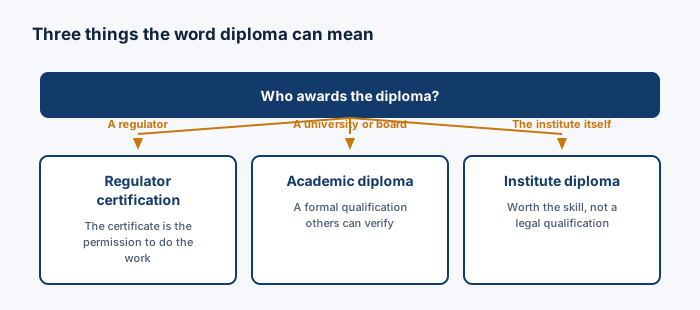
A certification set by a regulator
Some finance work requires a named certificate, and the clearest example for commerce students is mutual fund distribution. NISM Series V-A is the examination the National Institute of Securities Markets specifies as the requisite standard for anyone engaged in selling or distributing mutual funds (NISM).
The certificate is valid for three years, and students can take the exam. With this kind of credential, the paper is the permission to do the job. That makes it unusually easy to judge: either the work requires it, or it does not.
A recognised academic diploma
A recognised academic diploma is one awarded by a university or a state board of technical education, and it counts as a formal qualification. Its value is portable, because another institution or employer can check it against the awarding body.
If a course claims formal recognition, check it yourself. The National Qualifications Register is the public record of qualifications aligned to the national skills framework, and NCVET maintains it. A recognised qualification should be findable there by name.
An institute’s own diploma
An institute diploma is a certificate awarded by the institute that teaches the course, and most job-oriented accounting diplomas, including NIMB’s, are this kind. It is not a legal qualification. Its worth is the skill it builds, and whether employers see that skill when you sit down to work.
That is not something to hide. It is the question to ask. So ask every institute, including this one, who awards the certificate. A straight answer either way is a good sign. A vague one is not.
Which diploma leads to which job?
Diplomas after 12th commerce cluster into five job families. Choose the family first, and the specific course follows from it.
Accounts
This is the largest family, and the most common first job after 12th commerce: accounts assistant, then accounts executive. The work is bookkeeping, bank reconciliation, GST entries and month-end closing, almost always inside accounting software. Tally Prime is widely used by small and mid-sized Indian businesses, which is why most accounts diplomas teach it.
At NIMB the options run from the two-month Tally Prime course, through the six-month Business Accounting and Taxation programme, to the twelve-month Diploma in Financial Accounting. They differ in scope rather than quality, and DFA versus BAT sets out exactly where.
Tax and GST
Tax work suits students who like rules and deadlines. Junior roles in a CA firm or a company’s tax desk involve preparing GST returns, TDS filings and income tax returns for someone senior to review.
A focused course covers GST alone, while a broader diploma covers direct and indirect tax together. NIMB’s GST Practitioner course runs two months. The Diploma in Taxation Law runs three months and adds income tax and TDS. Which of the two fits depends on whether GST is the whole job or only part of it.
Payroll and HR
Every business with employees has to pay them correctly and meet its PF, ESI and salary TDS obligations. That is steady, specialised work, and it is usually learnt on the job rather than taught.
A payroll course shortens that learning curve. NIMB’s HR and Payroll Management course runs three months. It covers salary structures, provident fund, ESI, TDS on salary, gratuity and the statutory registers an employer has to keep.
Finance and markets
For mutual funds, broking or investment distribution, the relevant credential is usually not a diploma at all. It is a NISM certification, and for mutual fund distribution it is the stated standard. NIMB does not teach these. They are exams you register for directly with NISM.
Office and computing
Some students need confidence with a computer before any accounting course makes sense. A computer applications course covers Word, Excel, PowerPoint and email. NIMB’s Basic Computer course runs one month as a certificate or twelve months as a diploma. It works best as a first step towards Tally rather than a destination on its own.
NIMB’s courses at a glance
| Course | Length | Prepares you for |
|---|---|---|
| Diploma in Financial Accounting | 12 months | Accounts roles covering the books, payroll, GST and SAP FICO |
| Business Accounting and Taxation | 6 months | Accounts and tax work in a company finance team |
| Diploma in Taxation Law | 3 months | Direct and indirect tax work, to the point of filing |
| HR and Payroll Management | 3 months | Payroll, PF, ESI and TDS on salary |
| GST Practitioner Course | 2 months | GST registration, returns and reconciliation |
| Tally Prime Course | 2 months | Entry-level accounts work in Tally Prime |
| Basic Computer Course | 1 month (certificate), 12 months (diploma) | Office work, and a foundation for Tally |
What will a diploma not do?
A diploma will not replace a degree where the degree is the legal requirement. That is the most expensive thing to get wrong at this stage, because you usually discover it after the course is finished.
Government recruitment is the clearest case. The Staff Selection Commission’s Combined Graduate Level examination requires a bachelor’s degree from a recognised university (SSC notice). No diploma, from any institute, substitutes for it.
Other posts, recruited through SSC’s Combined Higher Secondary Level examination, are open after class 12. So whether you need a degree depends on the post you want, not on the diploma you hold. Check the current notice on the SSC website for the exact rules.
Private employers are less rigid, but not indifferent. Plenty of accounts roles ask for a B.Com, and a diploma on its own can put you behind a graduate with similar skills.
A diploma also does not count towards CA, CS or CMA. Each has its own registration route through its own institute. What a practical diploma can do is make the working side of those qualifications far less of a shock.
Should you do a diploma instead of a degree, or alongside one?
For most students, alongside. A degree and a diploma do different jobs, and together they are stronger than either one alone.
The degree carries eligibility: government exams, postgraduate study, and the employers who filter applications by it. The diploma carries employability: the software, the filing practice, and the ability to be useful in your first week. A graduate with no practical skills and a diploma holder with no degree hit the same wall from opposite sides.
There are two realistic ways to combine them.
- Degree first, then the diploma in the final year or straight after. The diploma lands closest to your job search, when it is most useful. B.Com versus an accounting course covers this route in detail.
- The diploma alongside the degree. This works when the degree timetable leaves room, as distance and part-time programmes often do. Check that the batch timings fit before you commit, because a clash in the second month is how these plans fail.
A diploma instead of a degree is the right choice for fewer students. It suits those who need to earn soon, and who are confident the work they want does not require a degree. That is a legitimate route. Take it knowingly, rather than by default.
How can you judge a diploma before you pay?
Six questions separate a useful diploma from an expensive certificate. Ask them of every institute, and expect straight answers.
- Who awards the certificate? The institute, a university or a regulator. If formal recognition is promised, look it up on the National Qualifications Register.
- Is the syllabus published, module by module? A vague promise of “complete accounting” usually means the content is vague too.
- Will you use the real software yourself, every session? Watching an instructor post entries is not the same as posting them.
- Will you file on the live government portals? GST and income tax work is learnt on the portals themselves, not on slides.
- Is the full fee clear before you commit? That includes instalments, and anything that might be added later.
- What happens after the course? Ask what support is offered, in concrete terms. Be wary of any job guarantee, because no institute controls what an employer decides.
Which diploma fits which student?
| If this sounds like you | Start with |
|---|---|
| You want to be working within a year, and you like numbers | A Tally course, then BAT or DFA if you want more |
| You are doing a B.Com and want a practical edge | DFA or BAT in your final year |
| You like rules, deadlines and getting things exactly right | The GST course or the Diploma in Taxation Law |
| You want a steady specialism that every employer needs | HR and Payroll Management |
| You are not yet comfortable on a computer | The Basic Computer course first |
| You want to work in mutual funds or broking | A NISM certification, not a diploma |
Frequently asked questions
Is a diploma after 12th commerce valid for government jobs?
It depends on the post. Graduate-level posts, such as those filled through SSC’s Combined Graduate Level exam, require a bachelor’s degree, and a diploma does not substitute for it. Posts open after class 12 do not require a degree, so there a diploma is an extra rather than the eligibility.
Can I do a diploma along with a B.Com?
Yes, if the timetables allow it. Many students take a practical diploma in the final year of their degree. Check the batch timings against your college schedule before enrolling.
Is a private institute’s diploma recognised?
It is recognised by employers who value the skill it represents, not as a formal qualification. If an institute claims formal recognition, check the course on the National Qualifications Register.
Which diploma is best for an accounting job after 12th?
The one that covers the software and filing work the job involves: Tally Prime, GST returns and TDS. If you are unsure which course that is, the three-question course finder at the end of this guide will narrow it down.
How long does a diploma after 12th commerce take?
At NIMB, from two months for a focused course to twelve months for a full diploma. Regulator certifications such as NISM’s are exam-based, so the time depends on your preparation. Whether a short course is enough on its own is covered in is a Tally course enough for a job?
Still deciding?
Start from the job, not the certificate. Work out which of the five families you want to be in, check who awards the diploma, and decide whether it sits alongside a degree or replaces one.
If you would rather talk it through, call 9212008787 or message us online. For the full range of options beyond diplomas, see the overview linked at the top of this guide.
Not sure which fits? Answer three questions and get a straight recommendation, including when the answer is none of them.