NIMB EDU
Most paramedical courses after 12th ask for Physics, Chemistry and Biology (PCB), but not all: NCAHP’s curricula allow Medical and Psychiatric Social Work after 12th in any stream, and Applied Psychology after 12th in Science, Arts or Psychology. Since 2025 the central regulator, the National Commission for Allied and Healthcare Professions (NCAHP), has been fixing the degree names, lengths and entry rules. That is why a 2024 list of “paramedical courses” can now be wrong on eligibility, on NEET and on whether a diploma is even allowed.
This guide uses NCAHP’s published curricula, corrigenda and letters, checked on 17 October 2026 and refreshed on 23 October 2026. It separates three things that most pages blur: courses that need PCB, courses that do not, and courses under other regulators, such as the Indian Nursing Council and the Pharmacy Council of India. It sits under courses after 12th science and beside medical courses after 12th, which covers MBBS, BDS and the AYUSH degrees. For short options after Class 10, see paramedical courses after 10th.
What counts as a paramedical course after 12th?
“Paramedical” is an everyday word, not a legal one. The legal category is allied and healthcare professions, listed in the schedule of the NCAHP Act, 2021. NCAHP groups them into ten categories: medical laboratory and life sciences; trauma, burn care and surgical or anaesthesia technology; physiotherapy; nutrition science; ophthalmic sciences; occupational therapy; community care and behavioural health; medical radiology, imaging and therapeutic technology; medical technologists and physician associates; and health information management (NCAHP). The curriculum page listed 21 notified curricula on 23 October 2026, the newest being a Diploma in Medical Equipment Technology uploaded on 22 October.
Nursing, pharmacy and the AYUSH systems are outside this list. They have their own councils, covered below. A course with “paramedical” in its name that matches none of these may not lead to a registrable qualification, so ask the college which regulator recognises it.
Which paramedical courses need PCB?
The science-based degrees and diplomas need PCB, and several set a 50% mark. The table uses the eligibility sections of NCAHP’s notified curricula as amended by NCAHP’s corrigenda. Lengths are given only where the curriculum states them.
| Programme | Length (curriculum) | Class 12 requirement | NEET in the current text |
|---|---|---|---|
| Bachelor of Physiotherapy (B.PT) | 4 years plus a 1-year internship | PCB (or Botany and Zoology), 50% aggregate with English pass; 40% for SC, ST, OBC-NCL and PwBD; age 17 | Appearance required, deferred to 2027-28 |
| Bachelor of Occupational Therapy (B.OT) | 5 years including a 1-year internship | PCB, 50% aggregate; age 17 | Appearance required, deferred to 2027-28 |
| B.Sc Medical Laboratory Sciences | 4 years including a 1-year internship | PCB (Botany and Zoology); age 17 | No: 10+2 merit (corrigendum, 20 March 2026) |
| Diploma in Medical Laboratory Technology (DMLT) | 2 years | 10+2 with PCB, age 17 | No: merit-based |
| B.Sc Medical Radiology and Imaging Technology | 4 years: 3 years plus a 1-year internship | 10+2 with Physics, Chemistry, Biology; age 17 | No: 10+2 merit (corrigendum, 6 May 2026) |
| B.Sc Nuclear Medicine Technology | 4 years including 1 year of clinical training | 10+2 with Physics, Chemistry and Biology | No: 10+2 merit or a state or university entrance test |
| B.Optom (Optometry) | 5 years (4 + 1 internship) | Physics, Chemistry, Biology or Mathematics, 50% | No: 10+2 merit (corrigendum, 13 May 2026) |
| Anaesthesia and Operation Theatre Technology (degree) | 4 years, with at least 1,440 hours of internship | 10+2 with Physics, Chemistry and Biology or Mathematics | No: 10+2 merit (corrigendum, 27 April 2026) |
| Respiratory Technology (B.Sc RT) | 4 years (8 semesters, 2 of them internship) | 10+2 with Physics, Chemistry and Biology, pass marks | No: 10+2 merit |
| Nutrition and Dietetics (Honours) | 4 years including internship | PCB with 50% and English | No: 10+2 merit (corrigendum, 10 April 2026) |
| Diploma in Health Information Management | 2.5 years including 6 months of internship | 10+2 in Science, Commerce or Arts, with English as a mandatory subject (corrigendum, 5 February 2026) | No NEET: entrance test of the university or institute |
Sources: the competency-based curricula and corrigenda on the NCAHP site (NCAHP curriculum page). Where the original curriculum text and a later corrigendum differ, the table follows the corrigendum. Courses not listed here, including dialysis, radiotherapy and physician associate, have their own curricula on the same page.
Which newer NCAHP programmes are there besides the main degrees?
The first table covers the courses most students search for. NCAHP has since notified more curricula, and several set their own entry rule. These come from the curriculum text on the NCAHP curriculum page and the corrigenda that amended it, so confirm the latest corrigendum and your state’s rule before you apply.
| Programme | Length (curriculum) | Class 12 requirement | How admission works |
|---|---|---|---|
| Diploma in Ophthalmic Assistant (D.OA) | 2 years: three semesters plus a 6-month supervised internship | 10+2 with Physics, Chemistry and Biology or Mathematics, minimum 50% | Senior Secondary merit |
| Diploma in Medical Radiology and Imaging Technology | 2.5 years (5 semesters including 6 months of internship) | 10+2 with Physics, Chemistry and Biology; age 17 by 31 December of the admission year | 10+2 merit; no lateral entry |
| Diploma in Medical Equipment Technology | 2.5 years | 10+2 with Physics, Chemistry and Mathematics, or Physics, Chemistry and Biology; 35% aggregate for the general category | Higher secondary performance |
| Radiotherapy Technology (diploma level) | 2.5 years including internship | 10+2 with Physics, Chemistry and Biology; age 17 by 31 December of the admission year (corrigendum, 27 May 2026) | 10+2 merit; the corrigendum replaced the original 50%-in-science and maximum-age-30 wording |
| Physician Associate (Bachelor of PA) | 4-year degree | 10+2 with Physics, Chemistry and Biology (Botany and Zoology); age 17 by 31 December of the admission year (corrigendum, 8 April 2026) | 10+2 merit; the corrigendum replaced the original 50%-in-each-subject rule, the maximum age of 40 and the common entrance test |
| Emergency Medical Technologist (Paramedic), bachelor level | 4-year programme including 1 year of clinical training or internship | 10+2 with Physics, Chemistry and Biology (or Botany and Zoology); age 17 by 31 December. Emergency medical services diploma holders can join the second year | 10+2 merit; the corrigendum of 6 May 2026 replaced the original “NEET appeared” wording |
Medical Physics, Dialysis Therapy Technology and Nuclear Medicine Technology also have notified curricula. Dialysis and radiotherapy curricula have corrigenda dated 13 May and 27 May 2026 respectively, so read those before relying on an older college brochure.
What about B.Voc and other degrees with “paramedical” in the name?
Ask which regulator recognises the exact degree before you pay. In a letter of 5 October 2026 to the Himachal Pradesh State Allied and Healthcare Council, NCAHP said B.Voc. qualifications in allied and healthcare professions are not covered under its notified registration regulations, although such courses may be proposed for provisional registration under the Act (NCAHP letter, 5 October 2026). In plain terms, a B.Voc in a healthcare field does not automatically give you the registration route that a notified NCAHP degree does. Ask the college for the exact registration path in writing, and check it against the NCAHP list.
How does paramedical admission work, step by step?
- Shortlist by profession, not by college name. Pick the profession from NCAHP’s list (for example physiotherapy, medical lab sciences, radiology and imaging).
- Read the curriculum and its corrigenda for entry marks, subjects, age and internship.
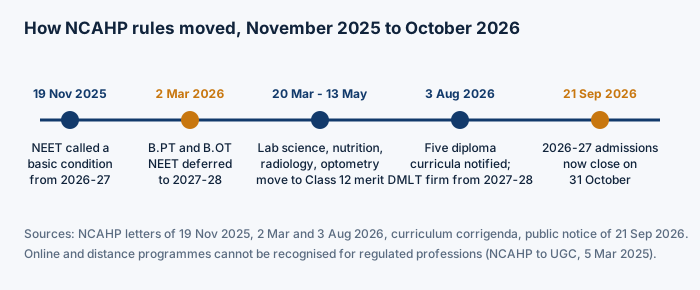
- Check the NEET position for your year. NEET appearance was deferred to 2027-28 for B.PT and B.OT, and it is not mentioned for the programmes that moved to Class 12 merit.
- Find the admitting authority. Merit lists are made by the state or the university. In the letter of 2 March 2026 NCAHP described a merit list on PCB marks for B.PT and B.OT.
- Watch the calendar. The last date to complete 2026-27 undergraduate admissions was 31 October 2026, and the notice said no further extension would be considered.
- Confirm the internship against the curriculum, because registration depends on completing it.
What mistakes do paramedical applicants make?
- Assuming one NEET rule for every course. Rules differ by programme, as the sections above show.
- Paying for an online or distance programme in a regulated profession.
- Joining a diploma that is being replaced. NCAHP’s 3 August 2026 letter records that instructions to discontinue diplomas in physiotherapy, occupational therapy and optometry had been received.
- Trusting a brochure over the curriculum. Corrigenda have changed entry rules for several programmes since April 2025.
- Not asking about registration. A degree is useful for practice only if it leads to registration under NCAHP or the relevant council.
Which paramedical courses do not need Science?
Three NCAHP curricula open the door beyond PCB. The Medical and Psychiatric Social Work curriculum accepts students who passed Senior Secondary (10+2) in any stream, including those awaiting results, and sets age 17 by 31 December of the admission year. The Applied Psychology and Behavioural Health curriculum, as corrected on 1 April 2026, accepts 10+2 in Science, Arts or Psychology with 50% marks and admits through a university or institute entrance test. The Health Information Management curriculum, as corrected on 5 February 2026, accepts 10+2 in Science, Commerce or Arts with English as a mandatory subject. That holds for the diploma and, with 50% aggregate, for the B.Sc. Both admit through an entrance test of the university or institute (NCAHP, HIM corrigendum 1). If you have no science, these are the NCAHP routes to look at first, along with the commerce-side options in courses after 12th commerce and courses after 12th arts.
The Indian Nursing Council also keeps one door open: GNM accepts 10+2 with English and at least 40% in any stream, with Science preferred, and ANM accepts Arts or Science (Indian Nursing Council). Short certificate courses for roles such as patient care assistant exist outside NCAHP’s degree structure. They are not a registered profession, so ask what the certificate lets you do before you pay.
Does paramedical admission need NEET?
For B.PT and B.OT the NEET requirement exists on paper but is deferred; for several other courses NCAHP has since replaced it with Class 12 merit. In November 2025 NCAHP wrote to the education departments and boards. It said most notified curricula make appearing in NEET a basic eligibility condition for undergraduate allied and healthcare admission from 2026-27, over and above the other criteria (NCAHP letter, 19 November 2025).
On 2 March 2026 NCAHP changed this for two degrees. It deferred the mandatory NEET (UG) appearance for Bachelor of Physiotherapy and Bachelor of Occupational Therapy to the next academic year, 2027-28. For 2026-27 those admissions followed the basic eligibility rule: 10+2 with Physics, Chemistry and Biology (or Botany and Zoology) at 50% aggregate with a pass in English. SC, ST, OBC-NCL and PwBD candidates need 40%, and the merit list uses the PCB marks (NCAHP letter, 2 March 2026).
Between March and May 2026 NCAHP’s corrigenda moved Medical Laboratory Sciences, Nutrition and Dietetics, Medical Radiology and Imaging Technology and Optometry to admission on Senior Secondary merit, and deleted the NEET wording from those curricula. Corrigenda in the same period did the same for Anaesthesia and Operation Theatre Technology, Dialysis Therapy Technology, Radiotherapy Technology, Emergency Medical Technology, Respiratory Technology and Physician Associates. Read the corrigendum for your programme on the curriculum page, and ask the college in writing whether NEET applies to your year. A coaching or college page that gives one answer for every paramedical course is out of date.
Also note the calendar. NCAHP’s public notice of 21 September 2026 extended the last date to complete 2026-27 admissions in undergraduate and postgraduate allied and healthcare courses from 30 September to 31 October 2026. It said no further extension would be considered (NCAHP public notice). That date has passed, so the practical plan now is the 2027-28 cycle.
Are diploma courses still allowed?
Some are, some are being phased out, and the rule depends on the profession. NCAHP’s letter of 3 August 2026, written to the Uttar Pradesh State Allied and Healthcare Council, notified competency-based curricula for five diplomas: Anaesthesia and Operation Theatre Technology, Radiotherapy Technology, Dialysis Technology, Health Information Management and Medical Laboratory Technology. Institutions must implement them from 2026-27, with DMLT mandatory from 2027-28. Eligibility for these diplomas is 10+2 in the relevant stream (NCAHP letter, 3 August 2026).
The same letter says diploma-level qualifications are not permissible for healthcare professions classified under ISCO Code 22. NCAHP’s physiotherapy curriculum classes physiotherapists as ISCO 2264, and the state council’s own letter, attached to the reply, records that instructions to discontinue diplomas in physiotherapy, occupational therapy and optometry had already been received. For other diplomas, institutions already running them with government approval may continue with their existing approved intake until the curriculum is notified, and new courses in scheduled professions without an approved curriculum are not allowed to start.
The list is moving. When that letter was written the Ophthalmic Assistant and Medical Radiology and Imaging diplomas were still being drafted, and NCAHP’s curriculum page now shows both uploaded, on 29 and 30 September 2026. A diploma is therefore not automatically safe; ask whether it appears on NCAHP’s curriculum page.
Is an online or distance paramedical course valid?
Not for the regulated professions. In a letter of 5 March 2025 to the UGC, NCAHP stated that allied and healthcare programmes for professions in the Act’s schedule are not as per the Act if obtained through open and distance learning. It added that only full-time regular professional programmes can be recognised, and that it cannot include online-mode programmes. On 12 August 2025 the UGC told higher education institutions that none may offer such programmes in ODL or online mode from the July-August 2025 session, and that existing recognition would be withdrawn (NCAHP letter and UGC notice). NIMB does not offer paramedical courses; this is a warning to apply to any provider that does.
What about nursing and pharmacy?
They are separate. B.Sc Nursing needs PCB with 45% under the Indian Nursing Council, and the Pharmacy Council of India describes D.Pharm as a two-year course and B.Pharm as a four-year course after 10+2 (PCI FAQ). Both are explained in the medical guide linked above.
How do you check a paramedical course before paying?
- Find the profession on NCAHP’s list of ten categories. If it is not there, ask which law recognises it.
- Read the curriculum’s eligibility section and its corrigenda on the NCAHP curriculum page, not the college brochure.
- Ask about NEET for your year, in writing.
- Confirm the length and the internship against the curriculum.
- Check the state allied health council and registration route, because practising professionals are registered through the NCAHP framework.
- Do not pay for an online or distance version of a regulated profession.
For the wider picture, the courses after 12th hub maps every stream, and how to choose the best course after 12th helps you pick.
Frequently asked questions
Which paramedical courses can I do after 12th?
Physiotherapy, occupational therapy, medical lab technology, radiology and imaging, optometry, anaesthesia and operation theatre technology, dialysis, respiratory technology, nutrition and dietetics, health information management, applied psychology and medical social work, among others recognised under NCAHP.
Is PCB compulsory for paramedical courses?
For most science-based programmes, yes. Medical and Psychiatric Social Work accepts 10+2 in any stream, Applied Psychology accepts Science, Arts or Psychology, and Health Information Management accepts Science, Commerce or Arts.
Is NEET required for paramedical courses?
It depends on the programme and year. NCAHP deferred NEET for B.PT and B.OT to 2027-28, and its corrigenda moved lab science, nutrition, radiology and optometry to Class 12 merit. Check the curriculum and its corrigenda for the rest.
What is the minimum percentage?
Many curricula set 50% in PCB, with 40% for SC, ST, OBC-NCL and, for B.PT, PwBD candidates. B.Sc Nursing needs 45% and GNM 40% under the Indian Nursing Council. Check the specific curriculum.
Is DMLT still valid?
Yes. NCAHP has notified a DMLT curriculum for a two-year course with 10+2 PCB, mandatory from 2027-28 for existing providers.
Can I do a paramedical course online?
NCAHP has told the UGC it cannot recognise open, distance or online programmes for regulated allied health professions, and the UGC has barred institutions from offering them in those modes.
Is paramedical the same as nursing?
No. Nursing is regulated by the Indian Nursing Council; paramedical or allied health professions fall under NCAHP.
Which paramedical course pays best?
No official source ranks them, so we give no salary figure. Compare the registration route, the internship and the employer’s published pay level.
How many paramedical courses has NCAHP notified?
The NCAHP curriculum page listed 21 curricula on 23 October 2026, from Physician Associates to a new Diploma in Medical Equipment Technology.
Can I do a paramedical course after 12th Commerce or Arts?
Yes, in three cases: Medical and Psychiatric Social Work accepts 10+2 in any stream, Applied Psychology and Behavioural Health accepts Science, Arts or Psychology with 50%, and Health Information Management accepts Science, Commerce or Arts with English. Most other programmes need PCB.
How long is a paramedical diploma?
It varies by curriculum: 2 years for the Ophthalmic Assistant diploma and DMLT, and 2.5 years including internship for the radiology and imaging, radiotherapy and medical equipment diplomas.
Is a B.Voc in a healthcare field valid for registration?
NCAHP said on 5 October 2026 that B.Voc. qualifications are not covered by its registration regulations, though provisional registration may be proposed. Ask the college for the registration route.
What is the last date for 2026-27 paramedical admission?
NCAHP’s notice of 21 September 2026 set 31 October 2026 as the last date, with no further extension. That date has passed; plan for the 2027-28 cycle.
Still deciding?
Write down your Class 12 subjects, your marks in PCB and the year you will join, then check the curriculum for two programmes side by side. If you want a second opinion, book career counselling or call 9212008787.