You can move into accounting from science, arts, or no relevant background at all. It is done regularly. What follows is what is actually different about that route, rather than reassurance.
What is genuinely harder
Two things. Being warned about them is most of the fix.
The vocabulary arrives without context. A B.Com student has heard “debit”, “credit”, “provision” and “accrual” for three years before touching software. You meet them in week one. This feels like being behind. It is not, but it does mean the first few weeks demand more from you than from the person next to you.
Some employers filter on the degree. Not all. Fewer than you would fear, in fact. But it happens, and it is why demonstrable software skill matters more for you than for a commerce graduate. A certificate saying you can operate Tally answers a question a B.Com alone does not.
What is not harder
The work itself. Accounting is procedural and rule-bound, which is precisely why it can be taught from fundamentals in a way that many subjects cannot, and why someone arriving with no background at all can be genuinely competent within a year if the course is built to start from zero. People from technical backgrounds often find the systematic side straightforward. Some find it easier than the commerce students do.
Which courses accept non-commerce students
The Diploma in Financial Accounting is the one to look at first. It explicitly accepts students from both commerce and non-commerce backgrounds, and it starts from fundamentals rather than assuming them. Twelve months, ₹60,000, covering accounting, Tally Prime, BUSY, SAP FICO, payroll, and PF and ESI returns.
The shorter courses are open after 12th regardless of stream.
- Tally Course, two months, ₹10,000. The fastest route to an employable skill.
- GST Practitioner Course, two months, fee on enquiry. Open after 12th or B.Com.
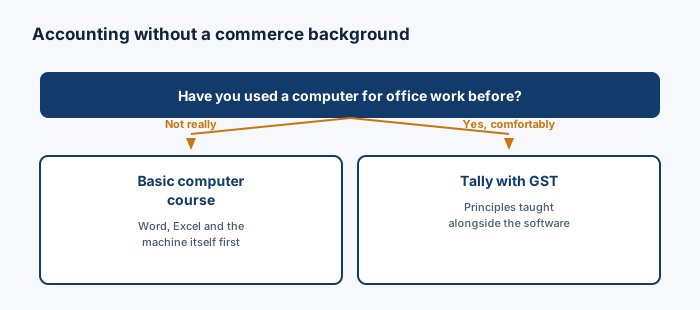
- Basic Computer Course, one month certificate, fee shared on enquiry. Start here if computers themselves are the barrier.
The order that works
If you are coming in cold and can commit properly, go straight to the DFA course. Twelve months starting from fundamentals is the most reliable route available to you, and the reason it works is not that it is longer but that it never assumes the vocabulary you are missing, which is the single thing that derails non-commerce students on shorter courses.
If twelve months is not realistic right now, stage it. Basic Computer if you need it, then Tally to become employable, then continue while working. Slower, but it earns while it teaches.
What does not work is a two-month Tally course as your entire qualification when you also lack the commerce grounding. You would be able to operate the software without understanding what the entries mean. That becomes obvious in an interview, usually within two questions.
Frequently asked questions
Can I do an accounting course after 12th science?
Yes. Courses at NIMB are open after 12th regardless of stream, and the DFA diploma explicitly accepts non-commerce students.
Will employers reject me without a B.Com?
Some will. Many will not, particularly for roles where practical software competence is the requirement. This is exactly why a demonstrable qualification matters more for you than for someone with the degree.
Should I do a B.Com as well?
If you have the time and money, a degree plus practical training is the strongest combination. If you need to be earning sooner, the practical route first is reasonable. The degree can be added later through distance education.
How long before I can get a job?
Realistically, one to two months with a Tally certificate for an assistant role. Twelve months with DFA for a stronger start. It depends heavily on the local market and on how you interview.
Talk to someone before deciding
Call NIMB on 9212008787 or visit E-56, Laxmi Nagar, Delhi 110092. Say what you studied and what you want to be doing. That is enough to get a straight recommendation.