 NIMB EDU
After Class 10 you have four routes: stay in school for Classes 11 and 12 in Science, Commerce or Arts; take a three-year polytechnic diploma; take an ITI trade course; or start with a short skill course or an early job. Most students and parents ask “which course?” when the real first question is “which route?”, because the route decides which courses you can enter next.
This page is the map. It shows what each route is, what is and is not open after Class 10 (several popular lists get this wrong), how the routes connect, and how to check a course before paying. The detailed guides, such as which stream after 10th and diploma courses after 10th, go deeper on each. If you are further along, courses after 12th is the next map.
What can you do after Class 10?
There are four routes, and they connect more than people expect. Pick by the work you want to be doing in ten years and the money and time your family can commit, not by which course name sounds impressive.
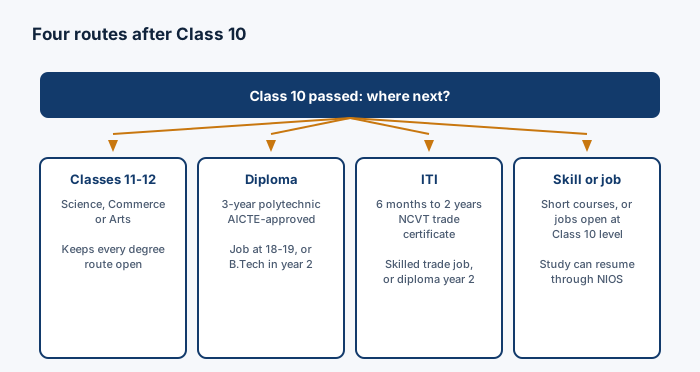
| Route | Length | Entry | What it leads to |
|---|---|---|---|
| Classes 11 and 12 (Science, Commerce, Arts) | 2 years | Class 10 pass; school sets stream cut-offs | Degrees, CA, medicine or engineering depending on stream |
| Polytechnic diploma | 3 years | Class 10 pass; state sets marks and subjects | Technical jobs, or second-year B.Tech by lateral entry |
| ITI trade course | 6 months to 2 years | Class 8 or 10, by trade | National Trade Certificate; skilled work; second-year diploma |
| Short skills or an early job | Weeks to months | Varies | Useful as an add-on; rarely a full career alone |
Diploma and ITI facts above come from AICTE’s Approval Process Handbook and the Directorate General of Training (AICTE handbook 2024-27; DGT’s NSTI Ludhiana). The schools route is set by your board and the school’s own rules.
Which popular “after 10th” courses are really open after 10th?
Fewer than most lists suggest. Some courses commonly listed after Class 10 need Class 12, and finding out after you have paid is the costliest mistake at this stage.
| Course | Open after Class 10? | Basis |
|---|---|---|
| Engineering diploma (polytechnic) | Yes, three years | AICTE handbook: Class 10 pass is the entry |
| Applied arts and crafts diploma; design diploma | Yes, three years | AICTE handbook |
| ITI trades | Yes; Class 8 or 10 by trade | DGT and NIOS-DGT scheme |
| Classes 11 and 12 | Yes | Board and school rules |
| CA Foundation registration | Provisional registration yes; the exam once you have appeared in Class 12 | ICAI FAQ |
| D.Pharm | No; two years after 10+2 | Pharmacy Council of India |
| B.Tech, MBBS, B.Com, any degree | No; entered after Class 12 (or a recognised equivalent) | Regulator rules |
| NDA (Army, Navy or Air Force officer entry at 16 to 19) | No; the Army wing needs a Class 12 pass, the Air Force and Naval wings need Class 12 with Physics, Chemistry and Mathematics | UPSC NDA (II) 2026 notice |
| Commercial pilot licence | No; DGCA asks for Class 12 with Physics and Mathematics | DGCA Pariksha FAQ |
| Nursing (ANM, GNM) and paramedical (DMLT, radiology) | No for ANM (entry moved to 10+2); not confirmed for the rest | CBSE circular on ANM; INC publishes durations |
The last row is deliberately honest. The Indian Nursing Council lists ANM at two years and GNM at three (INC), but it does not state the entry qualification. For ANM, CBSE circular 20 of 15 March 2012 records that INC revised the eligibility from Class 10 to 10+2, and we could not confirm a Class 10 entry for GNM, DMLT or radiology from any regulator, so we do not list those courses as after-10th options. Ask for your state council’s written rule before you pay a deposit.
What does each route look like up close?
Each route has a guide of its own. Here is what each one comes down to, so you can tell which deserves your next hour.
Polytechnic diploma
It is a three-year diploma in engineering and technology with Class 10 as the national entry rule. The state decides everything else: Uttar Pradesh and Bihar admit through an entrance test, Maharashtra on marks. The diploma can lead to a technician job or to the second year of a B.Tech, within seat limits. The detail is in polytechnic courses after 10th, and the wider diploma family is covered in the diploma guide linked at the top of this page.
ITI trades
The Directorate General of Training reports 14,643 ITIs and 169 trades (DGT, Craftsmen Training Scheme). Its trade table (170 entries when we read it on 20 October 2026) has 109 one-year trades, 53 two-year trades and 8 of six months. Most ask for Class 10; the two-year engineering trades usually ask for Class 10 with Science and Mathematics, and 20 entries, among them the welding, plumbing, wireman, masonry and sewing trades, take Class 8. ITI courses after 10th sorts the trades by length and entry rule and follows the four exits: apprenticeship, diploma year 2, a Class 10 or 12 certificate, and railway posts that name ITI.
Health and paramedical courses
This is the area where lists mislead most. The regulated diplomas in medical laboratory and radiology technology ask for Class 12 with Physics, Chemistry and Biology. What is open after Class 10 is narrower: ITI health trades such as Radiology Technician and Physiotherapy Technician, the short Home Health Aide certificate, and in Bihar a state Dresser course. See paramedical courses after 10th before you pay a deposit.
Hospitality, short skills and early work
The National Council for Hotel Management and Catering Technology lists craftsmanship certificates in Food Production and Food and Beverage Service with a Class 10 entry, against Class 12 for its diplomas and degrees (NCHMCT eligibility list). Its own course pages give Food Production as three semesters (1.5 years) and Food and Beverage Service as one semester (0.5 year) (Food Production page; Food and Beverage Service page). Computer and office skills run alongside school; for what these routes pay on paper, see high salary courses after 10th.
Which route should you take?
Choose Classes 11 and 12 if you are unsure or want medicine, engineering degrees, CA or a general degree. Choose a diploma if you know you want a technical career. Choose ITI if you want a hands-on trade soonest. Add short skills to any of them.
| If this sounds like you | Start with |
|---|---|
| You are unsure and want options kept open | Classes 11 and 12; use the stream guide to choose |
| You want to build, repair or draw for a living | A polytechnic diploma in the matching branch |
| You want to start earning in two years or less | An ITI trade, with a Class 12 pathway through NIOS |
| You want medicine or an engineering degree | Science in Class 11; see courses after 12th science for what follows |
| You like business, money and accounts | Commerce in Class 11; see courses after 12th commerce for what follows |
| You like law, media, design or public service | Arts in Class 11; see courses after 12th arts |
Are the routes dead ends, or do they connect?
They connect, with conditions. AICTE’s handbook lets a student with Class 10 plus a two-year ITI enter the second year of a diploma. It also lets a three-year diploma holder with at least 45% marks (40% for reserved categories) seek lateral entry into the second year of a B.Tech. That entry is capped at 10% of an institute’s approved intake, plus unfilled first-year seats. And the NIOS-DGT scheme lets ITI trainees earn a Class 10 or Class 12 certificate while they train, with up to four ITI trade subjects credited (NIOS-DGT).
So an ITI student can reach a diploma, and a diploma student a degree. The routes are narrower than the straight path through Class 12, and they depend on marks, so choose them knowing that, not assuming it.
What about government jobs after Class 10?
Some are open, and age matters as much as qualification. The Staff Selection Commission’s 2025 notice for MTS and Havaldar posts asked for the Matriculation examination or equivalent, with an age limit of 18 to 25 for MTS and 18 to 27 for Havaldar as of 1 August 2025 (SSC MTS notice). A student who passes Class 10 at 16 is two years short of the minimum age, so this is a plan for later, not a substitute for continuing study now.
Another Class 10 entry is the uniformed forces. The Staff Selection Commission’s 2026 notice for Constable (GD) in the central armed police forces, the Secretariat Security Force and Assam Rifles asked for a Matriculation or Class 10 pass by 1 January 2026 and an age of 18 to 23 on that date. It listed 25,487 tentative vacancies at Pay Level 3 (Rs 21,700 to Rs 69,100). Selection had a computer-based exam, physical standard and efficiency tests, a medical examination and document checks (SSC notice). The pay range is a scale, not a starting salary, and the age floor again puts this after school, so treat it as a plan for later.
Higher-level SSC exams ask for more. CHSL needs Class 12 and CGL a bachelor’s degree. The qualification, the age and the post change with every notice, so plan around the current one, not last year’s.
What changed in 2026: the second Class 10 board exam
CBSE now holds two Class 10 board examinations. Its notification of 14 February 2026 says the first is mandatory for every student, and passed students may improve their performance in up to three subjects out of Science, Mathematics, Social Science and languages in the second. A student who did not appear in three or more subjects in the first exam cannot sit the second and goes into the “Essential Repeat” category for the next year’s main exam. Students with a compartment result can take the second exam under the compartment category, and additional subjects are not allowed after passing Class 10 (CBSE notification).
This applies to CBSE schools; other boards set their own rules. For your route choice it matters in one way: a low mark in a single subject is no longer the end of the road, so the question of improving a score and the question of which route to take can be handled together.
When do admissions open, and what will you need?
Earlier than most families expect. Polytechnic admissions in several states ran their main steps in May 2026, so waiting for results and then starting to read about routes is a common way to lose a seat. The three states below show how much the timing differs.
| State (2026 cycle) | What the official source shows |
|---|---|
| Uttar Pradesh (JEECUP) | Online applications ran from 15 January to 30 April 2026, and the Group A entrance test from 15 to 22 May 2026 (UPJEE(P) 2026 brochure, in Hindi) |
| Bihar (BCECE Board) | The DCECE 2026 prospectus gave 23 May 2026 as the proposed date of the engineering diploma entrance exam (DCECE 2026 prospectus) |
| Delhi (Directorate of Training and Technical Education) | The directorate’s portal notice said admission to approved institutes affiliated with the Board of Technical Education, Delhi for 2026-27 would commence on 25 May 2026 |
Dates change every year, so read your own state’s current notice. Keep the paperwork ready before applications open. Bihar’s 2026 prospectus is a useful sample of what a state asks for. It lists the Matric pass certificate, marksheet and admit card, and a caste certificate if you claim a category. It also lists an income and asset certificate for the economically weaker section, a character certificate from the last institution attended, the filled application form with a photograph, and a residence certificate for Bihar quotas. Your state’s list will differ, which is why the checklist in each prospectus is the one to follow.
Is there money to help with the cost?
For girls entering a diploma there is one national scheme worth knowing. AICTE’s Pragati scheme for girl students (diploma) gave Rs 50,000 a year in its 2020-21 guidelines, for up to three years for first-year admissions and two for lateral entry, to a girl admitted to an AICTE-approved institution. At most two girl children per family were eligible, family income could not exceed Rs 8 lakh a year, and 5,000 scholarships were earmarked per year (AICTE Pragati guidelines for the diploma, 2020-21). We could not open a current-year guideline on an official site, so confirm the present amount, deadline and seat count on the National Scholarship Portal before you plan around it. We do not quote ITI or diploma fees, because they are set by each state and institute.
How do you check a course before you pay?
Check three things: who awards it, who regulates it, and whether the fee is in writing. A formal diploma should name an AICTE-approved institute and a state board or university. An ITI should be affiliated to NCVT. A skill course claiming national recognition should be findable on NCVET’s National Qualifications Register. Treat any placement guarantee as a warning sign, because no institute controls hiring. The full checklist is in diploma courses after 10th.
Guides in this section
Each guide below goes deeper on one decision. They are added as they are reviewed and verified.
All guides in Courses After 10th
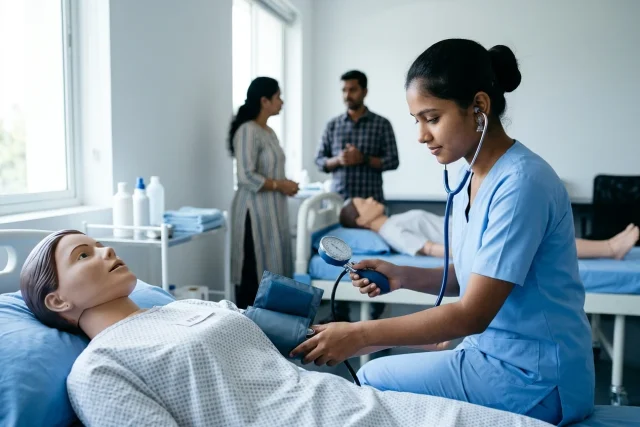
Paramedical Courses After 10th: What Is Open, and What Needs Class 12
DMLT, radiology and ophthalmic diplomas need Class 12 Science. What is open after 10th: DGT health ITI trades, Home Heal…

High Salary Courses After 10th: What the Government Documents Show
No course after 10th has an official salary. See documented pay: apprentice stipends, railway Levels 1, 2 and 5, SSC con…
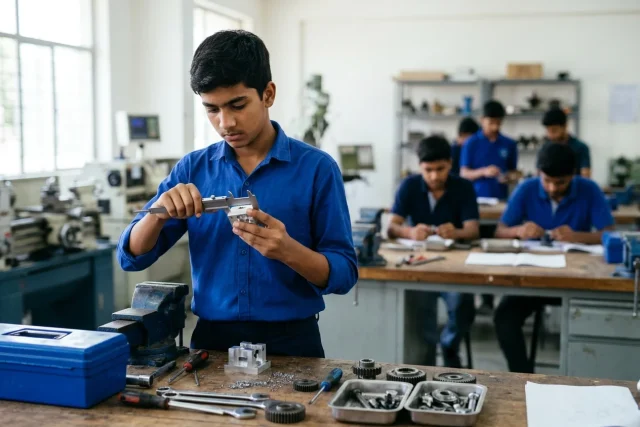
Diploma Courses After 10th: What Is Open, What Is Not, and Where Each Leads
Which diplomas you can do after Class 10, how admission and documents work, why D.Pharm is not one, how ITI and lateral…

Which Stream After 10th: Science, Commerce or Arts?
No stream is best. See which doors each stream keeps open, five stream myths checked, the one-way choices, a two-week te…
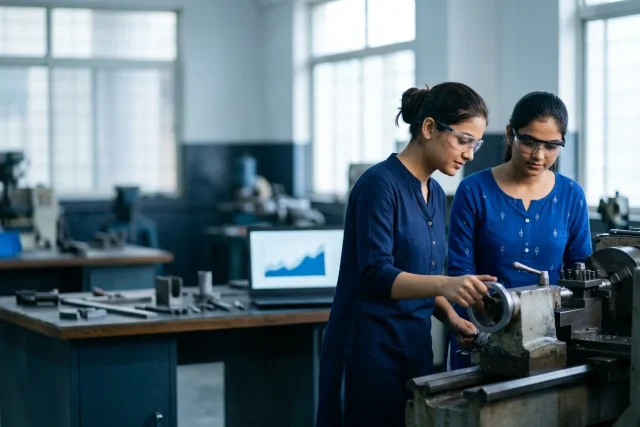
ITI Courses After 10th: Trades, Eligibility, and Where Each Leads
DGT trade table read closely: length, entry and NSQF level by trade, how to apply, ITI to diploma, NIOS Class 10 and 12,…
Polytechnic Courses After 10th: Eligibility, Branches, and the Routes In and Out
Polytechnic after Class 10: AICTE entry rule, state rules compared (UP, Bihar, Telangana, Maharashtra), how to apply, an…
Frequently asked questions
What are the best courses after 10th?
There is no single best course. The strongest choice is the route that fits your interests and the career you want: Classes 11 and 12 to keep degrees open, a three-year diploma for a technical career, or an ITI for a trade. Lists ranking “best” courses by salary usually cite no source, and we do not quote figures we cannot verify.
Which course is best after 10th for a good job?
Jobs depend on skill, institute and the market more than on the course name. A three-year engineering diploma from an AICTE-approved institute and a Class 12 followed by a degree are the two routes with a formal qualification at the end. Check the actual job notices in your field to see what they ask for.
Can I do a diploma after 10th and then a degree?
Yes. A three-year engineering and technology diploma can lead to the second year of a B.Tech through lateral entry, subject to minimum marks (45% under AICTE’s rules, 40% for reserved categories) and limited seats. The conditions are in our diploma guide.
Which courses can I do after 10th in commerce?
Commerce is a stream you enter in Class 11, not a course you can take straight after Class 10. Accounting diplomas such as Tally and GST generally assume Class 12. A computer basics course is the realistic add-on while you are still in school.
Can I skip Classes 11 and 12 and go straight to college?
Degrees ask for Class 12 or a recognised equivalent. The routes that skip the standard Class 11 and 12 are the diploma and ITI, which have their own paths onward, and open schooling through NIOS if you want a Class 12 certificate later.
What should I do if my Class 10 marks are low?
Marks affect which school or college you can get into, not whether routes exist. Keep a diploma or ITI application open alongside your school applications, check whether your board offers improvement exams for specific subjects, and use the free textbook test in the stream guide to see which subjects you can build on.
What is the shortest course I can do after 10th?
The shortest we could verify are NCHMCT’s Food and Beverage Service craftsmanship certificate (one semester, or half a year, on its course page) and the six-month trades in DGT’s table. Short does not mean employable on its own: check what job the certificate is accepted for before you enrol.
Which courses are best after 10th for girls?
None of the entry rules we read in the regulators’ documents is limited by gender, so the route guides above apply equally. The one scheme aimed at girls is AICTE’s Pragati scholarship for diploma students, described above. Choose the route by interest and the work you want, as for anyone else.
What can I do if I fail Class 10?
If you are in a CBSE school and have a compartment result, the second board examination lets you appear under the compartment category (CBSE notification of 14 February 2026). The National Institute of Open Schooling’s Secondary course asks for a Class 8 pass or a self certificate (NIOS admission procedure), and its Senior Secondary course follows a Class 10 pass. Your state board has its own supplementary exam rules, so ask your school.
Can I do a skill course while I am still in school?
Yes, and it is the cheapest way to test an interest. A computer basics course is the usual first choice; NIMB’s online Basic Computer course has no prerequisite. Keep it as an add-on to Classes 11 and 12 or a diploma, not a replacement.
Still deciding?
If the choice still feels open, that is normal. You do not have to settle it alone: book career counselling, or call 9212008787 or message us on WhatsApp with your Class 10 result and the subjects you enjoy, and we will help you compare routes fairly, including when the answer is a route we do not teach.