Finishing 12th commerce hands you a genuinely wide set of options, but almost no framework for choosing between them. Some students drift into a degree because it is the default choice. Others start a CA attempt without first asking whether they can sustain it for several years. Neither approach is wrong exactly, but both skip the question that actually matters: what do you want to be doing in three, five or ten years, and which route gets you there without wasting time you cannot get back?
This guide sets out every realistic option after 12th commerce, compares them side by side in one table, and works through the decision in the order most students actually face it. B.Com is a three-year undergraduate degree in commerce, covering accounting, economics, business law and related subjects at a general, largely theoretical level, and it remains the most common starting point after 12th commerce, so it is worth understanding clearly before looking at the alternatives.
Key takeaways
- Commit to CA only if you can sustain a multi-year course with a genuinely difficult examination; the ceiling is the highest in commerce, but so is the failure rate.
- If a degree is the plan and employability is the worry, pair a B.Com with a short accounting or GST course rather than choosing one over the other.
- If income is needed soon, a two-month Tally course is usually the fastest legitimate route to a first accounts job, and studying can continue afterward.
- If you are still unsure, a short skill course is a cheaper way to test your interest than three years of a degree you might later abandon.
- The comparison table below covers every major route, from B.Com and BBA through CA, CS, CMA, M.Com and MBA to NIMB’s own practical diplomas, with duration, indicative cost and who each one suits.
The three routes after 12th commerce
Almost everything available after 12th commerce falls into one of three groups, and seeing them as three related decisions rather than one single decision makes the whole choice considerably easier.
The first is a degree: B.Com, BBA or BCA, typically three years and broad in scope. The second is a professional qualification: CA, CS or CMA, each long and difficult, but each offering a ceiling that no degree or diploma matches. The third is a skill course: accounting, GST, taxation or Tally, usually months rather than years, aimed directly at making someone employable.
These three are not mutually exclusive, and treating them as though they were is the most common mistake students make at this stage. A large number of people complete a B.Com and a practical accounting course, precisely because the degree alone rarely makes them job-ready on its own. In other words, the real decision is not degree versus course, but which combination fits the time and money actually available.
Every route after 12th commerce, compared
The table below lines up every major route, from a straight degree through the professional qualifications to NIMB’s own short courses, so the trade-offs sit in one place instead of being scattered across separate pages. Costs for third-party degrees and professional qualifications are marked as indicative, because they vary by college, city and institute, and inventing one figure would mislead rather than help. NIMB’s own course fees are exact, because that information is public and NIMB controls it directly.
| Route | Duration | Approximate cost | What it leads to | Who it suits |
|---|---|---|---|---|
| B.Com | 3 years | Indicative; low at government colleges, higher at private colleges | Broad commerce degree; usual prerequisite for M.Com and, in practice, CA, CS, CMA | Students unsure of specialisation who want options open |
| BBA / BMS | 3 years | Indicative; varies by college | Management-focused degree, useful before an MBA | Students aiming at general business, not accounting |
| BCA | 3 years | Indicative; varies by college | Computer applications degree for software/IT roles | Commerce students whose real interest is technology |
| CA | 5-6 years including articleship | Indicative; registration, tuition, exam and articleship costs | India’s top accounting qualification; audit, tax, senior finance roles | Students certain they can sustain a long, difficult course |
| CS | Several years | Indicative | Corporate law and governance qualification | Students drawn to corporate compliance specifically |
| CMA | Several years | Indicative | Cost and management accounting qualification | Students drawn to costing over audit or tax |
| M.Com | 2 years, after a B.Com | Indicative; usually similar to undergraduate fees | Postgraduate commerce degree; route into teaching/research | Students aiming at academia, not industry |
| MBA | 2 years, usually post-experience | Indicative; ranges enormously by institute | Postgraduate management degree | Graduates with experience moving into management |
| Diploma in Financial Accounting (DFA) | 12 months | Rs 60,000 | Complete practical accounting: Tally, BUSY, SAP FICO, payroll, statutory filing | Students wanting the full accounts job in one course |
| BAT Course | 12 months, or 6 fast track | Shared on enquiry | Accounting, tax and financial management for corporate roles | Graduates aiming at corporate accounts departments |
| Diploma in Taxation Law (DTL) | 5 months | Rs 20,000 | Direct and indirect tax combined | Students drawn to tax consultancy or practice |
| GST Practitioner Course | 2 months | Fee on enquiry | Registration, computation and return filing | Students wanting fast GST specialisation |
| Tally Course | 2 months | Rs 10,000 | Working competence in Tally | Students needing fast employability |
| Basic Computer Course | 1 month certificate, 12 month diploma | Fee on enquiry | Foundational computer and Excel skills | Students not yet confident with computers |
The BAT row deserves a note, because an unpublished fee can look evasive out of context. It is not unique to one course here: NIMB’s own research into local accounting fees surveyed eight Delhi institutes on 12 September 2026 and found that none of the four local competitors it could reach published a fee anywhere on the page selling the course. An unpublished fee is closer to the market norm than a published one, which is worth knowing before you judge any institute by whether a number appears on the page.
Route 1: the degree
B.Com
A B.Com is a sensible default if you are unsure, because it keeps the widest range of doors open and is a prerequisite for later options, including M.Com and, in practice, CA, CS and CMA.
Its weakness is that it is academic. Consider a fairly ordinary case: a student finishes a B.Com with a solid aggregate, applies for an accounts assistant role, and is asked in the interview to pass a simple entry in Tally for a sample transaction. The student can define accrual accounting correctly but has never opened the software, so the interview effectively ends there. That gap, not the degree itself, is usually what a B.Com graduate meets first, which is why pairing the degree with a short practical course closes the exact hole that causes it.
BBA and BMS
BBA is a three-year undergraduate degree focused on management, marketing and business operations rather than accounting, and BMS follows a similar pattern. Both make sense if you are aiming at general business or an MBA later, but they suit accounts or tax work less well, because neither goes deep into bookkeeping or filing.
BCA, the exception worth naming
A smaller number of 12th commerce students choose BCA, a three-year degree in computer applications aimed at software and IT roles. It is worth mentioning because it does happen, even though it takes a commerce-stream student toward technology rather than accounting, so it is not a natural fit for anyone reading this guide for an accounts or finance career specifically.
Route 2: the professional qualifications
CA (Chartered Accountancy)
CA is a multi-stage professional qualification in accounting, audit and taxation, awarded by the Institute of Chartered Accountants of India after Foundation, Intermediate and Final examinations plus practical training. It is the highest-status option in Indian commerce, and also the hardest, because pass rates at each stage are low and the whole process typically takes several years.
Articleship is the practical training period CA students complete under a practising chartered accountant, working on live audit, tax and accounting assignments while continuing to study for later exams. It is where the theory starts turning into real capability, so a CA student who takes articleship seriously graduates with a mix of qualification and experience that few other routes match at the same age.
If you are genuinely committed, starting at seventeen rather than twenty-two is a real advantage that compounds over a career, and nothing else in commerce comes close to the ceiling CA offers. If you are not sure, work that out early, before two failed attempts and three years you cannot get back make the decision for you instead. Anyone already partway through an attempt and reconsidering should read what to do after not clearing CA, which covers that decision in more depth than is useful here.
CS and CMA
CS is a professional qualification in corporate law, governance and compliance, awarded by the Institute of Company Secretaries of India, while CMA is a professional qualification in cost accounting, budgeting and management accounting, awarded by the Institute of Cost Accountants of India. CS suits students drawn to corporate law and governance; CMA suits those drawn to costing and management accounting instead. Both are long, and both work best for students already fairly certain about the specialism, rather than those still exploring.
Many CA, CS and CMA students also hold or later pursue an M.Com, a two-year postgraduate degree in commerce usually taken after a B.Com by students aiming at teaching, research or further study. It is not required for any of the three professional qualifications, but it sits comfortably alongside them.
Route 3: skill courses
This is the route most under-explained to 12th commerce students, which is unfortunate, because it is often the fastest way to a first income.
Tally Course: two months, Rs 10,000. Tally is the accounting software most Indian businesses use to keep their books, so this is usually the fastest route to being genuinely useful in an accounts department. The Tally Prime guide covers what the software does day to day, and is a Tally course enough for a job covers where the one-month certificate stops being enough.
GST Practitioner Course: two months, fee on enquiry. A GST practitioner is someone authorised to prepare and file GST returns on behalf of a taxpayer, and the course teaches registration, computation and return filing to that standard, enough to file returns for small clients independently.
Diploma in Taxation Law: three months, Rs 20,000, covering direct and indirect tax together, aimed at consultancy rather than a single in-house role.
Diploma in Financial Accounting: twelve months, Rs 60,000. DFA is NIMB’s twelve-month practical diploma covering accounting, payroll and statutory return filing across Tally, BUSY and SAP FICO, which makes it the most complete single option on this list.
BAT Course: six months, combining accounting, taxation and financial management for corporate accounts roles rather than small-business practice.
Basic Computer Course: one month certificate or twelve month diploma, fee on enquiry. The sensible starting point if you are not yet confident with computers, since attempting Tally before basic computer literacy makes both harder than they need to be. It also covers the Excel skills later courses assume you already have.
The practical-versus-academic split
Every route above sits somewhere on a line between academic and practical, and most people benefit from picking a point on that line deliberately rather than by accident.
A degree proves you completed a recognised course of study and understand the underlying concepts: why depreciation exists, how a balance sheet relates to a profit and loss account, what double entry actually means. A skill course proves you can do the job itself: enter a transaction correctly, file a return on the real government portal, close a set of books that balances. Employers generally want both, which is exactly why the B.Com-plus-practical-course combination shows up so often as the answer.
B.Com versus a practical accounting course goes through this trade-off in detail, including a full side-by-side comparison, and it is worth reading before assuming the two compete rather than complement one another.
A decision tree, in plain terms
If none of the above quite answers the question, work through it as a series of if-then statements rather than one large decision.
If you can commit to several years of difficult study and want the highest ceiling commerce offers, do CA, and start now rather than after a degree, because the age advantage is real and hard to recover later. If corporate law and governance appeal specifically, do CS instead. If costing and management accounting interest you more than audit or tax, do CMA.
If you want a degree but worry about employability, do both. Start a B.Com and add a Tally or GST course during the second or third year, so you graduate already able to do the job rather than only able to describe it. If you are not even sure a degree is the right call, start with a short skill course first, because a one-month commitment tells you more about whether you enjoy the work than any prospectus will.
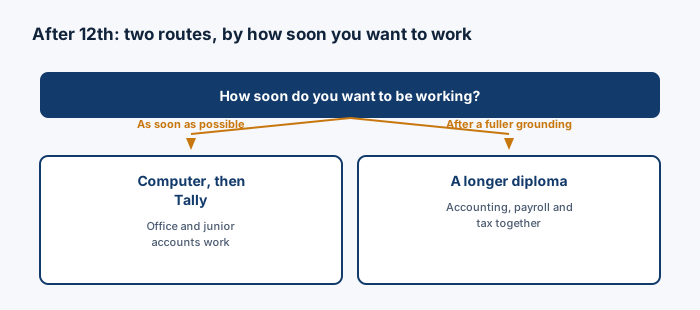
If you need income soon and cannot wait three years, start with the Tally course, then keep studying part-time once a salary is coming in. If your interest is specifically tax and compliance, go straight to the GST Practitioner Course or the Diploma in Taxation Law instead of the broader diploma. And if you genuinely cannot tell which of these describes you, that uncertainty is itself useful information: it usually means a short, inexpensive course is the right next step, not a three-year one.
What the next few years actually look like
The B.Com-plus-practical-course path
Year one typically means starting the degree and, for students who plan ahead, adding a short course such as Tally or GST during the same period. By year three, the degree is finished, ideally alongside or shortly after a completed skill course, so the graduate enters the job market able to both explain and perform the work. By year five, someone who took this route seriously is usually well into real accounts or tax work, often having added a second skill course, such as the Diploma in Taxation Law, once the first job was secure.
The CA path
Year one is registration, Foundation-level study and, for many students, the start of articleship arrangements. By year three, most students are deep into Intermediate exams and articleship simultaneously, widely regarded as the hardest stretch of the qualification because both compete for the same hours. By year five, a student who progressed steadily may be close to, or have completed, the Final examinations, coming out with both a qualification and several years of practical experience that a degree-only route cannot match at the same age.
The skill-course-first path
Year one means a short course, such as the two-month GST Practitioner Course or the two-month Tally course, followed by a first job within weeks. By year three, someone on this path has typically added further study, whether a degree pursued alongside work or a longer diploma such as DFA. By year five, the outcome depends heavily on what was added in between, which is precisely why this guide treats the three routes as combinable rather than as one choice made once at eighteen.
Common mistakes at this stage
Treating the three routes as rivals rather than as combinable options is the single most common mistake, and it usually leads to years spent defending a choice rather than adjusting it as circumstances change.
Starting a professional qualification without being honest about whether it can be sustained is the second mistake. CA, CS and CMA are all long, and attempting one while unsure creates exactly the drift described in not clearing CA: what to do next, where years pass without a clear decision either to continue or to stop.
Choosing a course because it is the cheapest or the longest, rather than because it fits the goal, is the third mistake. A three-month taxation diploma is not a lesser version of a twelve-month accounting diploma; it is a different tool aimed at a different destination, so comparing them purely on price or duration misses the point of both.
Assuming a degree alone will be enough is the fourth, and it causes the most disappointment, because it usually surfaces at the worst moment: the first real interview, after three years of otherwise good results.
Frequently asked questions
Which course has the best scope after 12th commerce?
Scope depends on what you actually want. CA has the highest ceiling and the highest failure rate. B.Com has the widest applicability. Accounting and GST skill courses have the shortest path to a first job. There is no single answer that holds for every student.
Can I do a job-oriented course along with B.Com?
Yes, and it is a common approach. Courses run in classroom and online mode, so students frequently take a Tally or GST course during a B.Com rather than waiting until after graduation.
Do I need a commerce background for an accounting course?
Not for NIMB’s courses. The Diploma in Financial Accounting explicitly accepts students from both commerce and non-commerce backgrounds, because it starts from fundamentals. See accounting without a commerce background for what that involves.
Which is better after 12th, Tally or GST?
Tally if you want general accounts work, because it is what employers ask for most often. GST if you want to specialise in compliance, or eventually file returns for your own clients.
How soon can I start earning after 12th commerce?
Fastest is the skill-course route: a two-month Tally course can lead to a first accounts-assistant role within weeks, though pay and responsibility at that level are limited until further study is added. A degree takes three years before it opens the same doors on its own.
Does a short skill course stop me from doing CA, CS or CMA later?
No. A Tally or GST course takes a few months and does not compete for years of your life the way a mid-attempt distraction would. Many students use a short course to earn while studying for Foundation-level papers.
What if I am still unsure which route to take?
Answer three questions and get a straight recommendation, including when the honest answer is to finish a degree first or settle a CA attempt before starting anything new.
Still deciding?
Call NIMB on 9212008787 or visit the centre at E-56, Laxmi Nagar, Delhi 110092. A short conversation about what you want to be doing in two years is more useful than any comparison table, including this one.
Still comparing two courses?
If you have narrowed it down but cannot decide, these pages go through the trade-offs properly.
- GST Course vs Diploma in Taxation: a specialism against a foundation.
- Is a Tally course enough to get a job? An honest answer about where a one-month certificate stops.
- Accounting without a commerce background: if you did not take commerce at 12th.
- DFA vs BAT Course: worth reading now if a longer diploma is likely after a degree.
Read next
For the wider library of course and compliance guides, see the NIMB guides hub.
- B.Com versus a practical accounting course: which of the two you are actually missing.
- Not clearing CA: what to do next: what the attempt was worth and what stays open.
- What accounting courses in Delhi actually cost: we checked who publishes a fee. Almost nobody does.
Not sure which fits? Answer three questions and get a straight recommendation, including when the answer is none of them.