NIMB EDU

The best course after 12th commerce is the one that matches what you can sustain, not the one with the best brochure. For most students that means a degree such as B.Com or BBA plus either a professional route (CA, CS, CMA) or a job skill, chosen by four things: your tolerance for long exams, your comfort with maths, how soon you need an income, and your CUET or entrance score.
Pages that answer this question usually list courses and stop. You already have lists, so this guide does the other half: it tells you which route fits which situation, what to do first, and how to check any option before paying. For the complete list of options, see all courses after 12th commerce; for what the pay evidence says, see high-salary courses after 12th commerce. If you are comparing streams as well, start with which course is best after 12th. Sources were re-opened between 18 and 23 October 2026.
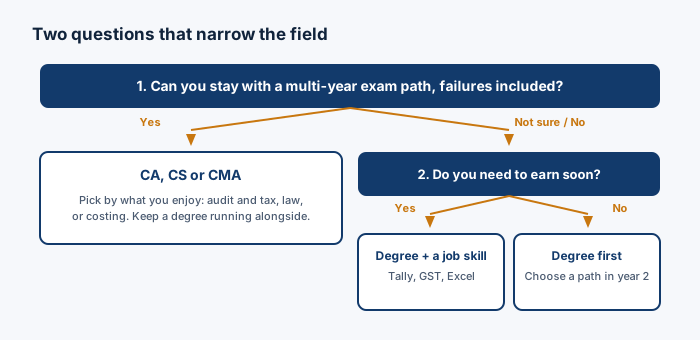
Which course is best for your situation?
Find the row closest to you. Each row names a route, the reason and the first step to take this month. The routes are explained in more depth in the full course list linked at the top.
| If this is you | Consider | Why | First step |
|---|---|---|---|
| You love accounts and tax and can accept a long path | CA, alongside a degree | ICAI’s scheme has Foundation, Intermediate and Final with two years of practical training | Read ICAI’s current scheme, then register for Foundation when ready |
| You like company law, drafting and compliance | CS | ICSI’s entrance test, CSEET, is open to candidates who have passed or are appearing in 10+2 | Check the current CSEET schedule on ICSI |
| You like costing and how businesses control spending | CMA | ICMAI’s Foundation needs only a Class 10 pass | Read the ICMAI eligibility page |
| You want the safest, widest option | B.Com | It keeps CA, CS, CMA, MBA and government exams open | List the universities that accept your CUET subjects |
| You want business, marketing or HR | BBA | Management-focused, with MBA as a later step | Compare college placement reports, not brochures |
| You are strong in maths and like economics | BA Economics or an integrated management programme | Both reward quantitative skills | Check the entrance test and maths expectation |
| You need to earn within a year | Degree plus a job skill, or a job skill first | Tally, GST and Excel are asked for in first accounts jobs | Pick the skill that matches a job you can name |
| You are drawn to argument and reading | Integrated law | CLAT is the route to the NLUs | Check CLAT eligibility and dates |
| You like people and service work | Hotel management | NCHM admits through the NCHM JEE after 10+2 with English as one of the subjects | Read the NCHM eligibility rules |
| You have no idea yet | B.Com or BBA, then decide | It buys two years to test interests | Take a short skill course to see what you enjoy |
How should maths change your choice?
Maths narrows a few doors and closes none of the main professional ones. Without maths, B.Com, BBA, law, hotel management, CA, CS and CMA remain open, since their registration rules do not require it. With maths, add economics, integrated management and actuarial science.
Be careful not to confuse entry rules with the exam itself. ICAI’s Foundation includes a Quantitative Aptitude paper covering business mathematics, logical reasoning and statistics (ICAI FAQ). Students who avoided numbers at school should expect to put in extra practice there. The Institute of Actuaries of India accepts Class 12 passers at the ACET stage with a 50% pass mark (IAI), but the exams that follow are maths-heavy.
What if you took Accountancy but not Maths?
You are not locked out of the main degree route. The University of Delhi’s 2026-27 bulletin lists two CUET combinations for B.Com (Hons): one language, Mathematics or Applied Mathematics, and two other domain subjects, or one language, Accountancy or Book Keeping, and two other domain subjects (University of Delhi). The same bulletin requires you to appear in CUET in the subjects you studied at Class 12. Other universities will differ, so shortlist three or four and read each bulletin before choosing your CUET subjects.
Should you choose CA, CS or CMA, and when?
Choose one when you can name what you would do all day in that career, and not just the title. Here is how they differ in daily work.
- CA: audit, tax and finance. The scheme runs Foundation (four papers), Intermediate (six) and Final (six), with two years of practical training (ICAI).
- CS: company law, governance and compliance. Per ICSI’s CSEET FAQ, the restructured test began with the June 2026 session, is centre-based and runs three times a year, in the first week of February, June and October (ICSI).
- CMA: costing and management accounting, with Foundation, Intermediate and Final levels (ICMAI).
If you have a few weeks, test the fit cheaply: read a sample chapter from the body’s own study material, or sit in on an introductory lesson. If your first attempts do not go well, not clearing CA: what next shows the options. For the deep route, read how to become a chartered accountant.
What if you need to earn soon?
Start with a degree and a job skill, not a long exam path. A skill course opens junior accounts roles quickly, and you can study alongside. Which accounting course should you take works through the choice between courses in three questions, and is a Tally course enough for a job sets out the limits. For the awarding-body question behind any diploma, see diploma courses after 12th commerce.
NIMB sells online courses in this lane, such as the TallyPrime course, and none of the degrees or professional routes in this guide. A short course is an add-on to a degree, not a replacement for one.
How do CUET and your score affect the choice?
Many central universities admit to B.Com and BBA through CUET (UG), run by NTA (CUET). The 2026 cycle ran from May to June, and the NTA site showed no 2027 bulletin on 20 October 2026, so watch it. Subject rules differ by university: some require accountancy or maths in Class 12, so read each university’s own bulletin and plan your CUET subjects to match your target colleges.
A weak score does not end the plan. Private universities, state universities and professional routes have their own entry rules, and CA, CS and CMA do not use CUET. For a path after the degree, see best courses after B.Com.
What would the choice look like for three typical students?
These are profiles, not real people. Each shows how the four filters (exam tolerance, maths, money and score) combine into one plan. Treat them as templates for your own answers.
| Profile | Plan | Why it holds up |
|---|---|---|
| Strong marks, studied Accountancy and Maths, family can fund five years | B.Com (Hons) through a CUET-based university, with CA Foundation registered alongside | Delhi University accepts either Maths or Accountancy for B.Com (Hons), so your CUET combination has more than one way in. ICAI lets you register for Foundation early. |
| Average marks, no maths, needs an income within a year | B.Com or BBA from an affordable college, plus a Tally and GST skill from the first semester | The entry rules for these degrees and for CA, CS and CMA do not require maths, and the skill gets you junior accounts work while you study. |
| Interested in several things, no clear career yet | A general B.Com or BBA, with one short skill course and one sample chapter of CA, CS or CMA study material in year one | It keeps the professional bodies, an MBA and government exams open while you test what you enjoy. |
In each case the plan has a first step you can take this month, and each plan can be changed after a year without losing the degree.
How much failure should you plan for?
Plan for it before you start a long exam path, because the pass rates are low enough that failing an attempt is common. For CA Final in May 2026, ICAI’s results release gave a pass rate of 14.07% for candidates sitting both groups together (23,776 appeared, 3,345 passed), 12% for Group I alone and 20.49% for Group II alone (ICAI press release). Those are attempts at one level in one sitting, not a verdict on any one student, but they show what the average candidate faces.
Ask yourself three questions before you commit. Can you study through a failed attempt without losing a year’s income? Does your family agree to the longer timeline? Do you have a fallback that uses what you have already learned? If the answer to the third is a degree plus a skill, you are safe. The CA course guide gives the pass rates for the earlier levels and the full timeline.
When do the windows open? A decision calendar
Several deadlines fall in the year you finish Class 12, so decide the broad route before results arrive. The table collects the dates the bodies themselves state.
| Route | What the body says | What it means for you |
|---|---|---|
| CA Foundation and Intermediate | Exams are held three times a year, in January, May and September (ICAI FAQ) | There is no single annual deadline; plan the first sitting around your study time |
| CS entrance (CSEET) | Held three times a year, in the first week of February, June and October (ICSI) | You can start in the year you finish Class 12 without waiting for a degree |
| CUET (UG) for central and many other universities | The 2026 cycle ran from May to June, and the NTA site showed no 2027 bulletin on 20 October 2026 (NTA) | Choose your CUET subjects early; the window is short |
| Scholarships on the National Scholarship Portal | On 18 October 2026 the portal gave 31 October 2026 as the student closing date for renewal applications under the merit-based CSSS; we found no published closing date for fresh applications (NSP) | Register early and read the notice for your own category; each cycle has its own dates |
How do you check an option before paying?
- Who awards the certificate? For CA, CS and CMA it is the institute. For a degree it is a university. For a short course it is usually the provider itself, which is fine if you know it.
- Is an online degree recognised? Search the university on the UGC Distance Education Bureau lists.
- Is the qualification registered? Look for it on the National Qualifications Register.
- Is there a salary or placement claim? Ask for the source, the year and who is counted. Our salary evidence guide, linked at the top, shows how.
- What is the refund and exit policy? Ask before you pay.
What are the most common choosing mistakes?
- Choosing for prestige without checking whether you enjoy the daily work.
- Treating the options as either-or, when a degree plus a skill or a professional route is normal.
- Letting a friend’s choice or a family comparison set your route.
- Skipping the maths question, then finding it in the first exam.
- Paying a fee before checking who awards the certificate.
Frequently asked questions
What is the short answer to which course is best after 12th commerce?
There is no single best course. B.Com or BBA suits students who are still deciding, CA or CS suits those ready for a long exam path, and a skill course suits those who need to earn soon. Use the situation table above to pick.
Which is better after 12th commerce, B.Com or BBA?
B.Com leans toward accounts, finance and the professional exams. BBA leans toward management, marketing and HR. If CA, CS or CMA is on your list, B.Com is the more natural partner.
Which course is best after 12th commerce without maths?
B.Com, BBA, law, hotel management, CA, CS and CMA are all open without maths. Economics and actuarial science expect it.
Can I do CA along with B.Com?
Yes, many students do. ICAI allows registration for Foundation after Class 10, and a degree can run alongside the CA stages.
What is the best short course after 12th commerce?
Tally if you want general accounts work, GST if you want compliance, and Excel if you want reporting. Choose by the job you can name.
Which course is best after 12th commerce for a government job?
Some posts, such as those recruited through SSC CHSL, are open after Class 12, while others need a degree. Read the notification on the SSC website.
Can I change my mind after starting a course?
Yes, and it is easier early. A degree in the first year keeps most routes open. Switching out of a professional course or a degree may cost fees or time, so ask the awarding body or college what carries forward before you decide.
Should I take a gap year to decide?
A gap year with no plan costs time. A short course, a CUET attempt or an internship during the gap tests your interests while you decide.
Is CA better than B.Com?
They are different kinds of qualification. B.Com is a university degree and CA is a professional qualification awarded by ICAI. Many students do both, and a commerce graduate with at least 55% can register for CA Intermediate directly, as the post-B.Com guide linked above explains.
Which course is best after 12th commerce with maths?
Maths adds BA Economics, integrated management programmes and actuarial science to the list, and at Delhi University it is one of two accepted CUET routes into B.Com (Hons). Choose among them by the work you want and by each entrance test.
Should I do CA or a degree first?
You do not have to pick one. ICAI allows Foundation registration after Class 10, and a degree can run alongside the CA stages. If a long exam path worries you, take the degree first and decide in year two.
Which course after 12th commerce guarantees a job?
None does. A course can raise your chances, but any guarantee on a brochure should be treated as marketing. Ask for the placement report with its year, the number of students counted and the roles filled.
Still deciding?
If two options still look equal, talking it through with a counsellor often settles it. Book a session on the career counselling page or call or WhatsApp 9212008787. Disclosure: NIMB EDU sells online accounting and tax courses. This guide covers many options we do not sell, and says when a short course is the wrong choice.