NIMB EDU

To become a chartered accountant you register with ICAI, clear the Foundation (unless you are a qualifying graduate), Intermediate and Final exams, complete two years of articleship and the other mandatory courses, and then apply for ICAI membership. The order of those steps matters more than most guides admit, because several of them can only be done once an earlier one is finished.
This guide is the step-by-step version. It follows ICAI’s 2026 prospectus and its latest exam notices, read in October 2026, and it reflects the current scheme, which has a two-year articleship, six papers at Final and four self-paced online modules. What each level contains is in the CA course guide, and money is in CA course fees. If CA is one of several options you are weighing after Class 12, start from all courses after 12th.
What are the steps to become a CA?
There are ten steps, and direct entrants skip step 3 because they do not sit Foundation. Here they are in order.
- Choose your entry route (Foundation or direct entry).
- Register with ICAI online through its Self Service Portal.
- Clear Foundation after four months of study and your Class 12 exam (Foundation route only).
- Register for Intermediate and complete eight months of study.
- Clear both Intermediate groups.
- Complete the ICITSS course, about four weeks.
- Register and serve a two-year articleship.
- Register for Final and qualify four self-paced online modules.
- Complete Advanced ICITSS after articleship, then clear both Final groups.
- Apply for membership of ICAI.
The ordering rules come from ICAI’s prospectus. You cannot start articleship until you have passed both Intermediate groups and finished ICITSS, and you cannot sit Final until six months after articleship ends (ICAI Prospectus 2026).
Which route should you take?
Take the Foundation route if you are in school or have not met the graduate percentage, and direct entry if you are a graduate with at least 55% in commerce or 60% in another stream. Both end in the same Intermediate and Final.
| Where you are now | Route | What to do next |
|---|---|---|
| Passed Class 10 | Foundation | Register with ICAI; the four months of study can run alongside Class 11 and 12 |
| In Class 12 | Foundation | Register at least four months before the sitting you want, and appear in Class 12 first |
| Passed Class 12, any stream | Foundation | Register and pick a Foundation sitting |
| In the final year of graduation | Direct entry, provisional | Register provisionally for Intermediate; confirm with your marks |
| Graduate with 55% (commerce) or 60% (other) | Direct entry | Register for Intermediate and start the eight-month study period |
| Graduate below those percentages | Foundation | The Foundation route needs only Class 10 registration and Class 12 appearance |
| Passed CS or CMA Intermediate | Direct entry | Register for Intermediate with your pass certificate |
The percentages and conditions are in the prospectus. The last-but-one row is our reading of the Foundation rules, not a separate ICAI provision, so confirm it with ICAI if it applies to you. If you are a B.Com student comparing paths, see the best courses after B.Com. If you did not study commerce, courses after 12th without commerce and accounting courses without a commerce background show where the Foundation papers will feel unfamiliar.
How do you become a CA after graduation, step by step?
Register for Intermediate through direct entry, which you can do provisionally in the final year of your degree, finish the eight-month study period, and sit the exam once your marks meet ICAI’s minimum. The steps below follow the ICAI FAQ.
- Check your marks. You need 55% in a commerce degree (with the prescribed papers) or 60% in any other degree, or an Intermediate pass from ICSI or ICMAI.
- Register provisionally if you are in the final year. Your registration is confirmed when you submit the marksheet, within six months of appearing in the final-year exam.
- Use the final year for the eight months of study. The study period counts from the date of provisional registration, so you can finish it before your result arrives.
- Fill the Intermediate exam form only after you hold the marks. If your degree marks fall short, the provisional registration is cancelled and no credit is given for the study done.
- Carry on as for any entrant: pass both groups, ICITSS, two years of articleship, Final registration, the four modules, Advanced ICITSS, then Final.
If you already hold the marks and are doing a postgraduation, register on the strength of your graduation marks. If you missed the marks in graduation, you can register provisionally in the last year of the postgraduation instead (ICAI FAQ). Whether to spend the next four years this way is a different question, which CA vs CS vs CMA vs ACCA helps with.
Can you start CA preparation in Class 11 or 12?
Yes. You can register for Foundation after Class 10, study alongside school and take your first attempt only after appearing in the Class 12 exam (ICAI FAQ). Early registration does not start the validity clock, which runs from your first eligible attempt. What matters is the four-month minimum between registration and the first day of the exam month, so plan back from the sitting you want.
How do you register with ICAI?
You register online through ICAI’s Self Service Portal, with a valid email address and mobile number for OTP verification, and you upload soft copies of your documents. ICAI states that no personal visit or physical submission is needed (ICAI Prospectus 2026).
The entry point is ICAI’s students services page, which links to the entry-level form for Foundation and for Intermediate through direct entry. After ICAI verifies your documents and confirms registration, you get details to order study material from its Centralised Distribution System. Keep your registration number, because every later step runs through the same portal at eservices.icai.org.
What do you need ready before filling an ICAI exam form?
A working login on the Self Service Portal, a course code in the new scheme, an acceptable photo and signature, and the documents for your level. ICAI’s notices for the latest sittings list these checks, and a gap in any of them can stop the form.
- Course code. If your dashboard code is not NEWFND23 or CONFND23 (Foundation) or NEWINT23 or CONINT23 (Intermediate), convert to the new course first. ICAI’s notice says no fee is payable for the conversion.
- Class 12 proof for Foundation. Upload your Class 12 admit card if you are appearing, or your marksheet if you have passed.
- Group registration for Intermediate. Check that you are registered for the group or groups you intend to sit.
- Articleship status and Advanced ICITSS for Final. The status must read “Registered”, and Advanced ICITSS must be done by the stated cut-off (10 October 2026 for November 2026).
- Medium and centre. Choose English or Hindi and your city carefully, because ICAI allows changes only in a short correction window.
ICAI’s notice asks for a jpg photograph of 20 to 50 KB that fits 4.5 cm by 3.5 cm on a white background, with no caps, goggles or selfies, and a jpg signature of 10 to 20 KB that fits 6 cm by 2 cm, signed in black pen on plain white paper. The specifications and the eligibility checks are in ICAI’s January 2027 exam requirements and the November 2026 Final requirements. The same kind of notice is issued for each sitting, so read the one for yours.
How do you clear Foundation?
You register, finish at least four months of study before the sitting, appear in Class 12, and fill the exam form online. Foundation has four papers, and you pass with 40% in each paper and 50% overall (ICAI FAQ).
Timing is the trap. ICAI counts the study period from your registration date to the first day of the exam month, so for the January 2027 sitting you had to be registered by 1 September 2026 (ICAI Foundation notice). You must also upload your Class 12 admit card or marksheet. Miss a cut-off and the next sitting is four months away. The cut-off table for every sitting is in CA course duration.
How do you clear Intermediate?
You register for Intermediate, complete eight months of study, and pass both groups, each of three papers. You can appear in one group at a time, but you register for both. Each paper needs 40% and each group or the combined pair needs 50% overall.
The eight-month rule works like Foundation’s: you must be registered on or before a cut-off date before the sitting. For the January 2027 Intermediate exam the cut-off was 1 May 2026 (ICAI exam requirements). Direct-entry students can use their final graduation year for the study period once provisionally registered, as long as the degree marks meet the minimum when they fill the exam form.
Exemption and pass-rate details are in the CA course guide.
How do you get an articleship?
You find a practising CA, or a CA in service, who will take you on, sign a training agreement (Form 102), and register it with ICAI through the portal (Form 103). Articleship can start only after you have passed both Intermediate groups and completed ICITSS.
Under the current scheme it lasts two years. Hours, leave, stipend and the last 9 to 12 months as an industrial trainee are tabulated in the CA course guide.
Two practical points that sites often skip. First, ICAI’s Final exam notice asks students whose articleship status is still pending to get it updated to “Registered” on the portal before applying, so unfinished paperwork can hold up an exam form (ICAI Final exam requirements). Second, the quality of training varies by firm, so ask what work trainees do day to day and whether the firm covers audit, tax and finance rather than only one.
What are your rights as a trainee?
Three provisions are worth knowing before you sign Form 102 (ICAI Prospectus 2026).
- Record of work. You can log the work you do in ICAI’s web-based e-diary, which gives you your own record of what you were trained in.
- Secondment. Under Regulation 54, a trainee can be seconded to another member in practice to gain experience in areas the principal cannot provide.
- Complaints. Under Regulation 67, a trainee can complain to ICAI about a principal on a matter concerning training. ICAI can investigate, and while the complaint is pending the President or Vice-President can terminate or suspend the articles and allow another member to take you on.
What are the ICITSS courses?
ICITSS is a compulsory course of about four weeks that you complete before articleship, combining an IT course and an orientation course. Advanced ICITSS is a second four-week course, with advanced IT and management and communication skills, done after articleship and before the Final exam (ICAI FAQ).
Book the first one early. Because you cannot begin articleship without it, a missed batch delays the whole sequence.
What are the self-paced online modules?
They are four online modules, A to D, that you clear at your own pace after registering for Final, and you must have qualified all four before the Final exam. Modules A and B are compulsory, you choose one elective for C from ten and one for D from four, and each is passed at 50% with no limit on attempts (ICAI FAQ).
Because there is no deadline other than your Final sitting, the sensible approach is to start them during articleship rather than leave all four for the end.
How do you clear Final and become a member?
You can sit Final once you are registered for it, have finished articleship at least six months before the exam month, completed Advanced ICITSS and qualified the four modules. Pass both groups, then apply to ICAI for membership (ICAI FAQ).
The Final has six papers in two groups. Five are closed book and Paper 6, Integrated Business Solutions, is an open-book case study. The November 2026 sitting runs from 2 to 13 November (ICAI guidance notes). Final exam months vary by cycle, so check ICAI’s examination announcements for the next one.
ICAI also lists an optional Business Accounting Associate certificate, fee Rs 500, for students who have passed both Intermediate groups, completed training and Advanced ICITSS, and qualified the online modules. It is not a CA qualification. See what to do if you do not clear CA for the wider set of options.
What are the next exam dates and deadlines?
As of 18 October 2026, the two sittings in view are Final in November 2026 and Foundation and Intermediate in January 2027. Always confirm on ICAI’s examination announcements, because dates are issued sitting by sitting.
| Sitting | Key dates | Source |
|---|---|---|
| Foundation, January 2027 | Registration cut-off 1 September 2026. Exam form window was 3 to 16 November 2026, with a late fee to 19 November and corrections 20 to 22 November. Papers on 3, 5, 7 and 9 January 2027 | ICAI guidance notes |
| Intermediate, January 2027 | Registration cut-off 1 May 2026. Same form and correction windows as Foundation. We did not find the paper dates in a primary ICAI document | ICAI exam requirements |
| Final, November 2026 | Form closed 19 July 2026 (late fee window to 22 July). Papers 2 to 13 November 2026. Advanced ICITSS cut-off 10 October 2026 | ICAI guidance notes |
If you missed a cut-off, the next sitting is typically four months later for Foundation and Intermediate.
How do you apply for membership and what comes after?
When you have passed both Final groups, finished articleship and Advanced ICITSS and qualified the four modules, you apply to ICAI for membership. ICAI’s FAQ is explicit that the compulsory modules, Sets A and B, must be qualified before you apply for membership (ICAI FAQ). We did not find the membership procedure or fee in ICAI’s Prospectus, so confirm both with ICAI before you apply.
A member who wants to practise independently also needs a Certificate of Practice, which ICAI issues subject to its conditions. Others take jobs. ICAI runs a virtual campus placement for newly qualified CAs, and its 64th drive in April to May 2026 reported an average package of Rs 13.30 lakh, a highest offer of Rs 27.50 lakh and 2,570 candidates offered jobs (ICAI Placement Directorate). That figure covers those who take part in the programme, not all CAs, and the difference is explained in CA salary in India and CA fresher salary.
How long does it take to become a CA?
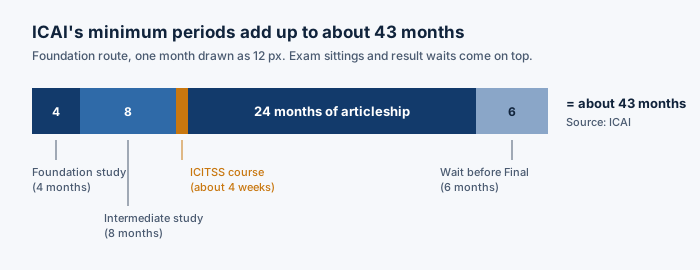
ICAI’s prescribed periods add up to about 43 months on the Foundation route and about 39 months for direct entry (our sum). With exam sittings and results, a first-attempt run is likely to take about four to five years from Class 12 (our estimate). The stage-by-stage breakdown, worked calendar and registration validity are in CA course duration.
Can you study something else or work while doing CA?
Outside articleship, the ICAI documents we read set no rule on studying for a degree or working, and a final-year graduate can complete the Intermediate study period in the same year. During articleship, Regulation 65 bars any other course of study, business or occupation without ICAI’s prior permission in Form 112, which must be applied for within one month of joining the college or course. College hours must not clash with working hours, or the articleship period will not be recognised (ICAI Prospectus 2026). If you are weighing CA against a degree, which course is best after 12th commerce compares the two.
What mistakes cost students the most time?
These are the deadline and paperwork slips that ICAI’s own notices warn about.
- Missing a registration cut-off. Each sitting has a date by which your study period must have started.
- Old course codes. ICAI’s notices ask students whose dashboard code is not a current new-scheme code to convert before applying, which it does at no charge.
- Photo and signature rejections. The exam form needs a specific size and format, and a poor upload can block your form.
- Unregistered articleship. A pending status can stop the Final form.
- Treating the online modules as optional. You cannot sit Final without all four.
Frequently asked questions
How can I become a CA after 12th?
Register for Foundation with ICAI, pass it, then clear Intermediate, serve a two-year articleship, clear Final and apply for membership. You can register after Class 10 and take the Foundation exam after you appear in Class 12.
Can I become a CA after graduation?
Yes. Graduates with at least 55% in commerce or 60% in another stream register directly for Intermediate and skip Foundation.
Can I become a CA without commerce in Class 12?
Yes. ICAI accepts any Class 12 stream for Foundation. Commerce students have an easier start in Accounting and Business Laws, but there is no stream restriction.
How many years to become a CA after 12th?
ICAI’s minimum periods come to about 43 months, which is about 3.6 years. Including sittings and results, expect about four to five years if you clear everything the first time. That is our estimate, not an ICAI figure.
Is articleship compulsory to become a CA?
Yes. Two years of practical training is required, and you cannot sit Final before it ends. The Business Accounting Associate certificate also requires it.
Can I do a job while preparing for CA?
Articleship is full-time training, so it is effectively your job for those two years. Outside articleship, the ICAI documents we read set no rule about working while you study, so that is your own call.
Is the CA exam very difficult?
ICAI’s own data shows low pass rates: in May 2026, 8.47% of Intermediate candidates who sat both groups passed both, and 14.07% at Final. Details are in the CA course guide.
How much does it cost to become a CA?
ICAI’s published fees come to about Rs 84,500 from Foundation or Rs 74,000 for direct entry, before coaching. See the fee breakdown guide, and the salary guide for the return side.
Still deciding?
If you are not sure that a four-to-five-year route is right for you, or want to compare it with a degree or a shorter accounting qualification, a conversation helps more than another article. See career counselling, or call 9212008787 or message us on WhatsApp. To compare options first, read which course is best after 12th.