NIMB EDU

The best course after BCA is an MCA to go deeper into computing, an MBA to move into management, or a job with skills and a portfolio to start earning now. Which one fits depends on three things. These are your marks, whether your degree included mathematics or statistics (the MCA entrance test checks this), and whether you want to build software or run teams.
Most pages on this question list MCA, MBA, data science and cyber security and stop. This guide adds the part that decides outcomes. It gives the actual entry rule for each route, from the body that sets it. It also flags the common trap for BCA graduates: the main MCA entrance test needs maths or statistics somewhere in your degree. Facts were last checked on 26 October 2026. For the wider picture across degrees, see courses after graduation.
What can you do after BCA?
You have four starting points, and many graduates combine two, such as a job plus an MBA application a few years later. The diagram sets them out.
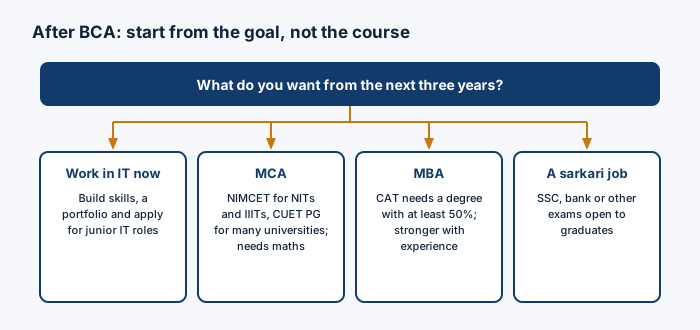
Every option after BCA, compared
| Route | How you get in from BCA | Who should think twice |
|---|---|---|
| MCA at NITs and IIITs (NIMCET) | At least 60% (55% for SC, ST, PwD) in a UG programme of at least three years with Mathematics or Statistics as a subject | BCA graduates with no maths or statistics in the degree |
| MCA at universities (CUET PG and others) | Eligibility set by each university; check the university page | Anyone who has not read that university’s rule |
| MBA / PGDM (CAT) | Bachelor’s degree with at least 50% (45% for SC, ST, PwBD); final-year students can apply | Anyone applying with no clear management goal |
| IT job now | Skills and a portfolio, no entrance exam | Anyone who needs a postgraduate degree for a specific role |
| CA / CS / CMA | CA direct entry with 60% in a non-commerce degree; CS for any graduate; CMA for a recognised degree | Anyone who does not want finance, law or audit work |
| Government exams | A bachelor’s degree is the base condition | Anyone who cannot sustain long preparation |
Is MCA the best course after BCA?
MCA is the most common and most direct next step if you want a software or systems career and a postgraduate degree, but it is not best for everyone. It is strongest when you want depth in programming, systems or data work, and weakest when you mainly want to start earning or to move into business roles.
For the NITs and IIITs, the entrance test is NIMCET, coordinated by NIT Tiruchirappalli. The 2026 brochure says candidates need at least 60% marks in aggregate or 6.5 CGPA on a 10-point scale (55% or 6.0 for SC, ST and PwD). The marks must come from a UG programme of at least three years with Mathematics or Statistics as one of the subjects, or from a B.E./B.Tech. Final-year students can apply but must submit proof of eligibility by 30 September 2026, and admission is on NIMCET rank only (NIMCET 2026 brochure). Read it as a warning for 2027: if your BCA did not include maths or statistics as a subject, check the new brochure before you plan around NIMCET.
Some universities use CUET (PG), which NTA conducts, for postgraduate admission. The NTA FAQ tells candidates to check the eligibility of the university where they seek admission. Confirm that your MCA is offered and what it asks (CUET (PG) 2026 FAQ). If you plan an MCA from a private institute, check that it is approved by AICTE.
What does NIMCET test, and which institutes use it?
NIMCET is one computer-based paper of 120 multiple-choice questions and 1,000 marks, taken in 2 hours, and Mathematics carries 600 of those marks. That weighting is why a BCA with little maths is a risk, and why the rule asks for Mathematics or Statistics in your degree. The 2026 brochure sets the pattern below, and the three parts are timed and cannot be revisited once their time ends.
| Part | Subject | Questions | Marks per correct answer | Deduction per wrong answer | Total marks | Time |
|---|---|---|---|---|---|---|
| I | Mathematics | 50 | 12 | 3 | 600 | 70 minutes |
| II | Analytical Ability and Logical Reasoning | 40 | 6 | 1.5 | 240 | 30 minutes |
| III | Computer Awareness | 20 | 6 | 1.5 | 120 | 20 minutes for both |
| III | General English | 10 | 4 | 1 | 40 |
Ranking is by total weighted marks, with ties broken first by Mathematics, then Analytical Ability, then Computer Awareness, and then by age (older candidate ahead). A candidate who scores zero or negative in Mathematics or in total is disqualified. Admission into the MCA at the participating institutes is on NIMCET rank alone. For 2026 those institutes were the NITs at Agartala, Allahabad, Bhopal, Delhi, Jamshedpur, Kurukshetra, Meghalaya, Patna, Raipur, Tiruchirappalli and Warangal, and the IIITs at Bhopal and Vadodara (NIMCET 2026 brochure (PDF)).
What did the NIMCET 2026 timeline and cost look like?
It ran from a May application to a July counselling, and the money was spread across three payments. Use it to plan your own year, because the 2027 dates will differ.
| Step | 2026 cycle |
|---|---|
| Application form submitted by | 1 May 2026, 5:00 PM IST |
| Admit card download | 27 May to 6 June 2026 |
| Test | 6 June 2026 |
| Results (tentative) | On or before 29 June 2026 |
| Counselling registration and choice locking | 30 June to 3 July 2026 |
| Fees | Application Rs 2,500 (Rs 1,250 for SC, ST and PwD); counselling registration Rs 1,000; seat acceptance Rs 10,000 once a seat is allotted |
Candidates in their final year can apply, but the brochure required proof of eligibility at counselling or admission by 30 September 2026, and admission could be cancelled without it. If your BCA results come late, check this deadline in the next brochure before you apply.
Should you do an MBA after BCA?
Do an MBA after BCA if you want to move from building software to managing products, teams or business functions. It makes less sense if you want to stay hands-on in code, where an MCA or a few years of experience does more.
The CAT 2026 notice required a bachelor’s degree with at least 50% marks or equivalent CGPA (45% for SC, ST and PwBD). Final-year students could apply, and meeting the minimum does not ensure a shortlist (CAT 2026 eligibility). An MBA tends to pay back better with some work experience, because it gives you a reason to choose a specialisation. Compare an MBA with a PGDM only after confirming the institute’s approval.
Can you get an IT job directly after BCA?
Yes, and many BCA graduates do. There is no official entry test: employers look at what you can build and explain. A realistic plan is a small portfolio of working projects, a clear specialisation (web, data, testing, cloud or security) and a course that fills a named gap.
- NPTEL runs IIT and IISc courses, and most of its certificates need a proctored in-person exam (NPTEL FAQ); pick one aligned with the role you want.
- NIELIT accredits computer-training institutes for specified levels of its O, A, B and C level courses, so ask any centre to show its accreditation (NIELIT accreditation scheme).
- Vendor certifications (cloud, security and similar) are set by the vendor, so read the vendor’s own page for syllabus and fee before paying anyone else.
Check any provider’s claim of recognition under the national skills framework on the National Qualifications Register. This guide prints no salary figure, because no official source gives one for “BCA graduates”. Portal averages rarely state a source, year or sample. Compare three live job adverts for your target role and city instead.
Which specialisations after BCA have a recognised route?
Data science, cloud, cyber security and full-stack development appear on most of the pages that rank for this question, but they are skills, not regulated courses. This guide found no single body that sets entry rules or a syllabus for them, so the value of a certificate depends on who awards it. The recognised routes with published rules are the MCA and MBA above, and NIELIT-accredited computer courses, which NIELIT describes by O, A, B and C levels. For a specialisation, pick the one that matches the job adverts you are applying to, and keep a project in that area on a public repository for an interviewer to open. For a role in finance technology, the shorter accounting route is explained above.
Can a BCA graduate do CA, CS or CMA?
Yes, and a BCA gives a useful edge in finance roles that run on software, but each route takes years. ICAI lets graduates in subjects other than commerce register directly for Intermediate with at least 60% marks (55% for commerce graduates), so you skip Foundation (ICAI FAQs). For CS, graduates in any discipline are exempt from the entrance test (ICSI). For CMA, a degree of a recognised university is an entry route to Intermediate (ICMAI). See the CA course guide and CA vs CS vs CMA vs ACCA before committing.
If you want to combine IT with accounts, a shorter route is practical: learn TallyPrime and GST filing and apply for accounts-technology roles. NIMB’s TallyPrime course and GST practitioner course are built for that, and the accounting course picker says which fits. This route is not for you if you want a pure software career.
Can you prepare for a government job after BCA?
Yes. UPSC civil services asks for a graduate degree of a recognised university in any subject (UPSC notice 05/2026). SSC CGL asks for a bachelor’s degree for most posts, but some name a subject. Statistical Investigator Grade-II lists Statistics, Mathematics, Economics, Computer Science and Computer Application among others (SSC CGL 2026 notice). Age limits, attempts, stages and upcoming dates are in the government-jobs section of the courses after graduation guide linked at the top. Read the post-specific qualification in every notice, and keep a skill or a job going during preparation.
Which mistakes do BCA graduates make?
- Assuming NIMCET is open to every BCA. It needs maths or statistics in the degree. Check before paying for coaching.
- Doing an MBA to avoid choosing. The fee is large and the outcome depends on the institute.
- Collecting certificates instead of building projects. A portfolio shows skill; a stack of certificates often does not.
- Trusting ranked lists. “Top 10 courses” pages are usually written by an institute promoting its own programme.
Frequently asked questions
Which course is best after BCA?
MCA for a deeper computing career, MBA for management, or a job with skills and a portfolio. There is no single best course, only the best fit for your goal and marks.
Is MCA compulsory after BCA?
No. Many BCA graduates take IT jobs directly. An MCA helps when you want a postgraduate degree for specialist or teaching roles, or when an employer or university asks for it.
Can I do MCA after BCA without maths?
For NIMCET, the 2026 brochure requires Mathematics or Statistics as a subject in the UG programme. Other universities set their own rule through CUET (PG) or their own tests, so read the university’s eligibility.
Is MBA better than MCA after BCA?
Neither is better in general. MCA deepens technical skill; MBA moves you toward management. An MBA usually pays back better with work experience.
What courses can I do after BCA for a job?
Web or data skills, software testing, cloud and security certifications from the vendor, and for accounts-technology roles, Tally with GST. Pick the one that matches the job adverts you are applying to.
Can I do CA after BCA?
Yes. ICAI allows direct entry to Intermediate for non-commerce graduates with at least 60% marks. Training is 2 years under the new scheme.
Can I appear for government exams after BCA?
Yes. SSC CGL and UPSC need a bachelor’s degree, and bank exams are open to graduates. Always read the current notification for age, attempts and post-specific qualification.
Is an online MCA valid?
Only if the university and programme are recognised by UGC. Verify the institution and programme on the UGC-DEB site before paying.
What is the NIMCET exam pattern?
One paper of 120 multiple-choice questions and 1,000 marks in 2 hours: Mathematics 50 questions (600 marks), Analytical Ability and Logical Reasoning 40 (240), Computer Awareness 20 (120) and English 10 (40). Wrong answers lose 25% of the marks, and unanswered questions lose nothing.
Is Maths in Class 12 enough for NIMCET?
The 2026 brochure’s rule refers to Mathematics or Statistics as one of the subjects in the undergraduate programme, not in Class 12. If your BCA had no such subject, write to the NIMCET helpdesk before you pay, because the brochure is the only authority on whether your degree counts.
How much does NIMCET cost?
For 2026 the application fee was Rs 2,500 (Rs 1,250 for SC, ST and PwD). Counselling registration cost Rs 1,000 and the seat acceptance fee was Rs 10,000 once a seat was allotted. Read the next brochure for the 2027 amounts.
Still deciding?
If you would like to talk it through, book a career counselling call or message us on WhatsApp at 9212008787. Bring your BCA marks, your subject list and a rough idea of the work you want in three years, and you will get a straight answer. More degree-specific guides are on the NIMB guides page, and B.Sc. graduates should read which course is best after B.Sc..