
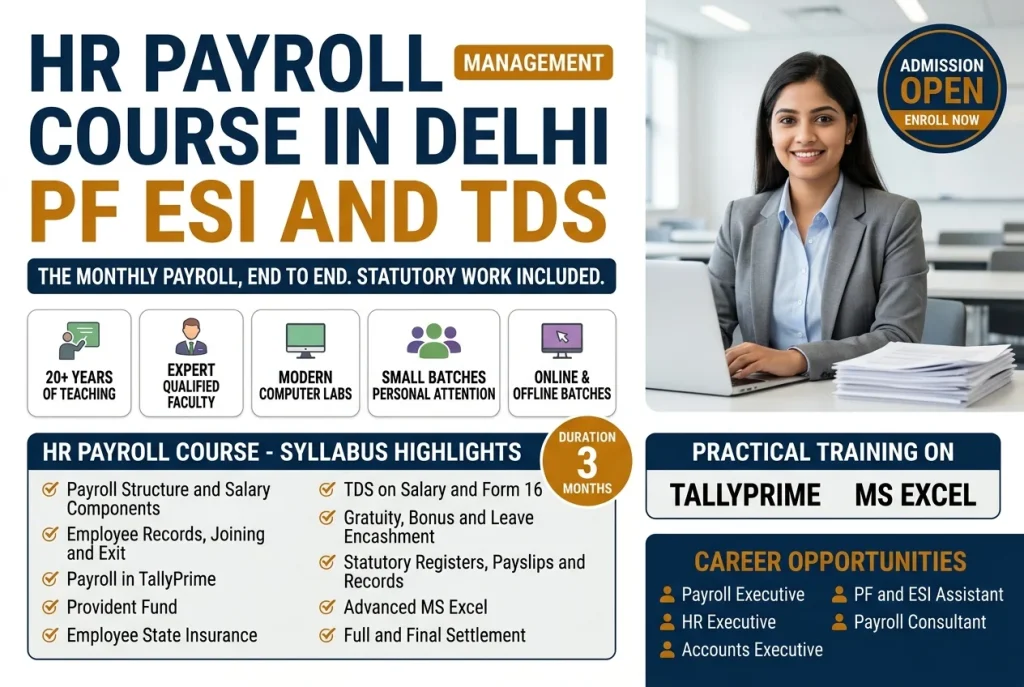
Payroll is the one job in an accounts department that runs on somebody else’s calendar. Salaries fall due on a date, the statutory deductions fall due on another, and every rupee of those deductions was withheld from an employee’s own wages. This three-month course teaches that cycle end to end, from the structure of a salary to the challan that proves the remittance was made.
In short: the HR and Payroll Management course runs three months, in classroom or online mode, with the fee shared on enquiry. It covers salary structure, provident fund, employee state insurance, TDS on salary, gratuity and bonus, hands-on payroll in TallyPrime, and the statutory registers an inspection asks for.
What is the HR and Payroll Management course?
It is a functional course rather than a general accounting one. The subject is a single recurring process: take a workforce, a pay structure and a month of attendance, and produce correct payslips, correct remittances and a record that survives scrutiny.
Three statutory regimes meet inside that process, and the course takes each one separately before joining them up. Provident fund answers to EPFO. Employee state insurance answers to ESIC. Tax deducted from salary answers to the income tax department under Section 192, on its own quarterly rhythm. They share a payroll and share nothing else, which is precisely why they are taught apart first.
Alongside those sits gratuity, bonus and leave encashment. These are not monthly. They arise at a particular point in someone’s service, they are computed differently from each other, and they are the entitlements a small employer is most likely to discover late.
The fourth strand is the software. Employee groups, pay heads and attendance types are configured in TallyPrime so that a month recalculates itself rather than being retyped. Payroll in TallyPrime sets out what that configuration looks like and what it costs to get wrong.
Who should do this course
Three groups, arriving for different reasons.
Junior accountants who already keep the books but hand payroll to somebody else. This is one of the commonest gaps between an accounts assistant and an accounts executive, and it is a gap that closes in a single quarter.
HR assistants who own the employee side already – joining papers, attendance, exits – and need the statutory half of the same job. Salary structure, provident fund, ESI and Form 16 are exactly where those two halves meet.
Owners of a small business running payroll in a spreadsheet, or paying somebody else to run it. Three months is enough to bring the work in-house, and enough to know when an outside consultant has it wrong.
What payroll work actually involves
A payroll month has a shape, and the course follows that shape rather than the order a syllabus would suggest.
Attendance is finalised first, because everything downstream is computed from it. The payroll is then processed and the register read before anybody is paid. The check that matters is on exceptions rather than totals: joiners, leavers, arrears, and anyone whose pay moved for a reason nobody can name. A register can total correctly and still be wrong for two employees at once.
The statutory work follows payment. Provident fund is remitted through the Electronic Challan cum Return, the ECR, which is a member-wise statement rather than a summary figure – a wrong wage on one row misstates that employee’s own contribution history. ESI runs on the same monthly clock but on two fixed six-month contribution periods, which is what makes a mid-period pay rise behave counter-intuitively. Tax deducted under Section 192 is deposited monthly and reported quarterly on Form 24Q, and it is Form 24Q that eventually produces Part A of the employee’s Form 16.
Rates, wage ceilings and coverage thresholds are notified figures, and they change. The course teaches where to confirm them for the period being processed rather than asking anyone to memorise them, and PF and ESI returns explains at length why that distinction is not pedantry.
Certification and examination
Assessment is a one-hour multiple-choice examination, taken online through the institute’s own portal. A certificate follows on completion.
Fee and what it covers
No fee is published for this course. It is quoted on enquiry, and the same conversation is the place to ask what the quote includes and whether it can be paid in instalments.
Why study HR and payroll at NIMB
The payroll, provident fund and ESI content already sits inside the Diploma in Financial Accounting, where it is one component of a twelve-month qualification. This course is that component given a timetable of its own, with gratuity, bonus, TDS on salary and the statutory registers added around it.
Two things follow from teaching it that way. The software work stops being a demonstration and becomes a configuration exercise you do yourself. And the statutory content is written to be checked against EPFO, ESIC and the income tax portal, which is the habit that keeps a payroll correct after the course ends.
How the course is taught
The three months are built around one repeated exercise: run a month, then run the next one with something changed. A joiner in week two, a leaver mid-month, a backdated increase, an employee whose wages cross a ceiling. Each variation is the same process meeting a different exception, and exceptions are where payroll errors live.
Both classroom and online batches are offered, so the course can sit alongside a job. The statutory sessions are deliberately taught against the current published position rather than from a fixed handout, because a printed rate goes stale and a student who knows where to look does not.
Career opportunities after this course
Payroll work recurs by definition – every employer with staff does it every month – so the demand is steady rather than seasonal. These are the roles this course points at.
Payroll Executive
Owns the monthly run for one employer: attendance, processing, payslips, and the provident fund, ESI and TDS remittances that follow. The role this course is built for. It is also the role most often filled by promoting somebody who already worked in the accounts team and happened to learn payroll.
HR Executive with payroll responsibility
Sits in the HR function and carries the statutory half of it. Joining and exit documentation, attendance, full and final settlements, and the coordination with whoever files the returns. Common wherever HR and accounts are two people rather than two departments.
Compliance Assistant, provident fund and ESI
Works on the filing side specifically: preparing and uploading the ECR, tracking coverage as employees join and leave, remitting on time, and keeping the challans where an inspection can be shown them in under a minute. Found in consultancies and in payroll bureaux as much as in single employers.
Accounts Executive with payroll responsibility
A general accounting role where payroll is part of the job rather than all of it. The most common first destination, because a small accounts team needs one person who can run the month without sending it outside.
Independent payroll consultant
Running payroll for several small employers at once. It is a plausible practice to build because the work repeats on a fixed date, the client relationship renews monthly, and a handful of small clients is enough to begin part-time.
None of these roles is quoted here with a salary. There is no figure the institute can evidence, and a number invented for a course page is worse than silence – ask what recent students were actually offered.
What you can do after each module
Eight modules over three months. Each adds a skill that can be checked rather than one that has to be taken on trust.
| Module | What it covers | What you can do afterward |
|---|---|---|
| 1. Payroll structure | Basic, allowances, reimbursements, deductions and the rule behind each | Read a salary structure and say what each line is and how it was arrived at |
| 2. Employee records | Joining documents, capturing an existing UAN, exit and settlement | Set up a new joiner correctly and close a leaver without leaving a gap |
| 3. Payroll in TallyPrime | Employee groups, pay heads, attendance types, the monthly pay run | Configure a payroll so that it recalculates itself, and run a full month in it |
| 4. Provident fund | Coverage, UAN and member ID, the contribution split, the ECR | Decide who is covered and prepare a member-wise ECR for a month |
| 5. Employee state insurance | Coverage, the two contribution periods, monthly remittance | Apply the contribution-period rule to an employee whose wages cross the ceiling |
| 6. TDS on salary | Section 192 computation, Form 24Q, Form 16 Part A and Part B | Compute a monthly salary deduction and explain what produces each half of Form 16 |
| 7. Gratuity, bonus, leave encashment | What triggers each entitlement and how each is computed | Work out what is owed to a long-serving employee at exit |
| 8. Registers and records | Wage, attendance and deduction registers, payslips, challans | Produce the paper trail behind any month already filed |
Who this course is not for
It is not a general accounting qualification, and it does not pretend to be. There is no ledger work, no finalisation of accounts and no balance sheet in it. Someone who wants the whole accounts job should look at the Diploma in Financial Accounting or the BAT Course instead.
It is also not a human resources management course in the broader sense. Recruitment, appraisal, training and employee relations are outside it. The HR content here is the part of HR that produces a number: who joined, who left, who was present, and what each is therefore owed.
And if the immediate priority is simply to be employable quickly in an accounts role, the Tally Course gets there faster. Payroll is a strong second skill and a narrow first one.
A realistic three months
The first few weeks are the least dramatic and the most load-bearing. Salary structure and the employee record are where every later calculation comes from, and students who rush them spend the rest of the course correcting inputs rather than learning rules.
The middle stretch carries the software work and the two contribution schemes together, which is deliberate – provident fund and ESI make more sense once you have watched them come out of a pay run you configured yourself. Expect the coverage questions to take longer than the arithmetic.
The last stretch is TDS on salary, the annual entitlements, and the registers. This is the part that ties a year together rather than a month, and it is where most of the exam questions come from.
How this compares with our other courses
This is the narrowest course NIMB runs and the deepest on its subject. The Diploma in Financial Accounting covers payroll, provident fund and ESI as part of a twelve-month qualification; if you want the whole accounts role and payroll within it, that is the better fit.
The Diploma in Taxation Law shares the TDS ground but approaches it from tax rather than from payroll, and adds income tax and GST. The Tally Course overlaps only on the software. For the compliance side of indirect tax instead, the GST Practitioner Course is the parallel two-month specialisation.
The terms you will be working with
Payroll has a vocabulary, and most of it is acronyms issued by three different authorities. These are the ones the course is built around.
A pay head is one component of pay or deduction, defined with a calculation rule rather than a fixed amount. Defining pay heads as amounts is the single decision that turns an automated payroll into a manual one.
The ECR, the Electronic Challan cum Return, is the monthly provident fund filing. It is member-wise, so it is simultaneously the return, the basis of the payment, and the thing that updates each employee’s passbook.
The UAN, the Universal Account Number, is allotted to an employee once and follows them between employers. A new job creates a fresh member ID underneath the same UAN, which is why an incoming employee who already holds one is not a first-time member.
A contribution period is the six-month window ESI runs on. Coverage is judged at the start of it, which is the rule that catches employers out mid-year.
Form 24Q is the quarterly return reporting tax deducted from salaries. Form 16 is what the employee receives: Part A is generated from the filed returns, Part B is the employer’s own statement of the salary and the deductions behind them.
More questions about the HR and Payroll Management course
Can I do this alongside a job?
Yes, and many of the people this course is written for are already working. Both classroom and online batches run, and three months is short enough to commit to without rearranging a year.
Do I need Tally experience before starting?
No. The payroll module is taught from its own starting point rather than assuming the rest of the package. If you have never opened TallyPrime at all, the Tally Course is a comfortable thing to have done first, but it is not a prerequisite.
Will I be able to file the returns myself afterward?
You will know how each return is built, what it contains and when it is due. Actually filing for an employer needs that employer’s own portal credentials, which is a matter of access rather than of ability.
How much of this is arithmetic?
Less than people expect. The computations are simple; the difficulty is in the rules that decide which computation applies to whom, and in noticing the month when the answer should have changed and did not.
How to enrol in the HR and Payroll Management course
Admission is a conversation rather than an entrance test. Call the institute on 9212008787, or come to the centre at E-56, Laxmi Nagar, Delhi 110092, and an advisor will confirm the three-month schedule, quote the fee and explain what the current batch looks like.