Provident fund and employee state insurance are the two statutory deductions that recur every month with a hard deadline, and they are where a small business most often discovers it has a compliance problem — usually several months after acquiring one.
Sourcing, stated plainly. EPFO’s rate pages and the ESIC website both failed to respond while this page was written, so the figures below are corroborated across independent secondary sources rather than taken from the authorities directly. They are long-standing and widely consistent. They are also notified amounts that change, and a stale figure here would be deducted from someone’s salary — so confirm the current position with EPFO and ESIC for the period you are processing before you rely on any of it.
Provident fund
The rates
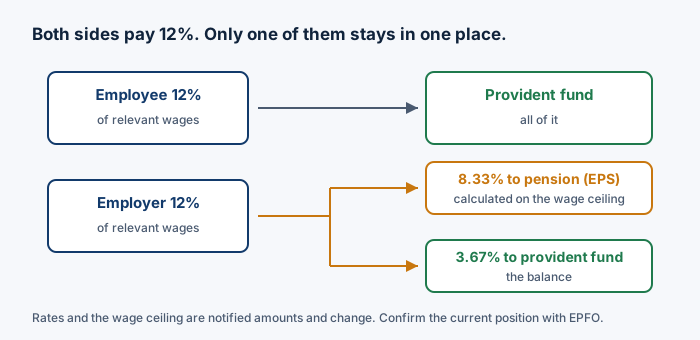
Both sides contribute 12% of the relevant wages. The employee’s 12% goes to provident fund. The employer’s 12% splits:
- 8.33% to the pension scheme (EPS), calculated on the statutory wage ceiling
- the balance, 3.67%, to provident fund
The statutory wage ceiling is commonly applied at Rs 15,000 a month, which puts the EPS portion at Rs 1,250. Contributions above the ceiling are possible and are a decision rather than an automatic consequence of a higher salary.
This split is the part people get wrong when reconstructing payroll by hand. “Both sides pay 12%” is true and does not mean both 12% amounts land in the same place.
The deadline
The Electronic Challan cum Return — the ECR — is uploaded and the contribution remitted by the 15th of the following month. The ECR is both the return and the basis of the payment, so there is no separate filing step to forget.
Employee state insurance
The rates
Employee 0.75%, employer 3.25%, of wages. The employer share is larger, which surprises people used to the symmetry of provident fund.
Coverage applies to employees earning up to a wage ceiling commonly applied at Rs 21,000 a month.
The contribution periods
ESI runs on two fixed six-month periods — April to September and October to March — and this creates the rule employers most often miss:
If an employee is covered at the start of a contribution period and their wages rise above the ceiling mid-period, they remain covered until that period ends. Coverage does not stop the month the salary increases. Stopping the deduction immediately after a mid-year rise is a common and entirely avoidable error.
The deadline
Contributions are payable monthly by the 15th of the following month, aligning with the provident fund date.
Split a salary into PF and ESI
PF 12% from each side, of which 8.33% of the employer share goes to the pension scheme on wages up to Rs 15,000. ESI 0.75% employee and 3.25% employer, for wages up to Rs 21,000. Rates and ceilings are notified and change — confirm with EPFO and ESIC for the period you are processing.
The coverage questions that decide everything
Before any rate matters, two threshold questions:
- Is the establishment covered? Both schemes apply to establishments meeting employee-count thresholds, and coverage once triggered does not lapse simply because headcount later falls.
- Is this individual covered? Depends on wages against the ceiling, and for provident fund on whether an existing member joined you — an employee who is already a member generally continues, regardless of current salary.
That second point catches growing businesses constantly. Hiring someone who has been a member elsewhere is not the same as hiring a first-time employee, and treating them identically produces a gap that surfaces at inspection.
What lateness costs
Both schemes charge interest on delayed remittance and provide for damages on default, at rates that step up with the length of the delay. We are not printing the slabs here for the same reason as above.
The practical point is more useful than the slab table: these are amounts withheld from employees’ wages. Late remittance of an employee’s own deduction is treated considerably more seriously than a late payment of the employer’s own money, and it is not a good place to be managing cash flow from.
A monthly sequence
- Finalise the payroll and identify everyone covered under each scheme.
- Check the joiners and leavers. Mid-month movements are where errors cluster.
- Check anyone whose wages crossed a ceiling — and for ESI, remember coverage runs to the end of the contribution period.
- Generate and upload the ECR; remit provident fund by the 15th.
- Remit ESI by the 15th.
- Keep the challans. They are what an inspection asks for.
PF and ESI, side by side
Both schemes get confused with each other because they run on the same monthly clock and come out of the same payroll. They are not the same thing, and the table below is the fastest way to see where they diverge.
| Scheme | Employee rate | Employer rate | Wage ceiling | Deadline | What it covers |
|---|---|---|---|---|---|
| Provident fund | 12% | 12%, split into 8.33% to the pension scheme and 3.67% to provident fund | Commonly applied at Rs 15,000 a month for the pension-scheme portion | 15th of the following month, via the ECR | A retirement corpus for the employee, plus a pension benefit funded from the employer’s share |
| ESI | 0.75% | 3.25% | Commonly applied at Rs 21,000 a month | 15th of the following month | Medical care, plus cash benefits for sickness, maternity and disability, for the employee and specified dependants |
These are notified figures, and both authorities revise them from time to time. Confirm the current rates and ceilings with EPFO and ESIC for the period you are actually processing before this table goes anywhere near a live payroll.
What the ECR actually contains
The ECR is not a summary total. It is a member-wise statement: for every employee covered that month, it carries their UAN, their gross wages, the wages taken as the EPF and EPS wage base, and the resulting employee and employer contribution figures, row by row.
This matters because the ECR is also what updates each employee’s PF passbook. A wrong wage figure on one row does not just misstate a total. It misstates that specific employee’s contribution history, and it is the employee, not the employer, who discovers it years later when the numbers do not add up at withdrawal or transfer.
The UAN, and how it follows an employee between jobs
The Universal Account Number is allotted once and stays with the employee for their working life, regardless of how many employers they have. What changes with each new job is the Member ID, a fresh account number that sits underneath the same UAN and gets linked to it.
The practical consequence for an employer is the coverage question raised above. An incoming employee who already holds a UAN from a previous job is an existing member, not a new one, and generally continues to be covered by provident fund regardless of their current salary. Capturing the existing UAN at the time of hiring, rather than treating everyone as a first-time joiner, is what avoids a gap that only shows up when the numbers are checked later. KYC details, Aadhaar, PAN and bank account, sit against the UAN, which is also why an employee with incomplete KYC on their UAN can hold up that month’s ECR upload.
What an inspection asks for
An inspection under either scheme is a documents exercise before it is anything else. What gets asked for, in practice, is the paper trail behind the numbers already filed. That means attendance and wage registers, the salary register for the period in question, copies of the ECR and the challans showing the contribution was actually remitted, and the employee master showing UAN and ESI numbers against each name.
Exact requirements vary by inspecting officer and by scheme, so treat this as what to have ready rather than an exhaustive list, and confirm the specific documents an inspection has asked for directly with EPFO or ESIC. The pattern worth remembering: an employer who can produce the challan for a given month in under a minute is having a very different inspection from one who cannot.
The mid-month joiner and leaver problem, worked through
This is the single most common source of manual error in both schemes, because the contribution is due on wages actually earned for the days worked, not on the full month’s wage.
Take an employee on a monthly wage of Rs 18,000 who joins on the 16th of a 30-day month. Fifteen days are worked that month, so the wage actually earned is Rs 9,000, not Rs 18,000. Provident fund contribution for that month is calculated on the Rs 9,000 actually paid: employee PF is Rs 1,080, not the Rs 2,160 a full month would produce. The same logic applies to an employee who leaves on the 10th of a month, where the earned wage is Rs 6,000 and the contribution is calculated on that figure.
The exact method used to arrive at the earned wage, whether by calendar days or a scheme-specific formula, is set by the authorities and can vary by circumstance. Treat the figures above as illustrating the principle rather than a formula to apply unchecked. Confirm the applicable proration method with EPFO and ESIC before relying on it for a live payroll. What does not vary is the principle itself: a mid-month joiner or leaver is not entitled to, and should not be charged, a full month’s contribution on a part month’s wage. That is exactly the exception the monthly sequence above is checking for.
Frequently asked questions
Is the employer contribution really 12% as well?
Yes, but it splits — 8.33% to the pension scheme on the ceiling wage and the balance to provident fund. It does not all go where the employee’s 12% goes.
An employee’s salary went above the ESI ceiling mid-year. Do I stop deducting?
Not immediately. Coverage continues to the end of the contribution period — April to September, or October to March. This is the single most common ESI error.
Can we contribute on more than the ceiling wage?
Higher provident fund contributions are possible, but it is a decision with consequences rather than something that happens automatically. Take advice before changing it.
What is the ECR?
The Electronic Challan cum Return — the monthly provident fund filing, which also generates the challan for payment.
Where is this taught?
Payroll including PF and ESI returns is part of the Diploma in Financial Accounting. See also payroll in TallyPrime for how this is actually processed.