Payroll is the part of Tally that most short courses skim and most employers actually need. It recurs every month, it carries statutory deadlines, and it is unpleasant to get wrong — which is precisely why someone who can run it reliably is worth hiring.
If you are deciding where to spend your effort, this is the highest-return corner of the package.
In practical terms, the payroll module takes each employee’s pay structure and attendance for the period, and calculates what they are owed and what must be deducted. It produces the payslips, the payroll reports and the data the statutory returns are built from. A month’s pay run is then a repeatable process rather than a fresh calculation every time.
A worked month
The mechanics above read as abstractions until an actual month runs through them. Take a small team of three.
Employee A works the full month on a fixed pay structure. Their pay heads produce the same figures every month because nothing about their attendance changed, which is exactly what a correctly configured pay head should do: nothing for the accountant to touch.
Employee B joins on the 18th of a 30-day month, on a monthly figure of Rs 24,000. Because their basic pay head is defined against the attendance and production type rather than as a flat amount, the earned pay is calculated from the days actually worked. That is 13 days out of 30, so Rs 24,000 divided by 30 and multiplied by 13, which is Rs 10,400. Had that pay head been set up as a flat amount instead, it would have produced a full month’s Rs 24,000. Someone would have had to notice the joining date and correct it by hand, for every mid-month joiner, every month.
Employee C leaves on the 10th of the same month, on the same Rs 24,000 monthly figure. The attendance-linked pay head produces Rs 8,000 for the 10 days worked, again without manual intervention.
| Employee | Monthly figure | Days worked | Earned pay |
|---|---|---|---|
| A | Full month, fixed structure | 30 of 30 | Unchanged |
| B, joiner | Rs 24,000 | 13 of 30 | Rs 10,400 |
| C, leaver | Rs 24,000 | 10 of 30 | Rs 8,000 |
When the payroll register is reviewed, B and C are exactly the entries the exception check is designed to catch: wages that moved for a reason unrelated to a raise or a cut. The register also carries the statutory deduction lines for both employees, calculated on whatever the current PF and ESI rates and wage ceilings are. Those figures are covered, with the caution they deserve, on the PF and ESI returns page, and should be confirmed with EPFO and ESIC for the period being processed rather than assumed from a previous month.
The exact method used to arrive at an earned wage, calendar days or another basis, is not fixed by Tally. It depends on how the pay head and attendance type were configured, and different employers configure it differently for reasons of their own. What matters is that it is configured deliberately, as a calculation, rather than defaulted to a flat figure that then has to be corrected by hand.
Arrears follow the same logic in reverse. A backdated increase of Rs 2,000 a month, applied three months late, adds Rs 6,000 of arrears pay in the month it is finally processed. That Rs 6,000 is added to the wage base for that month’s statutory deductions as well. Both PF and ESI are computed on wages actually paid in the month of payment, not on the period the arrears relate to.
A register can also look right and still be wrong in a way totals never reveal: two employees’ fixed allowances swapped against each other, or a leaver paid for the full month because their leaving date was never entered anywhere. The total for the month can still look entirely plausible. Only checking exceptions by employee, not the total, catches either one.
Why it is worth more than it looks
Most accounting tasks are periodic and forgiving. Payroll is neither. It happens on a date, it affects every employee personally, and errors surface immediately and loudly.
For a small business the choice is to do it badly in a spreadsheet, pay an outside consultant, or employ someone who can run it. Being the third option is a specific, durable reason for a business to keep you.
The structure comes first
Tally’s payroll is built from a hierarchy, and setting it up carelessly is the source of nearly all later pain.
- Employee groups — how staff are categorised, which drives reporting and often the applicable rules.
- Pay heads — each component of pay and deduction: basic, allowances, statutory deductions, reimbursements.
- Salary details — what each employee is actually entitled to.
- Attendance and production types — what is being measured, where pay varies with it.
The one to think hardest about is pay heads, because each carries a calculation type — a flat amount, a percentage of another head, something computed on attendance. Those relationships are what make the payroll recalculate correctly when something changes. Define them as fixed amounts to save time at setup and you will be re-entering figures by hand every month for as long as you hold the job.
The statutory components
Provident fund and employee state insurance are deductions with deadlines attached, and they are the part where errors stop being internal and start involving a department.
Two things matter here more than the mechanics:
- Rates, wage ceilings and thresholds change. They are set by the respective authorities and revised from time to time. Confirm the current figures with EPFO and ESIC for the period you are processing rather than relying on a figure learned in a course — including any figure you might read on a page like this one.
- Coverage is conditional. Whether a given establishment and a given employee fall within each scheme depends on tests that are not obvious from the payroll screen.
This page deliberately does not print rates or ceilings. They move, and a stale number here would be worse than no number, because payroll errors compound monthly and are recovered from the employee.
The monthly rhythm
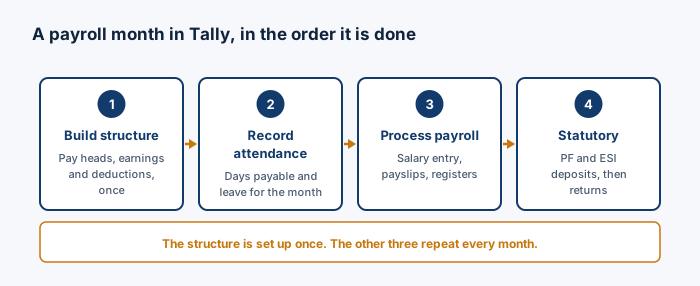
- Record attendance for the period.
- Process the payroll and review the register before anything is paid.
- Check the exceptions, not the totals. Anyone whose pay changed materially, anyone who joined or left mid-period, anyone with zero or unusually high pay. Totals look right far more often than they are right.
- Pay, and record the payment.
- Deal with the statutory returns and remittances by their due dates.
Step 3 is the one that separates a payroll you can trust from one that merely ran.
Where it usually goes wrong
- Mid-month joiners and leavers. Proration is where manual errors cluster.
- Arrears and revisions. A backdated increase affects prior periods and often the statutory deductions with them.
- Pay heads defined as flat amounts when they should have been computed, which quietly turns an automated payroll into a manual one.
- Treating the register as the check. It confirms the software did what you told it, not that you told it the right thing.
The compliance side
Processing payroll and filing what it generates are different jobs. PF and ESI returns covers the rates, the monthly ECR deadline and the coverage rules, and TDS return filing covers the salary deduction reported on Form 24Q. For the rest of TallyPrime, start with what to learn and in what order.
A month, worked through
Take a small firm with eleven people on the payroll. One joined on the 12th, one left on the 20th, and one had a backdated increase agreed in the previous month but processed in this one. Nothing about that month is unusual, and all three are where the errors come from.
- Attendance first. Record the period before anything else. The joiner and the leaver both need part-month attendance, and if you process pay before attendance is final you will process it twice.
- Let the pay heads compute. If basic, allowances and the statutory deductions are defined as calculation types rather than flat amounts, proration for the joiner and the leaver happens on its own. If they were defined as amounts, this is the month you find out.
- The arrear is a separate line, not a bigger number. A backdated increase paid this month affects the statutory deductions for the months it relates to. Rolling it silently into this month’s basic understates the earlier months and is the single most common correction an inspection asks for.
- Read the exceptions, not the total. Sort the register by change from last month. The joiner, the leaver and the arrear should be the only three lines that move materially. A fourth is a question worth answering before anyone is paid.
- Pay, record, remit. Then the statutory remittances by their due dates, which are covered on the PF and ESI returns page.
The whole sequence takes under an hour once the structure is right. It takes a day every month when the pay heads are flat amounts, and that difference is entirely decided at setup.
What the module actually is
Tally’s payroll module calculates pay and statutory deductions, produces payslips and the registers behind them, and generates the data the PF and ESI filings are built from. It is not a separate product and it is not an HR system — there is no leave workflow, no appraisal, no recruitment. It computes what someone is owed and what must be withheld, and it keeps the record that proves it.
That boundary matters when a business asks whether Tally can replace its HR software. For pay and statutory compliance, yes. For anything upstream of pay, no.
Frequently asked questions
Is Tally payroll worth learning if the company is small?
Especially then. Small businesses are the ones without a dedicated payroll person, which is what makes the skill valuable there.
What are the current PF and ESI rates?
Deliberately not stated here, because they are revised from time to time. Confirm them with EPFO and ESIC for the period you are processing.
Can payroll be run in Excel instead?
It can, and for very small teams it often is. It stops scaling once statutory deductions and headcount grow, and it leaves no audit trail worth the name.
Where is this taught?
Payroll with PF and ESI returns is part of the Diploma in Financial Accounting.