This question gets asked as though one package will turn out to be correct. In practice the answer for most people is “whichever your employer runs”, and the useful version of the question is how much it costs you to switch.
The short answer to that: less than you think, and much less than learning the first one did.
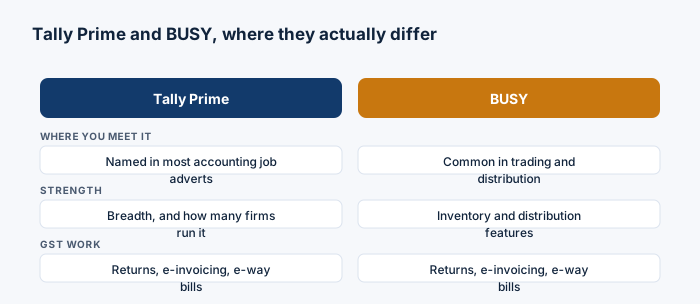
What they have in common
Both are accounting packages built for Indian small and medium business. Both handle the accounting cycle, inventory, GST and statutory reporting. Both are built on the same underlying accounting model, because that model is not optional — double entry, ledgers grouped into heads, transactions separated by type.
That shared foundation is why switching is not starting over. What transfers is everything that matters: knowing that a group determines where a balance lands, that a contra is not a payment, that classification drives the return. What does not transfer is where the menus are.
Where they differ in practice
| Tally | BUSY | |
|---|---|---|
| Market position | The default. Most widely deployed, most widely asked for in job adverts | Strong and long-established, particularly in trading and distribution |
| Recognition on a CV | Universally recognised | Recognised, less universally |
| Typical strength | Breadth, ubiquity, availability of help | Inventory and trading-oriented features |
| Finding answers | Very large user base; most problems are documented somewhere | Smaller community |
We are not going to rank them on features. Feature lists change with releases, and a comparison written today would be stale within a year — which is what most “Tally vs BUSY” pages are.
The practical answer
Learn Tally first. Not because it is better, but because it is asked for more often, so it is the one that gets you interviewed. It is also the one with the largest body of material available when you are stuck at eleven at night.
Then add BUSY if the work calls for it. Once you understand accounting properly, picking up a second package is a matter of weeks. Employers know this, which is why job adverts asking for BUSY will generally take a competent Tally user.
Being able to say you have used both is a genuine advantage in the trading and distribution sector, where BUSY is common.
The mistake worth avoiding
Do not treat the choice as important enough to delay. People spend weeks deciding which package to learn, which is weeks not spent learning either.
The thing that makes you employable is not the package. It is whether you understand what you are doing inside it — whether you can tell that a balance sheet is wrong, not merely produce one. That understanding is package-independent, and it is what an interview actually probes.
If you find yourself researching this question for a third evening, you are procrastinating. Open Tally.
When you would actually choose BUSY
The honest answer to which to learn first is Tally, for the reasons already given. But specific situations do call for BUSY, and they are worth naming rather than left as a vague exception.
- The employer or client already runs it. If the books you will actually be touching are in BUSY, learning Tally first and BUSY later is backwards. Match the software to the job in front of you.
- You are building client work in trading or distribution. BUSY’s established base in that sector means a freelance bookkeeper serving wholesalers and distributors will meet it often enough that knowing it stops being optional.
- A specific job advert names it and nothing else. Some do. Where the advert is explicit and does not mention Tally, assume the interviewer will test what the advert asked for.
- You already know Tally solidly and want to widen the client base you can serve. This is the add-it-second case described above, and it is the most common reason a working accountant learns BUSY at all.
None of these is a claim that BUSY is the better package. They are all versions of the same idea: match the tool to the actual job, not to which one is talked about more. Someone with no accounting-software experience at all should still begin with the Tally course, then treat BUSY as an addition once the underlying accounting is second nature.
How this plays out in an actual interview is worth knowing too. An interviewer at a small trading firm running BUSY is rarely testing whether you know BUSY’s menus. They are testing whether you can explain what a debit note is doing to their outstanding balance, which is accounting knowledge, not software trivia. Naming the concept correctly, even while admitting you have not opened BUSY before, tends to land better than a vague claim of familiarity that falls apart under one follow-up question.
What switching between them actually costs
The honest cost of switching is not zero, and it is worth naming precisely rather than waved away. Ledgers, groups, stock items and tax classifications do not transfer between Tally and BUSY. The two products do not share a data format, so a company’s masters have to be rebuilt in the new package rather than imported. What carries across is the opening balances and your own understanding of what each ledger should contain, not the data itself.
What this means in practice: switching software for an existing business, mid-year, is disruptive enough that most businesses do it at a year-end boundary if at all. Switching which software you personally know how to use, as an employee or freelancer moving between clients, is a different and much cheaper thing, because you are not migrating a company’s history. You are opening a new interface on concepts you already have.
The compliance-parity point people miss
A belief worth correcting directly: neither package is more GST-compliant than the other. The return formats, GSTR-1, GSTR-3B and the rest, are defined by the GST portal, not by Tally or BUSY. Both products capture the same classification data, the rate, the place of supply, the HSN code, and export it in whatever structure the portal currently expects. What differs between the two is how that data is entered and reviewed on screen, not whether the resulting return is correct.
This is worth knowing because it removes a bad reason to choose either package. Choose based on who is asking for the skill and what you will actually be using it on, covered above, not on an assumption that one product’s GST handling is inherently more reliable than the other’s.
Where SAP changes the calculus
Everything above assumes the employer is a small or medium business, which is the market both Tally and BUSY are built for. SAP FICO is a different category: it is the financial accounting and controlling module of an enterprise ERP system, built for larger organisations that need consolidated accounting across multiple entities, currencies and business units, integrated with the same system’s inventory, sales and procurement modules.
If the employers you are targeting are large enterprises rather than small businesses, the Tally-versus-BUSY question becomes secondary to whether you have any SAP exposure at all, because that is what those employers actually screen for. Most people learning accounting software should still start with Tally, since it is the more common starting point and opens the most doors at the small-business end of the market where most first jobs sit, and pick up SAP exposure later if the target employer calls for it. Someone aiming at the enterprise end from the outset should weigh that from the start, since it changes which of the three is worth the first serious hours.
What actually carries over, item by item
Naming the shared concepts is more useful than asserting that they transfer. A contra voucher in BUSY still means movement between the business’s own cash and bank accounts, and recording a withdrawal as a payment instead still invents an expense that never happened, the same failure covered on the TallyPrime page. A ledger in BUSY still sits under a group that decides where it lands in the final accounts, and a wrong group still lets the trial balance tally while the balance sheet is wrong. GST classification still has to be set correctly at the ledger or item level before a single voucher is entered, or the return inherits the same mistake every time.
What genuinely does not carry over is where any of this lives on screen. Someone who already understands why a rent deposit is not rent will find the equivalent decision in BUSY in a different place, under a different label, but will recognise it as the same decision the moment they see it.
A quick decision check
| What you are seeing | What it points to |
|---|---|
| Job adverts in your target city ask for Tally by name, rarely BUSY | Learn Tally first; it is what gets you shortlisted |
| The specific employer or client you already have runs BUSY | Learn BUSY for that engagement; matching the job beats matching the market |
| You work, or want to work, in wholesale, distribution or trading | Add BUSY once Tally is solid; the sector uses it widely enough to matter |
| You are targeting large enterprise employers rather than small business | SAP exposure matters more than the Tally-versus-BUSY choice |
Where to go from here
If you have settled on Tally, the order to learn it in is the next thing to read. The two areas worth reaching quickly are GST classification, which decides your return, and payroll, which is the module employers most often need. Excel sits alongside both.
Frequently asked questions
Which do employers ask for more?
Tally, by a wide margin, which is the main practical argument for starting there.
How long to learn the second package?
Weeks rather than months, if the accounting underneath is solid. The concepts carry; the interface does not.
Should a course cover both?
It is a reasonable thing to look for. The Diploma in Financial Accounting covers TallyPrime and BUSY along with SAP FICO and Excel.
What about SAP?
Different category — an ERP used by larger organisations rather than a small-business accounting package. It is the component that tends to open doors at bigger companies.