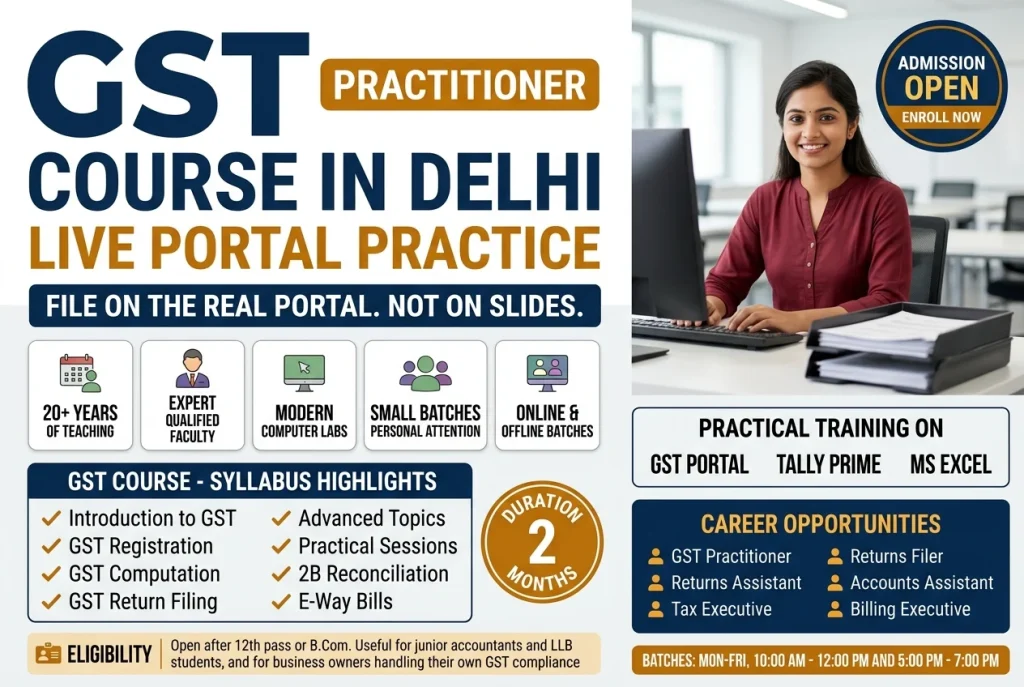
GST touches nearly every registered business in India, and every one of them needs somebody who can file its returns correctly and on time. The GST Practitioner Course at NIMB is a two-month practical course that teaches you to do exactly that — register a business, compute the tax, claim input credit properly, and file GSTR-1 and GSTR-3B without guessing.
In short: the GST Practitioner Course is a two-month program, with the fee shared on enquiry, covering GST registration, return filing (GSTR-1 and GSTR-3B), input tax credit, reverse charge, e-way bills and GST audit. It’s taught by practising chartered accountants in classroom and online formats, and it’s open to anyone with a 12th pass or B.Com.
What is the GST Practitioner Course?
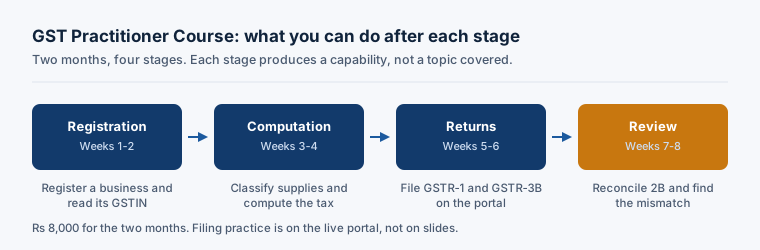
It is a working course in India’s Goods and Services Tax, built around the tasks a practitioner actually performs rather than around the theory of indirect taxation. You spend the course moving through the compliance cycle in order: understanding what GST is and how the rates are structured, registering a business and obtaining a GSTIN, computing tax on supply, and then filing returns against real deadlines.
The later part of the course covers the situations that catch people out — reverse charge, e-way bills, and what a GST audit involves. It closes with practical sessions: case studies and real-time filing exercises on GST software, so the first return you file is not the first one you have ever seen.
Who should do this course?
The course is open after 12th pass or B.Com, and suits three groups in particular:
- Commerce students finishing 12th or a B.Com who want a specific, employable skill rather than a general qualification.
- Working accountants who handle books competently but hand GST work to somebody else, and want to stop doing that.
- LLB students and practising consultants who want to add GST return filing to what they already offer clients.
Business owners also take the course to bring GST compliance in-house. If you are registered and currently paying somebody monthly to file returns you could file yourself, the arithmetic tends to work out quickly.
What GST compliance actually involves
The reason GST work is steady work is that it recurs on a fixed calendar. For a monthly filer, GSTR-1 is generally due on the 11th of the following month and GSTR-3B on the 20th. Smaller taxpayers can file quarterly under the QRMP scheme instead.
The penalties are what make accuracy matter. Late filing attracts a fee of ₹50 per day, capped at ₹10,000, alongside interest at 18% per annum under Section 50. There is also a hard limit worth knowing: a GSTR-3B cannot be filed more than three years after its original due date, after which that tax period is permanently blocked.
This course teaches you to work to that calendar rather than react to it — which, in practice, is most of what separates a competent practitioner from someone who files returns.
Filing dates and penalty amounts are periodically revised, and individual due dates are sometimes extended by notification. Always confirm the current position on the official GST portal before relying on a date.
Certification and examination
The institute conducts its examination online through its own portal. Questions are multiple choice and the paper runs for one hour. On passing, you receive a recognised diploma certificate awarded by the institute.
Fee and what it covers
The GST Practitioner Course fee is not published on this page; the institute shares it on enquiry, along with what it includes.
Why study GST at NIMB
The course is taught by practising chartered accountants who file returns themselves, which matters more in indirect tax than in most subjects. The rules change, and the useful knowledge is what is being applied this quarter, not what a textbook was printed with. Classes run in classroom or online mode, and the practical sessions use the same software you would use in a job.
How the course is taught
The course follows the compliance cycle in the order the work actually happens rather than the order a textbook presents it. Registration first, then computation and input credit, then filing against real deadlines, then the situations that catch people out, reverse charge, e-way bills, audit. The later sessions are practical: case studies and real-time filing exercises on GST software, so the first return you file for a client is not the first one you have ever seen.
Classes run in both classroom and online mode, so the course can be taken alongside a job. Assessment is an online examination through the institute’s own portal: multiple choice questions, one hour. Students who pass receive the certificate or diploma for the course.
Career opportunities after this course
GST work is recurring work. Every registered business files returns every month or quarter, which means the demand does not arrive in bursts and then disappear, it repeats on a fixed calendar. These are the roles this course points at.
GST Practitioner
Files GST returns on behalf of businesses, usually several clients at once. This is the role most students take the course for, because it can be done independently: a handful of small clients filing monthly is a realistic way to begin practising, and it grows by referral rather than by advertising.
GST Executive
Sits inside one company and owns its GST compliance — registration, computing tax on supply, claiming input credit correctly, and filing GSTR-1 and GSTR-3B on time. Common in businesses large enough to bring compliance in-house but too small for a full tax department.
Tax Analyst
Works across indirect tax rather than only filing, checking whether input credit has been claimed correctly, reconciling returns against books, and flagging exposure before an audit does. Usually a step up from an executive role and expects you to explain your reasoning, not just complete the form.
Accounts Executive with GST responsibility
A general accounting role where GST is part of the job rather than all of it. The most common first destination, because a small accounts team needs one person who can handle returns without outsourcing them.
Independent tax consultant
Practising for yourself. GST filing is a sensible entry point because the work recurs, the client relationship renews monthly, and you can start part-time alongside employment before committing.
Actual pay for these roles shifts with the city you work in, the employer’s scale and the hands-on GST work you can point to in an interview. We don’t publish salary figures without evidence behind them, so ask the institute directly about outcomes for recent GST batches.
If GST is not quite the right fit
GST is a specialism. If you want the broader taxation picture, income tax and TDS alongside GST, the Diploma in Taxation Law covers all three over three months and is the better base for consultancy work. If you are aiming at a company accounts department rather than independent practice, the BAT Course combines taxation with accounting and financial management.
If you are new to accounting software entirely, take the Tally Course first. GST compliance is done inside accounting software, and being fluent in the software makes this course considerably easier.
How to enrol in the GST Practitioner Course
Admission runs through a short conversation rather than an entrance test. Call the institute on 9212008787, or visit the centre at E-56, Laxmi Nagar, Delhi 110092, and an advisor will confirm the two-month schedule, take you through the current batch timings, and explain what the course covers in practice.
Comparing options? GST Course vs Diploma in Taxation goes through the trade-off in detail.
What you can do after each module
The compliance cycle breaks into five practical blocks. Each one leaves you able to do something specific, not just aware of a topic.
| Module | What it covers | What you can do afterward |
|---|---|---|
| 1. GST fundamentals and registration | Structure of GST, rate slabs, registering a business and obtaining a GSTIN | Complete a GST registration application for a business without assistance |
| 2. Computation and input tax credit | Calculating tax on supply, claiming ITC correctly against purchases | Work out a business’s GST liability and check whether input tax credit has been claimed correctly |
| 3. Return filing: GSTR-1 and GSTR-3B | Preparing and filing both returns against the compliance calendar | File GSTR-1 and GSTR-3B for a client ahead of the 11th and 20th deadlines |
| 4. Reverse charge and e-way bills | Identifying reverse-charge transactions, generating e-way bills for goods movement | Recognise when reverse charge applies and generate a compliant e-way bill |
| 5. GST audit and case studies | Audit procedure, real-time filing exercises on GST software | Review a return for errors before filing it, using the same workflow as a working practitioner |
Who this course is not for
This course is not for someone who wants the complete accounts function of a business, payroll, ledgers and financial statements, rather than one compliance area; the Diploma in Financial Accounting or BAT Course cover that ground. It is also not the right starting point if you have never touched accounting software at all, since the practical sessions assume you can find your way around a screen; a month of the Basic Computer Course or Tally Course first will make it far less frustrating. And if your actual interest is income tax rather than GST, income tax sits in the Diploma in Taxation Law, not here.
A realistic two months
Expect the course to front-load concepts and back-load practice. Early sessions cover GST structure, registration and computation, mostly through explanation and worked examples. By the second half, most class time shifts to filing practice on GST software using case-study data, because that is the actual skill being tested at the end. The exam sits at the close of the second month, which is why software work concentrates there rather than at the start.
GST course or the full Diploma in Taxation Law
GST is a narrower course than the Diploma in Taxation Law, which also covers income tax and TDS over three months, at a published fee of ₹20,000. If your client base or job will only ever need GST, staying narrow is not a disadvantage. GST Course vs Diploma in Taxation sets out when the extra scope of DTL is worth the extra time and cost, and when it isn’t.
The terms you will be working with
A syllabus that lists “GSTR-1, GSTR-3B, ITC and e-way bills” is readable only to somebody who already knows GST. Here is what each one is, so the syllabus above means something before you enrol.
GST is a single indirect tax on the supply of goods and services in India, introduced in July 2017 to replace a set of separate central and state taxes.
A GSTIN is the fifteen-character registration number a business receives under GST. The first two digits are the state code and the next ten are the PAN, which is why a GSTIN tells you both where a business is registered and who it belongs to.
GSTR-1 is the return that reports outward supplies, meaning the sales side. It matters more than its name suggests, because what you file here is what appears in your buyer’s credit statement.
GSTR-3B is the summary return in which the tax is actually paid: outward supplies, input tax credit claimed, and the net liability settled.
Input tax credit is the GST already paid on purchases, set off against the GST owed on sales. Most of the difficulty in practice is not claiming it, but proving you were entitled to it.
An e-way bill is the electronic document required before goods above a threshold value are moved. It is generated on the portal and carried with the consignment.
Reverse charge is the arrangement in which the recipient of a supply pays the tax instead of the supplier.
More questions about the GST Practitioner Course
Can I do this while working a job?
Yes. Classes are offered in both classroom and online formats, and the two-month length is built to fit around a job rather than replace one.
What happens if I miss a class?
The course follows a fixed compliance calendar, so missing a session means catching up on that block before the next one builds on it. Ask your advisor at enrolment how the institute handles make-up sessions for the batch you join.
What software do I need at home?
None that you need to buy yourself. The practical filing sessions happen on the institute’s software during class, so at home you mainly need a computer or laptop with a stable internet connection for online sessions and case-study review.
Is the certificate recognised?
The diploma certificate is issued and recognised by the institute on passing its exam. If your goal is to practise as a government-enrolled GST Practitioner rather than work inside an accounts team or consultancy, check the separate statutory enrolment requirements under GST law directly with the GST department. A private course certificate and a statutory practitioner enrolment are not the same thing.