These two courses overlap enough to be confusing and differ enough that picking the wrong one wastes either money or time. The short version: GST is a specialism, DTL is a foundation. Which is right depends on whether you want to do one thing well or advise on tax generally.
The difference in one table
| GST Practitioner Course | Diploma in Taxation Law | |
|---|---|---|
| Duration | 2 months | 5 months |
| Fee | Shared on enquiry | ₹20,000 |
| Covers | GST only, in depth | Income tax, GST and TDS |
| Eligibility | After 12th or B.Com | After 12th or B.Com |
| Best for | A specific, immediately usable skill | Working as a tax consultant |
What each one actually teaches
The GST Practitioner Course follows the compliance cycle: registration and GSTIN, computing tax on supply, input tax credit, then filing GSTR-1 and GSTR-3B against real deadlines. It closes with reverse charge, e-way bills and GST audit, plus practical filing sessions. Two months, and at the end you can file a return.
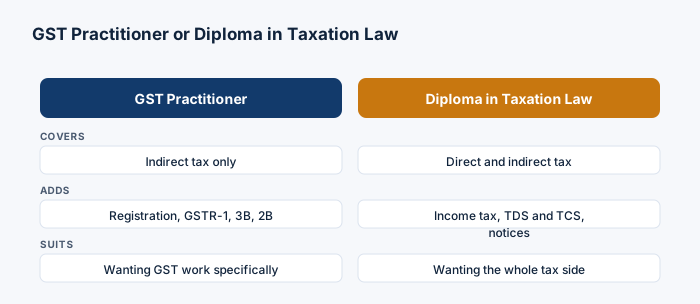
The Diploma in Taxation Law starts with the structure of the Indian tax system, then covers income tax law, salary, business and property income, and online ITR filing, calculation and planning. GST is one component rather than the whole course, and TDS and TCS get their own treatment. Work is done in Tally ERP and Excel throughout.
Choose GST if…
- Your employer needs GST specifically. Common where an accounts team handles books competently and outsources compliance.
- You want to start earning from filing quickly. Two months is a small commitment, and GST returns recur monthly — which is what makes a small client base viable.
- You are testing whether you like this work. Cheaper and shorter, and it credits naturally toward the longer diploma later.
Choose DTL if…
- You want to set up as a tax consultant. Clients do not arrive with only GST questions. Someone who cannot handle an ITR refers away half the work that walks in.
- You are aiming at a taxation role in an accounts department. These roles almost always span direct and indirect tax.
- You are an LLB student or financial advisor. The breadth is what makes it useful alongside what you already do.
The honest answer for most people
If you are choosing between them with no strong pull either way, do the GST course first. It is two months, and the fee is shared on enquiry rather than published. You will know quickly whether compliance work suits you — some people find the monthly rhythm reassuring and some find it grinding, and that is not something you can predict in advance.
If it suits you, DTL afterwards is the obvious next step and the GST knowledge transfers directly. If it does not, you have spent two months finding that out instead of three months and ₹20,000.
The exception: if you already know you want your own practice, start with DTL. You would end up taking it anyway, and doing it first is cheaper than doing both.
Neither of these?
If you want accounting rather than tax, look at the Diploma in Financial Accounting or the BAT Course — both spend more time on the accounting itself, which is what an accounts department hires for. If you need something employable in a month, the Tally Course is the fastest route.
Frequently asked questions
Can I do both courses?
Yes, and GST first then DTL is a common path. There is overlap in the GST portion, so tell the institute what you have already done.
Which has better job prospects?
DTL covers more ground, so it opens more roles. GST gets you to a usable skill faster. Neither is universally better — it depends whether you are optimising for range or for speed.
Do I need a commerce background?
Both are open after 12th pass or B.Com. DTL is particularly useful for junior accountants, financial advisors and LLB students.
Are the fees inclusive?
Yes. Both cover study material, tuition, the examination and the diploma certificate.
Still not sure?
Call NIMB on 9212008787 and describe your situation. Two minutes on the phone settles this faster than any comparison page, including this one.