A B.Com tells an employer you understand accounting in principle. It rarely tells them you can do the job, and that gap is what almost every course on this page exists to close. B.Com is a three-year undergraduate degree in commerce, covering accounting, economics, business law and related subjects at a general, largely theoretical level, so it prepares you to reason about the subject without necessarily having practised it. Knowing which gap you personally have, theory, software, filing speed or something else entirely, is the whole trick to choosing well from here.
Key takeaways
- A B.Com alone rarely gets you hired; a practical accounting or taxation course closes that gap faster than more theory would.
- For a job within a year, take a twelve-month practical diploma; for the fastest route into work, take the two-month Tally course.
- Choose CA, CS or CMA only if you are certain you can sustain years of study, not as a way to postpone deciding what to do next.
- Choose M.Com for teaching or research, and treat an MBA as more valuable after some work experience than straight after graduation.
- Combining the degree with a practical course, rather than choosing between them, is the most common and most reliable path from here.
Why B.Com graduates struggle in the first job search
The complaint from employers is consistent, and it has been for years: graduates arrive having studied accounting without ever once having done it, so they have never filed a GST return, never run a payroll, and never closed a set of books in the software the company actually uses. They know what a ledger is. They have not kept one.
Consider a concrete example. A B.Com graduate with a strong final-year result applies for a junior accountant role and is asked, in the interview, to reconcile a sample GSTR-2B against a purchase register in Tally. The graduate understands input tax credit as a concept but has never worked through the reconciliation in software, so the interview stalls there. None of that is the graduate’s fault: a B.Com was never designed to produce someone who can walk into an accounts department and be useful on the first morning. But the first hiring round comes as a shock regardless, and it hits students who did well in exams hardest of all, because nothing in three years of results prepared them for it.
The practical consequence is worth stating plainly. After a B.Com, the highest-value thing you can add is usually not more theory. It is demonstrable, software-level competence at a specific task, which is exactly what the routes below are built around.
Every route after B.Com, compared
The table below sets out the realistic next steps, from professional qualifications through postgraduate study to NIMB’s own practical diplomas, so you can weigh duration, cost and destination together rather than one at a time. Costs for third-party qualifications and degrees are marked as indicative, because they vary by institute and city, and a single invented figure would mislead more than it would help. NIMB’s own fees are exact and public.
| Route | Duration | Approximate cost | What it leads to | Who it suits |
|---|---|---|---|---|
| CA | 3-4 more years including articleship, from B.Com stage | Indicative; registration, tuition, exam and articleship costs | India’s top accounting qualification; audit, tax, senior finance roles | Graduates certain they can sustain a long, difficult course |
| CS | Several years | Indicative | Corporate law and governance qualification | Graduates drawn to corporate compliance specifically |
| CMA | Several years | Indicative | Cost and management accounting qualification | Graduates drawn to costing over audit or tax |
| M.Com | 2 years | Indicative; usually similar to undergraduate fees | Postgraduate commerce degree; route into teaching or research | Graduates aiming at academia rather than industry |
| MBA | 2 years, usually post-experience | Indicative; ranges enormously by institute | Postgraduate management degree, shifting toward strategy and leadership | Graduates with some work experience moving into management |
| Diploma in Financial Accounting (DFA) | 12 months | Rs 60,000 | Complete practical accounting: Tally, BUSY, SAP FICO, payroll, statutory filing | Graduates wanting the whole accounts job in one course |
| BAT Course | 12 months, or 6 fast track | Shared on enquiry | Accounting, tax and financial management for corporate roles | Graduates aiming at corporate accounts departments |
| Diploma in Taxation Law (DTL) | 5 months | Rs 20,000 | Direct and indirect tax combined | Graduates drawn to consultancy or tax practice |
| GST Practitioner Course | 2 months | Fee on enquiry | Registration, computation and return filing | Graduates wanting fast GST specialisation |
| Tally Course | 2 months | Rs 10,000 | Working competence in Tally | Graduates needing fast employability |
| Basic Computer Course | 1 month certificate, 12 month diploma | Fee on enquiry | Foundational computer and Excel skills | Graduates not yet confident with computers or Excel |
Notice that none of the professional or postgraduate rows carries a hard number. That is not an evasive habit unique to this table: NIMB’s own research into local accounting fees surveyed eight Delhi institutes on 12 September 2026 and found that none of the four reachable local competitors published a fee anywhere on the page selling the course. Ask any institution for the total figure in writing, not just the headline tuition, before you commit.
Option 1: practical accounting and taxation courses
The fastest route from graduate to employable, and the one most B.Com students here choose.
Diploma in Financial Accounting, twelve months, Rs 60,000. DFA is NIMB’s twelve-month practical diploma covering accounting, Tally Prime, BUSY, SAP FICO, payroll, and PF and ESI return filing. Choose this if you want the whole accounts job rather than one part of it.
BAT Course, six months, Rs 40,000. Accounting, taxation and financial management together, aimed squarely at corporate accounts departments. Six months suits graduates who do not want to spend another full year studying. See DFA versus BAT if you are torn between the two.
Diploma in Taxation Law, three months, Rs 20,000. Income tax and GST together, and the right choice if you are drawn to consultancy rather than an in-house role.
GST Practitioner Course, two months, fee on enquiry. A GST practitioner is someone authorised to prepare and file GST returns on behalf of a taxpayer, and this is the most focused option, enough to start filing returns for small clients on your own.
Tally Course, two months, Rs 10,000. The quickest way to clear the software requirement that appears in most junior accounting adverts; the Tally Prime guide and Excel for accountants are worth reading alongside it. If a one-month certificate alone feels thin, is a Tally course enough for a job explains exactly where it stops.
Option 2: professional qualifications
CA is a multi-stage professional qualification in accounting, audit and taxation, awarded by the Institute of Chartered Accountants of India, and a B.Com is useful preparation for it, though not a formal requirement. CS is a professional qualification in corporate law, governance and compliance, awarded by the Institute of Company Secretaries of India. CMA is a professional qualification in cost accounting, budgeting and management accounting, awarded by the Institute of Cost Accountants of India. All three remain fully open after a B.Com, and all three are multi-year commitments with genuinely difficult examinations, including an articleship component for CA: the practical training period spent under a practising chartered accountant, working on live audit and tax assignments while continuing to study.
They are the right choice if you want the ceiling they offer and can genuinely sustain several years of study alongside whatever else your life contains. They are the wrong choice if you are drifting into them because you are unsure what else to do, since a long qualification only postpones that decision rather than making it. Be honest about which situation you are in, and be honest early, because the cost of finding out late is measured in years, not months. Anyone reconsidering an existing attempt should read not clearing CA: what to do next.
Option 3: postgraduate study
M.Com is a two-year postgraduate degree in commerce, usually taken after a B.Com by students aiming at teaching, research or further academic study. It deepens the academic side and is the usual route if that is genuinely your direction.
An MBA is a postgraduate management degree, typically two years, that shifts focus toward management and strategy rather than accounting technique. It is generally more valuable after some work experience than immediately after graduation, because the coursework and the recruiting that follows both assume you already have something to apply it to. That is worth knowing before you spend two years and a substantial fee on it.
The practical-versus-academic split
Every option above sits somewhere between practical and academic, and the B.Com you already hold is firmly on the academic end. That is not a flaw in the degree. It means the highest-value next step, for most graduates, is something that sits further toward the practical end than the degree itself did.
B.Com versus a practical accounting course lays out this trade-off in full, including a side-by-side comparison of what each proves and what each leaves out, and it is worth reading if you are still framing this as a competition between the degree and a diploma rather than as a sequence.
A decision tree, in plain terms
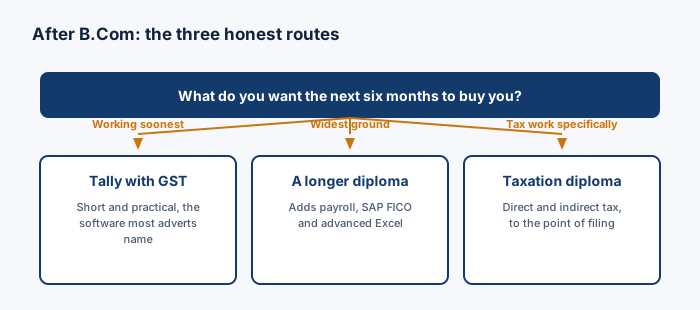
If you want a job within a year and do not yet have practical software skills, take a twelve-month diploma such as DFA, because it covers the full role rather than one slice of it. If you want a job within two months instead, take the Tally course first and keep studying while employed.
If your goal is your own practice rather than employment, take the Diploma in Taxation Law or the GST Practitioner Course, since both lead directly to work you can do for clients independently. If you want the highest ceiling commerce offers and are certain you can sustain the years involved, do CA, CS or CMA, choosing between them by whether audit and tax, corporate governance, or costing appeals most.
If academia is the actual goal, do M.Com. If management is the goal but you have little or no work experience yet, get some experience first and treat the MBA as a later step rather than an immediate one. And if you are not sure which of these describes you, a short, inexpensive course is a cheaper way to find out than a year-long commitment made on a guess.
What the next few years actually look like
The practical-course path
Year one usually means finishing the twelve-month DFA diploma, or a shorter route such as BAT at six months or the GST and Tally combination, and moving into a first accounts or tax role once it is complete. By year three, most graduates on this path have changed roles at least once, often adding a second short course, such as the Diploma in Taxation Law, to widen what they can do. By year five, the realistic position is someone handling a fuller accounts or compliance workload than a fresh graduate would, built on accumulated practical experience rather than on further exams.
The professional-qualification path
Year one from B.Com stage means registration and early-stage study, plus articleship arrangements if the route is CA. By year three, most candidates are deep into the harder middle stages of the qualification, balancing study with either articleship or work, which is widely the most demanding stretch of the whole process. By year five, a candidate who progressed steadily may have completed the qualification, or be close to it, coming out with both the credential and several years of practical exposure that a diploma alone does not provide.
The postgraduate path
Year one typically means starting M.Com or gaining the work experience an MBA programme will later expect. By year three, an M.Com graduate is often in teaching, research or further study, while an MBA-track graduate is usually applying with a few years of experience behind the application, which is generally when the degree pays off best. By year five, the two postgraduate routes have usually diverged clearly, one toward academia, the other toward management, which is why choosing between them early on the basis of genuine interest matters more than choosing on prestige.
Common mistakes at this stage
Treating a practical course as a consolation prize for the degree is the first mistake, and it is not accurate. The degree and the skill do different jobs, and employers want both, which is exactly why the combination works rather than one substituting for the other.
Starting CA, CS or CMA to postpone a decision, rather than because the ceiling genuinely appeals, is the second mistake. It shows up later as the drift described in not clearing CA: what to do next, where years pass without anyone deciding clearly to continue or to stop.
Going straight into an MBA with no work experience is the third mistake, because the degree and the recruiting around it both assume a foundation of experience that a fresh graduate has not yet built.
Assuming a B.Com is already enough, and not adding anything practical before applying widely, is the fourth mistake, and it is the one that costs the most time. It is usually only discovered after several rejections rather than before the first application.
Frequently asked questions
Which course is best after B.Com for a job?
For a general accounts role, the Diploma in Financial Accounting, because it covers three software packages plus payroll and statutory returns. For a corporate accounts department specifically, the BAT Course.
How long do these courses take?
From one month to twelve. Tally basic and the Basic Computer certificate are the short end; DFA, BAT and the Basic Computer diploma are the long end. The BAT course runs six months, which suits graduates in a hurry.
Can I do these courses online?
Yes. All courses run in both classroom and online mode, so studying alongside a first job is a normal and common arrangement rather than an exception.
Can the fee be paid in instalments?
Monthly instalments are available, and there is an education loan facility. Ask about both when you enrol, since terms can differ by course.
Is a B.Com enough on its own?
It is enough to apply. Whether it is enough to be hired depends on the role, and on who you are competing against, which in most junior accounting hiring rounds now includes graduates who also have practical software experience.
Should I do CA, CS or CMA instead of a practical course?
Not instead of, necessarily. A short practical course takes months and makes you employable while you study; a professional qualification takes years. Many candidates do both, in that order, so income and study support each other rather than competing.
Is M.Com or an MBA the better postgraduate choice?
M.Com suits teaching or research. An MBA suits management, and works best after some work experience rather than immediately after a B.Com, which is worth planning for rather than discovering after enrolling.
Talk it through
Call NIMB on 9212008787, or visit E-56, Laxmi Nagar, Delhi 110092. Bring your marksheet and a rough idea of what you want to be doing in two years. That is enough to have a useful conversation.
Comparing two specific courses?
These pages take the comparison further.
- DFA vs BAT Course: the twelve-month diploma and the six-month one, and how they actually differ.
- GST Course vs Diploma in Taxation: if you are set on tax but not on scope.
- Is a Tally course enough to get a job? Worth reading before choosing the short route.
Read next
For the wider library of course and compliance guides, see the NIMB guides hub.
- B.Com versus a practical accounting course: which of the two you are actually missing.
- Not clearing CA: what to do next: what the attempt was worth and what stays open.
- What accounting courses in Delhi actually cost: we checked who publishes a fee. Almost nobody does.
Not sure which fits? Answer three questions and get a straight recommendation, including when the answer is none of them.