NIMB EDU

The best course after B.Sc. is an M.Sc. in your own subject if you want research, teaching or a specialist science role. Choose an MBA or MCA to move into business or computing, a B.Ed to teach in schools, or a government exam for a public-sector job. The right one depends on your subject, your marks and whether you want to stay in science.
Most pages on this question list M.Sc., MBA, MCA, B.Ed and short certificates and stop. This guide adds what decides the choice. It covers the entry route for each (JAM for IITs, CUET PG for universities, CAT, NIMCET) and the rule that trips people up. It also shows how your B.Sc. subject changes which doors are open. Facts were last checked on 26 October 2026. For the wider picture across degrees, see courses after graduation.
What can you do after B.Sc.?
You have four starting points. Many graduates combine two, such as an M.Sc. with a NET attempt, or a job with an MBA application later. The diagram sets them out.
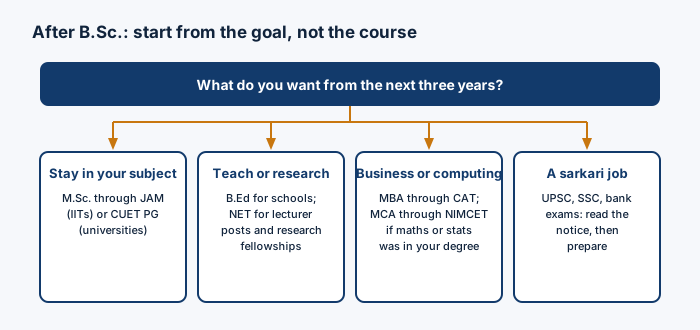
Every option after B.Sc., compared
| Route | How you get in from B.Sc. | Who should think twice |
|---|---|---|
| M.Sc. at IITs (JAM) | Completed or final-year undergraduate degree; each admitting IIT sets its own minimum qualification; test papers are Biotechnology, Chemistry, Economics, Geology, Mathematics, Mathematical Statistics, Physics | Anyone whose subject is not one of those papers |
| M.Sc. at universities (CUET PG) | Eligibility set by each university; pick the right test paper code | Anyone who has not read that university’s rule |
| B.Ed | Recognised by NCTE; admission rules differ by state and university | Anyone who does not want to teach in schools |
| NET (JRF / Assistant Professor) | UGC NET and CSIR-UGC NET, run by NTA; read the current bulletin for subjects and marks | Anyone who is not heading to research or college teaching |
| MBA / PGDM (CAT) | Bachelor’s degree with at least 50% (45% for SC, ST, PwBD) | Anyone with no clear management goal |
| MCA (NIMCET) | At least 60% in a UG programme with Mathematics or Statistics as a subject | B.Sc. graduates with no maths or statistics |
| CA / CS / CMA | CA direct entry with 60% in a non-commerce degree; CS for any graduate; CMA for a recognised degree | Anyone who does not want finance, law or audit work |
Should you do an M.Sc. after B.Sc.?
Do an M.Sc. if your goal is research, college teaching or a specialist role in science, because those routes usually need it. It makes less sense if you mainly want a quick start in work, where a skill or a different degree may pay back sooner.
There are two main entrance routes. IIT JAM fills around 3,000 postgraduate seats at 23 IITs for M.Sc. and related programmes. Candidates who have completed their undergraduate degree, or are appearing for the final examination in 2027, are eligible to appear. Each admitting IIT sets its own minimum qualification (JAM 2027 brochure).
Dates change every cycle, so read them from the JAM site. For JAM 2027 the brochure published registration from 11 September 2026 to 19 October 2026 and the exam for 14 February 2027. The closing date was then extended twice, to 24 October 2026. New registration is now closed, and fee payment is open to registered candidates until 26 October (JAM 2027 important dates). If you missed this cycle, the next cycle’s dates will appear on the JAM site.
Many universities admit M.Sc. students through CUET (PG), which NTA conducts. The NTA FAQ tells candidates to check the eligibility of the university where they seek admission, and to choose test paper codes to match (CUET (PG) 2026 FAQ). Treat the 2026 pattern as a guide until the next cycle’s bulletin is out.
What does the JAM exam look like, and what does it cost?
JAM 2027 is a computer-based test of 60 questions and 100 marks in 3 hours, offered in seven papers, and you may sit one or two. The papers are Biotechnology (BT), Chemistry (CY), Economics (EN), Geology (GG), Mathematics (MA), Mathematical Statistics (MS) and Physics (PH). You can take two papers only if they fall in different sessions. Chemistry, Geology and Mathematics are in the morning (9:30 am to 12:30 pm). Biotechnology, Economics, Mathematical Statistics and Physics are in the afternoon (2:30 pm to 5:30 pm). The test is held in around 114 cities.
| Section | Question type | Questions and marks | Negative marking |
|---|---|---|---|
| A | Multiple choice, one correct answer | 30 questions: 10 of 1 mark and 20 of 2 marks (50 marks) | One-third of a mark for a wrong 1-mark answer, two-thirds for a wrong 2-mark answer |
| B | Multiple select, one or more correct options | 10 questions of 2 marks (20 marks) | None, and no partial marks |
| C | Numerical answer typed on screen | 20 questions: 10 of 1 mark and 10 of 2 marks (30 marks) | None |
The JAM 2027 fee is Rs 2,000 for one paper and Rs 2,700 for two (Rs 1,000 and Rs 1,350 for female, SC, ST and PwD candidates). When you apply to IITs after qualifying, a separate non-refundable processing fee of Rs 750 applies. Admission is by All India Rank in the paper, with no interview or extra written test, and the brochure allows up to four rounds of admission. Beyond the 23 IITs, JAM scores are also used for over 2,000 seats at IISc, centrally funded technical institutes, NITs and other institutes through centralised counselling for M.Sc. and M.Sc. (Tech) admission. Because each admitting IIT sets its own minimum qualification for each programme, read its row in the brochure’s seat matrix before you choose a paper. JAM is open to all nationals with no age limit.
Which institutions do the official rankings list?
NIRF 2025, from the Ministry of Education, is a neutral place to start a shortlist for a science postgraduate programme. The top five in the Universities category were the Indian Institute of Science, Jawaharlal Nehru University, Manipal Academy of Higher Education, Jamia Millia Islamia and the University of Delhi. The top five in the Colleges category, which ranks undergraduate colleges, were Hindu College, Miranda House, Hans Raj College, Kirori Mal College and St. Stephen’s College. NIRF ranks an institution as a whole, not one M.Sc. programme, and many strong departments sit in institutions that do not take part. Check the department, the faculty and the lab facilities on the institution’s own pages.
What does the four-year degree mean for an M.Sc. or a Ph.D.?
NEP 2020 allows a one-year Master’s after a four-year Bachelor’s with Research, a two-year Master’s (the second year devoted to research) after a three-year Bachelor’s, or an integrated five-year programme. It says a Ph.D. will need either a Master’s degree or a four-year Bachelor’s with Research (NEP 2020, section 11.10). Which structure applies to you depends on your university’s adoption. The marks UGC asks for in a Ph.D. are in the four-year degree section of the courses after graduation guide linked at the top. If research is your goal, start looking for a faculty guide early.
Can you teach or do research after B.Sc.?
Yes. School teaching normally needs a B.Ed. Confirm that the programme is recognised by the National Council for Teacher Education, and read your state’s notice because admission rules vary. For college lecturer posts and research fellowships, the national tests are UGC NET (NTA UGC NET) and, for the sciences, CSIR-UGC NET (NTA CSIR NET). Both pages describe qualifying as eligibility for Assistant Professor and research-fellowship purposes, subject to UGC criteria. Check the current bulletin for who may apply and which subjects are offered, because the postgraduate degree usually comes first.
Is an MBA or MCA a good move after B.Sc.?
It can be, if you want to leave the lab for business or computing, and both are open to science graduates under the rules below. An MBA tends to pay back better with some work experience, and an MCA is natural if you had maths, statistics or computer science in your degree.
MBA. CAT 2026 requires a bachelor’s degree with at least 50% marks or equivalent CGPA (45% for SC, ST and PwBD). Final-year students can apply, and meeting the minimum does not ensure a shortlist (CAT 2026 eligibility). Check that any PGDM is approved by AICTE.
MCA. NIMCET needs at least 60% marks (55% for SC, ST, PwD) in a UG programme of at least three years with Mathematics or Statistics as one of the subjects, or a B.E./B.Tech. So a B.Sc. that includes Mathematics or Statistics qualifies on the rule as written, and a B.Sc. with neither does not (NIMCET 2026 brochure).
Can a B.Sc. graduate do CA, CS or CMA?
Yes, and the science background is no obstacle, but each route takes years. ICAI lets graduates in subjects other than commerce register directly for Intermediate with at least 60% marks (55% for commerce graduates), so you skip Foundation (ICAI FAQs). For CS, graduates in any discipline are exempt from the entrance test (ICSI). For CMA, a degree of a recognised university is an entry route to Intermediate (ICMAI). Read the CA course guide and CA vs CS vs CMA vs ACCA first. If you want to enter accounts without a commerce degree, accounting courses without a commerce background shows how, and the accounting course picker gives a recommendation in three questions.
Can you prepare for a government job after B.Sc.?
Yes. UPSC civil services asks for a graduate degree of a recognised university in any subject (UPSC notice 05/2026). SSC CGL asks for a bachelor’s degree for most posts, but some name a subject. Statistical Investigator Grade-II lists Statistics and Mathematics among others. Junior Statistical Officer accepts any degree with Statistics as a subject, or 60% in Mathematics at Class 12 (SSC CGL 2026 notice). Age limits, attempts and the dates to watch are in the government-jobs section of the hub linked at the top. Keep a skill or a job going during preparation.
Which short courses help after B.Sc.?
Short courses help when they add one testable skill that matches a job advert. Examples are data analysis, a programming language, lab or quality skills for your field, or an accounting package for finance roles. They do not replace a degree. NPTEL runs IIT and IISc courses, and most of its certificates need a proctored in-person exam (NPTEL FAQ). NIELIT accredits computer-training institutes for specified levels of its courses (NIELIT accreditation scheme). Check a provider’s claim of recognition on the National Qualifications Register. This guide prints no salary figure, because no official source gives one for “B.Sc. graduates”. Compare three live job adverts for your target role and city instead.
Which mistakes do B.Sc. graduates make?
- Missing the entrance cycle. JAM and CUET (PG) are annual. JAM 2027 registration closed on 24 October 2026 after two extensions, so plan before your final year and watch the JAM site for the next cycle.
- Assuming every B.Sc. qualifies for MCA. NIMCET needs maths or statistics in the degree.
- Doing an MBA to avoid choosing. The fee is large and the outcome depends on the institute.
- Trusting ranked lists. “Top 10 courses” pages are usually written by an institute promoting its own programme.
Frequently asked questions
Which course is best after B.Sc.?
An M.Sc. for research and specialist roles, a B.Ed for school teaching, an MBA or MCA for business or computing, or a government exam. There is no single best course.
Which entrance exam should I take for M.Sc. after B.Sc.?
IIT JAM for M.Sc. at IITs, and CUET (PG) for many universities. Some universities run their own tests, so read the admission notice of each one you apply to.
Can I do an MBA after B.Sc.?
Yes. CAT accepts a bachelor’s degree in any discipline with at least 50% marks (45% for SC, ST and PwBD).
Can I do MCA after B.Sc.?
For NIMCET, only if the UG programme had Mathematics or Statistics as a subject and you have at least 60% marks (55% for SC, ST, PwD). Other universities set their own rules.
Can I do B.Ed after B.Sc.?
Yes, B.Ed is the usual route into school teaching after any bachelor’s degree. The admission marks and process vary by state and university, so read your state’s notice.
Can I do CA after B.Sc.?
Yes. ICAI allows direct entry to Intermediate for non-commerce graduates with at least 60% marks. Training is 2 years under the new scheme.
Is a B.Sc. enough for a government job?
For many central exams, yes, since the base condition is a bachelor’s degree. Read each notification for age, attempts and post-specific qualification.
Is an online M.Sc. or MBA valid?
Only if the university and programme are recognised by UGC. Verify them on the UGC-DEB site before paying.
Is there negative marking in IIT JAM?
Yes, but only in Section A (the 30 multiple-choice questions). A wrong 1-mark answer loses one-third of a mark and a wrong 2-mark answer loses two-thirds. The multiple-select and numerical sections have no negative marking.
How many seats does IIT JAM cover?
The JAM 2027 brochure says around 3,000 postgraduate seats at 23 IITs, and over 2,000 more at IISc, NITs, centrally funded technical institutes and others through centralised counselling.
Can I take two JAM papers?
Yes, if they fall in different sessions. Chemistry, Geology and Mathematics are held in the morning, and Biotechnology, Economics, Mathematical Statistics and Physics in the afternoon. The fee for two papers is Rs 2,700 (Rs 1,350 for female, SC, ST and PwD candidates).
Still deciding?
If you would like to talk it through, book a career counselling call or message us on WhatsApp at 9212008787. Bring your B.Sc. subject, your marks and a rough idea of the work you want in three years, and you will get a straight answer. BCA graduates have their own page at which course is best after BCA, and the full library is on the NIMB guides page.