NIMB EDU

The CA course is the Chartered Accountancy programme run by the Institute of Chartered Accountants of India (ICAI). Under the current scheme it has three levels, Foundation, Intermediate and Final, plus two years of practical training called articleship, and it takes a minimum of about 43 months of prescribed periods before exam sittings and results are counted.
This guide is built from ICAI’s own 2026 prospectus, its FAQ on the new scheme and its latest exam notices, all read in October 2026. Where websites you will find in a search disagree with ICAI, we say so, because several still describe a three-year articleship and an eight-paper Final that no longer apply. The questions that have their own pages, what the course costs, the step-by-step route to qualifying and what CAs earn, are answered briefly here and in full there. For the wider picture, see every option after 12th commerce.
What is the CA course, and how is it structured?
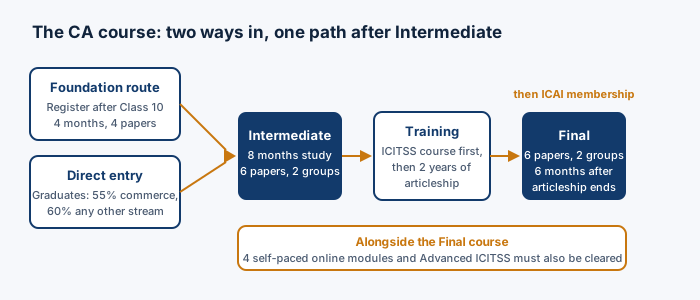
The CA course is a professional qualification, not a university degree. ICAI’s current “New Scheme of Education and Training” was launched on 1 July 2023 and has three levels, Foundation, Intermediate and Final, with four self-paced online modules attached to the Final level (ICAI FAQ on the new scheme).
You study through ICAI’s own material, sit ICAI’s own exams, and learn on the job through articleship under a practising CA or a CA in service. Passing the exams alone does not make you a CA. You also need the completed training and the self-paced modules, then you apply for membership.
| Level | Papers | Study period | Exams held |
|---|---|---|---|
| Foundation | 4 papers of 100 marks | 4 months | January, May and September |
| Intermediate | 6 papers, in 2 groups of 3 | 8 months | January, May and September |
| Final | 6 papers, in 2 groups of 3, plus 4 self-paced online modules | Registered after both Intermediate groups; exam six months after articleship ends | Set per cycle; the November 2026 sitting is announced |
The exam months for Foundation and Intermediate are from the ICAI FAQ. For Final, ICAI announces each sitting separately, and the one currently scheduled is November 2026, with papers from 2 to 13 November (ICAI guidance notes).
Who is eligible for the CA course?
You can start after Class 10 through the Foundation route, or after a graduation through direct entry. ICAI’s prospectus lets a Class 10 pass register for Foundation, and the Foundation exam can be taken once you have appeared in the Class 12 exam (ICAI Prospectus 2026). Stream does not matter, so commerce, science and arts students are all eligible.
Foundation route (after Class 10 or 12)
You register with ICAI’s Board of Studies, complete four months of study, then take the Foundation exam. ICAI’s rule is that you must have appeared in Class 12 before the Foundation exam. We found no minimum Class 12 percentage in ICAI’s prospectus or FAQ, so sites that quote “50%” or “55% in Class 12” are not repeating ICAI.
Direct entry (after graduation)
Graduates and postgraduates skip Foundation and register straight for Intermediate if they hold at least 55% in a commerce degree or 60% in any other stream. The commerce route also needs papers in subjects such as accounting, auditing, law, taxation or costing, as the prospectus sets out. Candidates who have passed the Intermediate level of the Institute of Company Secretaries of India or the Institute of Cost Accountants of India can enter directly too.
Final-year students can register provisionally. The registration is confirmed only when you submit marks that meet the minimum, and it is cancelled, with no credit for the study done, if you fall short. If you are a B.Com student wondering whether to go this way, the options after B.Com compared puts it beside the alternatives.
| Your position | Where you enter | What ICAI requires |
|---|---|---|
| Passed Class 10 | Foundation registration | Class 10 pass certificate; 4 months of study |
| Appearing in or passed Class 12 | Foundation exam | Registered at least 4 months earlier; appeared in Class 12 |
| Commerce graduate | Intermediate (direct entry) | Minimum 55% aggregate and the prescribed papers |
| Graduate in any other stream | Intermediate (direct entry) | Minimum 60% aggregate |
| CS or CMA Intermediate passed | Intermediate (direct entry) | Pass certificate of the Intermediate level |
How many years and how much money does the CA course take?
ICAI’s prescribed minimums add up to about 43 months on the Foundation route and about 39 months through direct entry (our sum of ICAI’s figures). The articleship is two years under the scheme launched on 1 July 2023, and it was three before. Real timelines run longer because of exam months and cut-offs, which CA course duration works through.
ICAI’s registration fees are Rs 9,000 for Foundation, Rs 18,000 for Intermediate and Rs 22,000 for Final (ICAI Prospectus 2026). With exam fees and the two soft-skills courses, a first-attempt run costs about Rs 84,500 from Foundation and Rs 74,000 for direct entry, before coaching. The working is in CA course fees.
What is in the CA syllabus, paper by paper?
Foundation tests basics, Intermediate tests application across six subjects, and Final adds analysis and judgement, ending in a case-study paper. ICAI’s own skill grid moves from “comprehension and knowledge” at Foundation, through “analysis and application” at Intermediate, to “evaluation and synthesis” at Final (ICAI Scheme at a glance).
The tables below list each paper’s marks and main topic headings, taken from the syllabus printed in the ICAI Prospectus 2026. ICAI adds and removes specific inclusions every year through study guidelines, so use ICAI’s syllabus page for the version that applies to your sitting.
Foundation: four papers
| Paper | Marks and type | Main topics |
|---|---|---|
| 1. Accounting | 100, written | Accounting concepts and standards, journal to trial balance, bank reconciliation, inventories, depreciation, bills of exchange, final accounts of sole proprietors, not-for-profit accounts, incomplete records, partnership and LLP accounts, company accounts (shares and debentures) |
| 2. Business Laws | 100, written | Indian regulatory framework, Indian Contract Act 1872, Sale of Goods Act 1930, Indian Partnership Act 1932, LLP Act 2008, Companies Act 2013 basics, Negotiable Instruments Act 1881 |
| 3. Quantitative Aptitude | 100, objective | Business Mathematics (40 marks), Logical Reasoning (20) and Statistics (40): ratio and equations, mathematics of finance, permutations, calculus basics, seating arrangements and blood relations, probability, distributions, correlation and regression, index numbers |
| 4. Business Economics | 100, objective | Demand and supply, production and cost, price determination in markets, national income, business cycles, public finance, money market, international trade, the Indian economy |
Papers 3 and 4 are objective type, with a deduction of 0.25 mark for each wrong answer.
Intermediate: six papers in two groups
| Group | Paper and marks | Main topics |
|---|---|---|
| I | 1. Advanced Accounting (100) | Framework for financial statements, applying individual Accounting Standards, company accounts, branch accounting including foreign branches |
| I | 2. Corporate and Other Laws (100) | Part I (70): Companies Act 2013 from incorporation, prospectus and allotment, share capital, deposits and charges to management, dividend, accounts and audit, plus the LLP Act 2008. Part II (30): General Clauses Act 1897, interpretation of statutes, FEMA 1999 |
| I | 3. Taxation (100) | Income-tax Law (50): residential status, heads of income, clubbing and set-off, advance tax, TDS and TCS, returns, an individual’s tax computation. GST (50): levy and collection, supply, registration, invoices and e-way bill, returns |
| II | 4. Cost and Management Accounting (100) | Cost ascertainment and overheads, activity based costing, methods of costing (job, batch, process, service), standard costing, marginal costing and short-term decisions, budgetary control |
| II | 5. Auditing and Ethics (100) | Audit planning, risk assessment and internal control, audit evidence, audit of financial statement items, documentation, audit report, audit of different entities and banks, ethics and engagement terms |
| II | 6. Financial Management (50) and Strategic Management (50) | Financing decisions and cost of capital, capital investment and dividend decisions, working capital; strategic analysis, choices, implementation and evaluation |
Final: six papers and four online modules
| Group | Paper (100 marks each) | What it covers |
|---|---|---|
| I | 1. Financial Reporting | Financial statements and group accounts under Indian Accounting Standards (Ind AS), including subsidiaries, associates and joint arrangements |
| I | 2. Advanced Financial Management | Financial policy and the CFO’s role, risk management, advanced capital budgeting, mergers, restructuring and startup finance |
| I | 3. Advanced Auditing, Assurance and Professional Ethics | Applying auditing standards, assurance and ethics to audit engagements and case problems |
| II | 4. Direct Tax Laws and International Taxation | Tax computation for companies and other entities under the alternative regimes, trusts, anti-avoidance rules, tax administration and appeals, international taxation |
| II | 5. Indirect Tax Laws | GST (80 marks) and Customs and Foreign Trade Policy (20 marks) |
| II | 6. Integrated Business Solutions | A multidisciplinary case study across Papers 1 to 5, the Corporate and Economic Laws and Strategic Cost and Performance Management modules, and Strategic Management |
Paper 6 is open book and the other five are closed book. The four self-paced online modules are cleared separately through the Final registration: Sets A (Corporate and Economic Laws) and B (Strategic Cost and Performance Management) are compulsory, and you choose one elective each for Sets C and D. A module is passed at 50% with no limit on attempts, and no separate registration fee is charged. All four must be qualified before you can sit Final, and their marks are not added to your Final marks (ICAI FAQ).
What do the skill levels mean for how you study?
ICAI publishes the verbs it uses at each of its three skill levels, so you can read a question the way the examiner built it.
| Level | Skill | Verbs ICAI uses | Where it is tested |
|---|---|---|---|
| I | Comprehension and knowledge | Define, describe, explain, state, outline | All three levels |
| II | Analysis and application | Apply, calculate, prepare, reconcile, analyse, compare, discuss | All three levels |
| III | Evaluation and synthesis | Advise, evaluate, recommend, review, assess | Final |
The Prospectus also prints, for every subject, the percentage range of marks set at each skill level (ICAI Prospectus 2026). Recalling a standard is therefore not enough at Intermediate, and Final rewards a clear recommendation over a long recitation.
What is the CA exam pattern and marking scheme?
Foundation has two written and two objective papers. Intermediate and Final carry 30% case-scenario multiple-choice questions and 70% descriptive questions in every paper, with no negative marking (ICAI FAQ).
| Level | Format | Negative marking | Timings in the latest notices |
|---|---|---|---|
| Foundation | Papers 1 and 2 written; Papers 3 and 4 objective | 0.25 mark per wrong answer in Papers 3 and 4 | January 2027: 2 pm to 5 pm for Papers 1 and 2, with 15 minutes of reading time; 2 pm to 4 pm for Papers 3 and 4 |
| Intermediate | 30% case-scenario MCQs and 70% descriptive, all six papers | None | See the notice for your sitting |
| Final, Papers 1 to 5 | 30 marks of MCQs, 70 marks descriptive, closed book | None | November 2026: 2 pm to 5 pm |
| Final, Paper 6 | Five case studies of 25 marks, attempt any four; each has 10 marks of MCQs and 15 of descriptive questions; open book | None | November 2026: 2 pm to 6 pm |
The timings are from ICAI’s January 2027 Foundation notice and November 2026 Final notice. In the Final sitting the first group’s papers fall on 2, 4 and 6 November and the second group’s on 9, 11 and 13 November 2026. MCQs carry one or two marks, have four options and are compulsory, with no internal choice. In the open-book paper you may bring printed study material, RTPs, textbooks, bare Acts and your own notes, but no phones or tablets, and you must write answers in your own hand.
You may write in English or Hindi and choose the medium on the exam form. ICAI allows no change of centre or medium after the correction window closes, and admit cards go on the portal about 14 days before the exam (ICAI Foundation notice).
How are CA exams passed, and what are exemptions and attempts?
At each level you need at least 40% in every paper and 50% in the aggregate of the group or exam. If you fail a group but score 60% or more in a paper, you keep an exemption in that paper for the next three sittings (ICAI Prospectus 2026).
The details matter, because they decide how a failed sitting affects you:
- Both groups together or one at a time. At Intermediate and Final you can sit one group or both. You pass both together with 40% in every paper and 50% in each group, or with 50% across both groups taken together. Groups can also be cleared in different sittings.
- Exemption. It applies only if you appeared in all papers of the group. A paper where you scored 60% or more is exempt for the three sittings that follow, and you must then score 40% in each remaining paper and 50% in the aggregate including the exempted marks.
- Permanent exemption. If you use up the three sittings, you may keep the exemption for later sittings, but you then need 50% in each remaining paper of that group.
- Attempts. The ICAI documents we read state no cap on the number of attempts. The limit is how long your registration stays valid: four years for Foundation from the first eligible attempt, five years for Intermediate (revalidable once) and ten years for Final. CA course duration has the revalidation fees and the cut-off dates for each sitting.
Source: ICAI FAQ.
What are ICITSS and Advanced ICITSS?
They are two compulsory soft-skills and IT courses of about four weeks each. ICITSS comes before articleship and Advanced ICITSS after it, before the Final exam (ICAI FAQ). ICITSS pairs an IT course (Office tools, compliance overview, data analytics, accounting packages) with an orientation course on ICAI, ethics, communication and the student code of conduct. Advanced ICITSS pairs an advanced IT course (forensic accounting, cyber security, auditing ERP systems, robotic process automation) with management and communication skills (ICAI Prospectus 2026).
Advanced ICITSS ends with an IT test set by ICAI’s examination department. For the November 2026 Final it had to be completed by 10 October 2026 (ICAI guidance notes). Batches are booked on ICAI’s online registration portal, and the fees are in the fees guide.
What is articleship, and what are the rules?
Articleship is the compulsory two years of full-time practical training that you do after clearing both Intermediate groups and the ICITSS course. It is served under a practising CA or a CA in service, and the last 9 to 12 months can be spent as an industrial trainee in an approved company (ICAI Prospectus 2026).
| Rule | What ICAI says |
|---|---|
| Starting | Submit Form 103, and sign a training agreement with your principal in Form 102 |
| Working hours | A minimum of 35 hours a week excluding lunch (Regulation 60); the working day normally starts by 11 am and ends no earlier than 5 pm; extra work is allowed only in exceptional cases, up to 45 hours in a week in total |
| Extra hours | Hours beyond 35 in a week earn compensatory leave |
| Leave | 12 days in each year of training |
| Industrial training | 9 to 12 months in the last year, only for Final-course students, who must tell the principal at least three months ahead |
| Other study | Not allowed without ICAI’s prior permission in Form 112, applied for within one month of joining the college or course; college hours must not clash with working hours, or the articleship period will not be recognised |
| Record of work | Trainees can upload the work they do to ICAI’s web-based e-diary |
The stipend is small. ICAI’s FAQ gives current minimums of Rs 2,000 to Rs 6,000 a month by city size and year, and proposes Rs 3,000 to Rs 6,000 for the two-year scheme, which was still a draft regulation in July 2026 (ICAI FAQ, ICAI announcement). Industrial trainees get at least Rs 15,000 a month. Trainees’ rights and complaint routes are in the step-by-step guide.
What study material does ICAI provide?
ICAI supplies the core material: hard copies can be ordered after registration from its Centralised Distribution System at icai-cds.org, and soft copies, revision test papers, past papers and study guidelines are on the Board of Studies page. Study is largely self-directed, but exams are written at a centre and articleship is full-time. Coaching and ICAI’s paid live classes are covered in the fees guide.
How hard is the CA course, really?
It is hard, and ICAI’s own results show how hard. In the May 2026 sittings, 20.09% of Foundation candidates passed, 8.47% of Intermediate candidates who appeared in both groups passed both, and 14.07% of Final candidates who appeared in both groups passed both.
| Level | Appeared | Passed | Pass rate | Source |
|---|---|---|---|---|
| Foundation | 90,217 | 18,124 | 20.09% | ICAI press release, 3 July 2026 |
| Intermediate, both groups | 33,304 | 2,820 | 8.47% | ICAI press release, 24 June 2026 |
| Final, both groups | 23,776 | 3,345 | 14.07% | ICAI press release, 18 June 2026 |
Read these carefully. The “both groups” row counts only candidates who sat both groups together, who are a subset of everyone who appeared. Single-group pass rates were higher: 10.25% and 16.11% for Intermediate Groups I and II, and 12% and 20.49% for Final Groups I and II. Pass rates also vary between sittings, so this is one data point, not a constant.
Most candidates do not clear a level together on the first sitting, so plan for a retake. See what to do if you do not clear CA before you need it.
What does a CA earn?
ICAI’s campus placement drive for newly qualified CAs (April to May 2026) reported an average package of Rs 13.30 lakh a year, a highest offer of Rs 27.50 lakh and 2,570 candidates offered jobs (ICAI Placement Directorate). That covers only those who take part and get offers, not all CAs. The gap is explained in CA salary in India.
What happens after you pass Final?
You apply to ICAI for membership, and you become a chartered accountant on admission. ICAI issues a Certificate of Practice to members who intend to practise, subject to its conditions (ICAI Prospectus 2026). The Prospectus also records two recognitions that matter if you are weighing CA against a degree. A University Grants Commission public notice of 15 April 2021 says the CA, CS and ICWA qualifications are to be considered equivalent to a postgraduate degree, which the Prospectus describes as being for appearing in UGC NET (UGC notice). The Association of Indian Universities treats CA with a graduation as equivalent to a postgraduate degree in commerce or an allied discipline for a doctoral programme.
Students who stop short of Final can apply for ICAI’s Business Accounting Associate certificate (fee Rs 500) once they have passed both Intermediate groups, finished training and Advanced ICITSS and qualified the online modules. It is not a CA qualification. Job roles and pay are in the CA salary guide and CA fresher salary.
How does CA compare with CS, CMA and ACCA?
CA has 16 ICAI-set exam papers across three levels, plus four online modules, and is the route to statutory audit. CMA, CS and ACCA each have their own exam structure, training rule and fee schedule, so compare by route, not by headline. CA vs CS vs CMA vs ACCA sets them side by side.
Frequently asked questions
Can I do CA after 12th?
Yes. You can register for Foundation after Class 10, then take the Foundation exam after appearing in Class 12. Any stream is eligible, and ICAI sets no minimum Class 12 percentage in its prospectus.
What is the eligibility for the CA course after graduation?
Commerce graduates with at least 55% and graduates of other streams with at least 60% can enter Intermediate directly. Final-year students can register provisionally, subject to confirming their marks.
Is the CA course 2 years or 3 years of articleship now?
It is two years under the new scheme, which started on 1 July 2023. Students registered under the old scheme continue under their own rules, which is why older articles still say three years.
How many attempts are allowed in the CA exams?
The ICAI documents we read state no cap on attempts. The limit is how long your registration stays valid: four years for Foundation, five for Intermediate (revalidable once) and ten for Final.
What is the pass percentage of CA exams?
In May 2026 it was 20.09% for Foundation, 8.47% for Intermediate (both groups together) and 14.07% for Final (both groups together), per ICAI’s results announcements.
Can I do CA along with B.Com?
Partly. Final-year graduation students can register provisionally for Intermediate and complete its eight-month study period during that year. During articleship, though, you need ICAI’s prior permission to pursue another course, and college hours must not clash with your working hours.
Is there negative marking in the CA exams?
Only in Foundation, where Papers 3 and 4 deduct 0.25 mark for each wrong answer. Intermediate and Final MCQs carry no negative marking, according to the ICAI FAQ.
Can I do the CA course online?
Partly. ICAI delivers its theoretical education in distance-learning mode and you register online. But exams are held at centres and the two-year articleship is full-time training with a firm or company, so the course cannot be completed fully online.
Is a CA equal to a postgraduate degree?
For two specific purposes, yes. the UGC has said CA is to be considered equivalent to a postgraduate degree (notice of 15 April 2021), and the Association of Indian Universities accepts it for doctoral registration. It does not make CA a university degree.
Still deciding?
CA is a long commitment, and the right moment to ask whether it fits you is before you register, not after the first attempt. If you would like a second opinion on CA, a degree or a shorter route, our counselling team can talk it through. See career counselling, or call 9212008787 or message us on WhatsApp.
Or browse all courses after 12th.