NIMB EDU
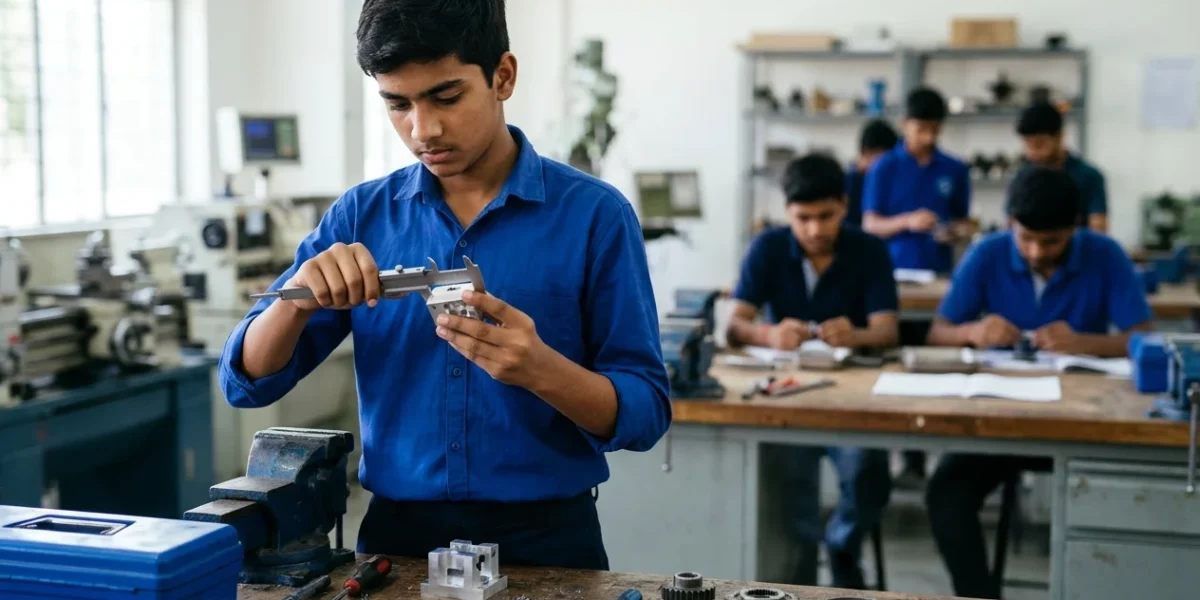
A diploma after Class 10 is, in most cases, a three-year polytechnic diploma in engineering or technology, approved by AICTE and run through your state’s technical education board. Everything else sold as a “diploma after 10th” is shorter, awarded by the institute itself, or is not open after Class 10 at all.
That last group matters most. Popular course lists mix real after-10th options with courses that need Class 12, and the mistake is usually discovered after the fees are paid. This guide separates the two, shows how each diploma connects to a degree later, and gives you six checks to run on any institute. For the wider picture, including staying in school, ITI and early jobs, start with all courses after 10th, by route.
What counts as a diploma after 10th?
Three things get called a diploma, and only the first two are formal qualifications. Ask which kind you are looking at before you compare fees or colleges.
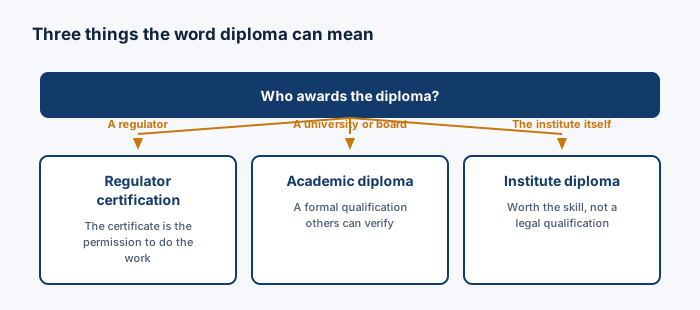
- A technical diploma from an AICTE-approved institute. AICTE’s Approval Process Handbook lists the engineering and technology diploma, the applied arts and crafts diploma and the design diploma as three-year programmes with Class 10 as the entry qualification (AICTE Approval Process Handbook 2024-25 to 2026-27, Annexure 8). This is what people usually mean by polytechnic.
- A trade certificate from the ITI system. Strictly a certificate, not a diploma, but it competes for the same students. It is covered below because it belongs in any honest comparison.
- An institute’s own diploma. Computer, accounting, design, digital marketing and similar courses run by private institutes. These are valued for the skill, not as a legal qualification, unless a university or state board awards them.
Which diplomas can you do after Class 10?
The table below holds only options whose entry rules we could confirm from an official document. Fees and salaries are deliberately left out, because they differ too much by state and college to quote without a source.
| Option | Length | Entry | Who sets the standard |
|---|---|---|---|
| Diploma in engineering and technology (polytechnic) | 3 years | Class 10 pass; marks and subjects set by each state | AICTE approval; state board of technical education |
| Diploma in applied arts and crafts | 3 years | Class 10 pass | AICTE approval |
| Diploma in design | 3 years | Class 10 pass | AICTE approval |
| ITI trade course (National Trade Certificate) | 6 months to 2 years, by trade | Class 8 or Class 10, by trade | DGT and NCVT |
| Institute diplomas in computers or office skills | Varies | Varies; some ask for nothing beyond Class 10 | The institute itself |
The AICTE entry rule is only “passed Class 10”. The marks, the subjects and the counselling process are state matters. Haryana, Uttar Pradesh and Delhi, for example, each run their own admissions on their own portals (Haryana’s technical admissions site, UP’s JEECUP and Delhi’s Directorate of Training and Technical Education). Read the current prospectus for your state, since cut-offs and subject conditions are set there and change from year to year.
Which engineering branches does a polytechnic offer?
Branches differ by institute, but the usual ones are civil, mechanical, electrical, electronics and communication, computer science and automobile engineering. A single polytechnic seldom offers all of them. When you compare colleges, compare the branch, because the same college can be strong in one and thin in another. Polytechnic courses after 10th goes through the branches, the three doors into a diploma and how Uttar Pradesh, Maharashtra and Bihar run admission.
How does admission work, and what documents do you need?
You apply through your state’s technical education portal, usually before or soon after Class 10 results, and the seat comes from either an entrance test or a merit list. The steps are the same in most states even though the dates and rules are not.
- Find your state’s portal and prospectus. The portals linked above carry the current notice, the eligibility rule and the schedule.
- Register and apply online. Uttar Pradesh’s 2026 cycle took online applications from 15 January to 30 April 2026 (UPJEE(P) 2026 brochure, in Hindi), so applications can open before results.
- Sit the entrance test where there is one. Uttar Pradesh held its Group A test from 15 to 22 May 2026, and Bihar’s DCECE prospectus gave 23 May 2026 as the proposed date for the engineering diploma test (DCECE 2026 prospectus). Other states admit on Class 10 marks.
- Attend counselling and accept a seat. Seats are allotted by rank or merit and by category; keep every allotment letter.
- Verify documents at the institute. Original certificates are checked at this stage.
Bihar’s 2026 prospectus lists the documents as a sample. They are the Matric pass certificate, marksheet and admit card, and a caste certificate if you claim a category. They also include an income and asset certificate for the economically weaker section, a character certificate from the last institution attended, an income certificate where needed at counselling, the application form with a photograph, and a residence certificate for the state’s quotas. Your state’s list will differ, so use the checklist printed in its own prospectus.
Which courses are listed after 10th but are not open after 10th?
Several courses that appear on after-10th lists need Class 12. Pharmacy is the clearest case: the Pharmacy Council of India describes the D.Pharm as a two-year course after 10+2, with 500 hours of practical training (PCI FAQs). No Class 10 route into D.Pharm exists.
Nursing and paramedical courses need more care. The Indian Nursing Council lists ANM at two years and GNM at three years from 2015-16 (INC nursing programmes), but that page does not state the entry qualification. For ANM, CBSE circular 20 of 15 March 2012 records that INC revised the eligibility from Class 10 to 10+2. We could not confirm a Class 10 entry for GNM, DMLT or radiology from any regulator, so we do not list them as after-10th options. If an institute offers one to a Class 10 student, ask for the state nursing or paramedical council’s written eligibility rule before paying anything.
| Often listed after 10th | What the regulator says | Verdict |
|---|---|---|
| D.Pharm | Two years after 10+2 (PCI) | Not open after Class 10 |
| B.Tech, B.Arch, MBBS | Degree programmes entered after Class 12 | Not open after Class 10 |
| ANM, GNM, DMLT, radiology | ANM entry moved to 10+2 (CBSE circular, 2012); no Class 10 entry confirmed for the others | Not open after Class 10; verify with the state council |
Are there diplomas after 10th outside engineering?
A few, and the entry rule decides which ones are real. Beyond the AICTE applied arts and design diplomas in the table above, the clearest verified example is hospitality. The National Council for Hotel Management and Catering Technology lists its craftsmanship certificates in Food Production and in Food and Beverage Service with a Class 10 entry. Its diplomas, such as Food and Beverage Service, Front Office Operations and Bakery and Confectionery, ask for Class 12 (NCHMCT eligibility list). Its course pages give Food Production as three semesters (1.5 years) and Food and Beverage Service as one semester (0.5 year) (NCHM Food Production; Food and Beverage Service).
| Field | Open after Class 10? | What the regulator’s document shows |
|---|---|---|
| Hospitality, craftsmanship certificate (Food Production, Food and Beverage Service) | Yes | NCHMCT: Class 10 entry; 1.5 years and 0.5 year on the course pages |
| Hospitality diploma (Front Office, Housekeeping, Bakery) | No | NCHMCT: Class 12 entry |
| Health technician diplomas (lab, radiology) | No for the regulated diplomas; a few ITI health trades are open | See paramedical courses after 10th |
| D.Pharm | No | Pharmacy Council of India: after 10+2 |
We did not find a national regulator’s list that includes agriculture or teaching diplomas at Class 10 level, so we do not list them as national options. Some state universities run their own, and the entry rule is in each university’s prospectus.
Is a diploma a dead end, or does it lead to a degree?
It leads to a degree if you plan for it. A three-year engineering diploma can open the second year of a B.Tech through lateral entry. AICTE’s rule asks for a minimum three-year diploma (or two-year lateral diploma) in any branch of engineering and technology with at least 45% marks, or 40% for reserved categories. The seats are limited to 10% of an institute’s approved intake, over and above its regular seats, plus any unfilled first-year vacancies (AICTE handbook, clause 6.13 and Annexure 8).
The practical meaning: the door exists, but it is narrow and marks-dependent. A student who wants a degree eventually should treat the diploma marks as seriously as Class 12 marks, because they decide the lateral seat. The same handbook lets a student with Class 10 plus a two-year ITI enter the second year of a diploma, so ITI can lead to diploma and diploma to degree.
What does a diploma cost, and is there help?
There is no national fee table, because states and institutes set fees. Pages that quote a single range for “diploma after 10th” mix government polytechnics, private colleges and short courses, so we do not repeat those figures. Ask the institute for the full fee in writing, as in the checks below, and compare a government polytechnic’s published fee with a private one’s quote for the same branch.
For girls there is one national scheme. AICTE’s Pragati scholarship for diploma students gave Rs 50,000 a year in its 2020-21 guidelines. It went to a girl admitted to the first year of a diploma, or the second year through lateral entry, at an AICTE-approved institution, for up to three years or two years respectively. At most two girl children per family qualified, family income had to be within Rs 8 lakh a year, and 5,000 scholarships were earmarked per year (AICTE Pragati guidelines, diploma). We could not open a current-year guideline on an official site, so check the National Scholarship Portal for the present amount and deadline. For what the jobs after a diploma pay, with sources, see high salary courses after 10th.
Diploma, ITI or Classes 11 and 12: which one?
Choose the diploma if you want a technical job or lateral degree entry, ITI if you want a skilled trade soonest, and Classes 11 and 12 if you want every degree route kept open. None of these closes the others permanently, but each changes the starting point.
| Polytechnic diploma | ITI trade | Classes 11 and 12 | |
|---|---|---|---|
| Length | 3 years | 6 months to 2 years | 2 years, then a degree |
| Output | Diploma; junior technical roles | National Trade Certificate | Class 12 certificate |
| Path to a degree | Lateral entry to B.Tech year 2 (45% minimum under AICTE rules) | Into diploma year 2, then onward; or Class 12 through NIOS | Any degree the stream allows |
| Best when | You like building, fixing or drawing, and want a career-ready skill | You want hands-on work and an early start | You are unsure, or want medicine, CA or a general degree |
What does ITI add that a diploma does not?
ITI courses run under the Craftsmen Training Scheme of the Directorate General of Training. Trades last from six months to two years. Trainees need to meet attendance and marks conditions to sit an NCVT examination; the NSTI page we read states a 70% minimum in one place and 80% in another, so ask your ITI for its rule. Passing earns a National Trade Certificate (DGT’s NSTI Ludhiana). Entry is by trade, from Class 8 for some to Class 10 with Science and Mathematics for others. ITI courses after 10th lists the trades by length and entry rule.
There is also a useful bridge. Under the NIOS-DGT scheme, ITI trainees can earn a Class 10 or Class 12 certificate from the National Institute of Open Schooling while they train, with up to four ITI trade subjects credited (NIOS-DGT scheme). So choosing ITI does not have to close the academic door.
What about computer, accounting and other short diplomas?
Short diplomas are fine as a skill on top of school, not as a replacement for it. Computer basics, spreadsheets and typing are useful in almost every office, and a Class 10 student can build them while continuing school. NIMB’s online Basic Computer course has no prerequisite and runs one month as a certificate or twelve months as a diploma.
Accounting diplomas such as Tally, GST and taxation are a different matter. Most assume Class 12, as NIMB’s own accounting diplomas do, so they belong to the next stage: diploma courses after 12th commerce covers who awards them and which job each leads to. Be wary of any institute that sells an accounting diploma to a Class 10 student as a complete career.
Does a diploma help in government jobs?
Only where the notice says so. Eligibility is set post by post. The Staff Selection Commission’s 2025 notice for MTS and Havaldar posts asked for the Matriculation examination or equivalent, which means a Class 10 pass was enough there (SSC MTS notice 2025), while its CHSL examination asked for Class 12 (SSC CHSL notice 2025). A diploma does not substitute for the stated qualification in either; it helps only for posts that name a diploma as an accepted qualification.
Before building a plan around a government post, read the “essential educational qualification” paragraph of the latest notice for that post. Notices change every cycle.
How can you judge a diploma or a college before you pay?
Run these six checks. Each takes minutes, and each catches a common problem.
- Is the institute AICTE-approved for the branch? Look it up in AICTE’s list of approved institutions. Approval is per programme and per year, so check the branch, not just the college name.
- Which board or university awards the diploma? A state board of technical education or a university is the answer you want. “Our own certificate” is a skill course, not a polytechnic diploma.
- For a short or skill course, is it on the National Qualifications Register? NCVET’s NQR lists qualifications aligned to the national framework. If a course claims national recognition, it should be findable by name.
- Is admission through the state counselling process? Government and aided polytechnics admit through state portals. A private “direct admission” is not wrong in itself, but ask what the seat is under.
- Is the full fee in writing? Including hostel, exam and material charges, and what is refundable.
- Who is promising placement? No institute controls hiring. Ask for last year’s list of recruiters and speak to one former student.
Which diploma fits which student?
| If this sounds like you | Look at |
|---|---|
| You like machines, circuits or construction and want a technical career | A polytechnic diploma in the matching branch |
| You like drawing, making and visual work | The applied arts, crafts or design diplomas |
| You want to start earning early with a hands-on trade | An ITI trade, then a Class 10 or 12 certificate through NIOS if you want one |
| You may want a degree, medicine or CA later | Classes 11 and 12 first; see which stream after 10th, and what comes after 12th |
| You are unsure what you like | School stream now, and a short computer course alongside |
Frequently asked questions
Which diploma is best after 10th?
There is no single best one. The strongest choice is the three-year engineering diploma in a branch you enjoy, from an AICTE-approved institute, because it carries a formal qualification and a route to lateral entry in a B.Tech. Whether it is best for you depends on the work you want to do.
Is a diploma after 10th valid for government jobs?
Validity depends on the post. A Class 10 pass is the stated qualification for some, such as SSC’s 2025 MTS and Havaldar posts, and a diploma is simply not required there. For posts that ask for a diploma, the notice names the accepted discipline. Read the notice before choosing.
Can I do B.Tech after a diploma?
Yes, through lateral entry into the second year, if you have a three-year (or two-year lateral) diploma in engineering and technology with at least 45% marks (40% for reserved categories) under AICTE’s rules. Seats are limited to 10% of the institute’s approved intake plus unfilled first-year seats, so marks matter.
Can I do D.Pharm after 10th?
No. The Pharmacy Council of India describes D.Pharm as a two-year course after 10+2. Any offer of D.Pharm after Class 10 should be checked with the state pharmacy council before you pay.
Is a diploma better than Classes 11 and 12?
Neither is better. The diploma suits a student who knows the technical field they want. Classes 11 and 12 keep more degree options open, including medicine and CA, and choosing the right course after 12th is a separate decision you can make later. A diploma student can still reach a degree later through lateral entry, but the route is narrower.
Do I need Maths and Science for a polytechnic?
Often, yes, but it is a state rule. Some state admission processes ask for Mathematics and Science in Class 10 along with a minimum aggregate. Check the current prospectus on your state’s technical education portal rather than relying on a college’s advertisement.
Can I do a diploma after 10th through distance or open learning?
Open learning exists for school-level certificates (NIOS) and for some vocational programmes, but an engineering diploma is a practical qualification delivered at approved institutes. For any online or distance diploma, check who awards it and whether it appears on the NQR.
Can I do a hotel management diploma after 10th?
Partly. NCHMCT’s craftsmanship certificates in Food Production and Food and Beverage Service ask for Class 10. Its diplomas in the same areas, and its B.Sc., ask for Class 12. See the section above for sources.
How much does a diploma after 10th cost?
It depends on the state, the institute and whether it is government or private. No national table exists, so ask for the full fee in writing before paying. Girls admitted to a diploma at an AICTE-approved institution may qualify for the Pragati scholarship if they meet its income and family conditions.
Which diploma has the highest salary?
No document ranks diplomas by pay. The best-documented figure is the railway Technician Grade I (Signal) post, which accepted a three-year engineering diploma (or a science degree) at an initial pay of Rs 29,200 but had only 323 vacancies among 6,557 in the 2026 notice (CEN 02/2026). The high salary guide for Class 10 routes has the figures and the catch.
Still deciding?
Start from what you enjoy doing, then check the entry rule, the awarding body and the route onward. If a counsellor can save you a wrong turn, it is worth a conversation: see career counselling at NIMB, or call 9212008787 or message us on WhatsApp with your Class 10 marks and the subjects you like.