NIMB EDU

ITI courses after 10th are trade-training programmes under the Directorate General of Training (DGT). After Class 10 you can join one. DGT’s own list shows trades that take one year, two years or six months, and entry ranges from Class 8 to Class 10 with Science and Mathematics. Which trade you can enter, and what it leads to, depends on the trade, not on the word “ITI”.
Most pages on this topic give a short list of famous trades and a fee range with no source. This guide uses DGT’s published trade table (read on 17 October 2026) to show how many trades exist, how long they take and what each needs. Then it follows the route onward: apprenticeship, a diploma, a Class 12 certificate and the railway posts that name ITI trades. For the wider map, start with all courses after 10th, by route.
What is an ITI course, and who runs it?
An ITI course is a trade-training programme under the Craftsmen Training Scheme (CTS). The Centre sets the standards, conducts the examinations and certifies; the state governments run the ITIs day to day, including admissions. DGT states that training is offered through 14,643 ITIs (3,331 government and 11,312 private) with 26.58 lakh trainees in 169 NSQF-aligned trades (DGT, Craftsmen Training Scheme, page last updated 19 October 2026).
Two facts follow from that. Admission, seat counts and fees are state matters, so a rule you read for one state may not hold in yours. And roughly three in four ITIs are private, which makes the affiliation check at the end of this page worth doing.
How long are ITI courses, and what do they ask for?
Most ITI trades take one year; about a third take two years. Most ask for Class 10, and the two-year engineering trades usually ask for Class 10 with Science and Mathematics. The counts below are a full recount of every row in DGT’s table (DGT, CTS course details, read 17 October 2026). The table has 170 rows, one more than the 169 trades named in DGT’s scheme page, so the totals can shift by one whenever DGT edits the list.
| What DGT’s table shows | Trades (of 170 rows) |
|---|---|
| Six months (600 hours) | 8 |
| One year (1,200 hours) | 108 |
| Two years (2,400 hours) | 54 |
| Entry: Class 8 pass | 20 |
| Entry: Class 10 pass, any subjects | 81 |
| Entry: Class 10 pass with Science and Mathematics (or a vocational subject in the same sector) | 64 |
| Entry: Class 12 pass | 5 |
Read the last row twice. A handful of newer trades, such as Database System Assistant and Semiconductor Technician, need Class 12, so they are not after-10th options even though they sit on the same list.
Which ITI trades can you do after Class 10?
Pick by the kind of work and the entry rule. Engineering trades are mostly two years and ask for Science and Mathematics; non-engineering trades are mostly one year and ask only for a Class 10 pass. The table gives examples from DGT’s list, with the entry rule as DGT states it.
| Group | Example trades on DGT’s list | Length | Entry |
|---|---|---|---|
| Core engineering | Electrician, Fitter, Machinist, Turner, Mechanic Motor Vehicle, Refrigeration and Air Conditioning Technician, Instrument Mechanic, Electronics Mechanic, Technician Mechatronics | 2 years | Class 10 with Science and Mathematics |
| Newer engineering | Mechanic Electric Vehicle, CNC Machining Technician, Surveyor | 2 years | Class 10 pass |
| Class 8 entry | Welder (several types), Plumber, Mason (Building Constructor), Dress Making; Wireman (2 years) | 1 year (Wireman 2) | Class 8 pass |
| Non-engineering, one year | Cosmetology, Stenographer Secretarial Assistant, Cyber Security Assistant, Artificial Intelligence Programming Assistant, Catering and Hospitality Assistant, Front Office Assistant | 1 year | Class 10 pass |
| Short trades | Drone Pilot (Junior), Drone Technician (Class 10 with Science and Mathematics); Fireman (Class 10) | 6 months | As stated |
| Health related | Radiology Technician and Dental Laboratory Equipment Technician (2 years); Health Sanitary Inspector, Physiotherapy Technician (1 year) | 1 to 2 years | Class 10 pass |
The health row deserves care. These are ITI trade certificates, a different thing from the diplomas regulated by the National Commission for Allied and Healthcare Professions, which ask for Class 12 Science. Paramedical courses after 10th explains the difference and what each qualifies you for.
Trade by trade: what DGT’s table says about length and entry
The groups above are a summary. This table lists individual trades as DGT’s table states them (read 17 October 2026), because the same word can hide different rules: there are six Welder entries, two Tool and Die Maker entries and at least two Electrician entries, each with its own line. NSQF is the National Skills Qualifications Framework level DGT assigns to the trade.
| Entry DGT states | Trade | Length | NSQF level |
|---|---|---|---|
| Class 8 pass | Welder (six variants, including Pipe and Structural) | 1 year | 2.5 to 3 |
| Class 8 pass | Plumber; Mason (Building Constructor) | 1 year | 2.5 |
| Class 8 pass | Dress Making; Sewing Technology | 1 year | 2.5 |
| Class 8 pass | Wireman; Painter (General) | 2 years | 3 |
| Class 10 pass | Cosmetology; Domestic Painter; Industrial Painter; Solar Technician (Electrical) | 1 year | 3.5 |
| Class 10 pass | Stenographer Secretarial Assistant (English or Hindi) | 1 year | 3 to 3.5 |
| Class 10 pass | Draughtsman (Civil); Mechanic Electric Vehicle | 2 years | 4 |
| Class 10 with Science and Mathematics | Mechanic Diesel; Marine Engine Fitter | 1 year | 3.5 |
| Class 10 with Science and Mathematics | Electrician; Electrician (Power Distribution); Fitter; Draughtsman (Mechanical); Architectural Draughtsman; Marine Fitter; Aeronautical Structure and Equipment Fitter | 2 years | 4 |
| Class 10 with Science and Mathematics | Tool and Die Maker (Dies and Moulds); Tool and Die Maker (Press Tools, Jigs and Fixtures) | 2 years | 4 |
| Class 10 with Science and Mathematics | Drone Pilot (Junior); Drone Technician | 6 months | 3 |
Three lines in that table differ from what many guides repeat. Mechanic Diesel is a one-year trade, not two, and it asks for Science and Mathematics. Tool and Die Maker is listed at two years, not three. And Computer Operator and Programming Assistant (COPA), often named as a top general trade, appears in DGT’s table only for visually impaired candidates (and, in one entry, candidates with other disabilities), so a general candidate should not plan around it. If you want a computing trade, look at the newer entries already named above, such as Cyber Security Assistant.
How do you pick a trade?
Start from what you want the certificate to do, then check the entry rule. The table matches goals to the routes this guide has verified.
| If you want | Look at | Check first |
|---|---|---|
| To enter a diploma later | A two-year engineering trade such as Electrician or Fitter | AICTE names a two-year ITI; ask your state board before choosing a one-year trade |
| A railway technician post | Fitter, Electrician, Electronics Mechanic, Instrument Mechanic, Mechatronics, Welder or Machinist (trades CEN 02/2026 named) | The next notice’s trade list and age limit; each cycle is different |
| To start work early with Class 8 | Welder, Plumber, Mason, Wireman | That your state’s ITI offers the trade and has seats |
| A health-sector job | Radiology Technician, Physiotherapy Technician and the others in the table above | Whether the employer accepts a trade certificate, as the paramedical guide explains |
| A Class 10 or 12 certificate alongside | Any CTS trade, through the NIOS-DGT scheme | How many NIOS subjects you still need |
| A technology trade | Mechanic Electric Vehicle, Drone Technician, Cyber Security Assistant | Whether a nearby ITI actually runs it; newer trades may have fewer seats |
How does admission work, and who can join?
Admission is through your state’s ITI process, normally on merit in the basic qualification (Class 8 or 10 marks). One NSTI’s published rules give a minimum age of 14 with no upper limit, and require a pass of 33% in trade theory, 33% in employability skills and 60% in trade practical, plus 80% attendance, to sit the final trade test (NSTI Agartala, CTS). Another NSTI page states a different attendance figure in places (NSTI Ludhiana), so ask your ITI for its written rule.
We do not quote ITI fees. Government ITIs set fees through the state, and private ITIs set their own; no national figure exists to cite. Ask for the full fee in writing, including exam and workshop charges, before you pay a deposit.
How do you apply, step by step?
The steps are much the same everywhere; the portal and the deadline are your state’s. Bihar’s 2026 cycle shows how one state does it, from its own prospectus for the Industrial Training Institute Combined Admission Test (ITICAT) 2026.
- Find your state’s portal. The state runs admissions, as DGT’s scheme page states; search for your state’s ITI admission notice.
- Check the trade’s entry rule against DGT’s table above, then register online. Bihar’s prospectus set online registration to close on 14 April 2026, and later notices on its board’s site extended the application date.
- Sit the test if your state has one. Bihar’s prospectus gave 17 May 2026 as the proposed date of its entrance examination; some states admit on Class 10 marks alone.
- Attend counselling and fill your choices. Bihar ran two main counselling rounds, then mop-up and spot rounds, with the latest spot-round notice on its site dated 17 September 2026 (ITICAT 2026 prospectus).
- Verify documents and pay the fee at the allotted ITI, and keep the allotment letter.
Bihar’s checklist of enclosures is a fair guide to what any state will ask for: the Class 10 pass certificate, mark sheet and admit card; a caste certificate if you claim reservation; an income and asset certificate for the economically weaker section; a character certificate from your last school; a residence certificate; an Aadhaar card; and a photograph. Residence and reservation rules differ by state, so read your own state’s prospectus and do not copy another state’s dates.
Is there a scholarship for ITI students?
Possibly, depending on your category and state. The PM YASASVI scheme guidelines, hosted on the National Scholarship Portal, define “Group 4” post-matric courses as non-degree courses entered after Class 10, and name ITI courses and three-year polytechnic diplomas among them (PM YASASVI guidelines). The copy we read covers 2021-22 to 2025-26 and sets the family income ceiling for OBC, EBC and DNT students at Rs 2.50 lakh a year. Confirm on the portal that the scheme has been renewed, what the current ceiling is, and whether a different scheme applies to your category or state, before you rely on it.
What can you do after an ITI?
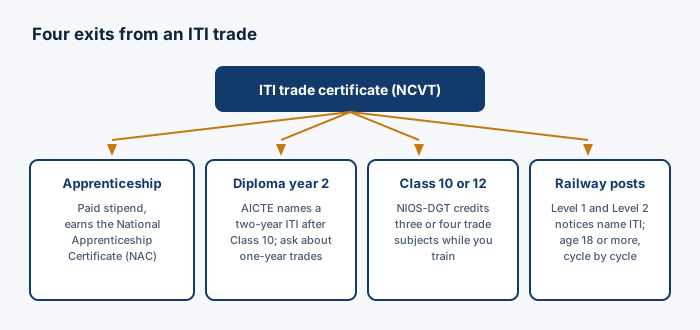
There are four exits, and each has a condition worth knowing before you choose a trade.
Apprenticeship and the National Apprenticeship Certificate
Apprentices are paid a stipend. Under the Apprenticeship Rules as amended in September 2019, the minimum first-year stipend is Rs 6,000 a month for a Class 10 school leaver and Rs 7,000 for a National or State certificate holder, rising 10% in the second year and a further 15% in the third (PIB, reply in the Lok Sabha, 14 September 2020). The same reply said the Government was not then considering an increase, so confirm today’s rate with the apprenticeship portal or the employer. A 2022 amendment says the cost of stipends is shared between the Central Government and the employer up to limits the Centre sets (Gazette, 15 November 2022). Completing an apprenticeship earns a National Apprenticeship Certificate (NAC), which matters for railway recruitment below.
The second year of a diploma
AICTE’s Approval Process Handbook says a candidate with Class 10 plus a two-year ITI is eligible for the second year of a diploma in any branch of engineering and technology, with bridge courses offered in subjects like mathematics and drawing (AICTE handbook 2024-27, Annexure 8). The text says two-year ITI. Whether a one-year trade is accepted is for your state technical board to say, so ask in writing before you choose a one-year trade for this purpose. The diploma then connects onward, as polytechnic courses after 10th explains.
A Class 10 or Class 12 certificate
Under the NIOS-DGT scheme, ITI trainees can earn a Class 10 or Class 12 certificate while they train, with up to four ITI trade subjects credited for a two-year trade and up to three for a one-year trade (NIOS-DGT). DGT’s scheme page adds that a two-year trade needs only one additional language subject and a one-year trade only two additional subjects, and says the resulting Class 10 or Class 12 equivalency is recognised by universities, government departments and employers (DGT, NIOS-DGT scheme). This keeps the degree door open if your plans change.
Railway jobs that name ITI
Two recent Railway Recruitment Board notices show what ITI can be worth on paper, and what it cannot. CEN 09/2025 invited applications for Level 1 posts at an initial pay of Rs 18,000, with 21,997 vacancies and an age range of 18 to 33 as on 1 January 2026. The qualification was “10th pass or ITI or equivalent or National Apprenticeship Certificate (NAC) granted by NCVT” (RRB CEN 09/2025). CEN 02/2026 offered Technician Grade III at Level 2, initial pay Rs 19,900, within 6,557 vacancies across Technician Grade I (Signal) and Grade III posts, at ages 18 to 30 as on 1 July 2026. For Grade III it asked for Matriculation plus ITI in trades such as Fitter, Electrician, Electronics Mechanic, Instrument Mechanic, Mechanic Mechatronics, Mechanic Diesel, Mechanic (Motor Vehicle), Welder or Machinist, or a completed apprenticeship in them (RRB CEN 02/2026).
Three cautions come out of those notices. These are single recruitment cycles, not standing offers. Both notices say a diploma or degree in engineering is not accepted in place of ITI or a completed apprenticeship for those posts unless the notice says otherwise (CEN 02/2026 says so for Level 2 technicians), so a trade certificate is the right ticket there, not a lesser one. And the age floor of 18 means a student who passes Class 10 at 16 and completes a two-year trade is just old enough, while a one-year trade leaves a gap year to fill with an apprenticeship. What these posts pay compared with other routes is set out in high salary courses after 10th.
What mistakes do students make when choosing an ITI?
- Choosing a one-year trade for the diploma route. AICTE’s text names a two-year ITI. Ask in writing first.
- Planning around COPA. DGT lists it for visually impaired candidates, not as a general trade.
- Ignoring the age floor for railway posts. The 2025 and 2026 notices asked for 18; a one-year trade finished at 16 or 17 leaves a gap.
- Treating a Class 12 trade as a Class 10 option. Five trades in DGT’s table ask for Class 12.
- Copying another state’s dates and rules. Admission is a state process; Bihar tests, others may admit on marks.
- Paying a deposit before seeing the affiliation letter for your trade.
ITI, polytechnic or Classes 11 and 12?
Choose ITI if you want a hands-on trade and an earlier start, polytechnic if you want a three-year technical diploma and a route to a degree, and Classes 11 and 12 if you want every door kept open. They connect, so the choice is about the starting point, not a permanent sort.
| ITI trade | Polytechnic diploma | Classes 11 and 12 | |
|---|---|---|---|
| Typical length | 6 months to 2 years | 3 years | 2 years, then a degree |
| Awarded | National Trade Certificate (NCVT) | Diploma (state board, AICTE-approved institute) | Class 12 certificate |
| Onward route | Diploma year 2 (two-year ITI), apprenticeship, NIOS | B.Tech year 2 by lateral entry (marks and seat conditions) | Any degree the stream allows |
| Best when | You want skilled work soon | You want an engineering career with a degree option | You are unsure, or want medicine or CA |
How do you check an ITI before you pay?
Run five checks; each takes minutes.
- Is the trade on DGT’s list? Match the exact trade name against the DGT trade table linked above, including its stated duration and entry rule.
- Is the ITI affiliated to NCVT for that trade? Affiliation is per trade, so ask for the affiliation letter showing your trade and the number of seats.
- Is admission through the state process? A private ITI should still follow the state’s merit and counselling norms.
- Is the full fee in writing? Ask what is refundable and what exam and workshop charges are extra.
- Can you meet one former trainee? Ask which employer or apprenticeship they went to. No ITI controls hiring, so treat any placement guarantee as a warning sign.
Frequently asked questions
Which ITI course is best after 10th?
There is no single best trade. Electrician, Fitter and the vehicle and refrigeration trades are widely asked for in recruitment notices such as the railway ones above, but the right trade is the one you can finish and that matches local employers. Look at who hires in your district before you choose.
Can I do ITI after 8th?
Yes, for the trades that ask only for Class 8. In DGT’s table about one trade in eight does, including Welder, Plumber, Mason and Dress Making, while most ask for Class 10.
How many years is an ITI course?
Six months to two years, depending on the trade. Most listed trades take one year and about a third take two years (54 of 170).
Is ITI valid for a government job?
Only where the notice names it. Some railway posts accept ITI or NAC; many posts ask for Class 12 or a degree. Read the “essential qualification” paragraph of each notice and check the age limit, since notices change every cycle.
Can I do a diploma or B.Tech after ITI?
AICTE allows Class 10 plus a two-year ITI into the second year of an engineering diploma. A diploma can then lead to the second year of a B.Tech by lateral entry, subject to marks and a seat cap, as set out in diploma courses after 10th.
Can I study Class 12 while doing ITI?
Yes, through the NIOS-DGT scheme, which credits up to four ITI trade subjects (three for a one-year trade) toward a Class 10 or Class 12 certificate.
Is ITI better than polytechnic?
Neither is better. ITI is shorter and more hands-on; polytechnic is longer and carries a clearer path to a degree. Which stream after 10th helps if you are weighing school against both.
What is the age limit for ITI?
One NSTI’s published rules give a minimum age of 14 with no upper limit (see the admission section above). States and trades can set their own limits, so read your state’s current prospectus; we did not find one national age rule for state ITIs.
Is there an entrance exam for ITI?
It depends on the state. Bihar’s ITICAT 2026 prospectus describes an entrance examination with a proposed date of 17 May 2026, followed by rank-based counselling. Other states may admit on Class 10 or Class 8 marks. Check your state portal.
Can I do ITI after 12th?
Yes, for the trades that ask for it: DGT’s table has five that ask for Class 12, such as Database System Assistant and Semiconductor Technician. Check each trade’s entry line before assuming a Class 12 pass opens every trade.
Is an ITI certificate equal to Class 10 or Class 12?
Not on its own. Through the NIOS-DGT scheme you add the remaining NIOS subjects and earn a Class 10 or Class 12 certificate while you train.
Which ITI trade pays the most?
We cannot name one, because no official source gives pay by ITI trade. What can be stated is the pay on a notice: Rs 18,000 at Level 1 and Rs 19,900 at Level 2 in the two railway notices above, plus the apprentice stipend minimums. Pay in private work depends on the employer and city.
Still deciding?
If you are comparing a trade, a diploma and school, a conversation can save a wrong turn. Book career counselling, or call 9212008787 or message us on WhatsApp with your Class 10 marks and the work you picture yourself doing, and we will compare routes with you, including ones we do not teach.