NIMB EDU

High salary courses after 10th do not come with an official salary: no course you can take straight after Class 10 does. What can be verified is the pay of government posts that those routes lead to. Apprentice stipends start at Rs 6,000 to Rs 8,000 a month. Railway posts have an initial pay of Rs 18,000 (Level 1), Rs 19,900 (Level 2) and, for diploma holders, Rs 29,200 (Level 5). A central police constable scale starts at Rs 21,700 (Level 3). Every other “high salary after 10th” figure is a survey, a placement claim or a guess.
That matters because pages ranking for this question mostly quote lakhs per year for engineers, pilots and data scientists. Most of those need Class 12 or a degree, so they are not after-10th courses, and the lists rarely say at what experience level the figure applies. This guide stays with what a Class 10 student can actually enter, prices each route with a government document, and says what the number does and does not mean. For the full map of routes, see courses after 10th.
Which course after 10th has the highest salary?
On documented entry pay, the highest is a diploma-level government post: Technician Grade I (Signal) in the railways, at Level 5 with an initial pay of Rs 29,200, which accepts a three-year engineering diploma or a degree. But the latest notice, CEN 02/2026, had 323 such vacancies against 6,234 Technician Grade III vacancies at Rs 19,900, so the top-paying slot was about 5% of that cycle’s 6,557 openings (RRB CEN 02/2026). The earlier technician notice (CEN 02/2025) carried the same pay levels.
For most students the honest answer is a route, not a course: finish a qualification that keeps doors open, and choose the career whose entry pay you can verify. The table below shows what each route pays on paper, with the source and the catch.
What does each Class 10 route pay on paper?
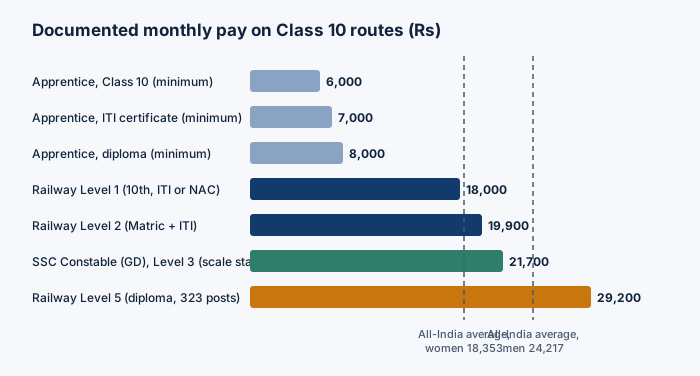
| Route and post | Documented pay (per month) | What it needs | The catch |
|---|---|---|---|
| Apprentice, Class 10 school leaver | Minimum Rs 6,000 in year 1 | Class 10 pass | A stipend during training, not a salary |
| Apprentice, National or State certificate (ITI) | Minimum Rs 7,000 in year 1 | ITI certificate | Rises 10% in year 2 |
| Apprentice, diploma holder | Minimum Rs 8,000 in year 1 | Three-year diploma | Minimum, not the going rate |
| Railway Level 1 (CEN 09/2025) | Initial pay Rs 18,000 | 10th pass, or ITI, or NAC; age 18 to 33 on 1 Jan 2026 | 21,997 vacancies in the notice as updated on 30 Jan 2026; a very large applicant pool |
| Railway Technician Grade III, Level 2 (CEN 02/2026) | Initial pay Rs 19,900 | Matriculation plus ITI in a notified trade, or apprenticeship; age 18 to 30 on 1 Jul 2026 | Diploma not accepted in place of ITI |
| Railway Technician Grade I (Signal), Level 5 (CEN 02/2026) | Initial pay Rs 29,200 | B.Sc. in listed subjects, a three-year engineering diploma or an engineering degree; age 18 to 33 on 1 Jul 2026 | 323 vacancies in the cycle |
| Constable (GD) in central armed police forces, Assam Rifles and SSF (SSC 2026) | Pay Level 3, scale Rs 21,700 to Rs 69,100 (plus allowances) | Matriculation by 1 Jan 2026; age 18 to 23 on that date | 25,487 vacancies; physical tests and medical; a pay scale, not a starting salary |
Sources: apprentice stipends are the minimum rates notified in the Gazette of 25 September 2019, as set out in a Government reply in the Lok Sabha (PIB, 14 September 2020). That reply said no increase was then being considered, so confirm today’s rates with the apprenticeship portal. Railway figures come from RRB CEN 09/2025 (Level 1) and the CEN 02/2026 notice above, the latest for these posts on 23 October 2026. The earlier CEN 08/2024 and CEN 02/2025 notices carried the same initial pay, while vacancies and age limits change with each cycle. The constable scale, age and vacancy count come from the SSC Constable (GD) notice, 2026. “Initial pay” is the starting pay in the notice; allowances come on top, and we do not estimate take-home pay.
How does that compare with what the average worker earns?
The Periodic Labour Force Survey’s 2025 annual report puts average monthly earnings of regular wage or salaried workers at Rs 24,217 for men and Rs 18,353 for women (MoSPI press note). These are all-India averages across every education level, from Class 8 to postgraduates, so they are a yardstick, not a forecast for any course.
Read against the table: railway Level 1 initial pay (Rs 18,000) is just under the women’s average and Level 2 (Rs 19,900) just over it, both below the men’s average, while a Level 5 diploma post sits above both. That is useful in one way. It says a Class 10 route does not by itself take you above the all-India average at the start; progress comes from skills, promotion and, for many students, a further qualification. The same figures are used in high salary courses after 12th science, where degree routes are priced.
Why do other lists show much bigger numbers?
Because they mix three different things. Many lists include degree careers that cannot be entered after Class 10, quote a best-case figure without an experience level, or use a survey with no stated method. We apply four filters to every figure on this page: is there a named document, is it dated, does it say which post or level it covers, and is the course really open after Class 10?
| Often listed as “high salary after 10th” | Is it open after Class 10? | What to read instead |
|---|---|---|
| MBBS and B.Tech | No, they follow Class 12 | Courses after 12th |
| D.Pharm, DMLT, radiology diplomas | No, they ask for Class 12 | Paramedical courses after 10th |
| Polytechnic diploma in engineering | Yes, three years | Polytechnic courses after 10th |
| ITI trades | Yes, six months to two years | ITI courses after 10th |
| Commercial pilot | No; DGCA asks for Class 12 with Physics and Mathematics | DGCA Pariksha FAQ |
| Officer entry through the NDA | No; the Army wing needs Class 12, the Air Force and Naval wings need Class 12 with Physics, Chemistry and Mathematics | UPSC NDA (II) 2026 notice |
| Short digital or design courses | Open, but no official pay data | Treat as a skill add-on |
Where do the big numbers on other pages come from?
We read the pages that rank for this question on 18 October 2026. Almost none names a source for its salary figures, and several disagree with themselves. One lists a Diploma in Computer Science at Rs 3 to 12 lakh a year in its text and Rs 4 to 25 lakh or more in its table. Another gives a Diploma in Hotel Management as one to three years in one section and two to three in its table. Others quote engineers at an average of around Rs 8.6 lakh or pilots at Rs 1.5 to 2 lakh a month, both of which need Class 12 or a degree, so they are not after-10th figures at all.
That is why this page quotes only what a notice, a Gazette rule or a government survey states. A private course, a skill certificate or a business can pay more than any figure here, but no document shows how often, so we cannot call it a likely outcome. If you see a salary range without a named source, treat it as an advertisement.
How long does each route take to reach those posts?
Age and time do real work here. Assume a student passes Class 10 at 16, as the usual school age implies. A two-year ITI ends at 18, the minimum age for the railway posts above. A three-year diploma ends at 19. Going ITI first and then the second year of a diploma (AICTE names a two-year ITI for that entry) means two more years, so about 20 at the diploma, a year later than starting the diploma directly (AICTE handbook 2024-27, Annexure 8).
| Route | Time after Class 10 | Earliest age of finishing (if Class 10 at 16) | First documented pay it unlocks |
|---|---|---|---|
| Apprenticeship alongside or after a one-year trade | Varies | 17 or later | Stipend from Rs 7,000 (ITI certificate) |
| Two-year ITI trade | 2 years | 18 | Level 2 post (Rs 19,900) if the notice is open and you meet the age rule |
| Three-year diploma | 3 years | 19 | Level 5 post (Rs 29,200) for the few seats; apprentice minimum Rs 8,000 |
| ITI then diploma year 2 | 2 + 2 years | 20 | Same as diploma, one year later |
| Constable (GD) route, Matriculation only | Wait for the age floor | 18 at the earliest, as of the 1 Jan 2026 cut-off date | Level 3 scale from Rs 21,700 if selected; the years before can go to Classes 11 and 12 or an ITI |
| Classes 11 and 12, then a degree | 2 years, then 3 or more | 21 or later | Priced in the Class 12 guides, not here |
This is arithmetic from the notices, not a promise: railway recruitment runs in cycles, the next notice may change qualification and age, and a government post is never guaranteed.
What helps pay after Class 10, whichever route you take?
Three things are within a student’s control and show up in the documents above. First, the right qualification for the post: the Level 2 notice asked for an ITI in named trades, and said a diploma would not do instead. Second, the age window: miss it and the route closes, as an 18 to 30 range for Technician Grade III shows. Third, keeping the next step open: NIOS credits ITI subjects toward Class 10 or 12 certificates (NIOS-DGT), and AICTE allows diploma holders to seek B.Tech lateral entry with 45% marks (40% for reserved categories), within a seat cap, as explained in our diploma guide.
A basic computer skill helps in most offices and is a cheap add-on during school; NIMB’s online Basic Computer course has no prerequisite. We do not claim it raises pay by any amount.
How can you test any “high salary” claim in five questions?
- Is the course really open after Class 10? Check the regulator’s entry rule, not the advertisement.
- Which document is the number from? A government notice or survey with a year, not “industry sources”.
- Is it a starting figure or a best case? Ask for the experience level and the sample size.
- Is it per month or per year, and before or after deductions? Mixed units hide the real comparison.
- How many people actually get that job? A Level 5 post with 323 seats among 6,557 is not the typical outcome.
Frequently asked questions
Which course is best after 10th for a high salary?
There is no course with an official salary table. The best-documented entry pay for Class 10 routes is in government posts: Rs 18,000 and Rs 19,900 at railway Levels 1 and 2, and Rs 29,200 for a diploma post. Choose the route that matches your interests and keep the next qualification open.
Can I earn Rs 50,000 a month after 10th?
We found no government document showing that figure for any Class 10 entry route. It may happen with experience, skills or a business, but no verified source gives it as a starting pay at this level.
Is diploma or ITI better for salary?
The railway notices price diploma-level posts higher (Rs 29,200 against Rs 19,900), but the diploma posts were far fewer in that cycle, and a diploma did not substitute for ITI in the ITI posts. Choose by the work you want and by the posts you can reach.
Which government jobs can I get after 10th?
Some, with age limits. The railway Level 1 notice (CEN 09/2025) accepted a Class 10 pass, ITI or NAC at ages 18 to 33 on 1 January 2026, before category relaxations. A Class 10 student is eligible only once the age floor is reached. Read the current notice before you plan around any post.
How much do apprentices earn?
Under the minimum rates notified in September 2019 the first-year stipend is Rs 6,000 for a Class 10 school leaver, Rs 7,000 for a National or State certificate (ITI) holder and Rs 8,000 for a technician apprentice or diploma holder. It rises 10% in the second year and a further 15% in the third. Employers may pay more, and rates are specified under the rules from time to time.
Are short skill courses a path to high pay?
They can add value to a school or diploma route, but we found no official pay data for them. Be wary of any course that quotes a salary without naming the source and the year.
Is Class 11 and 12 better for salary?
Degree routes usually take longer and have higher ceilings, but the ceiling depends on the course and institute. See which stream after 10th for a decision test, and the Class 12 guides for priced degree routes.
How much does an SSC GD constable earn?
The 2026 notice put the post at Pay Level 3, a scale of Rs 21,700 to Rs 69,100 plus allowances, for 25,487 vacancies across the CAPFs, SSF and Assam Rifles. The lower figure is where the scale begins; the notice does not state a take-home amount, and the post requires physical and medical tests as well as the written exam.
Can I become a pilot after 10th?
Not directly. DGCA’s examination FAQ asks every flight-crew applicant except those seeking a private pilot licence to have passed 10+2 with Physics and Mathematics. After Class 10 the route is Classes 11 and 12 in Science with those two subjects, then the licence training.
Is the merchant navy open after 10th, and what does it pay?
The Directorate General of Shipping runs pre-sea training courses for ratings, but we could not open its current circular today, so we do not quote its entry rule or any pay. Ask a DG Shipping-approved institute for the circular it is following, and for the official pay scale of the rank you would hold, not a recruiter’s range.
Still deciding?
If the money question is the one keeping you stuck, a conversation can turn it into a plan: book career counselling, or call 9212008787 or message us on WhatsApp with your Class 10 marks and the pay you need to reach. We will compare routes using documents like the ones above, including the ones we do not teach.