NIMB EDU

No official body ranks science courses by salary. So any list that says “this course pays Rs X lakh” without a named source, year and institution is a guess. What can be said is which routes tend to reward experience and specialisation, what the verified numbers look like, and how long each route takes before you start earning.
Pages ranking for this search mostly list engineering, medicine, data science and aviation with round figures and no source. This guide keeps the same routes but separates what is documented from what is marketing, then shows you how to test any salary claim yourself. It belongs to courses after 12th science, which covers eligibility and entrance exams for each route, and to the wider courses after 12th hub. Commerce students can read high salary courses after 12th commerce. Facts were checked on 17 October 2026.
Which science course has the highest salary?
No course has a fixed highest salary. The highest outcomes come from the strongest institutions in each field, and the same degree from a weaker college can pay far less. The routes below are the ones most often tied to high pay, with only the facts we could source.
| Route | Time to start earning (sourced) | What decides pay | Verified figure |
|---|---|---|---|
| Engineering (B.Tech), especially CS and related | Not stated in a source we could verify; check the college | Institution, branch, campus recruiters, skills | IIT Madras 2023-24: median Rs 19.6 lakh, average Rs 22 lakh a year (institute release) |
| Medicine (MBBS) | 4.5 years plus 1 year internship (NMC) | Postgraduate specialisation, government vs private practice | None we could verify by specialty |
| Nursing, central government | Nursing qualification plus Nursing Council registration | Pay level of the post | AIIMS Nursing Officer posts are at Level 7 on the pay matrix (NORCET-8 brochure) |
| Pharmacy (B.Pharm) | 4 years (PCI) | Sector (manufacturing, hospital, regulatory), further study | None we could verify |
| Commercial pilot | DGCA licensing route; 10+2 with Physics and Maths is required except for a private pilot licence (DGCA Pariksha) | Airline, licence ratings, hours flown | None we could verify |
| Architecture (B.Arch) | NATA, then the degree | Practice vs employment, portfolio | None we could verify |
Seeing “None we could verify” is not a gap in this guide, it is the state of public data. Where only blogs and college pages give a figure, we leave it out.
Which high-salary route fits PCM, PCB or PCMB?
Your Class 12 subjects decide which entrance routes you can even attempt, so start there before comparing pay. The detail for each route sits in a sibling guide; here is the short version.
- PCM (Physics, Chemistry, Maths): keeps B.Tech, architecture and the Air Force and Naval wings of the NDA open. B.Tech at the IITs runs through JEE Advanced, and at NITs and IIITs through JEE Main; JEE is not compulsory for state and private colleges, so check AICTE approval before paying. Eligibility, JoSAA and branches are in engineering courses after 12th.
- PCB (Physics, Chemistry, Biology): keeps MBBS, BDS, AYUSH, nursing and pharmacy open, with NEET (UG) as the single entrance route for the medical degrees. MBBS is 4.5 years plus a one-year internship. See medical courses after 12th.
- Allied health, nursing and pharmacy: nursing is regulated by the Indian Nursing Council and pharmacy by the Pharmacy Council of India. Check each degree’s entry rule before assuming it needs NEET. See paramedical courses after 12th.
- PCMB: you can attempt either set of entrance exams, which is an advantage only if you prepare for both seriously.
- Outside the lab: science students can also choose law, design, teaching or a defence entry. Pay for government and defence posts is published in the recruitment notice, so read the current one on the recruiter’s site. Government jobs after 12th lists the entries and the pay levels we could read.
The wider map of options, including law, design and teaching, is in the science guide linked at the top of this page.
What do the verified numbers tell you?
They tell you the range and the spread, which matter more than any single number. Three are worth knowing, and the table puts them side by side.
| Figure | Value | Published by | What it covers |
|---|---|---|---|
| IIT Madras placement, 2023-24 | Median Rs 19.6 lakh, average Rs 22 lakh a year | IIT Madras | One institute, one year, students placed by 30 April 2024 |
| Regular wage and salaried workers, 2025 | Rs 24,217 a month (men), Rs 18,353 (women) | MoSPI, PLFS | All education levels, all of India |
| AIIMS Nursing Officer post | Pay Level 07 | AIIMS, NORCET-8 brochure | One central government post |
The top end: IIT placements
In May 2024 IIT Madras reported that 1,091 students were placed in 256 companies in the 2023-24 placement season (as of 30 April). The median salary was Rs 19.6 lakh and the average Rs 22 lakh a year (IIT Madras). Two things to take from it. First, the average is about 12% above the median, because a few very high offers pull it up, so the median is the fairer guide to a typical student there. Second, this is one institute in one year. It does not describe engineering graduates in general.
The same institute, newer data: IIT Madras 2024-25 by department
The Career Pathway Centre of IIT Madras has published its 2024-25 annual report. It gives median and average cost to company (CTC) by department and programme, in lakhs of rupees (IIT Madras, CPC annual report 2024-25). The B.Tech columns for a few departments show how wide the spread is inside one institute.
| Department | Median | Average |
|---|---|---|
| Computer Science and Engineering | 46.0 | 53.2 |
| Electrical Engineering | 22.5 | 28.8 |
| Chemical Engineering | 17.4 | 18.8 |
| Civil Engineering | 17.2 | 17.5 |
| Aerospace Engineering | 16.2 | 17.1 |
| Mechanical Engineering | 15.0 | 16.9 |
Read it carefully. The B.Tech median in computer science is about three times the one in mechanical engineering, at the same institute in the same year. That is the branch effect, and it is large. But the summary table gives no student counts, so a department median can rest on a small group, and the figures describe one IIT. They say nothing about the same branch at another college. Treat 46 lakh as the ceiling for one branch at one institute, not as a salary for “computer science”.
The reality check: what the average worker earns
The Periodic Labour Force Survey’s 2025 annual report gives average monthly earnings of regular wage or salaried workers. These are Rs 24,217 for men and Rs 18,353 for women (MoSPI, PLFS press note). The ministry cautions that the 2025 estimates may not be strictly comparable with earlier reports because the sample design changed. These are all-education averages, so they are a floor for context, not a graduate benchmark. The gap between this and a headline “Rs 20 lakh package” is the first thing to keep in view.
Government pay: published, but not generous at entry
Central government pay is public. AIIMS recruits Nursing Officers through NORCET at Level 07 of the pay matrix, with nursing council registration required (AIIMS, NORCET-8 brochure). Government jobs trade a lower starting figure for stability and a published ladder, and the pay level is the number to look up.
How long before you start earning?
Years of study before first pay are part of the real cost of a “high salary” course. They are easy to ignore, and they are on the official pages.
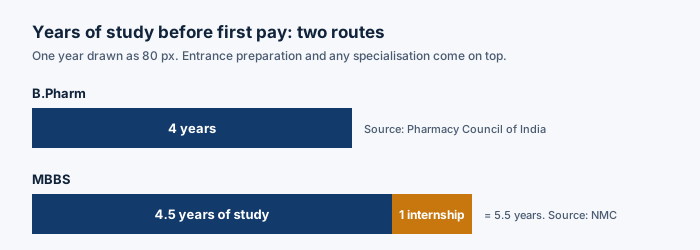
- MBBS: the National Medical Commission’s curriculum sets four and a half academic years followed by one year of compulsory rotating internship (NMC, CBME curriculum). A specialisation takes more years on top.
- B.Pharm: described by the Pharmacy Council of India as a four-year course after 10+2 (PCI FAQ).
- Entry itself takes time: medical entry runs through NEET (UG), and IIT admission needs JEE Advanced plus 75% in Class 12 or the top 20 percentile of your board (JEE Advanced criteria). Read the exam details in our science guide above.
How can you check a salary claim?
Test every claim with five questions. They take minutes and remove most of the marketing.
- Is it a median or an average? Averages are pulled up by a few high offers. IIT Madras reports both, and they differ by about 12%.
- Which year, and which institution? A figure with no year or college name is not evidence.
- How many students were placed? A high median for a quarter of a batch says little about the rest.
- Who published it? A placement office, a government body or a university is better than a blog or an agent.
- Is the pay an offer or a reality? Offers can include joining bonuses and stock that are not monthly income.
The same questions apply to every salary page, including ours. Our hub and each stream guide state where a figure comes from or leave it out.
Where can you check a college’s own placement figures?
Ask for the college’s placement report and compare it with what it submitted to NIRF. The ranking’s Engineering methodology scores each institution on placement percentage, selection for higher studies and the median salary of graduates over the previous three years, using primary data the institution provides in a prescribed format (NIRF Engineering methodology 2025). So a ranked college has already stated those numbers somewhere, and one that will not share them is telling you something.
When you get the report, check four things: the median and not only the average, the share of the batch placed, how many chose higher studies instead, and the year. A college that quotes only its “highest package” has answered none of them.
How can you pay for an expensive science degree?
If you get into a ranked institution, a collateral-free loan may be available. The Union Cabinet approved PM-Vidyalaxmi in November 2024. Students admitted to the qualifying institutions, chosen by NIRF rank and including all centrally governed institutions, can get collateral-free and guarantor-free loans from banks. Loans up to Rs 7.5 lakh carry a 75% credit guarantee. Students with family income up to Rs 8 lakh a year, who get no other scholarship or interest subvention, can receive 3% interest subvention on loans up to Rs 10 lakh (PIB, Cabinet approval of PM-Vidyalaxmi, 6 November 2024). The scheme started with 860 qualifying institutions and the list is updated every year, so check the PM-Vidyalaxmi portal for the current list before you rely on it. A loan is a bet on the pay figures above, so borrow against the median, not the highest package.
What mistakes make “high salary” courses disappoint?
- Choosing by the biggest number on the poster. That is usually the single highest offer, not the median.
- Ignoring the years. MBBS is 5.5 years to first pay including internship, and specialisation adds more.
- Picking a course you cannot enter. A route that needs a JEE or NEET rank is a plan only if you can prepare for it. Keep a second route that your marks can reach.
- Paying a private college without checking approval. Confirm AICTE approval for engineering and the relevant council for medical, nursing and pharmacy courses before you pay.
- Expecting the first salary to be the final one. Pay in most fields rises with experience, and specialisation can change the ceiling.
What if you want pay and cannot get into the top colleges?
Build a skill that employers can test, and pick an institution that is recognised. For degree routes, check colleges on the AICTE and UGC sites. For practical finance and computing skills that add to a science degree, see courses after 12th without commerce and the online Basic Computer course. They do not replace a degree, and they are not a pay guarantee.
Pay also grows with experience in the same field, so the first figure is not the final one. A route that starts lower but has a clear ladder, such as a central government pay level, can be a rational choice. So can a longer route whose entry is competitive but whose ceiling is higher.
Frequently asked questions
Which course has the highest salary after 12th science?
No official source ranks courses. The best verified figure we found is an institute-specific median of Rs 19.6 lakh a year at IIT Madras in 2023-24, which is a best case.
Is engineering or medicine better paid?
Neither wins on a verified national figure. Engineering can start earning after the degree; MBBS takes about five and a half years including internship, with specialisation after that. Compare time to start earning and the ceiling, not a headline number.
Which science course gives a job quickly?
Courses with a recognised licence or registration, such as nursing, lead directly to specific roles. Short skill courses can help you start working sooner, but they do not replace a degree.
Are data science and AI courses high paying?
Many colleges say so, but we found no official source for a salary range, so we do not give one. Judge a programme by its curriculum, its recognition by UGC or AICTE and its placement report.
Is a pilot course worth it?
The DGCA examination portal states that applicants other than for a private pilot licence must have passed 10+2 with Physics and Mathematics (DGCA Pariksha FAQ, linked above). Fees and pay are not set by a public source we could verify, so ask any flying school for its published fee schedule and its students’ licence record.
Can a PCB student earn well without MBBS?
Yes, through nursing, pharmacy, B.Sc and other degrees, with pay driven by the same factors: institution, role and experience. Central nursing posts show their pay level in the recruitment brochure.
Do I need a high percentage to get a high-salary course?
Often an entrance rank matters more than marks, but there are marks rules too. IITs need 75% (65% for SC, ST and PwD) or a top-20-percentile place in Class 12, per the JEE Advanced criteria.
Which PCM course has the highest salary?
No official body ranks them. The best primary data we found is IIT Madras’s 2024-25 report, where the B.Tech median ranged from Rs 15.0 lakh (mechanical) to Rs 46.0 lakh (computer science) among the departments shown above. That shows branch matters, but it is one institute. The entry routes are in the engineering guide linked above.
Which PCB course has the highest salary?
We found no official pay data by course for PCB routes, so we do not rank them. MBBS followed by specialisation is the longest route, and nursing, pharmacy and allied health lead to regulated roles. Compare years to first pay, and read the medical guide linked above.
Can I get a high-salary course without JEE or NEET?
For engineering, yes: JEE is not compulsory for state and private colleges, though the IITs, NITs and IIITs need it. MBBS and BDS need NEET (UG). Whatever the route, check approval by AICTE, UGC or the relevant council first.
Is there an education loan without collateral?
PM-Vidyalaxmi offers collateral-free, guarantor-free loans to students admitted to qualifying institutions listed by NIRF rank, with a 75% credit guarantee on loans up to Rs 7.5 lakh (PIB, 6 November 2024). Not every private college qualifies, so check the list.
Still deciding?
Pick two routes, find each one’s entry exam, years to first pay and one published salary source, and compare them side by side. If you would like help doing that for your marks and budget, book career counselling or call 9212008787.