NIMB EDU
After 12th, an engineering degree (B.E. or B.Tech) takes four years, and the official rule from AICTE is a pass in 10+2 with the subjects listed for your branch and at least 45% in them (40% for reserved categories). For Computer Science and Engineering that means Physics and Mathematics plus one more listed subject; for many core branches Chemistry is listed as well. The entrance exam is a separate question: JEE Main and JEE Advanced for the IITs and NITs, state or university tests for most other colleges.
Most lists of engineering courses name ten branches, repeat “50% in PCM” and stop. This guide uses the regulator’s own table and the 2026 JoSAA business rules, so you can see what a seat requires, which Class 12 marks count, and which routes exist besides JEE. It sits under courses after 12th science, which compares engineering with medicine, law and pure science. If your question is about pay, read high salary courses after 12th science; for a choice between streams, see how to choose the best course after 12th. Facts were checked on 17 October 2026.
What are the engineering courses after 12th?
The main routes are the four-year B.E. or B.Tech, the five-year integrated or dual-degree programmes, architecture and planning, and, for students who start from a diploma, lateral entry into the second year. The table shows the length and the entry rule for each.
| Route | Length | Entry rule (source) |
|---|---|---|
| B.E. / B.Tech | 4 years | 10+2 with the subjects in AICTE Table 8.4 for the branch, 45% in those subjects together (40% reserved); or a D.Voc. in the same or allied sector |
| Integrated / dual degree (engineering and technology) | 5 years | Same 10+2 rule; or a minimum three-year diploma with at least 45% (40% reserved) |
| B.E. / B.Tech lateral entry | Second year of the degree | Three-year (or two-year lateral) diploma in any engineering branch with 45% (40% reserved); or a B.Sc with Mathematics at 10+2 and 45%. Seats: up to 10% of approved intake, over and above the sanctioned seats, plus unfilled first-year vacancies |
| B.Arch (architecture) | See the Council of Architecture | NATA; Physics and Mathematics compulsory, 45% aggregate |
| B.Plan (planning) | 4 years (AICTE) | 10+2 at 45%; JoSAA institutes use JEE Main Paper IIB |
The rows come from AICTE’s Approval Process Handbook 2024-2027 (AICTE handbook) and the NATA 2026 brochure (Council of Architecture).
Which subjects do you need, and do you need Chemistry?
You need Physics and, for most core branches, Mathematics. Chemistry is mandatory for many branches but not for Computer Science and Engineering, where AICTE’s table asks for Physics and Mathematics plus one more subject from a list that includes Computer Science, Electronics, Biology and others. Each college’s own admission rules can be stricter than the AICTE minimum, so read the prospectus.
The 45% rule is measured on the listed subjects
The handbook measures the 45% (40% for reserved categories) in “the above subjects taken together”, meaning the subjects listed for your branch, not the whole marksheet. A student with 52% overall but weak Physics may still meet or miss the line, so add the marks in the listed subjects before you apply.
Biology students and bridge courses
The AICTE table has a footnote for agriculture, biotechnology, pharmaceutical and printing engineering: the first one or two semesters may be designed so that students with a Biology or Biotechnology background get adequate Mathematics, and the reverse. In other words, a PCB student is not shut out of every engineering branch, but you must confirm the specific college accepts it. For the main branches such as civil, mechanical and electrical, plan on PCM.
Which entrance exam do you need?
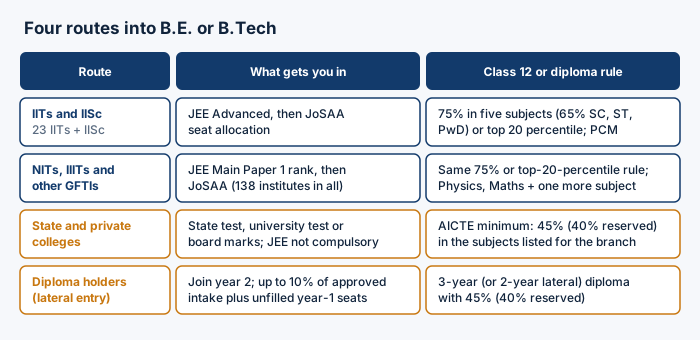
For the IITs, NITs and IIITs the route is JEE through JoSAA. For most other colleges it is a state test, a university test or board marks, and each has its own rules.
| Target | Exam | Class 12 rule |
|---|---|---|
| IITs and IISc | JEE Advanced, then JoSAA | Physics, Chemistry and Mathematics compulsory; 75% (65% SC, ST, PwD) across five subjects, or top 20 percentile of your board |
| NITs, IIEST, IIITs, other government-funded institutes | JEE Main Paper 1 rank, then JoSAA | 75% (65% SC, ST, PwD) across five subjects or top 20 percentile; Physics and Mathematics plus one of Chemistry, Biology, Biotechnology or a technical vocational subject |
| State government and private colleges | State test, university test or board marks | AICTE minimum, plus the state or college rule |
JoSAA: who is in it
For 2026-27 JoSAA allots seats in 138 institutes: 23 IITs, IISc Bengaluru, 31 NITs, IIEST Shibpur, 26 IIITs and 56 other government-funded technical institutes (JoSAA). Seat allocation in the IITs uses the JEE Advanced rank and in the NIT+ system the JEE Main rank. The 2026 business rules describe the process, including the common rank list and category rank lists (JoSAA 2026 business rules).
The Class 12 marks rule for NITs and IIITs
The business rules ask candidates for NIT+ seats to have appeared in Class 12 for the first time in 2024, 2025 or 2026 and to meet one of two tests: 75% aggregate (65% for SC, ST and PwD), or a place in the category-wise top 20 percentile of successful candidates in the same board. Five subjects count for B.E. and B.Tech: Physics, one of Chemistry, Biology, Biotechnology or a technical vocational subject, Mathematics, a language, and the best remaining subject. The marksheet must come from one board. Percentile improvement works only if you reappear in all required subjects in the same year (same document, Annexure 2(b)).
JEE Advanced and the IITs
For the IITs the brochure sets the same 75% (65% for SC, ST and PwD) across five subjects, or the top 20 percentile, with Physics, Chemistry and Mathematics compulsory (JEE Advanced admission criteria). A strong rank with a weak board score can still cost you the seat, so Class 12 matters as much as the entrance test.
What is the JEE Main pattern, and who can sit it?
JEE Main Paper 1 (for B.E. and B.Tech) was a computer-based test of three hours with 75 questions for 300 marks in the 2026 cycle. Mathematics, Physics and Chemistry carried 100 marks each, and every subject had 20 multiple-choice questions plus 5 questions with a numerical answer. A correct answer scored +4, a wrong answer -1 and an unanswered question zero, in both question types (NTA, JEE (Main) 2026 information bulletin).
- Two sessions. Session 1 ran from 21 to 30 January 2026 and Session 2 from 2 to 9 April 2026; if you sit both, your best NTA score is used.
- Who is eligible. There is no age limit. You must have passed Class 12 in 2024 or 2025, or be appearing in 2026; anyone who passed in 2023 or earlier was not eligible. Individual institutes can still apply their own age rule.
- Subjects in Class 12. For admission based on Paper 1 rank in NIT+ institutes: Physics, Mathematics, a language, one of Chemistry, Biotechnology, Biology or a technical vocational subject, and one more subject.
- Architecture and planning. Paper 2A (B.Arch) is 77 questions for 400 marks and includes a pen-and-paper drawing test of 100 marks; Paper 2B is for B.Planning.
- Beyond NITs. NTA says Paper 1 results are also used for integrated M.Sc., integrated B.Tech and some other programmes, and that JEE Main is the eligibility test for JEE Advanced.
When we checked the JEE Main site on 20 October 2026 it still showed the 2026 bulletin, so the 2027 pattern and dates were not yet published. Treat any 2027 date on a coaching page as a guess until NTA posts the bulletin.
How does JoSAA counselling work, step by step?
JoSAA runs in rounds, and each round has a deadline you cannot miss. The 2026 business rules set out these steps for an allotted seat.
- Register and fill choices. You list institute and branch combinations in order of preference on the JoSAA portal.
- Get an allotment and accept it. After each round you download the allotment slip and choose Freeze, Float or Slide.
- Upload documents. The suggested list for NIT+ seats includes Class 10 and 12 marksheets, the JEE Main admit card, a category certificate where applicable, a bank cheque copy or passbook image and a medical certificate.
- Pay the seat acceptance fee. It was Rs 30,000, or Rs 15,000 for SC, ST and PwD categories, and includes Rs 5,000 of JoSAA processing charges. The remainder is adjusted against your admission fee. Documents are verified only after you pay, and not paying counts as rejecting the seat.
- Complete reporting and verification within the round’s deadline, or the seat is cancelled and you leave the process.
| Option | What it means (JoSAA 2026 business rules) |
|---|---|
| Freeze | You accept the seat and stop. You are not considered in later rounds. |
| Float | You accept the seat but will take a higher-preference programme at any institute if offered later. |
| Slide | You accept the seat but will take a higher-preference programme at the same institute if offered later. |
Float and Slide are not available in the last round, and a Freeze choice cannot be changed afterwards. Category certificates have date rules (for OBC-NCL and EWS, issued on or after 1 April 2026 or an online-verifiable certificate valid till 31 August 2026 or physical reporting), so apply for them before results come out.
Which engineering institutions rank highest?
NIRF 2025 from the Ministry of Education ranks these engineering institutions highest. It is a ranking on teaching, research, outcomes and perception, not a promise of a seat in any branch, and cut-offs differ by branch and category (NIRF 2025 engineering ranking).
| NIRF 2025 rank | Engineering category |
|---|---|
| 1-3 | IIT Madras, IIT Delhi, IIT Bombay |
| 4-6 | IIT Kanpur, IIT Kharagpur, IIT Roorkee |
| 7-8 | IIT Hyderabad, IIT Guwahati |
| 9 | NIT Tiruchirappalli |
| 10 | IIT (BHU) Varanasi |
For architecture, the NIRF 2025 top five were IIT Roorkee, NIT Calicut, IIT Kharagpur, IIEST Shibpur and Jamia Millia Islamia (NIRF 2025 architecture ranking). NIRF 2026 results were not on the NIRF site when we checked on 20 October 2026. If your rank will not reach these, a good approved college in the branch you want usually serves you better than a top institute in a branch you do not want.
What do the main branches involve?
Branch names sound alike, so this is what each one is about in plain terms. No official source ranks them by pay, so none is ranked here.
| Branch | What you work on | Class 12 note |
|---|---|---|
| Computer Science and Engineering | Software, algorithms, data, networks, AI | AICTE lists Physics and Mathematics plus one more listed subject; Chemistry not compulsory |
| Electronics and Communication | Circuits, signals, communication and embedded devices | PCM is the safe choice |
| Electrical | Power generation and distribution, machines, control | PCM |
| Mechanical | Machines, thermal systems, manufacturing, design | PCM |
| Civil | Buildings, roads, water, structures | PCM |
| Chemical | Process plants and materials at scale | PCM |
| Biotechnology | Applying biology and engineering to products and processes | AICTE footnote allows bridge semesters for Biology or Mathematics background |
Can commerce or arts students study engineering?
Not straight after 12th. AICTE’s entry rule needs Physics and, for the main branches, Mathematics at 10+2, which commerce and arts students usually do not have. Two routes exist: take a polytechnic diploma after Class 10 and use lateral entry into the second year of B.Tech, or choose a related commerce or computing course instead. The AICTE handbook lets a diploma holder in any engineering branch enter lateral entry with 45% (40% reserved). Commerce students with Mathematics should still check each college’s rule, because AICTE’s table is a minimum.
What mistakes do engineering applicants make?
- Filling JoSAA choices by branch name only. The same branch at different institutes has different outcomes; list institute and branch pairs in order of true preference.
- Not paying the seat acceptance fee on time. The rules treat non-payment as rejection of the seat.
- Using a category certificate that is out of date. The 2026 rules set issue and validity dates for OBC-NCL and EWS.
- Counting overall marks instead of the five-subject rule. NIT+ seats need 75% (65% for SC, ST, PwD) across five subjects or the board’s top 20 percentile.
- Trusting a “direct admission” offer. Check the AICTE approval for the exact programme and year.
Do you need JEE to study engineering?
No. JEE is the gateway to centrally funded institutes, but AICTE-approved state and private colleges admit through their own routes. The risk in these routes is not eligibility but quality and recognition, so verify the college and the exact programme on the AICTE website and, for universities, on the UGC website. Agents who promise a “management quota” seat without an official counselling letter are the most common source of loss.
How do you pick a branch?
No public source ranks branches by salary, so choose by the work and the college. Pick the college first when your rank is strong, and the branch first when it is not. The questions below do more than any ranking.
- What do you want to build or run? Structures and cities point to civil; machines to mechanical; power and control to electrical; devices and communication to electronics; software and data to computer science and related branches; plants and materials to chemical and metallurgy.
- Which labs and projects does the college run? Ask for the lab list and the last year’s final-year projects.
- Is the programme AICTE-approved for the year you join? Approval is year-wise.
- What happens in the final year? AICTE’s handbook makes internships compulsory for final-year students, so ask where students intern.
- Can you change branch later? Ask the college in writing.
The branch you choose matters less than the skills you build. A practical computing base helps in any branch; the online Basic Computer course is one way to start before college. Students who want a shorter technical route after Class 10 can look at polytechnic courses after 10th, which lead into lateral entry.
What if your rank or marks fall short?
Keep a route that preserves your options rather than a branch you do not want.
- A diploma first. Complete a polytechnic diploma and join the second year of B.Tech by lateral entry, where the college has approved lateral seats.
- A B.Sc in a strong subject. It keeps postgraduate routes open, and the science guide above compares it with the other options.
- Another health or science route. If you studied Biology as well, see medical courses after 12th and paramedical courses after 12th.
- A retake with a date. Retake only if the last score was close and you can name what will change.
For the wider map across streams, the courses after 12th hub lists every option.
Frequently asked questions
What is the eligibility for B.Tech after 12th?
AICTE requires a pass in 10+2 with the subjects listed for the branch and at least 45% in them together (40% for reserved categories). Physics and Mathematics are the core; Chemistry is mandatory in many branches.
Can I do B.Tech without Mathematics?
Not in the main branches. AICTE’s table lists Mathematics for most core branches, a few branches list other combinations, and the starred branches such as biotechnology allow bridge semesters for Biology students. Confirm with the specific college.
Is JEE compulsory for engineering?
No. It is compulsory for the IITs, NITs and other JoSAA institutes. State and private colleges use their own admission routes.
What marks do I need for NITs and IITs?
75% in five subjects (65% for SC, ST and PwD) or a top-20-percentile place in your board, plus a JEE rank, per the 2026 JoSAA business rules and JEE Advanced criteria.
How long is B.Tech?
Four years under AICTE. Integrated or dual-degree programmes run five years.
Can a diploma holder join B.Tech?
Yes, through lateral entry into the second year, with 45% in the diploma (40% reserved). Seats are limited to 10% of the approved intake plus unfilled first-year vacancies, per the AICTE handbook.
Which engineering branch is best?
No official source ranks branches. Choose the work that interests you, then the best approved college your rank allows.
How do I check if an engineering college is approved?
Search the college and programme on the AICTE website for the year you are joining, and check the affiliating university on the UGC website.
What is the JEE Main exam pattern?
Paper 1 is a three-hour computer-based test with 75 questions for 300 marks: Mathematics, Physics and Chemistry, each with 20 multiple-choice and 5 numerical questions, scored +4 and -1 (JEE Main 2026 bulletin).
Is there an age limit for JEE Main?
No age limit in 2026, but you must have passed Class 12 in 2024 or 2025 or be appearing in 2026. Institutes may apply their own age rules.
What do Freeze, Float and Slide mean in JoSAA?
Freeze keeps your seat and ends your participation. Float keeps it but lets you move to a higher-preference programme anywhere. Slide lets you move to a higher-preference programme at the same institute only.
How much is the JoSAA seat acceptance fee?
Rs 30,000, or Rs 15,000 for SC, ST and PwD categories in 2026, including Rs 5,000 of processing charges; the rest is adjusted against the admission fee.
Which is the top engineering college in India?
NIRF 2025 ranks IIT Madras first in the engineering category, followed by IIT Delhi and IIT Bombay. A ranking is not a seat guarantee.
Can commerce students do B.Tech?
Not directly in the main branches, which need Physics and Mathematics. A polytechnic diploma and lateral entry is the usual alternative route.
Still deciding?
Write down your Class 12 marks in the subjects AICTE lists for your branch, the exams you can still sit and the fees you can fund for four years. That page makes most of the decision. If you want a second opinion, book career counselling or call 9212008787.