NIMB EDU

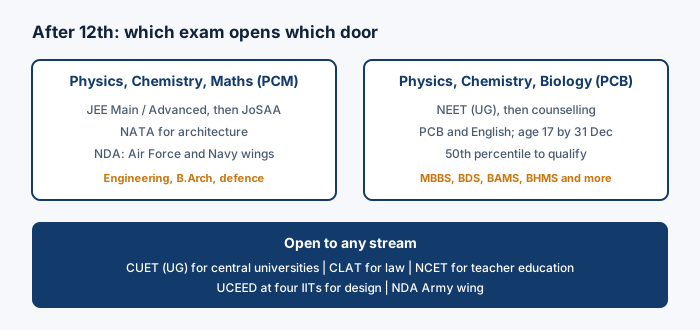
After 12th science you can study engineering, medicine, pharmacy, nursing, architecture, pure science, law, teaching, defence and aviation, but which doors open depends on your subject group. Physics, Chemistry and Mathematics (PCM) keep engineering, architecture and the defence-technical routes open. Physics, Chemistry and Biology (PCB) keep medicine, nursing and pharmacy open.
Most lists of science courses name the options and stop there. This guide does what a list cannot: it matches each course to the entrance exam, the subject rule and the official body that sets it, so you can see which routes your own subjects allow before you choose. It sits inside the full guide to courses after 12th by stream. For pay, read high salary courses after 12th science. If you are still choosing between streams, see how to choose the best course after 12th. Facts below were checked on 17 October 2026, and each links to the body that sets the rule.
Three sibling guides go deeper on the biggest routes: engineering courses after 12th, medical courses after 12th and paramedical courses after 12th. This page is the map that tells you which of those you can enter.
Which courses can you study after 12th science?
The table groups the main routes by the subjects they ask for. “Entry route” is the exam or rule that decides admission.
| Route | Subjects it asks for | Entry route |
|---|---|---|
| B.Tech / B.E. (engineering) | Physics, Chemistry, Mathematics | JEE Main for NITs, IIITs and other centrally funded institutes; JEE Advanced for IITs; many state and private colleges use their own tests |
| MBBS, BDS, BAMS, BUMS, BSMS, BHMS | Physics, Chemistry, Biology or Biotechnology, English | NEET (UG), then counselling |
| B.Sc Nursing | PCB and English | Entrance test or state rules; NEET covers selected central seats |
| B.Pharm | Physics, Chemistry, plus Mathematics or Biology; English | State or university process |
| B.Arch (architecture) | Physics and Mathematics, with another listed subject | NATA |
| B.Sc (Physics, Chemistry, Biology, Maths, Computer Science and more) | Depends on the subject and university | CUET (UG) at many universities, or the university’s own test |
| Defence: NDA | PCM for Air Force and Navy; any stream for the Army wing | UPSC exam, held twice a year |
| Commercial pilot training | Physics and Mathematics at 10+2 | DGCA licensing route |
| Law (BA LLB and similar) | 10+2 in any stream, 45% in most cases | CLAT and other law tests |
| Teaching: ITEP (B.A. B.Ed., B.Sc. B.Ed.) | Class 12 pass; see the NCET bulletin for marks | NCET through NTA |
What does PCM open, and what does it close?
PCM keeps the engineering, architecture and defence-technical routes open and leaves medicine closed unless you add Biology. That trade-off is the main thing to understand at the start of Class 11 or, if you are past Class 12, the main thing to check against your marksheet.
Engineering: JEE, JoSAA and the 75% rule
Seat allocation for centrally funded engineering institutes runs through JoSAA. For 2026-27 it covers 138 institutes: 23 IITs, IISc Bengaluru, 31 NITs, IIEST Shibpur, 26 IIITs and 56 other government-funded technical institutes (JoSAA).
For the IITs you need to qualify JEE Advanced. The brochure also sets a Class 12 rule: at least 75% aggregate (65% for SC, ST and PwD candidates) across a minimum of five subjects, or a place in your board’s top 20 percentile (JEE Advanced admission criteria). Marks in Physics, Chemistry, Mathematics, one language and one other subject count. Do not assume a good rank is enough; a low Class 12 score can cost you the seat.
JEE Main, run by NTA, has separate papers: Paper 1 for B.E./B.Tech, Paper 2A for B.Arch and Paper 2B for B.Planning. The 2026 cycle ran two sessions (NTA, JEE Main portal). Branch choice, cut-offs and what to do when a rank falls short are in the engineering guide linked above.
Many students miss the other half of the engineering map: state and private universities that admit through state tests, board marks or their own exams. They are valid routes if the college is approved. Check the college on the AICTE website and the university on the UGC website before you pay.
Architecture: Physics and Maths are compulsory
B.Arch admission needs the National Aptitude Test in Architecture (NATA). The 2026 NATA brochure requires 10+2 with Physics and Mathematics as compulsory subjects, along with Chemistry, Biology or another listed subject, and at least 45% in aggregate, or a 10+3 diploma with Mathematics at 45% (NATA 2026 brochure). Percentage limits can change between cycles, so read the current brochure rather than an older web page.
The same brochure explains that the Council of Architecture’s rules require an aptitude test conducted either by the Council (NATA) or by NTA (the JEE route), and that actual admissions are run by the state or institution on a valid score. NATA 2026 ran from 4 April to 13 June 2026 in two phases. In Phase 1 a candidate could take up to two attempts, and the best raw score set the percentile. Phase 2 allowed one attempt for vacant seats. A candidate may appear in only one phase.
Defence and aviation
The National Defence Academy exam is run by UPSC. In the NDA and Naval Academy examination (II) 2026, the Air Force and Navy wings and the Indian Naval Academy 10+2 Cadet Entry need Physics, Chemistry and Mathematics at 12th class. The Army wing needs only a 12th pass (UPSC notice). UPSC holds the exam twice a year. The notice also lets Class 12 students apply while still studying, with proof of passing due by the prescribed date.
For commercial pilot training, the DGCA examination portal states that applicants other than for a private pilot licence must have passed 10+2 with Physics and Mathematics (DGCA Pariksha). Read the current rules there before you pay any flying school. For the other uniformed and civil services open at 12th pass, see government jobs after 12th.
Merchant navy: a PCM route most lists skip
Indian Maritime University (a central university) lists B.Tech Marine Engineering with 10+2 including Physics, Chemistry and Mathematics as mandatory subjects, 60% aggregate in PCM and 50% in English. SC and ST candidates get a 5% relaxation in the PCM marks. Candidates must also be medically fit under the Directorate General of Shipping’s norms (IMU, B.Tech course page). Read the current IMU admission notice for the entrance test, age limit and seats before you plan around it. Salary figures for sea careers on ranking pages carry no source, so this guide leaves them out.
What does PCB open, and do you need Maths?
PCB opens medicine, dentistry, AYUSH degrees, nursing and pharmacy. It does not open engineering or architecture, because both need Mathematics, and the entrance exam for each says so.
MBBS and the NEET (UG) rules
NEET (UG) is the national entrance test for MBBS, BDS, BAMS, BUMS, BSMS and BHMS. The 2026 bulletin sets the following (NTA, NEET (UG) 2026 information bulletin):
- You must have completed 17 years of age by 31 December of the exam year. There is no upper age limit.
- You need Physics, Chemistry and Biology or Biotechnology, with English, in the qualifying examination. Studying them as additional subjects after Class 12 is also allowed, with proof of passing.
- The qualifying mark is the 50th percentile for the general category and the 40th percentile for SC, ST and OBC-NCL candidates.
The paper has 180 compulsory multiple-choice questions to be attempted in 180 minutes: 45 each in Physics and Chemistry and 90 in Biology (Botany and Zoology), for 720 marks. Each correct answer earns four marks, each wrong answer costs one, and an unanswered question scores zero (same NTA bulletin). So wild guessing has a price.
The 2026 cycle took applications from 8 February to 8 March, with the exam first set for 3 May 2026. NTA’s site also shows a NEET (UG) 2026 re-examination held on 21 June 2026 (NTA NEET portal). The lesson for next year’s students: keep your documents ready early and follow the NTA site for any change.
Under the National Medical Commission’s curriculum, MBBS is four and a half academic years followed by one year of compulsory rotating internship (NMC, CBME curriculum). So the degree takes about five and a half years, before any postgraduate study.
Nursing and pharmacy
The Indian Nursing Council’s eligibility page lists 10+2 with Science (PCB) and English with 45% aggregate for B.Sc Nursing, and a minimum age of 17 (Indian Nursing Council). INC documents word the 45% slightly differently, so read your university’s prospectus. Admission is often through a state or university process; the NEET bulletin covers only selected central B.Sc Nursing seats and military nursing.
The Pharmacy Council of India’s B.Pharm syllabus asks for 10+2 with English and Physics, Chemistry and Mathematics (PCM) or Biology (PCB or PCMB), and the Council describes B.Pharm as a four-year course after 10+2 (PCI syllabus). That makes pharmacy one of the few health routes open to both PCM and PCB students. Physiotherapy, lab technology, radiology and similar allied-health degrees are covered in the paramedical guide, and MBBS, BDS and AYUSH in the medical guide, both linked above.
Can you study agriculture or veterinary science after 12th science?
Yes, and agriculture is not limited to PCB students. For the ICAR All India Quota, ICAR’s 2026 public notice invites candidates who took CUET (UG) 2026 and passed Class 12 with at least three core subjects among Physics, Chemistry, Mathematics, Biology and Agriculture. The notice says these seats cover 13 undergraduate programmes in Agriculture and Allied Sciences. They sit at state and central agricultural universities, ICAR deemed universities and central universities with agriculture faculties (ICAR public notice, 11 June 2026). The CUET (ICAR-UG) bulletin on the ICAR site lists the subject eligibility programme by programme. Counselling for those seats runs on a separate ICAR portal. A PCM or PCB student should read the bulletin before assuming a programme is closed.
Veterinary science runs on NEET. The NEET (UG) 2026 bulletin says its data will also be used for BVSc and AH admissions under the 15% quota of the Veterinary Council of India in recognised veterinary colleges. State veterinary seats follow state rules, so check the state counselling notice.
What if you studied PCMB?
PCMB students meet the subject rule of both main gateways, so they can sit JEE and NEET in the same year. The trade-off is time, not eligibility: the two syllabi are large, and the JEE Advanced Class 12 marks rule and NEET’s percentile rule apply separately. Pick one primary target by the end of Class 11 and treat the other as a back-up. A PCM student who wants medicine has the route the NEET bulletin allows, which is to study Biology as an additional subject and show proof of passing. A PCB student aiming at engineering must meet the Mathematics requirement the exam sets, so read that exam’s rule first.
Which entrance exam do you need?
Match the exam to the course, then read that exam’s own bulletin. Exam rules change between cycles, which is why this table points you to the official source.
| If you want | Sit this | Who runs it | Check |
|---|---|---|---|
| IITs, NITs, IIITs | JEE Main (and Advanced for IITs), then JoSAA | NTA; IITs for Advanced | 75% or top-20-percentile Class 12 rule for IITs |
| MBBS, BDS, AYUSH | NEET (UG) | NTA | PCB and English, age 17, 50th percentile |
| B.Arch | NATA | Council of Architecture | Physics and Maths compulsory, 45% |
| B.Sc and general degrees at participating universities | CUET (UG) | NTA | Each university’s subject list |
| NDA | NDA and Naval Academy exam | UPSC | PCM for Air Force and Navy |
| Law | CLAT | Consortium of NLUs | 45%, or 40% for SC, ST and PwD |
| Teaching (ITEP) | NCET | NTA for NCTE | Institution list for the year |
Who runs counselling, and what happens after the exam?
Passing an entrance exam only gets you a rank or score. Seats are then allotted by a different body, and applying to the wrong one is a common way to lose a round. The table lists the bodies named in the official bulletins and notices above.
| Route | Who allots seats | What the source says |
|---|---|---|
| IITs, NITs, IIITs and other centrally funded institutes | JoSAA | 138 institutes in 2026-27 (JoSAA, cited above) |
| MBBS and BDS: 15% all-India quota, central institutions, AIIMS, JIPMER, central and deemed universities | Medical Counselling Committee (MCC) under DGHS | Stated in the NEET (UG) 2026 bulletin; see the MCC website |
| State government medical and dental seats | The state’s designated counselling authority | The same bulletin says state and UT authorities notify their own counselling separately |
| ICAR all-India-quota agriculture seats | ICAR online counselling portal | ICAR public notice, 11 June 2026 |
| B.Arch | State or institution, on a valid NATA or JEE Main Paper 2A score | NATA 2026 brochure |
| B.Sc and other CUET (UG) programmes | Each participating university | Subject lists are set by the university |
Many students apply only to the national round and forget that state-quota seats open through a separate process. Note the dates for both when the notices appear.
What about B.Sc and the CUET route?
A B.Sc is the broadest science degree, and at many central and other participating universities the route in is CUET (UG), not marks alone. NTA’s 2026 syllabus page lists 37 tests: 13 languages, 23 domain subjects and one General Aptitude Test, and the domain list includes Physics, Chemistry, Mathematics, Biology, Computer Science, Environmental Science, Geography and Economics (CUET (UG) 2026 syllabus).
Each participating university picks the subjects it wants for each programme, so a B.Sc in Biology at one university and a B.Sc in Computer Science at another need different test choices. The university’s own CUET page is the authority, not a coaching site’s list.
Ask a college whether its B.Sc is a three-year or four-year honours structure, because it changes the time you are committing.
A B.Sc is also the base for several scholarship and postgraduate routes. The Department of Science and Technology sponsors and manages INSPIRE. Its scholarship for higher education (SHE) has forms for B.Sc and M.Sc students; read the current call, eligibility and amount on the INSPIRE portal rather than on aggregator pages, which often copy old figures. Students of any stream can also check the Central Sector merit scheme (now listed as PM-USP) on the National Scholarship Portal, where, at the time of checking, renewal applications from students closed on 31 October 2026.
Which colleges should you shortlist?
Build the shortlist from official lists, not from a coaching site’s ranking. The National Institutional Ranking Framework publishes category-wise rankings, and the 2025 edition placed IIT Madras first in Engineering and AIIMS Delhi first in Medical, as listed on the NIRF website. A ranking is one input: it says nothing about your rank, your budget or your city. Use it to find names, then check each college’s approval with AICTE, UGC, NMC or the Council that governs the course, and compare seat matrices on the counselling site. Check the NIRF site for the newest edition before you decide.
What should you fix before applications open?
Most avoidable problems are paperwork. The NEET (UG) 2026 bulletin tells aspirants to update their Aadhaar well in advance so that name, date of birth, gender, photograph and address are correct, and to keep 6 to 8 passport-size colour photographs with a white background. It warns that an application without a photograph, or with fabricated details, can be rejected (NTA bulletin). The same habit helps for every exam: keep one set of documents whose spellings and dates match.
- Check your name and date of birth on the Class 10 certificate, Class 12 marksheet and Aadhaar.
- Keep proof of subjects, including an additional-subject pass certificate if you added Biology.
- Save the exam portals’ notice pages as bookmarks. Third-party sites copy dates wrongly.
- Write down which categories and quotas you are claiming and the certificates each needs.
Which mistakes cost science students seats?
- Relying on a good rank alone. The IIT Class 12 rule (75%, or the board’s top 20 percentile) can cost a qualified candidate the seat.
- Using an old brochure. Marks limits such as NATA’s 45% are set cycle by cycle; read the current brochure.
- Assuming Biology is optional for medicine. NEET (UG) asks for Physics, Chemistry and Biology or Biotechnology.
- Ignoring state counselling. Central rounds do not cover state-quota seats.
- Paying before checking approval. Verify the college with the regulator before any fee, as the checks above explain.
- List the routes your subjects still allow using the table above.
- Check seats and fees on the official counselling pages, not on agent pages.
- Add a skill that lets you earn or intern while you study.
- Decide the retake question with a date. If you retake, the exam bulletin sets the rules for another attempt.
Can you leave the lab altogether?
Yes. Science is a Class 12 stream, not a lifelong rule. A science student can enter law, teaching, hospitality, design, management, computing and accounting.
Law is open to any stream. The Consortium of NLUs’ CLAT 2027 page requires 10+2 with 45% (40% for SC, ST and PwD) and states there is no upper age limit (CLAT 2027 eligibility). Teaching has a newer route: the four-year Integrated Teacher Education Programme, which NCTE launched in 57 institutions from 2023-24 and admits through NCET (PIB, ITEP launch).
Accounting is a less obvious exit, and it needs no commerce background. If a science student wants a job-ready finance skill, read courses after 12th without commerce.
What if your marks or rank fall short?
Pick a route that keeps the main door open rather than a course you do not want. A B.Sc in your strongest subject keeps postgraduate options open, and a drop year only makes sense if your last score was close and you can name what will change.
If you want an arts-side switch, courses after 12th arts maps those routes. If commerce is a possible switch, courses after 12th commerce covers that side.
Frequently asked questions
Which course is best after 12th science?
There is no single best one. For PCM students the usual choices are engineering, architecture and B.Sc; for PCB students, MBBS, BDS, nursing, pharmacy and B.Sc. Compare entry route, cost and time, then use the five-step method for choosing.
Can I do MBBS without Biology in Class 12?
Not directly. The NEET (UG) 2026 bulletin requires Physics, Chemistry and Biology or Biotechnology with English. It allows studying them as additional subjects after Class 12, with proof of passing.
Can PCB students take engineering?
Not through the main engineering routes, which ask for Mathematics. A PCB student who adds Mathematics should check the specific entrance exam and college rules first.
What is the minimum percentage for IITs?
Per the JEE Advanced criteria, 75% in Class 12 (65% for SC, ST and PwD) or a top-20-percentile place in your board, plus a JEE Advanced rank.
Which courses after 12th science need no entrance exam?
Some private universities admit on marks or their own tests, and some B.Sc programmes use Class 12 marks. Check the university’s prospectus and its UGC status rather than relying on any list.
Can a science student do commerce courses like CA?
Yes, commerce-side careers are open to science students. See how to become a chartered accountant for the steps and the official rules.
Can PCM students take NEET?
Only if they also have Biology or Biotechnology. The NEET (UG) 2026 bulletin allows these subjects to be studied as additional subjects after Class 12, with proof of passing.
How many questions are there in NEET (UG)?
The 2026 paper has 180 compulsory questions in 180 minutes: 45 in Physics, 45 in Chemistry and 90 in Biology, for 720 marks, with +4 for a correct answer and -1 for a wrong one.
Is NEET needed for B.Sc Nursing?
Not for every seat. The NEET bulletin covers selected central B.Sc Nursing institutes and military nursing; other admissions follow state or university rules. The Indian Nursing Council sets PCB, English and 45%.
Can a science student study agriculture?
Yes. ICAR’s 2026 notice for its all-India-quota seats asks for Class 12 with at least three core subjects among Physics, Chemistry, Mathematics, Biology and Agriculture, and admission goes through CUET (UG). The bulletin lists the exact subjects for each programme.
Which courses after 12th science are not engineering or medical?
B.Sc, B.Arch, B.Pharm, nursing, agriculture and veterinary science, merchant navy engineering, ITEP teaching, law and defence are all open on the right subjects. The table near the top shows which exam each needs.
How long is MBBS?
Four and a half academic years plus one year of compulsory rotating internship, about five and a half years in all, according to the NMC curriculum.
Still deciding?
Write down your subject group, your marks, the exams you can still sit, and how many years your family can fund. That short page makes most of the decision. If you would like a second opinion, book career counselling or call 9212008787.