NIMB EDU

The best course after 12th is the one that fits your stream, your interests, your finances and how long you can stay with the path, in that order. No course wins for everyone. Engineering, medicine, commerce, law and the arts each reward a different kind of student. Each has entry rules that your Class 12 subjects can open or close.
Most pages that answer this question list popular courses by stream with unsourced salary numbers. This guide gives you a method instead, then points you to the right stream guide for the list. Start here, then go to all courses after 12th, by stream for the full hub. If you studied commerce, which course is best after 12th commerce is the deeper decision guide. Facts below were checked on 17 October 2026.
How do you choose the best course after 12th?
Work through five steps in order. Each removes some options so the last step is easy.
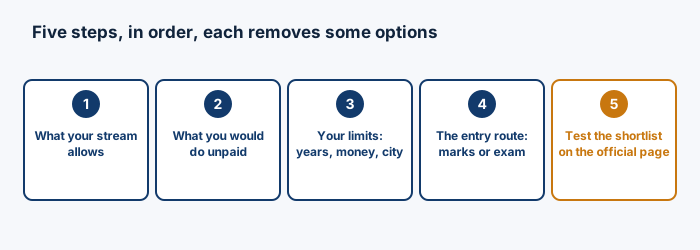
- List what your stream allows. Science with maths, science with biology, commerce and arts open different doors. The table below gives the broad picture.
- Name three things you could do for hours without being paid. Reading, building, persuading, counting, helping: the course should use at least one.
- Set your limits. How many years can your family fund before you earn full-time, and in which city can you study?
- Check the entry route. Is it marks, an entrance test or a university test? Find the date and the syllabus.
- Test the shortlist. Talk to someone doing the job, read the official eligibility page, and ask what the first two years look like.
Which course suits which stream?
Streams narrow the list but do not decide it. Use the table as a map, then open the stream guide for the full list.
| Stream | Doors that usually need your subjects | Doors open to most streams | Go deeper |
|---|---|---|---|
| Science (maths) | Engineering and architecture, through entrance tests such as JEE Main, run by NTA | Management, law, design, B.Com in many colleges, CA/CS/CMA, hotel management | Courses after 12th science |
| Science (biology) | Medicine and allied health, through NEET (UG), run by NTA | As above | Same science guide, NEET (UG) section |
| Commerce | Some economics and quantitative degrees expect maths | B.Com, BBA, CA, CS, CMA, law, hotel management | Courses after 12th commerce |
| Arts and humanities | Few; some programmes want a specific subject | BA programmes, law, design, mass communication, management, CS, CMA | Courses after 12th arts |
Exams for many of these routes are listed on the NTA website, and undergraduate admission to many central universities runs through CUET (UG). The 2026 CUET (UG) examinations began in May 2026, and at the time of checking the site showed no 2027 bulletin, so watch it. Subject rules for each course are set by the university, so read its own bulletin.
Which entrance route does each choice use?
Many choices hinge on one test rather than your Class 12 percentage, so learn the route before the college. The exact subject and age rules sit in each exam’s own bulletin, which changes yearly.
| If you are considering | Route | Run by |
|---|---|---|
| Engineering (B.E./B.Tech) | JEE (Main), Paper 1 | NTA |
| Medicine and allied courses that use it | NEET (UG) | NTA |
| Many central university BA, B.Sc and B.Com seats | CUET (UG) | NTA |
| Law at National Law Universities | CLAT | Consortium of NLUs |
| Chartered accountancy, cost accountancy | Registration with the institute, then its own exams | ICAI, ICMAI |
If your marks or stream do not fit a route, that is not the end. The specialist guides cover the alternatives: medical courses after 12th and paramedical courses after 12th for health, and engineering courses after 12th for technical branches.
What do your Class 12 marks actually change?
Marks decide which doors are open, not which one you should walk through. Some programmes set a minimum percentage for eligibility, some admit on entrance score alone, and some use both. So read the eligibility line for each shortlisted course, then ask what you can reach with a realistic score. Prepare a safe option, a target option and a stretch option instead of one choice, and keep the entrance test dates for all three in one list.
Is a degree always the right answer?
No, but it is the safest default. A degree is the eligibility ticket for postgraduate study, many private employers and government exams that require graduates. UGC’s Curriculum and Credit Framework for Undergraduate Programmes allows three-year and four-year undergraduate structures (UGC), so check how long a given university’s programme runs. The same framework describes multiple exit points. A student can leave with a UG certificate after one year, a UG diploma after two years, or a bachelor’s degree after three. The four-year programme is the preferred option. Whether a particular university has adopted these exits is its own call, so ask before you enrol.
Non-degree routes can still make sense. Professional bodies let you start early: ICAI and ICMAI both allow registration for the Foundation course after Class 10 (ICAI, ICMAI), and skill courses can lead to a first job quickly. The best plans often combine a degree with one of those.
What if you picked the wrong stream?
It is less final than it feels. Several routes accept any stream: management programmes, law through CLAT (CLAT 2027 eligibility), design, mass communication and the professional accounting courses. The routes that do need specific subjects are mostly medicine and engineering. If the doubt began earlier, which stream after 10th explains how to avoid it next time.
How do you compare two courses fairly?
Use the same five facts for each.
| Fact | What to find | Where to look |
|---|---|---|
| Entry | Marks or an entrance test, and the date | The exam body’s official site, such as the NTA website above |
| Length | Years to a first job or a licence | The awarding body or university |
| Cost | Fees | The college prospectus or official body, not a blog |
| First two years | What the work or study looks like | Someone doing the job, or the syllabus |
| Recognition | Who awards it | Online degrees: the UGC Distance Education Bureau lists. Short courses: the National Qualifications Register |
Which mistakes make students regret a choice?
- Choosing by a salary figure with no source. Ask who collected it, for which year and for whom.
- Choosing the college before the course. A strong course at an average college often beats the reverse, so settle the course first.
- Skipping the recognition check. Confirm who awards the qualification before paying a fee.
- Counting only the first year’s cost. Add every year plus hostel, travel and exam fees.
- Copying friends. Their interests, marks and budget are not yours.
- Having no second option. If one entrance test goes badly, a prepared plan B saves a year.
When should you do what?
A simple order works for most students. During Class 12, list your stream’s options and the entrance tests with their official dates. Before results, finish the shortlist and the documents you will need. After results, apply to your safe, target and stretch options together, and compare offers on the five facts above. Entrance and admission calendars differ by exam and university, so use the official sites for dates.
How do you pay for it?
Look at government scholarships before loans. The National Scholarship Portal handles student registration and applications, including the PM-USP central sector scheme for college and university students at the time of checking. Eligibility depends on the scheme and the year, so read its notice. Avoid paying anyone to “guarantee” a scholarship or seat.
What about salary?
Treat salary as a reason to compare, not to decide. Official placement data exists for few routes. ICAI’s 64th campus placement programme (April to May 2026) reported an average package of Rs 13.30 lakh and a highest offer of Rs 27.50 lakh (ICAI Placement Directorate). That is for newly qualified CAs in a campus programme. Most course pages quote numbers with no source. For commerce, high-salary courses after 12th commerce shows how to read them, and for science see high-salary courses after 12th science.
Is a government job a good plan after 12th?
It can be, with a plan B. Some posts are open after Class 12, such as those filled through the SSC’s CHSL examination, and others require a degree. The notice for each post sets the rule, so read it on the SSC website. Many students prepare for a government exam while studying a degree, which keeps both doors open. The full list of posts and routes is in government jobs after 12th.
When does it help to talk to a counsellor?
When two good options look equal, when family and student disagree, or when you do not know where to begin. A counsellor cannot choose for you, but can help you test the shortlist against your marks, money and interests. NIMB’s career counselling is online and covers every stream.
Frequently asked questions
Which course is best after 12th?
No single course is best. Choose within the doors your stream opens, then by interest, finances and how long you can study before earning. The method above does this in five steps.
Which course after 12th has the highest salary?
That depends on the route, employer and experience, and few routes have official pay data. Treat any single “highest salary” claim with caution and look for a named source and year.
Which short courses are good after 12th?
Choose a skill tied to a job you can name, such as accounting software, GST, Excel or computer basics, and check who awards the certificate. Short courses work best alongside a degree.
Can I change stream or course after 12th?
You can change course before or early in a degree, but each college has its own rules. Some routes, such as medicine, need specific Class 12 subjects, so check before you commit.
Should I choose a course by my marks?
Marks matter for entry, since many programmes set minimum scores or cut-offs, but they should not be the only guide. Choose from the options your marks allow, using your interests.
How early should I decide?
Start in Class 12, before results, because entrance tests and applications open on their own timelines. Check dates on the official exam sites instead of waiting.
What if I do not clear NEET or JEE?
You have options, and it is common to plan for this. Other health and technical routes exist that do not use the same test, and a degree plus a skill is a sound fallback. Start with the paramedical and engineering guides linked above, and check each programme’s own entry rule.
Which course is best after 12th arts?
It depends on whether you want a degree-led, law, media or design path, since each uses a different entry route. The arts guide linked in the stream table compares them.
Which course is best after 12th for a government job?
Choose a degree your target exam accepts and read that exam’s notice for the rule. The government jobs guide above lists the routes.
How do I check that a course is recognised?
Check the awarding body: UGC lists for degrees and online degrees, and the National Qualifications Register for short skill qualifications. Both are linked in the comparison table.
Still deciding?
If you want a second opinion on your shortlist, book a session on the career counselling page or call or WhatsApp 9212008787. Disclosure: NIMB EDU sells online accounting and tax courses, which suit some commerce students and no one else.