NIMB EDU

To study medicine after 12th you need Physics, Chemistry and Biology (or Biotechnology) with English, plus a qualifying score in NEET (UG), which is the single entrance test for MBBS, BDS, BAMS, BUMS, BSMS and BHMS. Nursing, pharmacy and the allied health degrees are also “medical” careers, but each has its own regulator and its own entry rule, and some of them do not use NEET at all.
Most lists of medical courses mix all of this together and add unsourced fees and salaries. This guide sorts the courses by the one thing that decides your plan: the entrance route. Every rule below comes from the regulator or the exam body, checked on 17 October 2026. It is a child of courses after 12th science, which compares medicine with engineering, law and the rest. Allied health degrees, which changed a lot in 2026, have their own section below.
Which medical courses can you study after 12th?
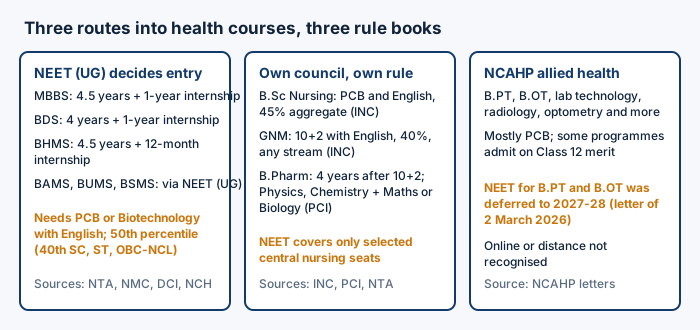
The table lists the main routes, how long each takes, and who sets the rules. The first four rows all use NEET (UG) as the entrance test.
| Course | Length (official source) | Entry | Regulator |
|---|---|---|---|
| MBBS | 4.5 academic years + 1 year compulsory rotating internship | NEET (UG) | National Medical Commission (NMC) |
| BDS (dentistry) | 4 academic years + 1 year paid rotating internship | NEET (UG) | Dental Council of India (DCI) |
| BAMS (Ayurveda), BUMS (Unani), BSMS (Siddha) | Check the college’s NCISM-approved scheme | NEET (UG) | NCISM |
| BHMS (Homoeopathy) | 4.5 years + 12-month internship | NEET (UG) | National Commission for Homoeopathy (NCH) |
| B.Sc Nursing | Four-year course | PCB with 45%; NEET only for selected central seats | Indian Nursing Council (INC) |
| B.Pharm | 4 years | State or university process | Pharmacy Council of India (PCI) |
| Physiotherapy (B.PT), lab technology, radiology, optometry and other allied degrees | Usually 4 years including a 1-year internship | PCB; NEET rules vary by programme and year | NCAHP |
What does NEET (UG) require?
NEET (UG) needs Physics, Chemistry and Biology or Biotechnology with English, age 17 by 31 December of the exam year, and a score at or above the 50th percentile for the general category. These are the 2026 rules from the NTA information bulletin (NTA, NEET (UG) 2026 information bulletin).
The exam in numbers
The 2026 paper had 180 multiple-choice questions for 720 marks over three hours: 45 each in Physics and Chemistry and 90 in Biology (Botany and Zoology). Biology therefore carries half the marks. The general-category fee in India was Rs 1,700, with lower fees for reserved categories (same bulletin).
Marking is +4 for a correct answer, minus 1 for a wrong one and zero for an unanswered question, so guessing across a whole section costs marks. The 2026 test was a single-day, single-shift paper-and-pen exam, offered in 13 mediums: English, Hindi, Assamese, Bengali, Gujarati, Kannada, Malayalam, Marathi, Odia, Punjabi, Tamil, Telugu and Urdu. The medium cannot be changed after you submit the form, and you choose three exam cities, with the centre allotted by computer. NMC notifies the syllabus, which NTA publishes in Appendix III of the bulletin.
Percentile, quotas and counselling
The qualifying mark is the 50th percentile for general candidates and the 40th percentile for SC, ST and OBC-NCL. For candidates with benchmark disabilities the bulletin sets the 45th percentile for the general category. Qualifying only makes you eligible; a seat depends on your rank. The bulletin separates the 15% All India Quota, handled by central counselling, from state-quota seats, which each state fills under its own rules and reservation policy.
Dates, and the 2026 re-examination
The 2026 cycle took applications from 8 February to 8 March, with the exam first set for 3 May 2026. NTA’s site also shows a NEET (UG) 2026 re-examination held on 21 June 2026 (NTA NEET portal). We found no NEET (UG) 2027 bulletin on NTA’s sites. When it is published it replaces everything above, so read it before you apply and ignore any “expected date” on a coaching blog.
How do you become a doctor after 12th, step by step?
The route has six steps, and the bulletin and counselling authorities, not coaching centres, control each one.
- Class 12 with Physics, Chemistry and Biology (or Biotechnology) and English. If you are still in Class 12, select the “appearing” code in the application.
- Register and apply on the NTA NEET portal. The form asks for Class 10 and 12 details, an APAAR ID, three exam-city choices, the question-paper medium, a live photograph and your signature. Take 6 to 8 passport photographs, because the same photograph is used for the exam and for counselling (NTA bulletin).
- Sit NEET (UG) and check your All India Rank. NTA’s job ends with the rank; it does not allot seats.
- Register for counselling. For All India Quota seats and central institutions, register on the MCC website (mcc.nic.in). For state-quota seats, register with your state’s counselling authority. For BAMS, BUMS, BSMS and BHMS, the All-India Ayush Central Counselling Committee (AACCC) runs the all-India quota.
- Fill choices, take a seat and complete document verification. Certificates for category, EWS or disability are verified at counselling, not by NTA.
- Join, study, then complete the internship and register with the regulator.
Who runs NEET counselling, and how do quotas and reservation work?
Two kinds of counselling run in parallel: central (MCC) and state. Under the NEET bulletin, MCC counsels for the 15% All India Quota seats of government medical colleges and for seats at AIIMS, JIPMER, central universities (Delhi University, BHU, AMU), ESIC medical colleges, PGIMER and deemed universities. States and Union Territories counsel for the rest, including private colleges, under their own notifications and reservation laws. AFMC Pune is separate: MCC only registers candidates, and AFMC runs its own screening and allotment.
For counselling conducted by MCC, the bulletin lists these reservations: 10% of seats for EWS, 27% for OBC-NCL (central list only), 15% for SC and 7.5% for ST, plus 5% horizontal reservation for persons with benchmark disabilities in each category. For state-quota seats the state’s own policy applies, which is why the same rank can mean different outcomes in different states. Admission within each category is on All India Rank alone.
The seat-blocking rule (Regulation 5A(4) of the Graduate Medical Education Regulations, 1997) can make you ineligible for later rounds if you take a seat in an earlier one and do not join. Read the MCC or state counselling scheme before you accept a round-one seat you do not intend to keep.
Which institutions rank highest for medicine and dentistry?
The Ministry of Education’s NIRF 2025 lists these institutions highest. The list is a ranking by teaching, research, outcomes and perception, not a promise of a seat, a fee or a placement, and the medical category also includes postgraduate-only institutes such as PGIMER and SGPGIMS, which do not admit students straight after 12th (NIRF 2025 medical ranking, dental ranking).
| NIRF 2025 rank | Medical category | Dental category |
|---|---|---|
| 1 | AIIMS, New Delhi | AIIMS, New Delhi |
| 2 | PGIMER, Chandigarh (postgraduate) | Saveetha Institute of Medical and Technical Sciences, Chennai |
| 3 | Christian Medical College, Vellore | Maulana Azad Institute of Dental Sciences, Delhi |
| 4 | JIPMER, Puducherry | Dr. D. Y. Patil Vidyapeeth, Pune |
| 5 | SGPGIMS, Lucknow (postgraduate) | Manipal College of Dental Sciences |
| 6 | Banaras Hindu University, Varanasi | A.B. Shetty Memorial Institute of Dental Sciences, Mangaluru |
Treat the table as a starting point for research. A government seat in your own state, at a college recognised by NMC or DCI, is often a sounder choice than a distant private seat chosen only for its rank. NIRF 2026 results were not on the NIRF site when we checked on 20 October 2026.
What about veterinary science, physiotherapy and other health degrees?
Veterinary science (B.V.Sc and A.H.) sits under the Veterinary Council of India, not NMC. The NEET bulletin says NEET (UG) 2026 data is used for B.V.Sc and A.H. admissions under the VCI’s 15% quota in recognised veterinary colleges. Remaining seats follow state processes, so check your state university’s prospectus.
Physiotherapy, occupational therapy, lab technology and similar degrees are allied health courses with a different regulator, and their rules changed in 2026. They are explained in paramedical courses after 12th. If you are in Class 10 and wondering whether to choose Biology at all, start with which stream to choose after 10th.
What mistakes do students make with medical admissions?
- Assuming “qualified” means “admitted”. The 50th percentile only makes you eligible. Seats go by rank within category.
- Choosing the wrong medium. The bulletin says the medium cannot be changed later, and the English version is final if a translation is ambiguous.
- Photograph or identity mismatches. The live photograph is matched with the Aadhaar record, and candidates whose photo does not match must submit an attested certificate and photograph.
- Taking a round-one seat and abandoning it. The seat-blocking rule can bar you from later rounds.
- Paying an agent for a “management seat”. Pay fees only against an official allotment letter from the counselling authority.
- Having no fallback. Register for state counselling as well, and keep one non-NEET route open.
How long is MBBS, and what comes after?
MBBS takes four and a half academic years followed by one year of compulsory rotating internship, about five and a half years in all (NMC, CBME curriculum). The degree is the start, not the end. A doctor who wants to specialise takes a postgraduate course after that, so the time to a fully trained specialist is much longer than the headline figure.
Because the route is long and competitive, plan a second route from the first day: a nursing, pharmacy, allied health or B.Sc option that you would genuinely accept if the rank falls short. The high salary courses after 12th science guide explains why time to first earning matters as much as the course name.
Is BDS or an AYUSH degree a good alternative to MBBS?
They are separate professions with their own councils, not lesser versions of MBBS. All of them use the same NEET (UG) score, but each leads to a different registration and practice scope.
BDS: dentistry
The DCI’s course regulations set the undergraduate dental programme at four academic years of 240 teaching days each, plus one year of paid rotating internship in a dental college. The internship is compulsory, and the BDS degree is granted after it (DCI, BDS Course Regulations 2007). That is five years from admission to degree.
BAMS, BUMS, BSMS and BHMS
The NEET bulletin states that all seats in these four degrees are filled through NEET (UG). It requires 10+2 with Physics, Chemistry and Biology or Biotechnology, a minimum age of 17 on 31 December of the admission year, and the 50th percentile (NTA bulletin, Chapter 9). The Ministry of Ayush bodies, NCISM for Ayurveda, Unani and Siddha and NCH for Homoeopathy, write the course rules.
For BHMS, the NCH regulations add a marks rule: 50% taken together in Physics, Chemistry and Biology (40% for SC, ST and other backward classes). The programme is four and a half years across four professional phases, followed by a compulsory rotatory internship of twelve months (NCH, BHMS Regulations 2022). Check your state’s counselling notice for any extra domicile or marks condition.
Which medical courses do not need NEET?
Nursing, pharmacy and several allied health programmes can be reached without NEET, though the rule depends on the course and, for allied health, on the year. Never rely on a list that says “no NEET” without a date.
Nursing
The Indian Nursing Council lists 10+2 with Science (PCB) and English at 45% aggregate for B.Sc Nursing, and age 17 by 31 December. GNM (General Nursing and Midwifery) needs 10+2 with English and at least 40% from any recognised board, with Science preferred. ANM accepts 10+2 in Arts or Science with English (Indian Nursing Council). The NEET bulletin covers only selected central B.Sc Nursing seats and military nursing, so most nursing admission runs through state or university processes.
Pharmacy
The Pharmacy Council of India describes D.Pharm as a two-year course and B.Pharm as a four-year course after 10+2 (PCI FAQ). B.Pharm needs Physics and Chemistry plus Mathematics or Biology, so PCM students can enter it (PCI syllabus). A pharmacist registers with the State Pharmacy Council after passing the approved qualification.
Allied health degrees
Physiotherapy, medical lab technology, radiology and imaging, optometry, dialysis and similar degrees are regulated by NCAHP under the Act of 2021. Admission rules there moved in 2026: NCAHP deferred the NEET requirement for B.PT and B.OT to 2027-28, and several other curricula now admit on Class 12 merit. They get their own page, linked above.
What do the Class 12 rules look like side by side?
The subject and marks rules differ by regulator, so the same marksheet can open one route and close another. The table gives the rule each body publishes.
| Course | Class 12 subjects | Marks or score rule | Source |
|---|---|---|---|
| MBBS, BDS, BAMS, BUMS, BSMS | Physics, Chemistry, Biology or Biotechnology, with English | NEET (UG) at the 50th percentile (40th for SC, ST, OBC-NCL; 45th for general-category candidates with benchmark disabilities) | NTA bulletin 2026 |
| BHMS | Physics, Chemistry, Biology | 50% taken together (40% SC, ST and other backward classes), plus NEET (UG) | NCH Regulations 2022 |
| B.Sc Nursing | PCB and English | 45% aggregate | Indian Nursing Council |
| GNM | Any stream, with English (Science preferred) | 40% at the qualifying examination | Indian Nursing Council |
| B.Pharm | Physics, Chemistry, with Mathematics or Biology | Not stated in the PCI syllabus; follow the state or university rule | PCI syllabus |
How do you choose between medical courses?
Choose by the work you will do for the next thirty years, then by what your rank and budget allow. A short decision list:
- Want to treat patients as a physician or surgeon? MBBS. Accept that it is long and rank-dependent.
- Prefer oral health and procedures? BDS.
- Drawn to an Indian system of medicine? BAMS, BUMS, BSMS or BHMS, knowing the practice scope of each is set by its own commission.
- Want patient care with a shorter, predictable route? Nursing, with registration through INC and your state council.
- Interested in medicines, not clinics? Pharmacy.
- Interested in diagnostics or rehabilitation? An allied health degree.
Before paying any deposit, check that the college is approved by its regulator: NMC for MBBS, DCI for BDS, NCISM or NCH for the AYUSH degrees. Seats sold by agents outside official counselling are the commonest way families lose money in this field. If you are weighing medicine against other streams, the five-step method for choosing a course after 12th helps, and the full courses after 12th hub shows every route. Students who miss out can also read engineering courses after 12th if they studied Mathematics.
Frequently asked questions
Which medical courses are available after 12th?
MBBS, BDS, BAMS, BUMS, BSMS and BHMS through NEET (UG); B.Sc Nursing, GNM and ANM under the Indian Nursing Council’s rules; D.Pharm and B.Pharm under the Pharmacy Council of India; and allied health degrees under NCAHP.
Can I study medicine after 12th without NEET?
Not MBBS, BDS or the AYUSH degrees; the NEET bulletin makes NEET (UG) the route for all of them. Nursing, pharmacy and many allied health courses have different rules.
Can I do a medical course without Biology?
MBBS, BDS and AYUSH degrees need Biology or Biotechnology. B.Pharm accepts Mathematics instead. NEET allows you to study the missing subject as an additional subject after Class 12, with proof of passing.
What is the minimum NEET percentile?
The 50th percentile for general candidates, the 40th for SC, ST and OBC-NCL, and the 45th for general-category candidates with benchmark disabilities, per the NEET (UG) 2026 bulletin.
How long is MBBS?
Four and a half academic years plus one year of compulsory rotating internship, about five and a half years, per the NMC curriculum.
Is there an age limit for NEET?
You must be 17 by 31 December of the exam year. The 2026 bulletin sets no upper age limit.
Is nursing a medical course?
It is a health-care profession regulated by the Indian Nursing Council, not by NMC. B.Sc Nursing needs PCB with 45%; GNM needs only 10+2 with English and 40%.
Which is better, BDS or BAMS?
Neither is better in general. They are different professions with different councils and practice scope. Compare the work, the length and the college’s recognition.
Is there negative marking in NEET (UG)?
Yes. Each correct answer gives 4 marks, each wrong answer takes away 1 mark, and unanswered questions score zero (NEET 2026 bulletin).
Who conducts NEET counselling?
MCC under the Directorate General of Health Services runs counselling for the 15% All India Quota and central institutions. Each state runs counselling for its own state-quota and private seats, and AACCC runs the all-India quota for AYUSH degrees.
How many seats are reserved for OBC, SC and ST in NEET counselling?
In seats filled by MCC, 27% for OBC-NCL, 15% for SC, 7.5% for ST and 10% for EWS, with 5% horizontal reservation for persons with benchmark disabilities. State seats follow state rules.
Which is the top medical college in India?
In NIRF 2025, the Ministry of Education’s ranking, AIIMS New Delhi is first in both the medical and dental categories. Rankings do not guarantee a seat or suit every budget.
Can I take NEET in my mother tongue?
Yes. In 2026 the paper was available in 13 languages, including Hindi and 11 regional languages, chosen at the time of application.
Still deciding?
List your Class 12 subjects, your likely NEET rank band and what your family can fund for five or six years. Then pick one main route and one backup. For a second opinion on that shortlist, book career counselling or call 9212008787.