NIMB EDU

Chartered Accountancy is the only route after 12th commerce whose body publishes a dated, counted placement result: ICAI’s 64th campus placement programme (April to May 2026) reported an average package of Rs 13.30 lakh a year for newly qualified CAs, a highest offer of Rs 27.50 lakh and 2,570 candidates offered jobs. For CS, CMA, ACCA, CFA, actuarial science, BBA, B.Com and law, no comparable dataset exists, so any single “average salary” you see for them is an estimate.
That matters because “high salary courses after 12th commerce” pages mostly print confident numbers with no source and no year. This guide does something more useful: it ranks the routes by how strong the pay evidence is, shows what drives pay up, and gives you a checklist for judging any figure. It is a child of the full list of courses after 12th commerce, so for the list itself go there, and for choosing between routes go to which course is best after 12th commerce. Sources were re-opened between 18 and 23 October 2026; the CMA, CS and accountant pay figures repeat the sibling salary guides, which read their sources on 17 or 18 October 2026.
Which courses after 12th commerce have real salary evidence?
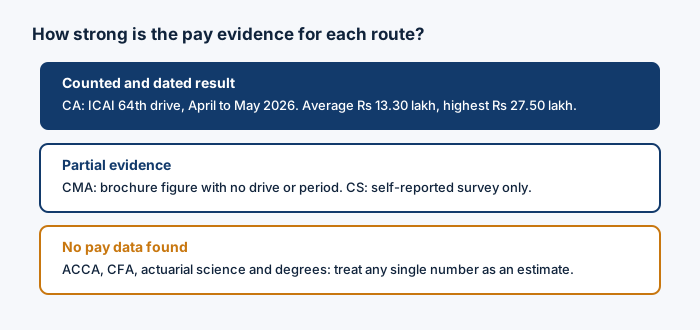
Only CA has a counted, dated placement result, so rank routes by evidence first and by pay second. The table shows what is measured for each route and what to be careful about.
| Route | Official pay data? | What exists | The catch |
|---|---|---|---|
| CA (ICAI) | Yes, from campus placement | Average package Rs 13.30 lakh, highest offer Rs 27.50 lakh (ICAI 64th campus placement programme, April to May 2026) | Counts newly qualified CAs who took part in the placement programme only; qualifying takes years, and the figure says nothing about those who stop earlier |
| CS (ICSI) | No ICSI figure we could verify | A self-reported survey only: typical Rs 11.1 to 12.3 lakh a year across 1 to 12 years of experience (AmbitionBox, about 25,000 salaries, 16 October 2026) | The survey counts people who chose to submit a salary; there is no official range to quote |
| CMA (ICMAI) | Partly: an institute brochure | ICMAI’s placement brochure for October to November 2026 prints an average CTC of Rs 12 to 14 lakh and a highest CTC of Rs 36 lakh | The figures carry no drive or period of their own and sit beneath charts headed 2018 to 2025; ICAI’s figures apply to CAs only |
| ACCA | None found | Structure and experience rules only | Pay depends heavily on country and employer |
| CFA | None found | Entry rules only | Not available straight after Class 12 |
| Actuarial science | None found | Exam route only | Pay tracks exams cleared, which takes years |
| BBA, IPM, B.Com | Per-institute only | Individual colleges publish their own placement reports | Reports are self-published; compare like with like |
| Skill courses (Tally, GST, Excel) | None found | Job descriptions only | Entry-level pay; grows with experience and added skills |
If you see a table listing “Rs 5-9 LPA” next to CA, CS and CMA with no source or data year, you are looking at an estimate. ICAI’s new scheme of education and training took effect on 1 July 2023 (ICAI announcement), so check that a page uses the current Foundation, Intermediate and Final stages.
How much does a chartered accountant earn after 12th commerce?
In its 64th campus placement programme (April to May 2026), ICAI reported an average package of Rs 13.30 lakh a year and a highest offer of Rs 27.50 lakh, with 2,570 candidates offered jobs (ICAI Placement Directorate). ICAI’s campus placement page says placements run twice a year.
Read those numbers carefully. They describe newly qualified CAs who took part in the campus placement programme. They do not describe a student halfway through Intermediate, and they do not describe every CA in practice. They also say nothing about how long it took each person to qualify.
The route behind the number is long: under ICAI’s current scheme you pass Foundation, Intermediate and Final, with two years of practical training (ICAI FAQ). For the salary at different stages and employers, see chartered accountant salary in India. For the route itself, see the CA course guide, and for costs, CA course fees.
What about CS, CMA, ACCA, CFA and actuarial science?
These can lead to well-paid work, but we found no counted, dated placement result for any of them, so we will not give you a number. The two partial sources, ICMAI’s brochure and a CS salary survey, are in the table below. What we can say from the official bodies is what each one asks of you.
- CS: the entry test, CSEET, is open to candidates who have passed or are appearing in 10+2, and was restructured from June 2026 into a centre-based test held three times a year, in the first week of February, June and October (ICSI). Graduates are exempt and go straight to the Executive programme. Pay tends to depend on company size and the quality of compliance work you handle.
- CMA: registration for Foundation needs a Class 10 pass, and Intermediate needs 10+2 plus Foundation, or a degree (ICMAI). The role is costing and management accounting, strongest in manufacturing and large finance teams.
- ACCA: 13 exams plus 36 months of relevant experience (ACCA). It helps most if you aim to work with multinational employers or abroad.
- CFA: a degree, a place within 23 months of graduating, or 4,000 hours of work or education are required to enrol (CFA Institute), so it is a plan for during a degree, not a Class 12 option.
- Actuarial science: open to Class 12 passers through ACET, with a 50% pass mark (Institute of Actuaries of India). Progress, and therefore pay, comes with each exam cleared.
Each of those routes is explained further in the full list linked at the top.
Where the pay evidence sits for each route
The table below summarises what exists, route by route, and points to the page that owns the detail. “Official” means the awarding body or a government notice published the figure.
| Route | Official pay data? | What exists | Detail |
|---|---|---|---|
| CA | Yes, campus placement | ICAI’s 64th drive (April to May 2026): average CTC Rs 13.30 lakh, highest Rs 27.50 lakh, 185 organisations registered and 2,570 candidates offered jobs, for newly qualified CAs | CA salary and CA fresher salary |
| CMA | Partly: an institute brochure | ICMAI’s placement brochure (October to November 2026) prints an average CTC of Rs 12 to 14 lakh and a highest CTC of Rs 36 lakh, with no drive, period or offer count of their own; the nearby charts are headed 2018 to 2025 | CMA salary |
| CS | No ICSI figure we could verify | Self-reported survey only: typical Rs 11.1 to 12.3 lakh a year across 1 to 12 years of experience, rising from Rs 5.5 to 6.1 lakh at 1 to 3 years to Rs 17.4 to 19.2 lakh at 12 years and above (AmbitionBox, about 25,000 salaries, updated 16 October 2026) | CS salary |
| Accountant roles | For central posts, a government pay level | Central government Accountant or Auditor posts sit at pay level 5, Rs 29,200 to 92,300 a month basic pay (SSC CGL 2026 notice, 21 May 2026); private pay is survey-based, typically Rs 3.4 to 3.8 lakh a year (AmbitionBox, about 2.3 lakh salaries, 16 October 2026) | accountant salary |
| ACCA, CFA, actuarial science | None found | Body pages describe the qualification, not pay | Treat any single number as an estimate |
| Degrees (B.Com, BBA, law, hotel management) | None found | Individual colleges publish placement reports; no national dataset | Ask each college for its report, year and count |
The pattern is the point. Pay is documented where a body runs placements for its own members, and undocumented almost everywhere else. A route with no data is not a route with low pay; it is a route where you cannot yet check the claim.
Do degrees like B.Com, BBA and law pay well?
A degree does not set a salary by itself; the college, the skills you add and the first employer do. A general B.Com opens the widest range of jobs and exams, but fresh graduates with no practical skill often start at the low end of whatever the employer pays. B.Com versus a practical accounting course shows why a skill changes the first job.
BBA and an integrated programme such as IIM Indore’s IPM, a five-year programme after Class 12, can lead to better-paid management roles, but results differ sharply by institute. Compare each college’s own placement report, and check how many students it covers. Integrated law at a national law university starts with CLAT (eligibility), and pay in law depends mostly on the firm or practice you join.
Which high-paying routes need maths, and which do not?
Most pages on this topic split the list into “with maths” and “without maths”. The entry rules are less tidy than that. The professional bodies do not make maths a condition of registration, while a few degrees and the actuarial route lean on it hard. The table uses the entry rules from the bodies themselves.
| Route | Maths needed to get in? | Where maths still shows up |
|---|---|---|
| CA | No. Foundation registration is open after Class 10 (ICAI) | Foundation has a Quantitative Aptitude paper on business mathematics, reasoning and statistics |
| CS | No. CSEET is open after Class 12 | Light; the weight is company law and compliance |
| CMA | No. Foundation needs a Class 10 pass (ICMAI) | Costing and management accounting involve calculation throughout |
| B.Com (Hons) at Delhi University | Either Mathematics or Accountancy in CUET (DU bulletin 2026-27) | Other universities set their own subject rules |
| Actuarial science | Open to Class 12 passers at the ACET stage (IAI) | The later exams are probability- and statistics-heavy |
| Integrated management (IPM) | The entrance test has a quantitative section (IIM Indore) | Quantitative reasoning decides the cut-off |
If you skipped maths, the high-paying routes with official placement data are still open to you. What changes is the preparation, not the door.
How many people clear the exams behind the top pay?
The highest figures in this guide belong to people who finished a hard qualification, so the pass rate matters as much as the package. For CA Final in May 2026, ICAI’s results release reported pass rates of 12% for Group I (54,606 appeared, 6,555 passed) and 20.49% for Group II (42,573 appeared, 8,725 passed). Candidates sitting both groups together passed at 14.07% (23,776 appeared, 3,345 passed). The results were declared on 18 June 2026 (ICAI press release). For scale, ICAI’s releases for the same session give 20.09% for CA Foundation and 8.47% for CA Intermediate with both groups together.
Read those numbers for what they are. They are one sitting, one level, and they count attempts rather than people, since a candidate can sit again. They show why a package average describes finishers, and why failing an attempt is normal rather than exceptional. Pass rates for Foundation and Intermediate are in the CA course guide, and the CA, CS, CMA and ACCA comparison sets the four bodies side by side. If you do not clear, not clearing CA: what next sets out the options.
What makes a commerce career pay more?
Five things move pay, listed here from most to least reliable.
- A credential the law or the industry requires. NISM runs the certification examinations for mutual fund distributors (NISM), and company audits are limited to chartered accountants under section 141 of the Companies Act (MCA). Where the paper is the permission, it is the clearest route to higher pay.
- A scarce skill used on real work. Tax, audit, financial modelling and payroll compliance pay more than bookkeeping once you can do them unsupervised.
- Employer and city. Large firms and metro offices usually pay more for the same title than a small firm in a smaller town.
- Years of experience. Pay grows with responsibility, and a first salary is rarely the one you keep.
- The degree itself. It matters for eligibility, but it rarely separates two candidates with the same skills.
How can you check a salary claim?
Run any figure through five questions. If two or more come back empty, treat the number as a guess.
- Does it name who measured it, such as a regulator, an institute or a survey?
- Does it give a year?
- Does it say whether it is a starting salary, an average or a top offer?
- Does it say who is counted, such as “qualified CAs in campus placement” or “all graduates”?
- Is the source independent of someone selling the course?
The ICAI figures above pass all five. A line like “CS earns Rs 5-8 LPA” with no source passes none.
What is the fastest route to a first full salary?
A degree plus a job skill, since you can study and work part-time sooner. A professional route gives a higher ceiling but delays full pay, because most of the training period is stipend-based. The table below compares only the structure of each route, not salary.
| Route | When pay starts | Main risk |
|---|---|---|
| Skill course alone | After weeks to months, in a junior role | Pay stalls without further study |
| Degree plus a skill | During or soon after the degree | The skill and the degree stay unconnected |
| CA | Training stipend during the two years of practical training; full pay after qualifying | Failed attempts lengthen the timeline |
| CS or CMA | Training stages; full pay after qualifying | Same: length depends on exam outcomes |
| ACCA | Depends on the job you hold while studying | Needs 36 months of experience before membership |
For a short course as a first step, read is a Tally course enough to get a job. If you took CA and it did not go as planned, not clearing CA: what next covers how to turn the years into a career.
Can you earn Rs 1 lakh a month after 12th commerce?
It is possible, but no course guarantees it, and the only route with official data reaches it after the full qualification, not after Class 12. Rs 1 lakh a month is Rs 12 lakh a year. ICAI’s reported average of Rs 13.30 lakh for newly qualified CAs works out to about Rs 1.1 lakh a month on a package basis, but a package (cost to company) is not take-home pay, and it applies only after Foundation, Intermediate, Final and two years of practical training.
For every other route here, a claim that you will earn Rs 1 lakh a month has no official dataset behind it. What you can control is the path: a qualification employers ask for by name, a skill that is scarce in your city, and a few years of experience. If you want the quickest income route rather than the highest ceiling, the section on the fastest route to a first full salary above covers it.
Why do other pages quote rounder, higher numbers?
In our read of the top search results on 17 October 2026, pages quoting ranges such as Rs 6 to 12 lakh for CA or Rs 5 to 8 lakh for CS gave no data year or source, and several were published by institutions that sell the courses. One widely read table lists the CA entrance as “CPT”, a name ICAI retired when its new scheme began in July 2023. Round ranges are easy to write and impossible to check, which is why this page prints only figures with a named source, a date and a description of who is counted.
Frequently asked questions
Which course after 12th commerce gives the highest salary?
CA has the best official evidence: an average package of Rs 13.30 lakh and a highest offer of Rs 27.50 lakh for newly qualified CAs in ICAI’s 64th campus placement programme (April to May 2026). Other routes can pay well, but no official dataset backs a number.
Is CA or CS better for salary?
We cannot give a verified comparison, since only CA has official placement figures. Choose by the work: CA for audit, tax and finance, CS for company law and governance.
What are the best high-salary courses after 12th commerce without maths?
CA, CS and CMA do not require maths for registration, and neither do B.Com, BBA and law. Pay in each depends on how far you take the qualification and where you work.
Can I earn well with a short course after 12th commerce?
A short course can get you a first job quickly, but entry-level pay is modest. Combining it with a degree or a professional route is what raises pay over time.
Is the Rs 13.30 lakh CA average guaranteed?
No. It is an average for newly qualified CAs in ICAI’s 64th campus placement programme, not a guarantee for anyone who starts the course.
Which commerce course has the best salary growth?
Routes that end in a regulated credential, such as CA, have the clearest growth, because the credential gates senior work. Growth in any route depends on skills and employer.
Is a degree needed for a high salary in commerce?
Not always, but it keeps doors open for postgraduate study, many private employers and government exams that need a degree.
Which commerce course is the toughest?
No official source ranks difficulty, and the bodies measure different things. For scale, ICAI reported a 14.07% pass rate for candidates sitting both CA Final groups together in May 2026, which is why CA is usually called the steepest route. Toughness also depends on you: the right test is whether you can stay with a long exam path.
How can I earn Rs 1 lakh a month after 12th commerce?
Rs 1 lakh a month is Rs 12 lakh a year. The only official benchmark is ICAI’s Rs 13.30 lakh average for newly qualified CAs, which needs the full qualification. For other routes, build toward it with a recognised credential, a scarce skill and experience, and do not trust a page that promises it without a source.
Do I need maths for the high-paying courses after 12th commerce?
Not to register for CA, CS or CMA, according to their bodies’ entry rules. Actuarial science and integrated management lean on maths, and B.Com (Hons) at Delhi University accepts either Mathematics or Accountancy in CUET.
Does B.Com (Hons) pay more than B.Com?
No national dataset compares them. The difference is in the course content and the admission route, and pay then depends on the college, the role and what you add through a skill or professional qualification.
Is BCA a high-paying option for commerce students?
No official pay data exists for BCA graduates either. Eligibility is set by each university, so check whether Class 12 maths is required before you assume it is open to you, and compare the college’s placement report.
Still deciding?
If salary is the deciding factor, say so and we will help you weigh it against effort and time. Book a session on the career counselling page or call or WhatsApp 9212008787.