NIMB EDU

After 12th arts (humanities) you can study a BA in dozens of subjects, law, journalism, design, teaching, fine and performing arts, or hospitality. You can also prepare for the civil services. Most doors are open to arts students; the few that are closed (engineering, MBBS) were never open to them, and a handful of others ask for a particular subject.
Most pages on this topic repeat the same list and attach a salary to each line with no source. This guide is organised by decision instead: which entrance exam each route needs, what the official body says about eligibility, and what a BA in Political Science or History leads to. It is part of the full guide to courses after 12th by stream. If you studied science or commerce, see courses after 12th science or courses after 12th commerce. Facts were checked on 17 October 2026.
Which courses can you study after 12th arts?
The main routes are the BA family, law, media, design, teaching, hospitality and the competitive-exam route. The table maps each to how you get in.
| Route | Typical degree | How you get in |
|---|---|---|
| General and honours arts | BA in History, Political Science, Sociology, Psychology, Geography, Economics, English and more | CUET (UG) at participating universities, or the university’s own process |
| Law | BA LLB (five-year integrated) | CLAT for the National Law Universities; other law tests for other colleges |
| Media | BA or BJMC in Journalism and Mass Communication | CUET (UG) has a Mass Media / Mass Communication test; some colleges have their own tests |
| Design | B.Des | UCEED for IIT-led and other participating programmes |
| Teaching | B.A. B.Ed. (ITEP, four-year) | NCET through NTA |
| Fine and performing arts | BFA, BA in music, dance, drama | CUET (UG) has Fine Arts and Performing Arts tests; many arts institutions hold auditions |
| Defence | NDA Army wing | UPSC exam; 12th pass is enough for the Army wing |
| Government clerical jobs | SSC CHSL (after Class 12) | SSC computer-based exam |
Is a BA still worth it, and how long is it?
A BA is worth it when you pair it with a clear next step: postgraduate study, a competitive exam, a professional degree or a practical skill. On its own, with no plan, it is a degree whose value depends heavily on what you do in years two and three.
UGC’s framework describes a three-year bachelor’s degree and a four-year honours or research degree, with exit points along the way (UGC, NHEQF). Ask any college which structure it uses. Check also that the university is recognised on the UGC website, since an unrecognised degree cannot be used for most exams and government jobs.
What does CUET (UG) offer arts students?
NTA’s CUET (UG) 2026 syllabus lists 37 tests: 13 languages, 23 domain subjects and one General Aptitude Test. The arts-side domain subjects are Anthropology, Economics, Fine Arts, Geography, History, Mass Media, Performing Arts, Political Science, Psychology, Sanskrit and Sociology, among others (CUET (UG) 2026 syllabus).
The subject you pick must match the programme at each participating university. A BA in Political Science at one university may ask for Political Science or History; another may ask for the General Aptitude Test. Read the university’s own CUET page before choosing.
Can arts students study law?
Yes, and law is the most prominent professional route out of the arts stream. The Consortium of NLUs’ CLAT 2027 page requires 10+2 with 45% marks (40% for SC, ST and PwD) and sets no upper age limit (CLAT 2027 eligibility). Students appearing for Class 12 in March or April can apply, but must show proof of passing at admission.
Note that the 10+2 stream does not matter for CLAT. That is why you will see commerce and science students in law classes too. The competition is for NLU seats, not for the right to apply. Other law colleges have their own tests, so read each college’s notice.
Which law schools rank highest on the official list?
The Ministry of Education’s NIRF (India Rankings) 2025 law category is the latest official list we could open on 17 October 2026; the 2026 edition had not been published yet. Its top ten are below. NIRF ranks institutions, not courses, and the list says nothing about which one suits you. Entry to the five-year BA LLB at the NLUs runs through CLAT; the other institutions on the list have their own admission routes, so read each one’s notice (NIRF 2025, Law).
| NIRF 2025 rank | Institution | City |
|---|---|---|
| 1 | National Law School of India University | Bengaluru |
| 2 | National Law University | New Delhi |
| 3 | Nalsar University of Law | Hyderabad |
| 4 | The West Bengal National University of Juridical Sciences | Kolkata |
| 5 | Gujarat National Law University | Gandhinagar |
| 6 | Indian Institute of Technology Kharagpur | Kharagpur |
| 7 | Symbiosis Law School | Pune |
| 8 | Jamia Millia Islamia | New Delhi |
| 9 | Aligarh Muslim University | Aligarh |
| 10 | Siksha ‘O’ Anusandhan | Bhubaneswar |
Can arts students do design, media or hotel management?
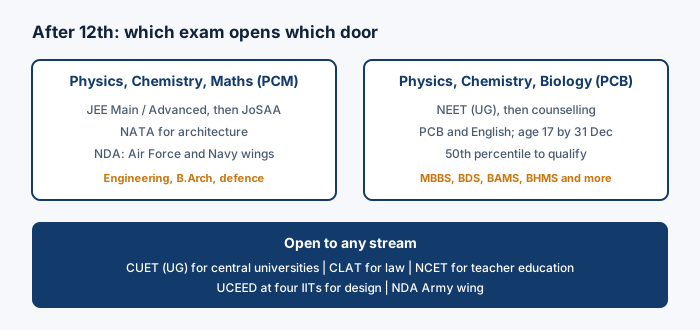
Design is open to all streams at several institutions. For the 2027 cycle, UCEED requires that you pass Class XII in 2026 or 2027. Candidates from any stream, including Arts and Humanities, can apply to IIT Bombay, IIT Delhi, IIT Hyderabad and IIT Indore. IIT Guwahati, IIT Roorkee and IIITDM Jabalpur ask for Physics, Chemistry and Mathematics (UCEED 2027 eligibility). Design rewards a portfolio and a way of seeing as much as marks.
Media and journalism are studied as a BA or BJMC, entered through CUET or the college’s own test. A degree helps, and a portfolio of published or produced work from the first year shows employers what you can do.
For hotel management, the National Council for Hotel Management and Catering Technology (NCHMCT) lists the B.Sc. in Hospitality and Hotel Administration as an academic programme admitted through NCHM JEE, and publishes the eligibility in an information document on its site (NCHMCT, NCHM JEE 2026 information). For the B.Sc. in Hospitality and Hotel Administration, the document asks for a pass in 10+2 or equivalent with English as one of the subjects, and it sets no age bar. Candidates still appearing in the qualifying exam can apply provisionally. No stream is named, so arts students are eligible; read it for the current cycle. For other hospitality, tourism and vocational degrees, check the awarding university and the recognition of the course, because admission rules and fees vary widely by institution.
Can arts students study B.Com, BBA or accounting?
Often yes, because the stream is rarely the barrier; the programme’s own rule is. CUET (UG) 2026 offers Accountancy / Book-Keeping, Business Studies and Economics as domain tests, and each university decides which of them a B.Com or BBA seat accepts. The Institute of Chartered Accountants of India lets candidates register for its Foundation course after passing Class 10 (ICAI FAQ on the new scheme). The commerce guides own the detail: which course is best after 12th commerce compares B.Com, BBA, CA, CS and CMA, diploma courses after 12th commerce covers the shorter accounting routes, and the CA course is covered in those guides. The commerce stream guide linked at the top of this page lists the rest.
Can arts students become teachers?
Yes. NCTE launched the four-year Integrated Teacher Education Programme in 57 institutions from the 2023-24 session, offering B.A. B.Ed. alongside B.Sc. B.Ed. and B.Com. B.Ed., with admission through NTA’s NCET (PIB, ITEP launch). The route saves a year compared with a separate degree plus B.Ed, in the Ministry’s words. Check the current NCET bulletin for the marks rule and participating institutions, which change each year.
What if you take a BA first and teach later?
ITEP is not the only road. Many arts graduates add a B.Ed after the BA. For school teaching, the Central Teacher Eligibility Test (CTET) is the national eligibility test. Its site says a teacher eligibility test is an essential qualification for appointment as a teacher of Classes I to VIII under the Right to Education Act, citing NCTE notifications. The 22nd CTET was scheduled for September 2026, so read the CBSE notice for the eligibility and dates of the next one (CTET, CBSE). Many states run their own TETs too.
Can arts students go into government jobs?
Yes, in two ways: jobs open after Class 12, and jobs open after graduation. Which one you aim for changes what you study.
After Class 12: SSC CHSL and the NDA
The SSC’s Combined Higher Secondary Level examination for 2026 sets the essential qualification as 12th standard pass or equivalent for LDC/JSA posts and most DEO posts. But for DEO posts in a few ministries, it asks for a 12th pass in the Science stream with Mathematics. Pay is Level-2 (Rs 19,900-63,200) for LDC/JSA and Levels 4 and 5 for DEO posts (SSC CHSL 2026 notice). Those are scales set in the notice, not what you will receive in hand, since allowances and deductions vary by city.
The NDA’s Army wing asks only for a 12th class pass, and arts students are eligible; the Air Force and Navy wings need Physics, Chemistry and Mathematics (UPSC NDA notice, 2026 II).
After graduation: UPSC civil services
The UPSC civil services notice for 2026 requires a graduate degree from a university incorporated by an Act of Parliament or a state legislature, or an equivalent qualification. It sets an age range of 21 to 32 for general candidates (UPSC, Civil Services Examination 2026 notice). It does not name arts as a requirement. A BA in a subject you enjoy and can score in helps, but so does any other bachelor’s degree. If UPSC is your target, the choice of degree matters less than finishing it with good marks and starting preparation early.
The same notice sets out the structure. The examination has two stages: a Preliminary (objective) examination of two papers carrying 400 marks, and a Main examination of nine written papers, two of them qualifying only, followed by an interview of 275 marks. General-category candidates get six attempts, with more for SC, ST, OBC and PwBD candidates as the notice specifies. Optional subjects in the Main examination include several that arts students study at school and college, among them Anthropology, Philosophy, Political Science and International Relations, Psychology and Sociology. You choose the optional subject yourself, and it need not match your degree.
After graduation: SSC CGL
The Staff Selection Commission’s Combined Graduate Level Examination is the other large graduate-level route. The 2026 notice requires a bachelor’s degree from a recognised university for many posts, with extra subject conditions for specific ones (for example Statistics for statistical posts). The age band depends on the post, from 18-27 up to 18-32 as on 1 August 2026. Tier-I is a computer-based test with four sections of 25 questions each: General Intelligence and Reasoning, General Awareness, Quantitative Aptitude and English Comprehension. Applications for the 2026 cycle ran from 21 May to 22 June 2026 and have closed, so read the next notice for the new dates (SSC CGL 2026 notice). Quantitative Aptitude is part of Tier-I, so arts students should plan for it. For the full list of jobs by qualification, see our guide to government jobs after 12th.
What do arts graduates earn?
There is no official source that gives starting salary by arts degree, so we do not give one. What exists is national data on wage-earners as a whole. The Ministry of Statistics’ Periodic Labour Force Survey reports that average monthly earnings of regular wage or salaried workers were Rs 24,217 for men and Rs 18,353 for women in 2025. The report cautions that estimates may not be strictly comparable with earlier years (MoSPI, PLFS Annual Report 2025 press note). These are all-education averages, not an arts-specific figure.
The practical lesson: income in the arts stream comes less from the degree title than from the second layer on top of it, such as a law licence, a clear specialism, a portfolio, or a skill employers can test. Accounting is one such layer that arts students overlook. Courses after 12th without commerce explains how it works, and the online TallyPrime course is one starting point.
Can you learn something free alongside a BA?
Yes. SWAYAM, the Ministry of Education’s national online platform, hosts courses from Class 9 to post-graduation, with content produced by bodies such as UGC, NCERT, NIOS, IGNOU and AICTE. Courses are free to take; a certificate needs a registered, fee-based, proctored exam at a designated centre (SWAYAM, about). A completed course shows initiative on a CV, but check with your own university before assuming it earns credit.
What mistakes do arts students make after 12th?
- Picking CUET subjects before checking the programme. Each university sets which test it accepts for each BA. Read the university’s page first.
- Assuming UPSC wants an arts degree. The notice asks for a recognised graduate degree. Choose a subject you can score in.
- Treating every government clerical post as open. Some SSC CHSL data-entry posts need Science with Maths, and SSC CGL Tier-I tests Quantitative Aptitude.
- Trusting salary tables. Ranking pages we read quote different pay for the same course, usually without a source. No official body publishes pay by arts degree.
- Joining an unrecognised programme. Check the university on the UGC website (linked above) before paying any fee.
- Missing the Class 12 deadlines. CLAT lets you apply while appearing in March or April, and UCEED asks that you pass Class XII in 2026 or 2027 for the 2027 cycle.
How do you choose between arts routes?
Choose by asking what you want your first job to be, then work backwards to the degree and exam.
| If you want to | Think about | Key step |
|---|---|---|
| Argue cases or work in policy | Law (BA LLB) or a BA in Political Science or Economics | CLAT in Class 12; or CUET for the BA |
| Teach | ITEP (B.A. B.Ed.) or a BA followed by a B.Ed | NCET for ITEP |
| Work in media or communication | BJMC or BA with a portfolio | CUET Mass Media or college test |
| Design | B.Des | UCEED |
| Join government after school | SSC CHSL, NDA Army wing | Read the current notice |
| Join government after a degree | Any recognised BA, then UPSC or SSC graduate exams | Degree plus the exam syllabus |
| Get a quick, practical job | A skill course alongside the BA | Pick one skill and finish it |
If you cannot choose, the five-step method for choosing a course after 12th works for any stream. If you plan to study further after the BA, read courses after graduation.
Frequently asked questions
Which course is best after 12th arts?
It depends on your goal. Law suits students drawn to argument and public service, ITEP suits future teachers, and a BA suits those who will add an exam or a skill. Compare entry route and first job rather than relying on a ranking.
Which course after 12th arts has a high salary?
No official source ranks arts courses by salary. The fields most commonly linked to higher pay (law, design, media) reward experience and portfolio more than the degree name. Treat any single salary figure without a source and a year as unverified.
Can I become an IAS officer after 12th arts?
Yes, after a graduate degree. UPSC requires a bachelor’s degree from a recognised university and an age between 21 and 32 for general candidates in the 2026 notice. The stream you studied in Class 12 is not named as a condition.
Can arts students do B.Com or accounting?
Yes. Some colleges admit arts students to B.Com and accounting programmes, so read each programme’s eligibility line; short accounting courses need no commerce background. See courses after 12th without commerce.
Is CUET compulsory for arts degrees?
Not everywhere. Central and many other participating universities use CUET (UG), but state universities and colleges can use marks or their own process. Check each college’s notice.
Can arts students join the army after 12th?
Yes, through the Army wing of the NDA, which asks for a 12th class pass. The Air Force and Navy wings require Physics, Chemistry and Mathematics.
Are there government jobs after 12th arts?
Yes. The SSC’s CHSL 2026 notice shows clerical and data-entry posts with a 12th pass. A few data-entry posts need Science with Maths, so read the notice for the post you want.
How many attempts do I get at the UPSC civil services exam?
The 2026 notice allows six attempts to general-category candidates, with relaxation for SC, ST, OBC and PwBD candidates as set out in the notice. The age range is 21 to 32 for general candidates.
Which optional subjects can arts graduates take in UPSC?
The notice lists optional subjects including Anthropology, Philosophy, Political Science and International Relations, Psychology and Sociology. The choice is yours and need not match your degree.
Can arts graduates apply for SSC CGL?
Yes, for posts that ask for a bachelor’s degree in any subject. A few posts need Statistics or Mathematics, and Tier-I includes a Quantitative Aptitude section.
Are SWAYAM courses free?
Yes to learn; the certificate requires a fee-based proctored exam.
Which law colleges rank highest in India?
On the NIRF 2025 law list, the top five are NLSIU Bengaluru, NLU Delhi, NALSAR Hyderabad, WBNUJS Kolkata and GNLU Gandhinagar. Rankings are a starting point, not a verdict on fit.
Still deciding?
List the three routes that interest you most, the exam each needs and the date, then compare them against your marks and your family’s budget. If you would like a second opinion, book career counselling or call 9212008787.