Tax deducted at source produces three separate obligations, and people routinely meet one and miss the others. You must deduct at the right time, deposit what you deducted, and file a return reporting it. Each carries its own deadline and its own charge for lateness.
A note on sourcing before the numbers. The GST pages on this site quote the CBIC repository directly. The income tax department’s website refused every request made while this page was written, so the figures below are corroborated across several independent sources rather than taken from the primary one. They match long-standing provisions and we have no reason to doubt them — but confirm against the income tax portal before you rely on them for a filing, particularly the due dates, which are extended by notification more often than any other item here.
Which form applies
| Form | What it reports |
|---|---|
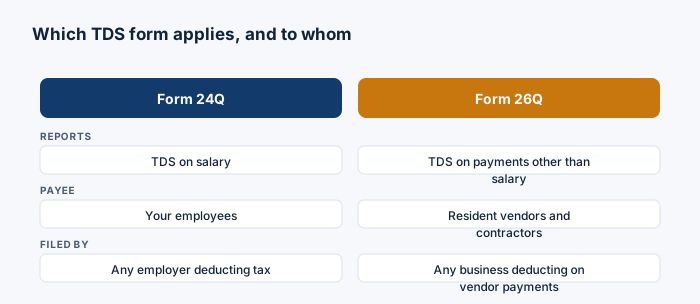
| 24Q | TDS on salary |
| 26Q | TDS on payments other than salary, to residents |
| 27Q | TDS on payments to non-residents |
| 27EQ | Tax collected at source |
Most businesses with employees and vendors file 24Q and 26Q every quarter. The others apply where the payee or the transaction type calls for them.
The two deadlines that are not the same
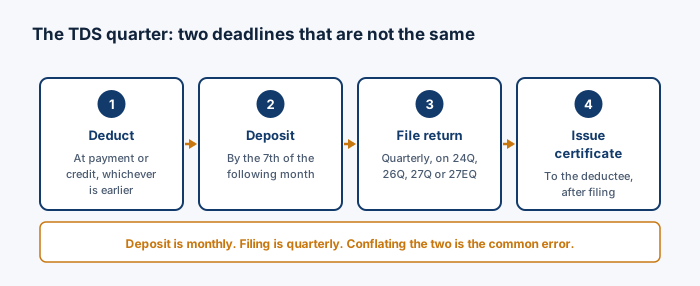
This is the distinction that causes most avoidable cost, because people conflate them.
Depositing the tax
Tax deducted must be deposited by the 7th of the following month, with deduction for March generally due by 30 April. Deposit is monthly.
Filing the return
The return is quarterly:
| Quarter | Period | Due date |
|---|---|---|
| Q1 | April to June | 31 July |
| Q2 | July to September | 31 October |
| Q3 | October to December | 31 January |
| Q4 | January to March | 31 May |
You can be fully paid up and still be late on the return, and the charges for that are separate from anything to do with the money.
The three charges
Section 234E — the late filing fee
Rs 200 per day for every day the return is late. It is a fee rather than a penalty, so it is not discretionary and there is nothing to argue about.
It is capped at the amount of TDS in the return. A return with Rs 50,000 of TDS filed 30 days late attracts Rs 6,000; the same return filed 400 days late attracts Rs 50,000 and stops there.
The cap is what makes this dangerous for small deductors. A quarter with Rs 4,000 of TDS reaches its cap in twenty days, after which the fee has stopped growing — and so has the pressure to file, which is how a single missed quarter turns into a year of them.
Section 271H — the penalty
A penalty of Rs 10,000 to Rs 1,00,000 for failure to file, or for filing incorrect particulars. Unlike the 234E fee this one is discretionary and is levied by an officer, and it sits on top of the fee rather than replacing it.
Note the second limb: incorrect particulars. A return filed on time with the wrong PAN against a deduction is exposed here, which is why the reconciliation below matters.
Section 201(1A) — interest
Two different rates for two different failures, and they are commonly confused:
- 1% per month where tax was deducted late — running from the date it should have been deducted to the date it was.
- 1.5% per month where tax was deducted on time but deposited late — running from deduction to payment.
Both are calculated per month or part of a month, so a single day into a new month costs a full month’s interest. Depositing on the 8th rather than the 7th is not a day late in interest terms.
Work out the TDS fee and interest
Section 234E fee Rs 200 a day, capped at the TDS in the return. Section 201(1A) interest 1% a month for late deduction and 1.5% for late deposit, charged per month or part of a month — so one day into a new month costs a whole month. Confirm on the income tax portal.
Why the wrong PAN is the expensive mistake
Everything above is about timing. This one is about accuracy, and it costs more.
Where a valid PAN is not furnished, tax is deductible at a higher rate under the provisions dealing with non-furnishing of PAN. Worse, a deduction reported against an incorrect PAN does not reach the deductee’s Form 26AS, so they cannot claim credit for tax you actually deducted from them — and they will, reasonably, come back to you about it.
Correcting it means a revised return. Validating PANs before filing takes minutes; the correction cycle takes weeks.
A working sequence each quarter
- Confirm every deduction in the quarter was made at the right rate and on the right date.
- Confirm each deposit was made by the 7th of the following month and that the challan details are to hand.
- Validate every PAN before the return is prepared, not after it is rejected.
- Prepare and file the return by the quarterly date.
- Download Form 16 or 16A from TRACES and issue them.
- Reconcile what the deductees see against what you filed.
Step 3 is where the money is. Everything else is calendar discipline.
The four forms, compared properly
The table above shows what each form reports. The distinction that actually matters when deciding which one to prepare is who files it and against what kind of payment, because that is where a deductor with a mixed set of payments goes wrong.
| Form | Who files it | Filed against | Certificate issued |
|---|---|---|---|
| 24Q | Any employer deducting tax on salary | Salary payments to employees, under Section 192 | Form 16 |
| 26Q | Any deductor paying a resident, other than salary | Interest, rent, professional fees, contractor payments, commission and similar payments to residents | Form 16A |
| 27Q | Any deductor paying a non-resident or a foreign company | Interest, royalty, fees for technical services and other payments to non-residents | Form 16A |
| 27EQ | Any seller or collector required to collect tax at source | Specified sale transactions where tax collection at source applies | Form 27D |
A business that pays both salaries and vendor invoices files two returns every quarter, not one. Treating 26Q as covering everything that is not salary is close enough for most small businesses, until a non-resident payment or a TCS-eligible sale appears. Those are the two categories people forget to check for.
A quarter worked end to end
The obligations read as a list of separate rules until you follow one payment through all four steps: deduct, deposit, file, issue the certificate.
The scenario. A company pays a consultant a monthly professional fee of Rs 60,000, with tax deducted at 10%. This is illustrative: confirm the current rate for the specific payment type on the income tax portal before applying it to a live case, since rates are changed by notification.
- Deduct. Each month the company deducts Rs 6,000, 10% of Rs 60,000, at the time the fee is credited or paid, whichever is earlier. Over April, May and June that is Rs 18,000 deducted across the quarter.
- Deposit. April’s Rs 6,000 is deposited by 7 May, May’s by 7 June, June’s by 7 July. Three separate challans, not one quarterly payment.
- File. Form 26Q for the April to June quarter is prepared showing the consultant’s PAN, the section code for professional fees, and all three months of deduction, then filed by 31 July.
- Issue the certificate. Form 16A for the quarter is generated from TRACES once the return is processed, and issued to the consultant, who needs it to claim credit for the Rs 18,000 already deducted from their income. The certificate deadline under the Income Tax Rules is 15 days from the due date for furnishing the return, which for this quarter is 15 August.
Miss the deposit date and Section 201(1A) interest starts running from the day after each due date. Miss the filing date and Section 234E starts running per day on the return as a whole. The two clocks run independently. That is why a business that pays everything on time can still owe a late fee, and why a business that deposits late every month but files on time avoids the fee but not the interest.
Correction statements: when a filed return has to be reopened
A revised, or correction, statement is needed whenever a return that was accepted still contains an error that affects a deductee’s record. That means a wrong PAN, an incorrect challan detail, an amount that does not match what was actually deducted, or a deductee row missing entirely.
The mechanism is narrower than re-filing from scratch. A correction statement references the token number, the acknowledgement number issued for the original return, and corrects only the fields that were wrong. It does not reopen deductions that were already correct.
The practical trigger is usually the deductee, not the deductor: someone checks their Form 26AS or Annual Information Statement, finds the credit missing or wrong, and asks why. If the answer is a wrong PAN or a wrong amount on the original return, a correction statement is the only way to get that credit to appear against their record. Filing it promptly matters more than filing it perfectly, because the deductee cannot act on their side until it is done, and this is generally handled through TRACES.
Related compliance
TDS sits alongside the other recurring filings. PF and ESI returns share the monthly rhythm and the statutory-deduction risk, and the GST return filing guide covers the indirect tax side. For how lateness is charged elsewhere, the GST late fee page makes the useful distinction between a capped fee and uncapped interest — the same shape of problem as Section 234E against Section 201(1A).
Frequently asked questions
Is the Rs 200 a day capped?
Yes, at the amount of TDS in that return. That cap is also why a small deductor can drift — once reached, lateness stops costing more under this head.
Can the late fee be waived?
The Section 234E fee is a fee rather than a penalty and is not generally waived on request. The Section 271H penalty is discretionary and is a different matter.
What if I deposited on time but filed late?
The 234E fee still applies. Deposit and return are separate obligations with separate deadlines.
What if I filed on time with a wrong PAN?
Correct it by revised return. The deductee cannot claim credit until you do, and incorrect particulars are exposed under Section 271H.
Where can I learn to handle this?
Direct and indirect taxation, including TDS, are covered in the Diploma in Taxation Law over three months.