Miss a GST deadline and two charges start running, not one. Most people budget for the daily late fee and are caught out by the interest. A third, higher rate exists for a narrower situation, and it is widely misdescribed.
This page works out the actual number, with the arithmetic shown, and explains where each figure comes from — because the figures most sites quote are not in the Act, and knowing why matters when they change.
The three charges, and which applies to you
They are cumulative. A late return with tax outstanding attracts both of the first two, and possibly the third.
| Charge | Rate | Applies when |
|---|---|---|
| Late fee | ₹50 per day, or ₹20 per day for a nil return | Any return filed after its due date |
| Interest | 18% per annum | Tax was outstanding |
| Higher-rate interest | Set by notification, ceiling of 24% | Input tax credit wrongly availed and utilised |
Why the daily fee is ₹50 when the Act says ₹100
This is the part almost every guide skips, and it is the thing that makes the rest make sense.
Section 47 sets the late fee at one hundred rupees for every day the failure continues, subject to a maximum of five thousand rupees. That is the statute. It has not been amended to say ₹50.
The figure you actually pay is lower because of Section 128, headed “Power to waive penalty or fee or both”. It lets the Government, on the Council’s recommendation, waive in part or in full any late fee referred to in Section 47, for a specified class of taxpayers.
So every reduced number quoted anywhere — the ₹50, the ₹20 for nil returns, the turnover-band caps below — is a waiver of the statutory amount, notified under Section 128. None of them are amendments to Section 47.
Two practical consequences follow:
- These numbers can move without the law changing. A waiver is withdrawn or revised by notification. The Act stays where it is.
- An amnesty is the same mechanism. The periodic schemes that let people clear old returns cheaply are Section 128 waivers with conditions attached, not special concessions outside the system.
If you take one thing from this page, take this: check the notification, not the section. The section tells you the ceiling. The notification tells you the price.
How the daily late fee works
It runs per day from the day after the due date until the day you file, and it accrues on each return separately. Two returns a month late are two late fees, not one.
The ₹50 is a combined figure: ₹25 under CGST and ₹25 under SGST. Sites quoting “₹25 per day” are quoting one half of it.
A nil return — no sales, no purchases, nothing to report — still attracts ₹20 per day if filed late. This is the most avoidable charge in the system, and it is the one small filers pay most often, because a month with no business feels like a month with nothing to do.
The cap depends on your turnover
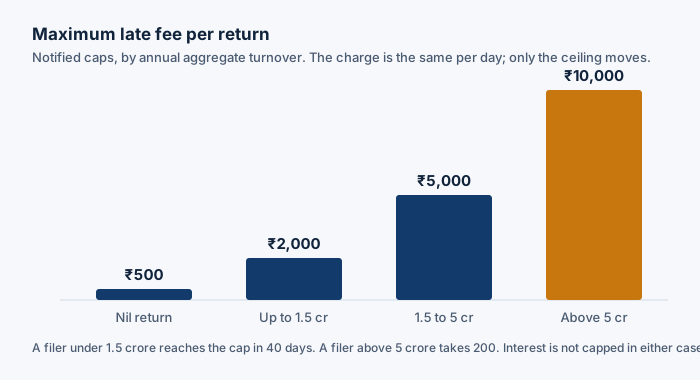
This is where most online calculators oversimplify. The maximum is not a single number — it scales with annual aggregate turnover. The bands below are notified waiver amounts, not figures in Section 47; confirm the current position on the GST portal before relying on them.
| Annual aggregate turnover | Maximum late fee per return |
|---|---|
| Nil return | ₹500 (₹250 CGST + ₹250 SGST) |
| Up to ₹1.5 crore | ₹2,000 |
| ₹1.5 crore to ₹5 crore | ₹5,000 |
| Above ₹5 crore | ₹10,000 (₹5,000 CGST + ₹5,000 SGST) |
Every figure in that table is the combined CGST plus SGST total, which is what you actually pay. The notifications state half of each amount under the CGST Act, and the matching state notification doubles it — so a table of “₹2,000” and a notification reading “₹1,000” are saying the same thing. This is the most common misreading of these caps.
The first three rows come from notifications 19/2021 and 20/2021-Central Tax, both dated 1 June 2021, covering GSTR-3B and GSTR-1 from the June 2021 period onward. The last row does not: neither notification has an above-₹5-crore slab, and the ₹10,000 is the ordinary statutory ceiling in Section 47(1) of the CGST Act, ₹5,000 per Act, that applies where no relief has been notified.
One more distinction worth holding on to: the nil-return concession is not the same test for both returns. For GSTR-3B it depends on the central tax payable in the return being nil, and a return whose output tax is fully offset by input tax credit is not nil for this purpose. For GSTR-1 it depends on there being no outward supplies at all in the period.
For a business under ₹1.5 crore the fee stops climbing after 40 days. Above ₹5 crore it runs for 200 days before it caps.
That difference decides what to prioritise. A small filer three months late has already hit the ceiling, so a further week costs nothing more in late fee — though the interest keeps running, which it does regardless.
Interest: how the rate is actually set
Interest is charged on the tax outstanding, not on turnover, and it runs from the due date until payment.
Section 50(1) provides for interest at “such rate, not exceeding eighteen per cent, as may be notified”. The rate itself is not in the Act. It sits in Notification 13/2017-Central Tax, which fixes 18% per annum for sub-section (1). That is the figure you calculate with — a notified rate under a statutory ceiling, not a number the section sets.
Section 50(3) covers a narrower case, and this is where most published guidance is out of date. The current text applies where input tax credit has been “wrongly availed and utilised” — both conditions, not either — at “such rate not exceeding twenty-four per cent”.
Two things follow, and both matter if you are working from older material.
- 24% is a ceiling, not a rate. The entry for sub-section (3) sits in the same Notification 13/2017-Central Tax as the 18%, and it has been amended since 2017. This page does not state a figure for it, because published sources disagree and the disagreement could not be settled against a primary source. Check the current text of that notification for the period you are dealing with.
- The trigger changed. The pre-2022 wording turned on excess credit claimed or output liability reduced, by reference to Sections 42(10) and 43(10). Those were omitted by the Finance Act 2022 and Section 50(3) was substituted with effect from 5 July 2022. Guidance still describing the old trigger is describing a provision that no longer exists.
The practical control is unchanged either way: credit that does not appear in your GSTR-2B should not be claimed. Reconciliation is what keeps you outside Section 50(3) altogether, which is why we treat it as the central task in GSTR-3B filing rather than as tidying up afterwards. The input tax credit rules set out when a claim is valid in the first place.
A worked example
Take a business with annual turnover of ₹2 crore. Its GSTR-3B for a month with ₹1,80,000 of tax outstanding is filed 45 days late.
Late fee
- ₹50 per day × 45 days = ₹2,250
- Turnover is in the ₹1.5–5 crore band, so the cap is ₹5,000
- ₹2,250 is below the cap, so the full amount applies: ₹2,250
Interest
- ₹1,80,000 × 18% × (45 ÷ 365)
- = ₹1,80,000 × 0.18 × 0.1233
- = ₹3,995 (3,994.52, rounded)
One qualification that changes this number for many filers: the proviso to Section 50(1) limits interest to the portion of the liability discharged by debiting the electronic cash ledger, where the return is filed after the due date and no proceedings have started under Section 73 or 74. Liability offset against input tax credit does not carry interest. The ₹1,80,000 above is the cash portion; if part of your liability is settled from credit, compute interest on the cash element only.
Total: ₹6,245
The late fee is capped; the interest is not. Past the cap, every further day of delay costs interest only — which is why filing late is always cheaper than filing later.
Work out what your late return costs
Late fee Rs 50 a day (Rs 20 for a nil return), capped by turnover. Interest 18% a year on the cash portion of the liability. All of these are notified amounts and change — confirm against the GST portal before you rely on the figure.
The annual return works differently
GSTR-9 is often described as costing “0.25% of turnover”. That inverts the provision.
Section 47(2) sets a late fee of one hundred rupees per day, “subject to a maximum of an amount calculated at a quarter per cent of his turnover in the State or Union territory”. SGST mirrors it. The charge is per day; the 0.25% is the ceiling that charge cannot exceed, not the fee itself.
From FY 2022-23 the amounts were reduced for smaller taxpayers by Notification 07/2023-Central Tax. For turnover up to ₹5 crore the late fee is ₹25 per day CGST plus ₹25 SGST, capped at 0.02% plus 0.02% of turnover in the State or Union territory.
For a business at ₹5 crore turnover that combined cap is 0.04% of ₹5,00,00,000, which is ₹20,000. A flat reading of the statutory ceiling — 0.25% under CGST plus 0.25% under SGST, so 0.5% combined — would suggest ₹2,50,000. The difference is an order of magnitude, and it is the most commonly repeated error about this return.
The deadline that is not a fee
Everything above is money. This one is not.
Section 39(11) bars a registered person from furnishing a return more than three years after its due date. It was inserted by the Finance Act 2023 with effect from 1 October 2023.
One qualification that most summaries drop: the sub-section carries a proviso letting the Government, on the Council’s recommendation, permit a person or class of persons to file even after the three years, subject to conditions. So the block is not absolute in the way it is usually described — but it is a discretion exercised by notification, not a right you can rely on.
Plan as though the bar is hard. A period that cannot be filed cannot be regularised. It stays on the record and surfaces during due diligence, loan applications and registration transfers, long after the tax itself would have been a manageable number. Of everything on this page, this is the one worth a calendar reminder.
How to keep the number at zero
Nothing here is complicated. It is a calendar problem more than a tax problem.
- File nil returns. Two minutes, and it removes the most avoidable fee in the system.
- File GSTR-1 before GSTR-3B. The outward liability in GSTR-3B is auto-populated from GSTR-1 and cannot be edited, so the filing order is structural, not a preference.
- Reconcile against GSTR-2B before claiming ITC. This is what keeps you outside Section 50(3) altogether.
- If you are already late, file anyway. The fee is capped; the interest is not.
Frequently asked questions
Is there a late fee if I had no sales?
Yes. A nil return filed late attracts ₹20 per day, capped at ₹500. Filing it on time takes about two minutes and costs nothing.
How is GST interest calculated?
Tax outstanding × 18% × days delayed ÷ 365. Interest runs on the portion discharged in cash, not on liability offset against input tax credit.
Why do different websites quote different late fee amounts?
Because the amount is a waiver under Section 128, notified from time to time, not a figure in Section 47. Sites quoting the statutory ₹100 per day, the waived ₹50, or a single CGST half of ₹25 are all describing the same charge at different points in the chain. Check the notification current for your period.
Does a higher rate of interest ever apply?
Section 50(3) allows a rate up to 24% where input tax credit was wrongly availed and utilised. Both limbs must be met. The operative rate is set by notification and should be checked for the period concerned.
Is the late fee capped?
Yes, and the cap scales with annual aggregate turnover — ₹2,000 up to ₹1.5 crore, ₹5,000 between ₹1.5 and ₹5 crore, and ₹10,000 above that. Interest is not capped.
Can a late fee be waived?
Section 128 gives the Government power to waive late fee under Section 47 by notification, for a specified class of taxpayers. That is the basis of the amnesty schemes announced periodically. It is not something an individual filer can apply for at will.
Where can I learn to handle this properly?
The GST Practitioner Course covers the full return cycle with real-time filing exercises over two months. Start with the complete filing guide for how the returns fit together.