GSTR-3B is the summary return where tax is actually paid. It is due on the 20th of the following month for monthly filers, and it is the return most changed by the 2025 rules.
If you learned GSTR-3B before mid-2025, the form now behaves differently in a way that matters.
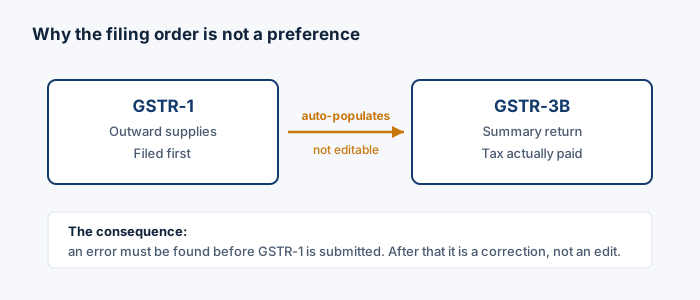
What is auto-populated and what is not
| Table | Contents | Editable? | Source |
|---|---|---|---|
| 3.1 / 3.2 | Outward supplies and liability | No | Your GSTR-1 |
| 4 | Input tax credit and reversals | Editable, with care | GSTR-2B |
| 5 | Nil-rated, exempt and non-GST inward supplies | Yes | Your records |
| 6.1 | Tax payment | Yes | Cash and credit ledgers |
Table 3.1 covers taxable supplies, zero-rated exports and SEZ supplies, nil and exempt supplies, and inward supplies liable to reverse charge, with taxable value and CGST, SGST or IGST against each.
Filing it, step by step
- File GSTR-1 first. Not a recommendation — Tables 3.1 and 3.2 will not populate correctly otherwise.
- Open GSTR-3B from the Returns Dashboard for the relevant period.
- Verify the auto-populated outward liability. You cannot edit it. If it is wrong, stop: the correction belongs in GSTR-1A, before this return is filed.
- Download GSTR-2B and reconcile. GSTR-2B lists the credit available based on what your suppliers actually filed. Match it against your purchase register line by line. Every difference is either a supplier who has not filed, an invoice you have not booked, or a genuine mismatch worth investigating.
- Complete Table 4. Enter eligible ITC and any reversals. Claiming credit that is not in GSTR-2B is the single most-scrutinised entry on this form.
- Complete Tables 5 and 6.1 — exempt inward supplies, then the tax payment, offsetting credit against liability.
- Pay any balance through the cash ledger, then submit with DSC or EVC.
Reconciliation is now the whole job
This is worth stating plainly, because it is the practical shift.
When Tables 3.1 and 3.2 were editable, a mismatch between GSTR-1 and GSTR-3B could be absorbed inside GSTR-3B. It cannot now. The outward figures arrive locked from upstream, and the ITC figures arrive from GSTR-2B, which reflects what your suppliers did rather than what you booked.
So the two reconciliations — sales register against GSTR-1, purchase register against GSTR-2B — are no longer housekeeping performed after the fact. They are the only points in the cycle where an error is still cheap to fix.
What late filing costs
- ₹50 per day, capped at ₹10,000.
- 18% per annum interest on outstanding tax. Section 50(1) permits “not exceeding eighteen per cent” and the operative rate is set by notification.
- A three-year hard limit. A GSTR-3B cannot be filed more than three years past its original due date. That tax period is then permanently blocked.
The daily fee is an irritation. The three-year block is not: a period that can never be filed cannot be regularised, and it stays on the record.
GSTR-1 vs GSTR-3B: how the two returns differ
GSTR-3B does not stand alone; it exists downstream of GSTR-1, and confusing what each one does is a common source of filing mistakes. The table below sets the two side by side.
| Aspect | GSTR-1 | GSTR-3B |
|---|---|---|
| What it reports | Outward supplies, invoice by invoice: B2B, B2C, exports, credit and debit notes | A consolidated summary of outward liability, input tax credit and the tax actually paid |
| Frequency | Monthly, or quarterly under QRMP with monthly IFF for B2B invoices | Monthly, or quarterly under QRMP |
| Due date | 11th of the following month (monthly); 13th after quarter-end (QRMP) | 20th of the following month (monthly); a staggered date by state grouping for QRMP filers |
| Editable after filing? | Not directly; corrections go through GSTR-1A before GSTR-3B is filed, or by amendment in a later period | Tables 3.1 and 3.2 are locked and non-editable since the July 2025 tax period; Table 4 (ITC) remains editable with care |
| Does it carry a payment? | No. GSTR-1 reports invoices; it does not settle tax | Yes. This is the return where cash and credit are actually applied against liability |
The row worth reading twice is the last one. GSTR-1 is a record of invoices with no payment attached to it; GSTR-3B is where cash actually moves. A business that files GSTR-1 on time and assumes the job is done has filed the record but not yet paid anything.
What if GSTR-1 and GSTR-3B do not match
Since the July 2025 tax period, the outward figures in Table 3.1 and 3.2 come directly from GSTR-1. So the classic mismatch, a different sales figure typed into GSTR-3B than what GSTR-1 actually reported, cannot happen for that specific pair of numbers anymore. It has been engineered out. What is left are mismatches that arise elsewhere in the same relationship.
The first is timing. If GSTR-1 has not been filed for the period, Tables 3.1 and 3.2 have nothing to pull from, and the return cannot be completed correctly. Filing GSTR-1 late does not just cost its own late fee; it stalls GSTR-3B behind it, which then risks a late fee for a separate reason.
The second is the QRMP quarter. A business filing IFF for months one and two of a quarter, then a consolidated GSTR-1 covering the full quarter, can find the quarterly GSTR-1 total does not obviously reconcile against three months of GSTR-3B activity. The reconciliation works only if the IFF figures are tracked separately from the final quarterly filing. The fix is to reconcile at the invoice level across all three months, not just compare quarter totals.
The third is amendment timing. An error caught after GSTR-3B has already been filed for a period is corrected by amendment in a later GSTR-1, not by rewriting the original. The correction then shows up in a different month’s numbers than the transaction actually belongs to, which looks like a mismatch to anyone comparing period by period without knowing an amendment happened.
Take a return where GSTR-1 reported Rs 40,000 tax collected but a historic GSTR-3B for the same period, filed before the July 2025 change when the outward tables were still editable, recorded only Rs 32,000 paid. The Rs 8,000 gap, plus interest for the period it stayed unpaid, is exactly the kind of difference this reconciliation exercise is built to catch, whether it surfaces through a department intimation or through a business’s own year-end review. Where a real gap between reported liability and paid tax turns up, the department’s system-driven reconciliation can generate an intimation asking the taxpayer to explain or pay the difference. That intimation has historically been issued as a DRC-01B-type intimation under the liability-mismatch rule. The mechanism and its current form reference are worth confirming against the GST portal or a recent CBIC circular rather than assumed, since this is an area the rules have actively developed. The practical response is the same regardless of the exact form: reconcile before responding, identify whether the gap is a timing difference or a genuine short-payment, and pay the shortfall with interest if it is the latter. That is better than disputing a system-generated notice that is, in most cases, arithmetically correct.
- Reconcile the sales register against filed GSTR-1 for the period before completing GSTR-3B, not after.
- For QRMP filers, track IFF figures for months one and two separately, then check them against the consolidated quarterly GSTR-1 rather than comparing quarter totals only.
- If an old period shows a mismatch, work out first whether it is a timing difference from an amendment landing in a later month, or a genuine short-payment, since the correct response differs.
- Respond to any system-generated intimation with figures reconciled in advance; most such notices are arithmetically grounded in data the department already holds.
The late fee is a waiver, not the full amount
Rs 50 per day, capped at Rs 10,000, is what businesses pay in practice, not what the law sets as the default. Section 47 fixes the late fee at Rs 100 per day under each Act, CGST and SGST or UTGST counted separately, capped against turnover in the state or union territory. The Rs 50 per day figure in everyday use is a partial waiver of that amount under the government’s power in Section 128, in force for as long as the current waiver notification remains in effect.
A waiver is not permanent by nature. If it is withdrawn or narrowed, the fee reverts toward the Section 47 figure unless a replacement waiver takes its place. The late fee page sets out the Section 47 baseline, the current Section 128 waiver, and the separate lower rate for nil returns; treat Rs 50 per day as today’s practice rather than a number fixed in the Act.
Frequently asked questions
Why can I not edit Table 3.1?
Since the July 2025 tax period the outward liability is auto-populated from GSTR-1 and non-editable. Corrections are made through GSTR-1A before GSTR-3B is filed.
Can I claim ITC that is not in GSTR-2B?
GSTR-2B reflects what your suppliers have filed, and it is what the department reconciles against. Claiming beyond it invites scrutiny and, more practically, the credit is usually recoverable by getting the supplier to file rather than by claiming anyway.
Do I file GSTR-3B if there were no transactions?
Yes, a nil return is required. Late fees apply to nil returns.
What happens if I miss the deadline by a few days?
₹50 per day plus 18% annual interest on any tax outstanding. Filing late is always cheaper than not filing.
What is the QRMP payment date?
QRMP taxpayers deposit tax monthly through PMT-06 by the 25th of the following month, even though the return itself is quarterly.
Where can I practise this properly?
The GST Practitioner Course runs two months and includes real-time filing exercises. See also how to file GSTR-1 and the complete filing cycle.