NIMB EDU

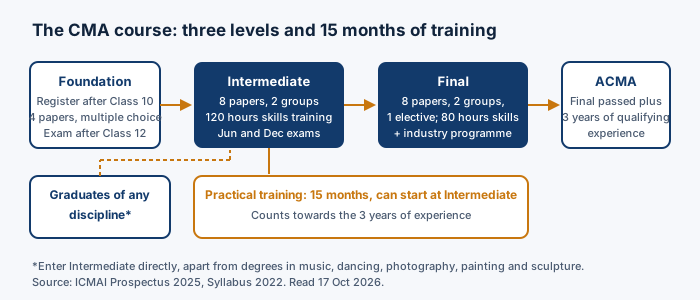
The CMA course is the Cost and Management Accountancy qualification run by the Institute of Cost Accountants of India (ICMAI). It has three levels, Foundation, Intermediate and Final, plus 15 months of practical training, and it ends with Associate membership (ACMA) after three years of qualifying experience.
This guide is built from ICMAI’s 2025 prospectus for Syllabus 2022 and its December 2026 exam notices, all read in October 2026. It covers the Indian CMA only, not the American “CMA” from the Institute of Management Accountants, which is a different credential. Costs are on CMA course fees, pay is on CMA salary in India, and the side-by-side with other qualifications is CA vs CS vs CMA vs ACCA.
What is the CMA course?
It is a professional qualification in cost and management accounting, run by a statutory body set up under the Cost and Works Accountants Act, 1959, which works under the Ministry of Corporate Affairs (ICMAI Prospectus 2025). Cost accounting looks at what products and services cost and how to control that cost, where financial accounting mostly reports what has already happened.
One legal point gives the qualification its edge. ICMAI says cost accountants are exclusively authorised to be appointed as cost auditors under Section 148(2) of the Companies Act, 2013 (ICMAI professional avenues). It also lists roles in industry, banking, government and independent practice.
What are the levels of the CMA course?
There are three levels. Foundation is the entry level, and Intermediate and Final have eight papers each in two groups, sixteen in all (ICMAI Prospectus 2025). Exams are held twice a year, in June and December.
| Level | Papers | Training attached |
|---|---|---|
| Foundation | 4 papers of 100 marks, multiple choice | Compulsory coaching |
| Intermediate | 8 papers in 2 groups of 4 | 120 hours of skills training; practical training can start here |
| Final | 8 papers in 2 groups, including one elective | 80 hours of skills training, an industry-oriented programme, 15 months of practical training |
Who is eligible for the CMA course?
You can register for Foundation after Class 10, take the Foundation exam after Class 12, or enter Intermediate directly as a graduate of any discipline. The stream you studied does not matter, and we found no minimum percentage for admission in the prospectus (ICMAI Prospectus 2025).
| Your position | Where you enter | What ICMAI requires |
|---|---|---|
| Passed Class 10 | Foundation admission | Class 10 pass; the exam needs Class 12 |
| Passed Class 12 | Foundation, then Intermediate | Pass the Foundation exam |
| Graduate of any discipline | Intermediate directly | Degree from a recognised university |
| Engineering student in the third year or sixth semester | Intermediate directly | Qualifying stage completed |
| ICAI Intermediate passed | Intermediate directly | Exempt from Foundation |
| Awaiting degree results | Intermediate, provisional | Convert to regular status within 18 months |
The prospectus excludes degrees in subjects such as music, dancing, photography, painting and sculpture.
How do you register for the CMA course, step by step?
You can register online at ICMAI’s student portal, or file the form at a Regional Council, chapter or accredited institution. Admission must be complete at least four months before the exam: 31 January for June and 31 July for December, at every level (ICMAI Prospectus 2025).
- Choose coaching mode (oral at a centre, or postal e-learning) when you register, because coaching is compulsory and the choice is made at admission.
- Fill the form and upload proof of qualification and age. Students from abroad send forms to the Kolkata Directorate of Studies only. A student who has appeared for a degree and awaits results can register provisionally: 36 months to convert at Foundation, 18 months at Intermediate, and the fees are forfeited if you do not submit the result in time.
- Pay the course fee by card or net banking on the student portal, or by challan at specified bank branches. Tuition is never collected in cash or as a demand draft.
- Get your number. Foundation gives an identification number valid for three years, and Intermediate gives a registration number valid for seven years.
To move from Intermediate to Final you enrol again, with your Intermediate pass mark sheet, by the same deadlines. Course fees are not refunded once admission is complete, but if ICMAI does not accept your registration the fee may be refunded less 10% for processing.
What do you study at each level?
Foundation tests basics, Intermediate tests application across eight subjects, and Final adds strategy, audit and a chosen elective. Every paper carries 100 marks, and the prospectus shows a percentage weight beside each section as a guide to study time and to how marks are spread in a paper (ICMAI Prospectus 2025, Syllabus 2022).
Foundation: four papers
| Paper | Sections and weight |
|---|---|
| 1. Fundamentals of Business Laws and Business Communication | Business Laws 80%; Business Communication 20% |
| 2. Fundamentals of Financial and Cost Accounting | Financial Accounting 70%; Cost Accounting 30% |
| 3. Fundamentals of Business Mathematics and Statistics | Business Mathematics 40%; Business Statistics 60% |
| 4. Fundamentals of Business Economics and Management | Business Economics 70%; Management 30% |
The December 2026 Foundation exam is OMR-based at a centre: 50 questions of 2 marks per paper, no negative marking, with papers 1 and 2 in the morning and papers 3 and 4 in the afternoon of the same day (ICMAI Foundation timetable).
Intermediate: eight papers in two groups
| Group and paper | Sections the syllabus lists |
|---|---|
| I, Paper 5: Business Laws and Ethics | Commercial Laws 30%; Industrial Laws 15%; Corporate Laws 40%; Business Ethics 15% |
| I, Paper 6: Financial Accounting | Accounting fundamentals; special transactions; preparation of financial statements; partnership accounting; lease, branch and departmental accounts; accounting standards |
| I, Paper 7: Direct and Indirect Taxation | Direct taxation; indirect taxation |
| I, Paper 8: Cost Accounting | Introduction to cost accounting; methods of costing; cost accounting techniques |
| II, Paper 9: Operations Management and Strategic Management | Operations management; strategic management |
| II, Paper 10: Corporate Accounting and Auditing | Corporate accounting; auditing |
| II, Paper 11: Financial Management and Business Data Analytics | Financial Management 80%; Business Data Analytics 20% |
| II, Paper 12: Management Accounting | Introduction; activity-based costing; decision-making tools; standard costing and variances; forecasting and budgetary control; divisional performance; responsibility accounting; decision theory |
Final: eight papers in two groups
| Group and paper | Sections the syllabus lists |
|---|---|
| III, Paper 13: Corporate and Economic Laws | Corporate Laws 60%; Economic Laws and Regulations 40% |
| III, Paper 14: Strategic Financial Management | Investment decisions; security analysis and portfolio management; financial risk management; international financial management; digital finance |
| III, Paper 15: Direct Tax Laws and International Taxation | Direct Tax Laws 60%; International Taxation 40% |
| III, Paper 16: Strategic Cost Management | Strategic cost management for decision making 60%; quantitative techniques in decision making 40% |
| IV, Paper 17: Cost and Management Audit | Cost audit; management audit; internal control and internal audit; forensic audit and anti-money laundering |
| IV, Paper 18: Corporate Financial Reporting | Indian Accounting Standards; valuation of shares; accounting for business combinations; consolidated statements; recent developments in financial reporting; government accounting in India |
| IV, Paper 19: Indirect Tax Laws and Practice | GST Act and rules; Customs Act and rules |
| IV, Paper 20: one elective | 20A Strategic Performance Management and Business Valuation (50% each); 20B Risk Management in Banking and Insurance (60% banking, 40% insurance); 20C Entrepreneurship and Start-up (eight sections) |
You pick the elective when you enrol for Final. Intermediate and Final candidates may answer in Hindi, but mixing Hindi and English in one script can lead to cancellation.
What is the exam pattern?
Foundation is a multiple-choice test, and Intermediate and Final are centre-based papers of 3 hours (10 a.m. to 1 p.m. for Final and 2 to 5 p.m. for Intermediate in December 2026, each group on alternate dates). Intermediate and Final results are due by 5 February 2027 and Foundation by 7 January 2027 (ICMAI timetable). Exams are offered at more than 100 centres across India and at Bahrain, Dubai and Muscat.
How are CMA exams passed?
In each group you need at least 40% in every paper and 50% in aggregate (Foundation applies the same rule to the whole exam). If you fail a group but score 60% or more in a paper, you are exempted from that paper in later sittings, and the benefit lasts for the next three terms (ICMAI Prospectus 2025). There is no exemption benefit in Foundation.
Registration for Intermediate and Final is valid for seven years, after which you need a “de novo” registration. To sit Final, you must have passed Intermediate before the immediately preceding term, so a December Intermediate pass does not let you sit the next June. The next sitting is December 2026, with Intermediate and Final papers from 10 to 17 December and Foundation on 13 December. The December forms closed on 10 October (Intermediate and Final) and 14 October (Foundation), and the late windows have also closed.
What exemptions can you claim?
There are three kinds, and the fees differ. The first is the 60% rule above. The second is corresponding exemption: if you passed a paper under the earlier 2016 syllabus, ICMAI maps it to the matching 2022 paper at no charge (for example, 2016 Paper 8 Cost Accounting maps to 2022 Paper 8). The third is paid exemption for a qualification you already hold, and you apply online at least 60 days before the exam.
| Qualification | Papers exempted | Fee per paper |
|---|---|---|
| Company Secretary (ICSI) | Intermediate Paper 7 (Direct and Indirect Taxation) and Paper 10 (Corporate Accounting and Auditing); Final Paper 13 (Corporate and Economic Laws), Paper 19 (Indirect Tax Laws and Practice) and Paper 20B (Risk Management in Banking and Insurance) | Rs 1,000 |
| LL.B. | Intermediate Paper 5 (Business Laws and Ethics) | Rs 3,000 |
| Engineer | Intermediate Paper 9 (Operations Management and Strategic Management) | Rs 3,000 |
Source: ICMAI Prospectus 2025. The prospectus adds that exemptions once given automatically for equivalent papers now need a separate application and fee under Syllabus 2022. The ICSI side of this arrangement, which exempts ICMAI Final passers from several CS papers, is in the CS course guide.
What training does the CMA course need?
You complete skills training, an industry-oriented programme and 15 months of practical training. Practical training can start as soon as you register for Intermediate, and ICMAI says around 15,000 companies are associated with it for practical training.
| Part | Length | What it covers |
|---|---|---|
| Skills training, Intermediate | 120 hours | ERP such as Tally or Zoho (40 hours, online), communication and soft skills (20, online), MS Office or Google Docs and Sheets (40, hybrid), e-filing (20, hybrid) |
| Skills training, Final | 80 hours | SAP, Oracle, MS Dynamics or another ERP (60 hours), business or data analytics (20, online) |
| Industry Oriented Training Programme (IOTP) | 10 days | 7 days of practical skills (finalising accounts, cost audit, taxation, company formation, working capital, project finance, risk, MIS reports, EHS) and 3 days of soft skills (interview, presentation, group discussion) |
| Practical training | 15 months | With a practising cost accountant, a corporate or another recognised body, in areas such as cost, financial and management accounting, audit, taxation, compliance and ERP |
The IOTP is compulsory before the Final exam form. The prospectus gives its length as 7 days in one place and 10 days in another, and its Annexure VI settles it: the programme is 10 days, made of a 7-day practical-skills module and a 3-day soft-skills module (ICMAI Prospectus 2025).
The rules of practical training
- Intimate ICMAI within 30 days. After you join an organisation or a practising cost accountant (PCMA), file Form T-1 (with UDIN) or Form T-4 online. A change of employer needs a new form and a Rs 1,000 fee, and no more than three changes are allowed within the 15 months.
- Complete it in time for Final. The prospectus requires 15 months of training before the result of your final group is declared. To be allowed to sit Final, you must show at least 10 months on the cut-off date: 31 August for the December exam and the end of February for the June exam, certified on Form T-5. That settles the two statements about timing that appear on different pages of the prospectus.
- Where it counts. Practising cost accountants and firms, government and public utilities, banks and insurers, PSUs, universities, co-operatives, NGOs and companies with a qualifying turnover (Rs 25 lakh for service sector, Rs 50 lakh otherwise). Time as an articled trainee in a CA or CS firm is not set off, unless the firm has a separate management-consultancy division in which you work exclusively, or you are its employee.
- Hours and leave. 35 hours a week, one day of paid leave a month, and up to 60 days of unpaid leave for ICMAI exams over the whole training. Excess leave extends the training.
- Trainee limits. A practising Associate can take 10 trainees and a practising Fellow 15.
- Exemption. If you already work in a recognised organisation and area, you can claim exemption on Form T-3 with a fee of Rs 4,500, and practising CAs and CSs are exempt in this way.
The stipend is set in the prospectus. A practising cost accountant must pay Rs 2,000, Rs 3,000 and Rs 4,000 a month in years one to three. Corporates and other organisations pay by city category, from Rs 15,000 to Rs 25,000 a month for Intermediate students and Rs 20,000 to Rs 30,000 for Final students, and Rs 37,000 to Rs 50,000 once you are Final-qualified. The corporate rates apply only if you train in a corporate and not with a practitioner. The prospectus says the corporate structure applies from 1 August 2024, and the city categories follow a government classification.
How does coaching and study material work?
Coaching is compulsory, and you choose one of two modes when you register: oral coaching at a Regional Council, chapter or recognised centre, or postal e-learning. Oral coaching runs 4 months with at least 240 lecture hours for each group (or for Foundation), each hour being 45 minutes. Both modes include ICMAI’s own study material, and foreign students may study by postal coaching only (ICMAI Prospectus 2025). Coaching clearance lasts for limited terms, and revalidation fees are on the fee page. Private coaching is optional, and ICMAI neither prices nor endorses it.
How long does the CMA course take?
ICMAI publishes no total duration. The building blocks are Foundation, Intermediate and Final, with 15 months of practical training that can run alongside Intermediate and Final study. Exams are held only twice a year, so each level takes at least one cycle, and failures add six months each.
This is our reading, not an ICMAI figure: a student who clears each level at the first sitting could finish in roughly three to four years from Class 12 and in about two to three years after graduation. Membership also needs three years of experience, which practical training counts towards.
What does the CMA course cost?
ICMAI’s course fees are Rs 6,000 for Foundation, Rs 23,100 for Intermediate and Rs 25,000 for Final. With exam fees and the Rs 2,500 practical-training registration, our addition of ICMAI’s figures comes to about Rs 64,100 from Foundation and Rs 56,600 for graduates entering at Intermediate, at first attempt and before GST. Instalments and other charges are in the fee guide.
How hard is the CMA course?
It is demanding, and the pass rates show it. In ICMAI’s press release for the June 2026 results, 23.93% of candidates who sat Intermediate Group I only passed, and 30.64% of those who sat Group II only. For Final, 30.22% of Group III-only candidates passed and 44.21% of Group IV-only candidates (ICMAI press release, June 2026).
| Level | Sat one group only: share who passed | Sat both groups: share who passed both | Completed the level this term |
|---|---|---|---|
| Intermediate | 23.93% (Group I), 30.64% (Group II) | 19.68% (2,144 of 10,897 candidates) | 7,885 |
| Final | 30.22% (Group III), 44.21% (Group IV) | 32.97% (1,430 of 4,337 candidates) | 4,220 |
“Completed” counts every candidate who finished the level on these results, including those clearing their second group after earlier terms. Pass rates change each term and are not a forecast for you, but about one in five candidates who sit both Intermediate groups together clears both.
How do you become a Cost Accountant (ACMA)?
You pass Final, show at least three years of qualifying practical experience, and apply for Associate membership. ICMAI’s rules count experience gained before or after passing Final, and the 15 months of practical training count towards the three years (ICMAI Prospectus 2025). You apply on Form M-2 with experience certificates attested by your employer, and the fee is a Rs 1,000 entrance fee plus a Rs 1,000 annual subscription.
| Experience | Minimum |
|---|---|
| Costing or industrial accounting in a responsible position in industry, commerce or government | 3 years |
| Banking, insurance or financial institutions (project analysis, feasibility, profitability) | 3 years |
| Full-time with a practising cost accountant | 3 years |
| Teaching costing or management accounting, full-time | 3 years (5 if part-time) |
| Part-time work with any organisation | 5 years |
An Associate can become a Fellow (FCMA) after five continuous years in practice, in a chief cost accountant or equivalent role, in qualifying government service or in teaching or consulting, and the periods can be combined (ICMAI 2025 guidelines). Time as a CA or CS articled trainee does not count. To practise independently you need a Certificate of Practice, applied for on Forms M-3, M-5 and M-6.
CMA calendar and common mistakes
| Date | What happens |
|---|---|
| 10 to 17 December 2026 | Intermediate and Final exams, each group on alternate dates |
| 13 December 2026 | Foundation exam, in two sessions |
| By 5 February 2027 | Intermediate and Final results |
| 31 January 2027 | Last date to register, enrol or pay the second instalment for the June 2027 term |
| 28 February 2027 | Cut-off for Form T-5 showing 10 months of training, for the June 2027 exam |
| 31 July 2027 | Same deadlines for the December 2027 term |
- Missing the second instalment. At Intermediate and Final the second instalment must be paid by 31 January (June) or 31 July (December) to be eligible for the exam.
- Sitting Final too early. You need to have passed Intermediate before the immediately preceding term, and to have 10 months of training certified on the cut-off date.
- Letting registration lapse. Intermediate and Final registration expires after seven years, and a de novo registration costs Rs 5,000.
- Skipping coaching or training. Both are conditions of the course, not extras.
How does CMA compare with CA and CS?
CMA focuses on cost and management accounting, CA on audit, tax and financial reporting, and CS on company law and governance. The institutes recognise each other’s qualifications: a CMA Final pass exempts you from the CS entrance test, and CS-qualified students can claim paper-wise exemption in CMA for Rs 1,000 a paper (ICMAI Prospectus 2025, ICSI announcement). The sister guides are the CA course and the CS course. In practical training, CMA asks for 15 months, against 21 months for CS and two years for CA.
Is the CMA course right for you?
CMA suits you if you like costing, budgeting and analysis, want to work in a manufacturing, services or finance team, or want to build a cost-audit practice. It suits you less if you want mainly statutory audit and income tax work, where CA is the usual licence. If you want a job within a year, look at shorter accounting courses first, and if you are unsure between routes, read which course is best after 12th commerce. NIMB EDU sells online courses in accounting and tax, and the CMA course is not one of them, so we have no stake in whether you choose it.
Frequently asked questions
Can I do CMA after 12th?
Yes. Register for Foundation after Class 10 or 12 and take the Foundation exam once you have passed Class 12. Any stream is eligible.
What is the eligibility for CMA after graduation?
Graduates of any discipline can register for Intermediate directly, apart from degrees in subjects such as music, dancing, painting and sculpture. Students awaiting results can register provisionally and have 18 months to submit them.
How many years is the CMA course?
ICMAI does not publish a total. Each level takes at least one exam cycle, and exams are held twice a year, so a first-attempt run is likely to take roughly three to four years from Class 12 by our estimate.
How many papers are there in CMA?
Four in Foundation, eight in Intermediate and eight in Final, which is sixteen in the two main levels. In Final you choose one of three electives.
What is the CMA exam pattern?
Foundation is multiple choice (50 questions of 2 marks per paper, no negative marking). Intermediate and Final are written 3-hour papers of 100 marks each, held at centres.
Is CMA India the same as US CMA?
No. This page covers the Indian CMA from ICMAI. The US CMA is a separate credential from the Institute of Management Accountants.
What is the passing percentage in CMA?
You need 40% in each paper and 50% in aggregate. In June 2026, ICMAI reported pass rates of 23.93% to 44.21% for candidates sitting one group, and 19.68% and 32.97% for those who sat both Intermediate and both Final groups and passed both.
Is practical training compulsory in CMA?
Yes. ICMAI requires 15 months of practical training, which can begin at Intermediate, along with skills training and a 10-day industry-oriented programme.
Does CMA have an exemption for CS or LL.B. holders?
Yes. Qualified CS holders can claim exemption in five papers for Rs 1,000 each, and LL.B. and engineering qualifiers in one paper each for Rs 3,000.
How can I become a Fellow of ICMAI (FCMA)?
After five continuous years in practice, a chief cost accountant role or another listed senior role as an Associate, on Form M-2. The periods can be combined.
Still deciding?
CMA is a long commitment, and the best time to ask whether it fits is before you register. If you would like help comparing CMA, CA, CS or a degree, talk to our counselling team. See career counselling, or call 9212008787 or message us on WhatsApp. You can also browse every option after 12th commerce.