NIMB EDU

ACCA, the Association of Chartered Certified Accountants, is a global accountancy qualification built from 13 exams across three levels, an ethics module and 36 months of supervised work experience. In India you can start after Class 12 with 65% in two subjects, including English and Maths or Accounts. ACCA is being redesigned from 2027, which affects anyone starting now.
This guide is built from ACCA’s own pages, read between 17 and 26 October 2026. It gives every exam with its format and latest pass rate, then entry, exemptions, sessions, experience, membership, the 2027 change and Indian recognition. Two questions have their own pages: what ACCA costs in rupees and how ACCA compares with CA, CS and CMA. If you are still choosing a stream, start from courses after 12th commerce.
What is the ACCA course?
ACCA is a professional accountancy qualification awarded by a UK-based global body. It is not an Indian degree and not an Indian licence to audit. It has three elements: exams, an Ethics and Professional Skills module, and a Practical Experience Requirement (ACCA qualification structure).
You register with ACCA directly, at any time of year, and study through a learning provider or on your own.
What are the ACCA levels and exams?
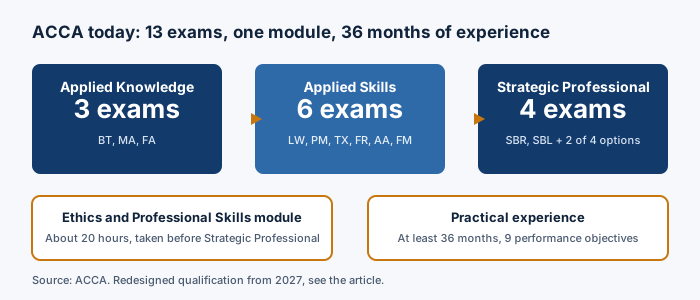
There are three exam levels and 13 exams in all. Applied Knowledge has 3, Applied Skills has 6, and Strategic Professional has 4 (two compulsory and two chosen from four).
| Level | Exams | Count |
|---|---|---|
| Applied Knowledge | Business and Technology (BT), Management Accounting (MA), Financial Accounting (FA) | 3 |
| Applied Skills | Corporate and Business Law (LW), Performance Management (PM), Taxation (TX), Financial Reporting (FR), Audit and Assurance (AA), Financial Management (FM) | 6 |
| Strategic Professional, essentials | Strategic Business Reporting (SBR), Strategic Business Leader (SBL) | 2 |
| Strategic Professional, options (choose two) | Advanced Financial Management (AFM), Advanced Performance Management (APM), Advanced Taxation (ATX), Advanced Audit and Assurance (AAA) | 2 |
| Ethics and Professional Skills Module | Online module of about 20 hours | Required |
The 20-hour figure is from ACCA’s note for current students. If you see 14 exams quoted, that is the 2027 structure with a Foundations level added; under the structure ACCA describes today, the count is 13.
What does each ACCA exam look like, and how many pass it?
Every ACCA exam has a 50% pass mark and is computer-based. Applied Knowledge exams last two hours, most Applied Skills exams three hours, and Strategic Professional exams three hours 15 minutes (ACCA Financial Reporting study guide 2026-27).
| Exam | Format (ACCA study guides) | Pass rate |
|---|---|---|
| BT, Business and Technology | 2 hours; 46 objective questions and six four-mark multi-task questions | 89% (June 2026) |
| MA, Management Accounting | 2 hours, computer-based | 65% (June 2026) |
| FA, Financial Accounting | 2 hours, computer-based | 71% (June 2026) |
| LW, Corporate and Business Law | 2 hours, objective test (English and Global versions) | 82% (June 2026) |
| TX, Taxation | 3 hours, objective and longer questions, 100 marks | 54% (September 2026) |
| FR, Financial Reporting | 3 hours: 15 two-mark questions, three five-question sets, two 20-mark written questions | 49% (September 2026) |
| PM, Performance Management | 3 hours, objective and longer questions, 100 marks | 42% (September 2026) |
| AA, Audit and Assurance | 3 hours, objective and longer questions, 100 marks | 45% (September 2026) |
| FM, Financial Management | 3 hours, objective and longer questions, 100 marks | 47% (September 2026) |
| SBR, Strategic Business Reporting | 3 hours 15 minutes, two sections, four professional-skills marks | 50% (September 2026) |
| SBL, Strategic Business Leader | 3 hours 15 minutes, closed-book case study; 80 technical and 20 professional-skills marks; pre-seen material two weeks earlier | 53% (September 2026) |
| AFM, Advanced Financial Management | 3 hours 15 minutes, two sections; 80 technical and 20 professional-skills marks | 47% (September 2026) |
| APM, Advanced Performance Management | Same format as the other options | 41% (September 2026) |
| ATX, Advanced Taxation | Same format as the other options | 53% (September 2026) |
| AAA, Advanced Audit and Assurance | Same format as the other options | 42% (September 2026) |
Pass rates are from ACCA’s pass-rates page; the BT format is from ACCA’s Business and Technology study guide. ACCA shows Applied Knowledge pass rates for the June and December sittings only, so those four figures are from June 2026. Its pass-rate page groups LW with Applied Knowledge, while its structure page puts LW in Applied Skills; the table follows the structure page.
What do the pass rates tell you?
The first three exams are passed by most candidates and the rest by roughly half. Across the four sittings from December 2025 to September 2026, each Applied Skills exam other than LW stayed between 40% and 55%, and each Strategic Professional exam between 38% and 53%. The lowest in September 2026 were Advanced Performance Management (41%), Performance Management (42%) and Advanced Audit and Assurance (42%).
A pass rate is per exam per sitting, so it does not say how many students finish. ICAI counts candidates who sit a whole group together, so the two are not comparable; the CA course guide gives those figures.
How and when are ACCA exams held?
Business and Technology, Management Accounting and Financial Accounting are on-demand: you book a computer-based exam centre, sit when you like, and see your result at the end of the exam, uploaded to your account within 72 hours. LW in its UK and Global versions is also on demand. The other exams are session exams in March, June, September and December, with results about six weeks later (ACCA: about our exams).
The full range of Applied Skills and Strategic Professional exams runs in June and December; only limited variants run in March and September (ACCA important dates).
| September 2026 | December 2026 | |
|---|---|---|
| Standard entry closes | 27 July 2026 | 2 November 2026 |
| Late entry closes | 3 August 2026 | 9 November 2026 |
| Exams | 7 to 11 September | 7 to 11 December |
| Results | 19 October | 18 January 2027 |
The December standard deadline is a week away as we write, and ACCA’s dates page did not yet show the 2027 sessions.
Who can do ACCA after Class 12 in India?
A Class 12 student qualifies for direct entry with passes in five subjects, including English and Mathematics or Accounts, with at least 65% in two subjects and over 50% in the others. For the general 10+2 and state-board certificates, at least three of the five subjects must be at Year XII level, and a Class 10 certificate alone is insufficient (ACCA minimum entrance requirements).
| Your position | Where you can start |
|---|---|
| Class 12 with 65% in two subjects including English and Maths or Accounts, over 50% in the rest | The ACCA Qualification, at Applied Knowledge |
| Below that, or Class 10 only | Foundations in Accountancy, ACCA’s route if you do not meet the minimum |
| Graduate or professional qualification | The ACCA Qualification, with exemptions if ACCA accepts your qualification |
You apply online with proof of identity, plus your qualification documents if you claim exemptions.
How does the ACCA exemption system work?
ACCA can exempt you from up to nine exams, all in Applied Knowledge and Applied Skills, if you hold a qualification it recognises. It awards none for Strategic Professional (ACCA exemptions FAQ).
What you get depends on your awarding institution, programme, modules and dates, so ACCA asks you to use its online exemptions calculator, which its FAQ links. We found no ACCA page that fixes a number of exemptions for an Indian B.Com as a class, so a promise of “up to nine exemptions with B.Com” is not ACCA’s. Students on an assessed course who have not yet graduated can claim conditional exemptions up to the Financial Management exam, converted when they submit proof of graduation. Each exemption carries a fee, so the benefit is saved study time; the amounts are in the the cost guide.
How long does ACCA take?
ACCA says students who work and study at the same time could qualify in as little as three or four years. There is no time limit on the Applied Knowledge and Applied Skills exams, but once you pass your first Strategic Professional exam you have seven years to pass the rest (How the ACCA Qualification works).
The experience runs alongside the exams, which is why a student who starts working early can finish in that range. A full-time student with no job will need to add the experience afterwards. ACCA publishes no average completion time, so we quote none.
How do the practical experience and membership work?
Passing the exams makes you an affiliate, not a member. To become a member you must also finish the Ethics and Professional Skills module and the practical experience requirement, and ACCA confirms all three before admitting you (ACCA: the next phase for affiliates).
- 36 months in a relevant accounting or finance role, signed off by a practical experience supervisor.
- Nine performance objectives: five Essentials and four Technical, recorded in ACCA’s MyExperience tool (ACCA: practical experience). The affiliate page also lets you claim an Approved Employer exemption from the objectives.
- Earlier experience counts if it is relevant and was supervised, with no fixed time limit, though ACCA advises considering whether work more than five years old is still relevant. Placements and internships done while studying can count (ACCA: PER FAQs).
- Your supervisor should ideally be your line manager and a qualified accountant recognised by law in your country or a member of an IFAC body. If your manager is not qualified, a second qualified person can co-sign the objectives.
After five consecutive years of membership, with fees paid and annual CPD declarations made, ACCA awards fellowship and the letters FCCA without an application. If you miss a renewal and are removed from the register, the five-year count restarts when you rejoin (ACCA: fellowship).
What is changing in 2027?
ACCA is replacing the current qualification with a redesigned one. New Foundations and Knowledge exams start in July 2027, and Expertise and Strategic Professional exams in September 2027. If you start now, you will probably cross over during your studies (ACCA: the future ACCA Qualification).
| Current | From 2027 | |
|---|---|---|
| Levels | Applied Knowledge, Applied Skills, Strategic Professional | Knowledge, Expertise, Strategic Professional (Foundations for those below the entry level) |
| Strategic Professional | 2 essentials plus 2 options | 2 core exams plus 1 option chosen from 5 |
| Exams for a student starting at Knowledge | 13 | 11, by our count: 3 at Knowledge, 5 at Expertise, 3 at Strategic Professional |
| Other elements | Ethics module | An Essential Employability Module at each level, available from early 2027; some are chargeable |
| Practical experience | 36 months, 9 objectives | No change in 2027; up to 6 months may later come from simulated experience, timing not yet given |
| Seven-year rule for Strategic Professional | Applies | Unchanged |
ACCA’s note to current students says you progress level by level and must enter all outstanding elements of your level before moving up. To gain the Applied Knowledge Diploma before the changeover you need FA, MA, BT and the Foundations in Professionalism module by mid-July 2027; for Applied Skills, the exams in or before the June 2027 session and the ethics module by mid-July 2027. These dates are still to be confirmed. ACCA maps each current exam to a new one and gives credit for passes you hold.
| Current exam | 2027 equivalent |
|---|---|
| FA, Financial Accounting | K1 Financial Accounting |
| MA, Management Accounting | K2 Management Accounting |
| LW, Corporate and Business Law | K3 Business Law (LW sits in Applied Skills now, so it must still be taken) |
| BT, Business and Technology | Responsible Business Management module (about 60 hours, chargeable, price to be confirmed in January 2027) |
| TX, FR, AA, FM, PM | E1 Taxation, E2 Financial Reporting, E3 Audit, Risk and Control, E4 Finance and Investment, E5 Performance with Data Analysis |
| SBR and SBL | S1 Business and Sustainability Reporting and S2 Strategic Business Leader |
| AAA, AFM, ATX, APM | SAA, SCF, STA and SPI, with only one option required; a new Data Science Professional option (SDS) has no current equivalent |
The same page says that if you have not finished Applied Skills by the changeover, you must buy the Digital Tech and Innovation module (about 100 hours, price to be confirmed) before entering Strategic Professional exams. The current ethics module will not be part of the redesigned qualification; those who complete it by mid-July 2027 get credit for the new Ethical, Sustainable Leadership module (about 70 hours, chargeable). Use ACCA’s transition tool before you plan your exam order.
Does ACCA let you audit in India, and is it recognised?
ACCA does not let you sign statutory company audits in India. Under Section 141 of the Companies Act, 2013, only a chartered accountant with a valid certificate of practice can be appointed auditor of a company, as ICAI’s study material explains (ICAI study material: audit and auditors). That is the main legal difference between ACCA and CA in India.
It does not make ACCA useless here. Many finance roles in reporting, management accounting, internal audit and corporate finance need no audit licence. On recognition, the position is mixed:
- The Institute of Cost Accountants of India signed an MoU with ACCA on 9 August 2021. Members of both bodies get mutual advanced entry with exemption from the majority of papers, and an addendum of 7 October 2024 extends exemptions to ACCA members pursuing CMA under Syllabus 2022 (ICMAI: MOU with ACCA).
- ICAI’s mutual-recognition page sets out its mutual recognition agreement with CPA Ireland and does not mention ACCA (ICAI mutual recognition).
- We found no UGC notice treating ACCA as equivalent to a degree, unlike the one the CA course guide records for CA, CS and ICWA, so ask a university directly if you need equivalence.
What jobs can you do with ACCA?
ACCA’s careers pages cover five sectors: public practice and small and medium practices, internal audit, the public sector, financial services, and corporate and SME finance. It describes financial accounting, management accounting, auditing and financial analysis as careers that transfer across industries (ACCA: sectors, industries and roles). We found no official ACCA or government dataset on hiring or pay in India, so we quote neither. For the nearest figures, see CA salary in India and accountant salary in India.
Is ACCA right for you?
ACCA suits someone who wants a finance career in industry, reporting, consulting or abroad, can pay in pounds, and is ready to combine study with 36 months of work. It suits you less if your goal is Indian statutory audit, or if a fixed rupee budget is tight: its fees are in pounds and run to about 2,280 pounds before tuition, against ICAI’s Rs 84,500 for CA (CA course fees). For the other routes, compare the Company Secretary course and the CMA course, or see the best courses after B.Com.
NIMB EDU sells online accounting and tax courses, and ACCA is not one of them, so we have no stake in whether you choose it.
Frequently asked questions
What is the eligibility for ACCA after 12th in India?
Passes in five subjects including English and Mathematics or Accounts, with at least 65% in two subjects and over 50% in the others. Below that, ACCA points you to Foundations in Accountancy.
Can I do ACCA after B.Com?
Yes. A graduate can register and claim exemptions where ACCA recognises the degree, as decided by its exemptions calculator.
Is ACCA valid in India?
It is a real international qualification, but it does not let you sign statutory company audits in India. That is limited to chartered accountants with a certificate of practice.
Is ACCA harder than CA?
Not on any like-for-like basis we can show. ACCA’s rates are per exam, 38% to 55% for Applied Skills and Strategic Professional exams in the four sittings from December 2025. ICAI’s May 2026 rates are per level, such as 8.47% for Intermediate candidates sitting both groups. Those count different things.
Will the 2027 change affect me if I start now?
Probably, because the new Knowledge exams begin in July 2027. ACCA gives credit for equivalent passes and publishes a transition tool. The current structure has 13 exams; the 2027 one has 11 from Knowledge level, by our count.
What is the ACCA pass percentage?
The pass mark is 50% in every exam. Pass rates differ by exam: in September 2026, 42% to 54% for Applied Skills and 41% to 53% for Strategic Professional; in June 2026, 65% to 89% for Applied Knowledge.
How do you become an ACCA member?
Pass or be exempt from the exams, complete the ethics module, and complete 36 months of experience with nine performance objectives. Until then you hold affiliate status.
Still deciding?
Choosing between ACCA, CA and a degree is a decision about money, time and where you want to work. Talk to a career counsellor, or call 9212008787 or message us on WhatsApp, and we will go through your marks and plans with you.