Preet Vihar is two stops from Laxmi Nagar on the Blue Line. A short enough journey that it never decides anything, which leaves the actual question exposed: is a twelve-month diploma the right thing to do after a degree that has not produced a job?
The decision is usually made with parents in the room
Preet Vihar is settled residential Delhi — planned colonies, families who have lived there a generation, and a large population of graduates living at home while they work out what comes next. Enquiries from here have a distinct character because of it. They are rarely made alone, they involve a fee being paid by someone other than the student, and the question asked is almost never about the timetable. It is: what is this actually worth?
That deserves a straight answer rather than a brochure one. A B.Com from a Delhi college teaches accounting principles and very little of what an accounts department does on a Tuesday. Graduates discover this at their first interview, when they are asked to pass a payroll entry in Tally and cannot. The degree was not useless; it was incomplete in a specific and fixable way.
The Diploma in Financial Accounting is the repair. It is not a second degree, it does not replace the first, and anyone selling it as a shortcut past the degree is selling something else.
What the twelve months cover
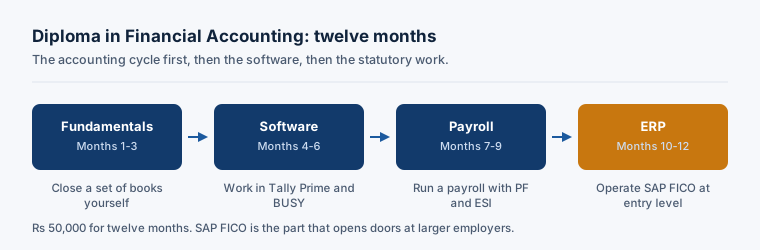
A B.Com teaches the principles; twelve months here fills in what it leaves out, bookkeeping from first entry to final accounts, payroll including PF and ESI, and working software, Tally Prime, MS Excel, BUSY and SAP FICO. Both commerce and non-commerce entrants join after 12th or after graduation. Module detail sits on the course page.
Fee
Twelve months of study costs Rs 60,000, and that covers tuition, all four packages, the payroll and returns work, and the diploma issued after an online examination. Since a parent is often the one paying, it is worth saying plainly what the fee does not include: no job is guaranteed, only the specific skills a commerce degree tends to skip.
Who in Preet Vihar this suits — and who it does not
It suits a graduate who has finished a B.Com, applied for accounts roles, and been turned down for lack of practical skill. That is the precise problem this course solves.
It does not suit you if you are still seriously pursuing CA. Do not spend twelve months and Rs 60,000 on a parallel qualification while your attempts are live — finish the attempt or stop it deliberately, then decide. Splitting your effort across both is how people end up with neither.
It does not suit you if you have not yet worked out what you want. A twelve-month commitment is a poor way to explore. Read the guide on options after B.Com first — it covers M.Com, CA, CS, CMA and MBA alongside the practical courses, including the ones NIMB does not sell.
Common questions from Preet Vihar
Is this worth Rs 60,000 after I have already paid for a degree?
Only if the degree has not produced the job. If it has, you do not need this. If it has not, the reason is usually a specific practical gap, and that is what twelve months here addresses.
Should I do this or an M.Com?
They answer different questions. An M.Com continues the academic path and suits teaching or further study. This is vocational and aimed at employment. Doing the wrong one of the two is a common and slow mistake.
Can I do this while preparing for CA?
We would advise against running both. Each is demanding and doing both badly is the usual outcome.
What if I have no commerce background at all?
Non-commerce students are accepted and it is more common than expected. This guide covers what starting from there actually involves.