Nirman Vihar is one stop from Laxmi Nagar on the Blue Line. That is close enough to be irrelevant as a commute, which means the decision here is almost never about logistics. It is about whether twelve months is worth it.
The Nirman Vihar enquiry is usually already employed
Nirman Vihar is more commercial than residential — offices along the Vikas Marg corridor, the V3S district centre, and the businesses that cluster around both. The people who enquire from here are disproportionately already working, and usually in a role adjacent to accounts without being in accounts: billing, data entry, back office, stores.
That group has a specific and frustrating problem. They can already operate the software. What they cannot do is explain why a figure sits where it does, which is the exact thing that separates a data entry salary from an accountant’s. Employers can tell the difference in about four minutes of conversation, and no amount of additional Tally practice closes it.
The Diploma in Financial Accounting is aimed squarely at that gap. The payroll, PF and ESI component is usually the part that changes the job, because it is a whole function that a back-office role never touches and that every employer needs covered.
What the course covers
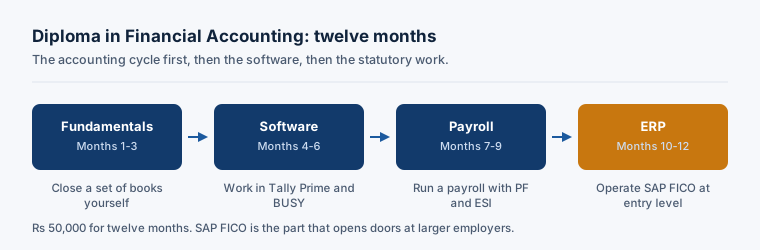
Twelve months of coursework cover the accounting cycle end to end, payroll with PF and ESI returns, and four systems: SAP FICO, Tally Prime, BUSY and MS Excel. Entry is open after 12th or B.Com from either a commerce or a non-commerce background. The course page carries the full module list.
Fee
The fee stands at Rs 60,000 for the full twelve-month programme. That single number buys tuition, the four software packages, payroll practice, and the diploma awarded after an online exam; external certification fees, if you sit one, come separately. Set that figure against the pay gap between your current role and an accounts job before deciding whether the year pays for itself.
Who in Nirman Vihar this suits — and who it does not
It suits someone stuck one rung below accounts who wants the qualification their employer will not provide. It is designed for exactly that move.
It does not suit you if you are looking for a line on a CV before an interview next month. Twelve months is not a CV item, it is a change of occupation, and treating it as the former wastes both the fee and the year.
It may not suit you if what interests you is tax specifically rather than accounting generally. The Diploma in Taxation Law is three months and Rs 20,000, and for someone who wants to move into a tax role rather than an accounts role it is the better instrument at a third of the cost. Choosing the longer course because it sounds more serious is a common and expensive mistake.
Common questions from Nirman Vihar
Can I keep working while I do this?
That depends on which batch slot your working hours leave free. It is the first thing to establish on enquiry, because it decides whether the course is possible at all for you.
Will this get me out of a data entry role?
It is the qualification most directly aimed at that move, but the course cannot do the interview for you. What it gives you is the payroll and ERP exposure that a back-office role never provides and that employers screen for.
Is SAP FICO really useful at my level?
It is the component that distinguishes candidates for roles at companies large enough to run an ERP. If you intend to stay in very small businesses it matters less; if you want to move up in size, it matters a great deal.
How does this compare to the BAT course?
The DFA versus BAT comparison sets the two side by side properly. In short: DFA leads with accounting and payroll depth, BAT leads with the combined accounting-and-taxation profile aimed at corporate accounts departments.